-
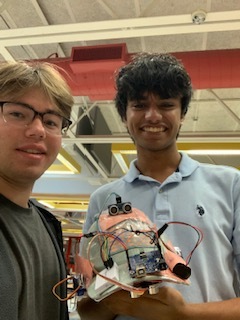
Us and our project!
-
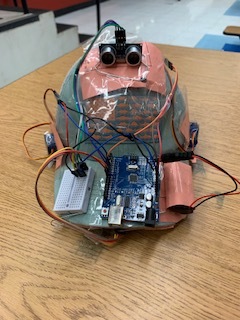
The project
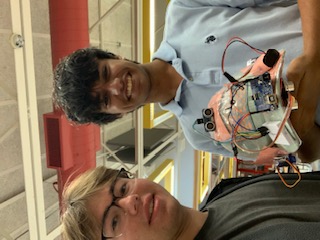
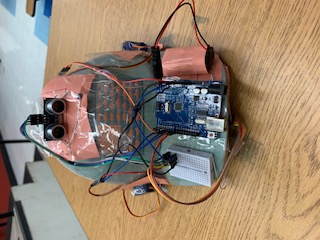
(Reposted from banned account)
ADVANCED HEALTH CARE SUBMISSION
VIDEO: https://drive.google.com/file/d/1rXS5sm3QsWY92eukicAmrEVpXGvVqhE0/view?usp=sharing
GITHUB: https://github.com/Dheirya/Optic-Prime
Inspiration
Blind people have been using the same technology for nearly a hundred years or more despite massive advances. We wanted to bring modern technological advances to their assistance instead of keeping them in the 1930s.
What it does
The device uses two ultrasonic sensors to gauge the distance from the individual to a surface in front and the ground. Using this information, two servos lightly tap the side of their head at a frequency to let the person know how close an object or a drop is approaching, allowing them to gain more information about their environment than may normally be possible.
How we built it
We built it using arduinos, sensors, servos, and C++ code.
Challenges we ran into
Physically constructing the device was the most challenging aspect of incorporating the idea. We had to attach all our wires and ultrasonic sensors onto the hat we brought, but the tape we used just did not stick. We had to think outside the box and tape paper to the hat first and then tape our electronics on top of the paper. Additionally, we had to debug the distance recordings in our code. Because the sensor has a limited range of up to 360 cm, the function in our code outputs -1 if the distance is out of range. Therefore, we had to incorporate a boolean that makes nothing happen when the output is -1.
Accomplishments that we're proud of
We are proud of how well the project works given the time frame and the materials we had to build our hat, and the confidence that we have when we walk with it.
What we learned
We learned about sound dampening—the ultrasonic sensor seemed to not work in some situations where there was a lot of noise in the environment. Our clothing also pontentially interfered by dampening the wave sent and received.


Log in or sign up for Devpost to join the conversation.