-
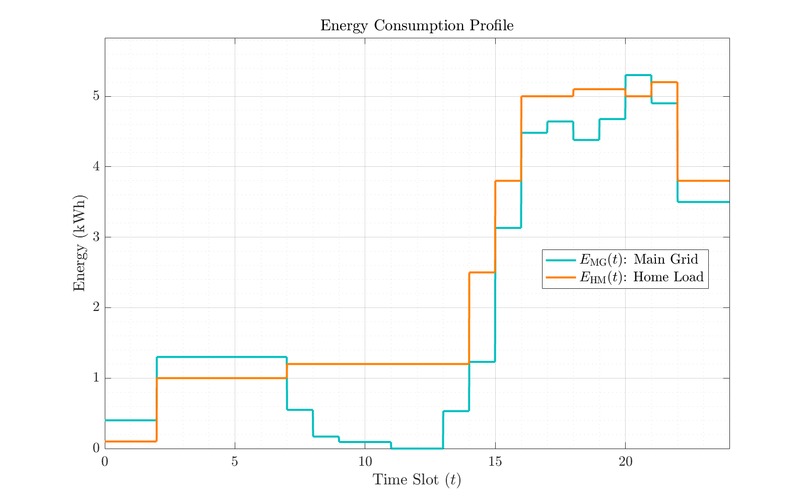
Hourly energy consumption with load needed from the grid
-
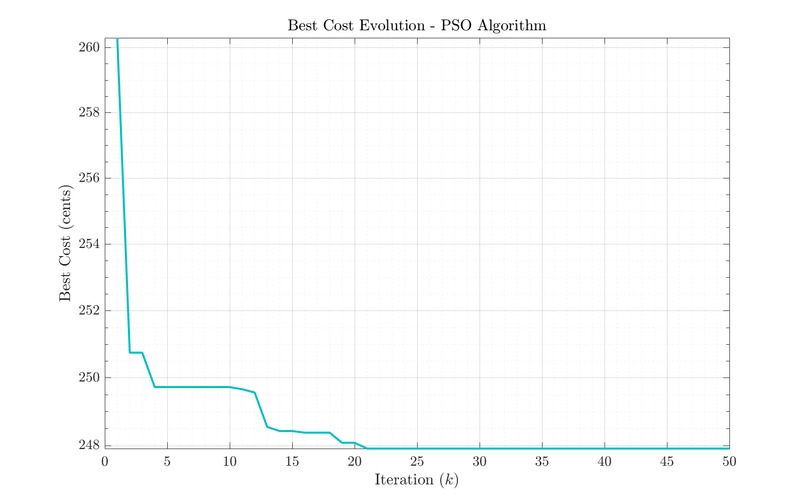
Convergence of the algorithm towards the best cost
Inspiration
With buildings consuming 40% of global energy and the transition to electric vehicles looming, there's an urgent need for smarter home energy management. The vision was to create an autonomous system that could optimize both cost and grid stability while seamlessly integrating renewable energy and storage systems.
What it does
OPTHOME is a Home Energy Management System (HEMS) that:
- Automatically schedules appliance usage to minimize energy costs
- Intelligently manages energy flow between solar panels, batteries, and the grid
- Optimizes when to store/use/sell energy based on electricity pricing
- Reduces peak demand on the power grid while maintaining user comfort
- Handles both shiftable appliances (like washing machines) and non-shiftable ones (like refrigerators)
How we built it
- Developed a binary particle swarm optimization (BPSO) algorithm to handle the complex scheduling problem
- Created a mathematical model accounting for all energy flows between components
- Implemented both single-objective (cost) and multi-objective (cost + peak reduction) optimization
- Built in real-world constraints like battery efficiency and appliance operating times
- Used MATLAB for simulation and optimization
Challenges we ran into
- Balancing multiple competing objectives (cost vs peak reduction)
- Handling the complexity of binary variables for appliance scheduling
- Managing physical constraints while keeping computation time reasonable
- Implementing particle corrections instead of penalty functions
- Dealing with unclear aspects of previous research implementations
Accomplishments that we're proud of
- Reduced peak-to-average ratio by 15% compared to existing systems
- Successfully integrated renewable energy and storage optimization
- Developed a more efficient binary optimization approach
- Created a solution that performs better with less solar capacity
What we learned
- The power of meta-heuristic algorithms for complex real-world problems
- Trade-offs between solution quality and computation speed
- Importance of proper constraint handling in optimization
- Benefits of binary vs continuous variable approaches
- Critical role of energy storage in future smart grids
Next steps
- Incorporating next day estimations for energy prices from public resources
- Developing a user interface and smartphone app to allow the user to monitor, add new appliances and estimate future costs


Log in or sign up for Devpost to join the conversation.