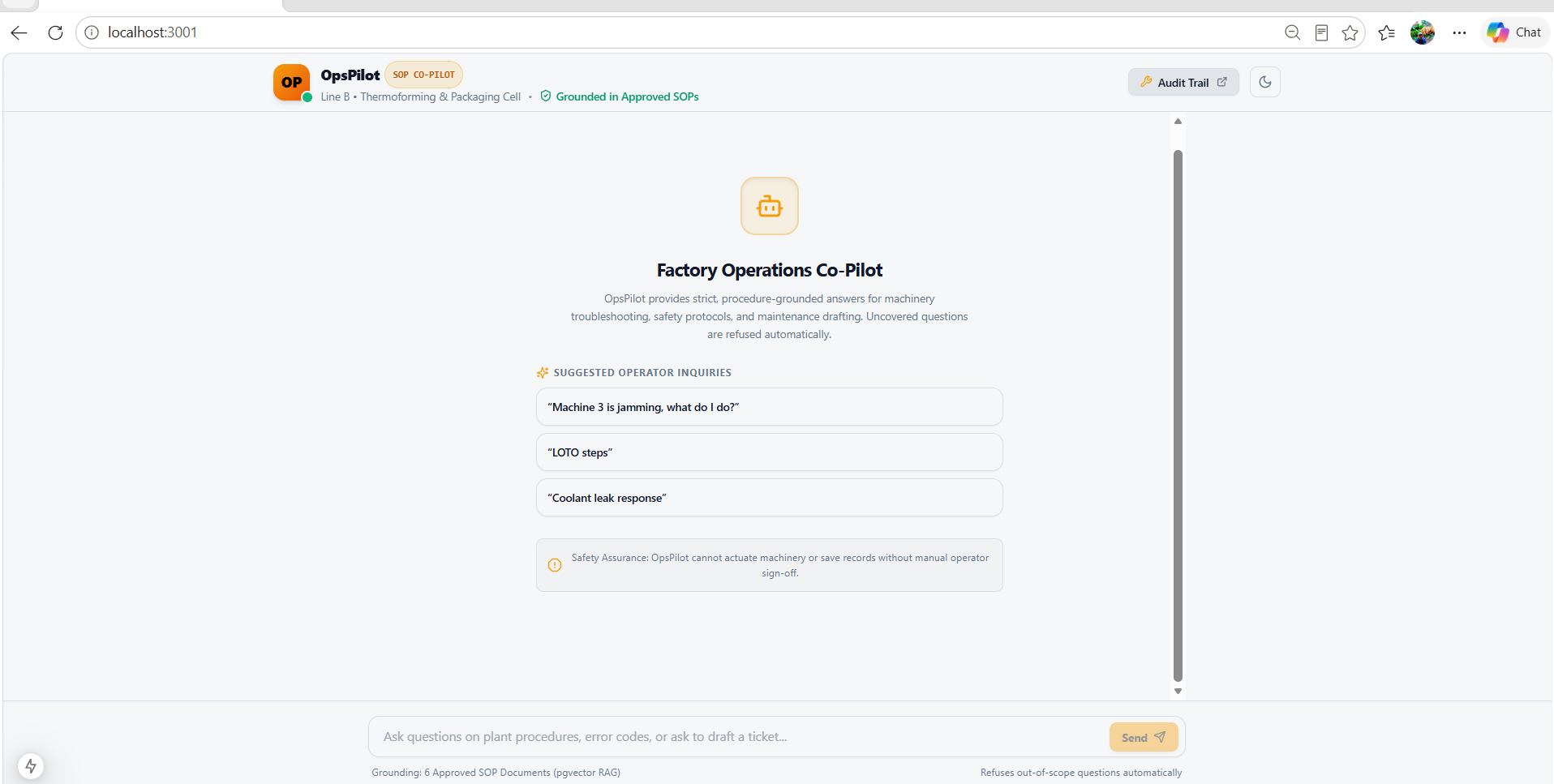
OpsPilot :factory:
Trusted answers from approved procedures, with a human always in control.
Inspiration
On a factory floor, a few minutes of downtime can cost thousands of dollars, and a wrong repair step can injure someone. Operators often flip through thick manuals, hunt for a supervisor, or rely on memory. A generic AI chatbot is not a safe fix, because it can confidently invent steps that are not in the plant's approved procedures.
So we asked: ==what if an AI could only speak from approved documents, show its proof, and never act without a human saying yes?== That idea became OpsPilot.
What it does
OpsPilot is an AI co-pilot for factory operators.
- Answers from approved procedures only. Ask "Machine 3 is jamming, what do I do?" and get step-by-step instructions from the right manual section.
- Cites every source. Clickable source chips open the exact passage from the original document.
- Refuses to guess. If the documents don't cover the question, it replies "I couldn't find this in the approved procedures."
- Drafts actions for human approval. Say "Create a high-priority ticket" and it prepares a maintenance ticket. Nothing is saved until a person clicks Approve.
- Keeps an audit trail. Every ticket records its status, approver, and timestamps.
- Highlights safety. A banner appears for lockout/tagout and emergency-stop steps.
OpsPilot never controls machines and never writes records on its own.
How we built it
| Layer | Technology |
|---|---|
| Frontend and API | Next.js, TypeScript, Tailwind CSS, shadcn/ui |
| AI orchestration | Vercel AI SDK (streamText, tool calling) |
| Models | Google Gemini (chat and embeddings) |
| Database | PostgreSQL + pgvector |
| Validation | Zod |
| Deployment | Vercel |
Pipeline
- [x] Ingestion: procedures are split by section heading, embedded, and stored in pgvector.
- [x] Retrieval: the question is embedded and compared with every chunk using cosine similarity:
$$ \text{sim}(q, c) = \frac{q \cdot c}{|q| \, |c|} $$
- [x] Threshold: only chunks with \(\text{sim}(q, c) \ge \tau\) reach the model, where \(\tau = 0.4\) in our tests. If none pass, the assistant refuses.
- [x] Grounded generation: a strict system prompt forces answers to use only the retrieved chunks and cite them.
- [x] Human in the loop: the
draftTickettool has no execute function, so it can only produce a draft. Only the Approve button writes to the database.
Operator question
      |
      v
Embed query --> pgvector search --> threshold filter
      |                                   |
      v                                   v
  Gemini answer with citations      "I couldn't find this"
      |
      v
Draft ticket --> [Approve / Reject] --> Audit log
Challenges we ran into
- Hallucinations from weak matches. Without a threshold the model answered confidently from poor results. A tuned \(\tau\) plus an explicit refusal rule fixed it.
- Chunk size. Large chunks diluted relevance and tiny ones lost context. Splitting by heading with a small overlap worked best.
- Embedding dimension mismatch. The
vector(N)column must match the embedding model exactly. - Serverless limits. Ingestion does not fit in a Vercel function, so we run it as a local script.
- Safe approvals. Letting the model draft but never commit took careful tool design.
Accomplishments that we're proud of
- A complete working loop: question, cited answer, draft ticket, human approval, audit log
Answers you have to trust blindlyAnswers you can verify in one click- A refusal behavior that makes the assistant trustworthy, not just impressive
What we learned
- Retrieval quality matters more than model size for safety-related answers.
- Trust is a product feature: citations, refusals, and approvals matter as much as the AI.
- Giving the AI the fewest tools and permissions it needs makes the system safer.[^1]
[^1]: In OpsPilot the model can search documents and draft a ticket, and nothing else.
What's next for OpsPilot
- [ ] PDF upload so new procedures are searchable immediately
- [ ] Hybrid search (keyword + vector) for part numbers and error codes
- [ ] Multi-language support for diverse shop floors
- [ ] Voice input for hands-free use
- [ ] Role-based approvals and integration with maintenance systems (CMMS)
- [ ] Langfuse tracing to measure answer quality
Built with
nextjs typescript tailwindcss shadcn-ui vercel-ai-sdk google-gemini postgresql pgvector zod vercel
Built With
- ai
- css
- neon
- next.js
- node.js
- pgvector
- postgresql
- rag
- react
- sdk
- shadcn/ui
- tailwind
- typescript
- vercel
- zod


Log in or sign up for Devpost to join the conversation.