Inspiration
Modern operational work often involves coordinating multiple steps, researching information, checking requirements, identifying risks, and deciding what should happen next. We wanted to build an agent that could handle this kind of work as an actual workflow rather than simply returning a chat response.
OpsPilot was created to explore how autonomous multi-agent systems can take a complex operational request, break it into specialized tasks, coordinate the work, and return a structured result while keeping humans in control of actions that require approval.
What it does
OpsPilot is an autonomous multi-agent operations assistant built with Google Agent Development Kit (ADK), Gemini, and Google Cloud.
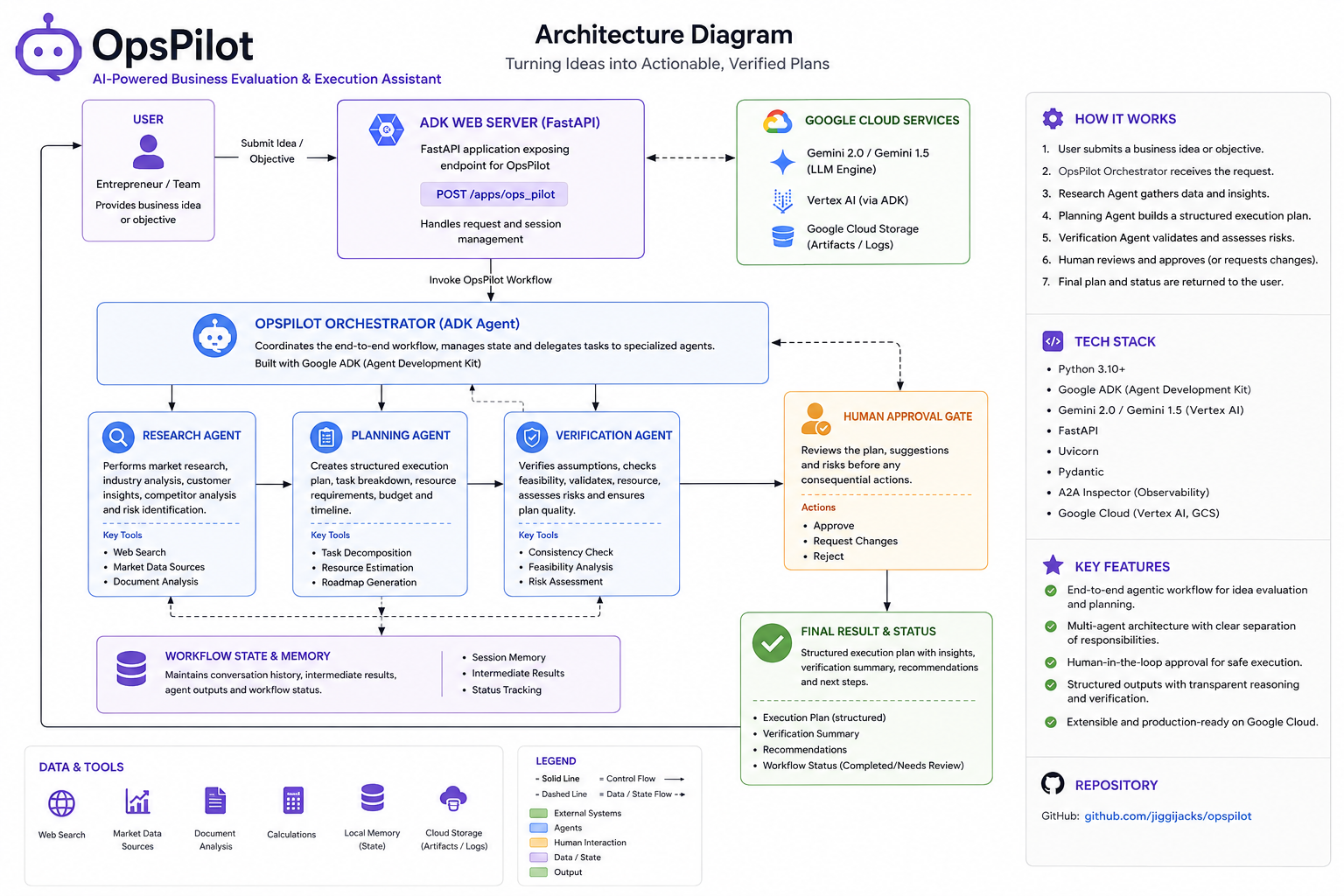
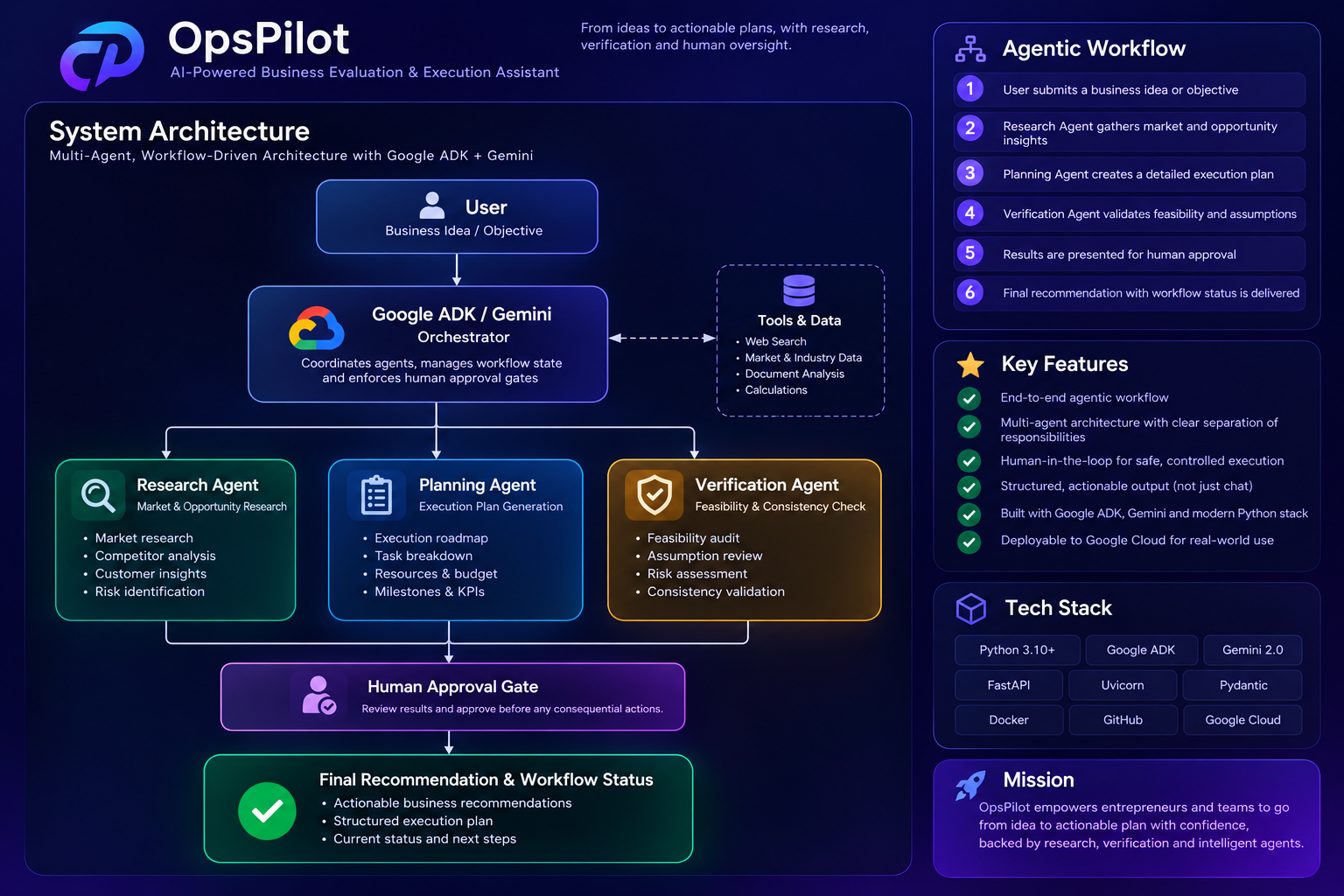
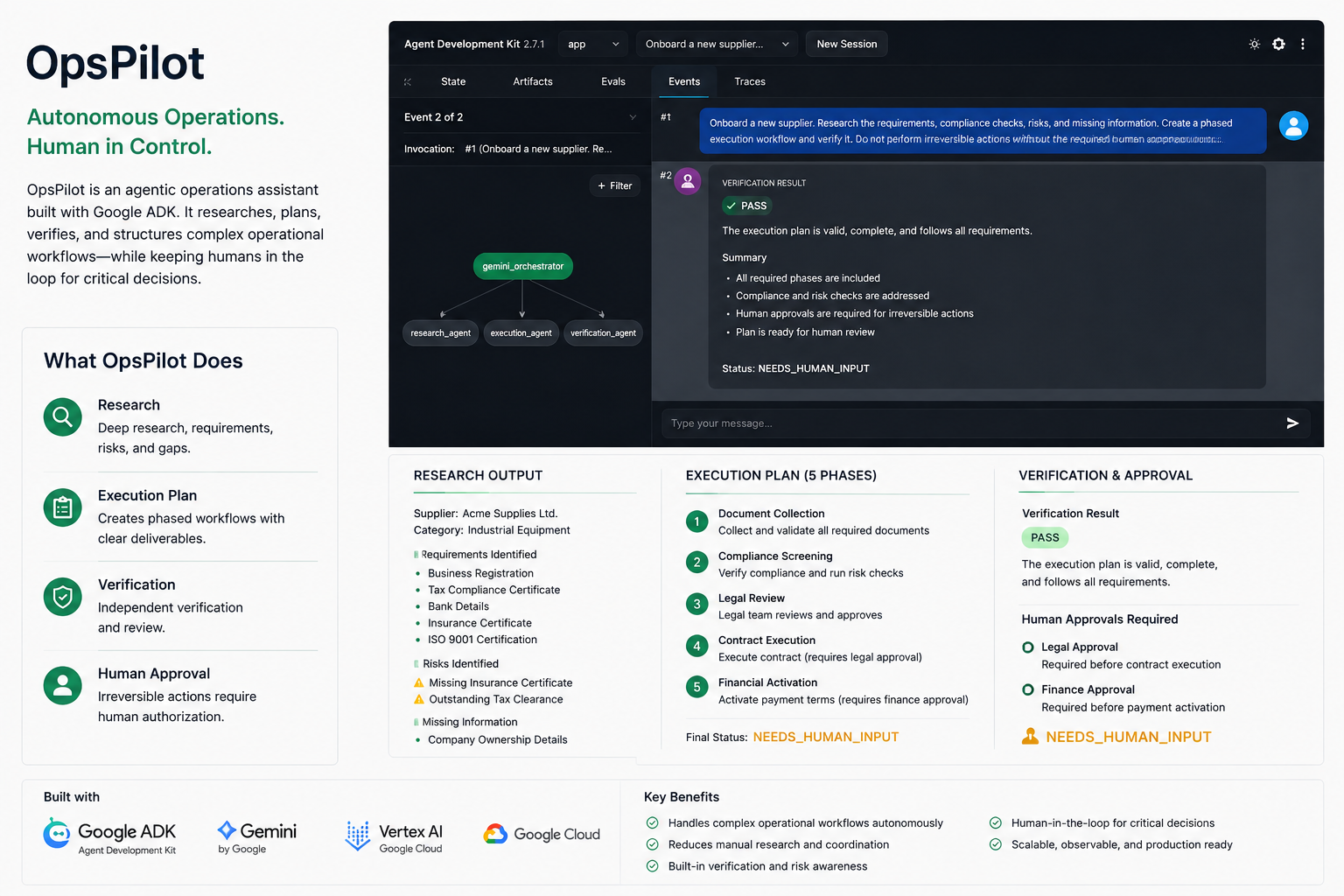
A request is handled by an orchestration layer that delegates work to specialized agents. For example, when asked to onboard a new supplier, OpsPilot can:
- Research the supplier and relevant requirements
- Identify compliance considerations and potential risks
- Detect missing information
- Create a phased execution workflow
- Verify the proposed workflow
- Keep irreversible actions behind human approval
The system is designed around coordinated agents rather than a single general-purpose chatbot.
How we built it
OpsPilot uses Google ADK to define and coordinate the agent workflow, with specialized agents responsible for research, execution planning, and verification.
The application is containerized and deployed to Google Cloud Run. Gemini provides the intelligence behind the agents, while the ADK development environment provides visibility into sessions, events, traces, and agent execution.
The architecture is designed so that responsibilities are separated between agents instead of placing the entire workflow inside one prompt.
Challenges we ran into
One of the biggest challenges was getting the local ADK environment and the cloud deployment to behave consistently.
We also had to work through configuration differences between local development and Cloud Run, particularly around authentication and Gemini/Vertex AI configuration.
Another challenge was designing the workflow so that agents could perform meaningful autonomous work while still respecting human approval for potentially irreversible actions.
Accomplishments that we're proud of
We successfully turned the concept into a working multi-agent application using Google ADK and deployed it to Google Cloud Run.
We are particularly proud of seeing the agents execute as a coordinated workflow inside the ADK developer interface, with the individual agent responsibilities and execution traces visible.
We also made the deployed application accessible through a live Cloud Run URL so the project can be evaluated outside our local development environment.
What we learned
We learned that building an effective agentic system is not just about connecting a model to a prompt. The orchestration, separation of responsibilities, state, verification, and safety boundaries are equally important.
Working with Google ADK also gave us a much clearer understanding of how multiple specialized agents can cooperate to solve workflows that would be cumbersome for a traditional chatbot.
What's next for OpsPilot
The next step for OpsPilot is to expand the number of operational workflows it can handle, strengthen persistent state and observability, and connect it to controlled enterprise data and tools while maintaining clear authorization and human-approval boundaries.

Log in or sign up for Devpost to join the conversation.