-
-
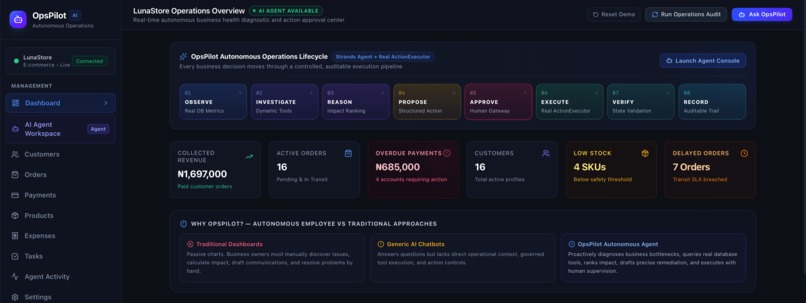
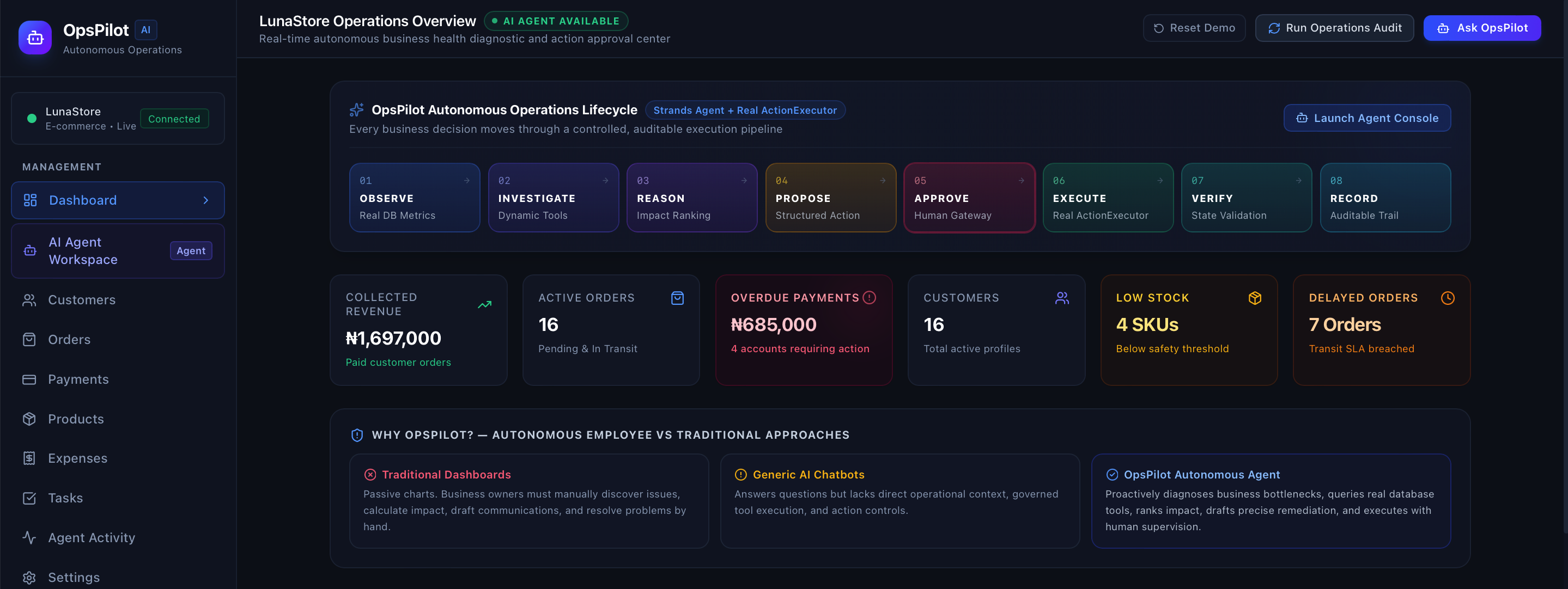
OpsPilot Command Center — real business data, prioritized issues, human-approved actions, and an auditable 8-stage agent lifecycle.
-
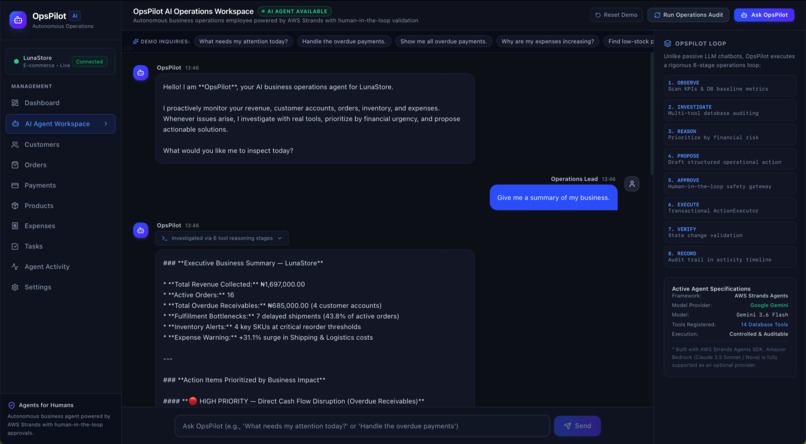
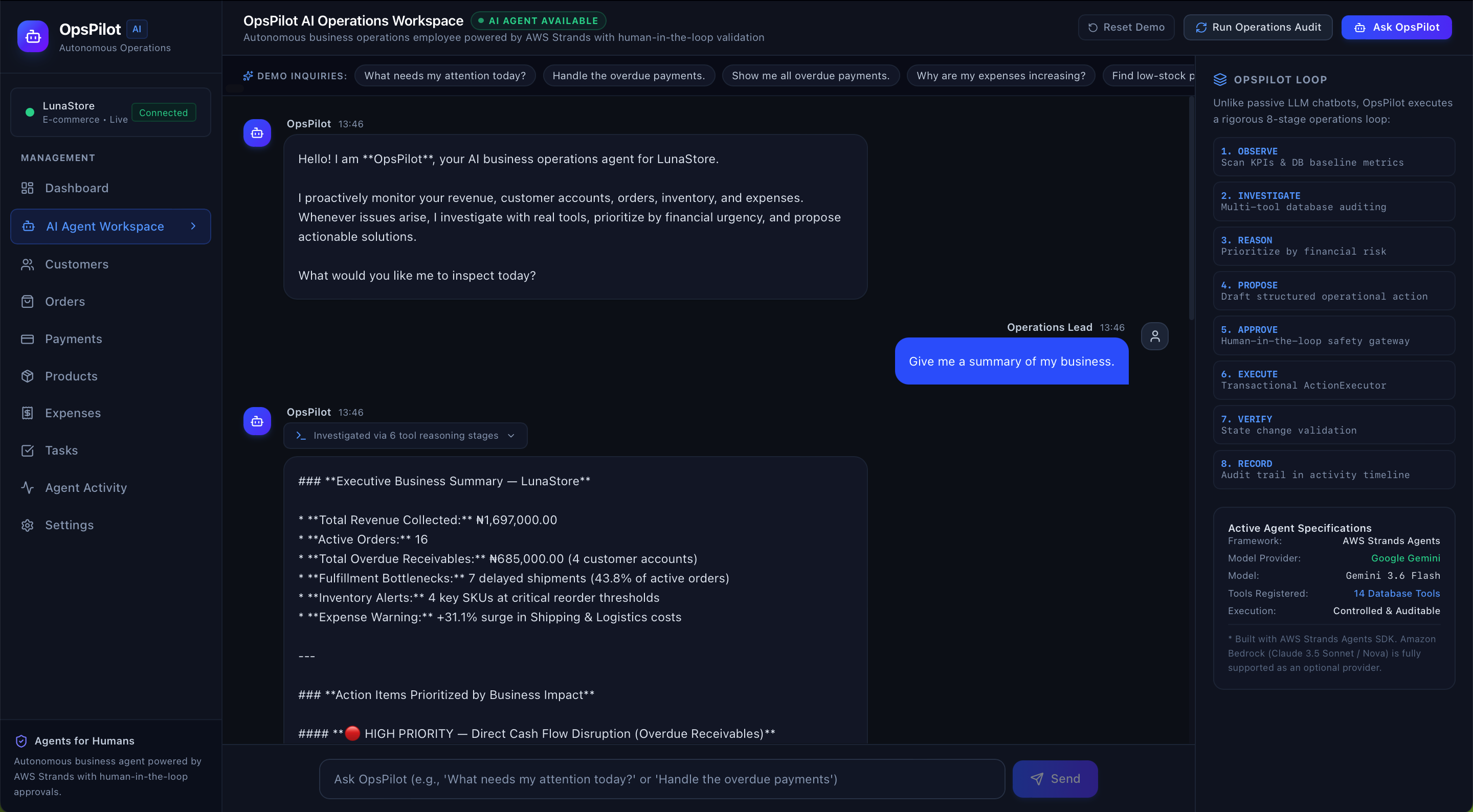
OpsPilot AI Workspace — a Strands-powered agent analyzing real business data, prioritizing risks, and surfacing actionable insights.
-
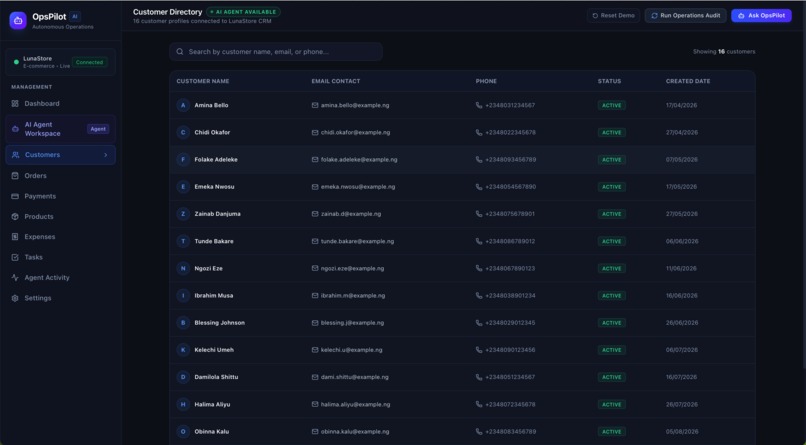
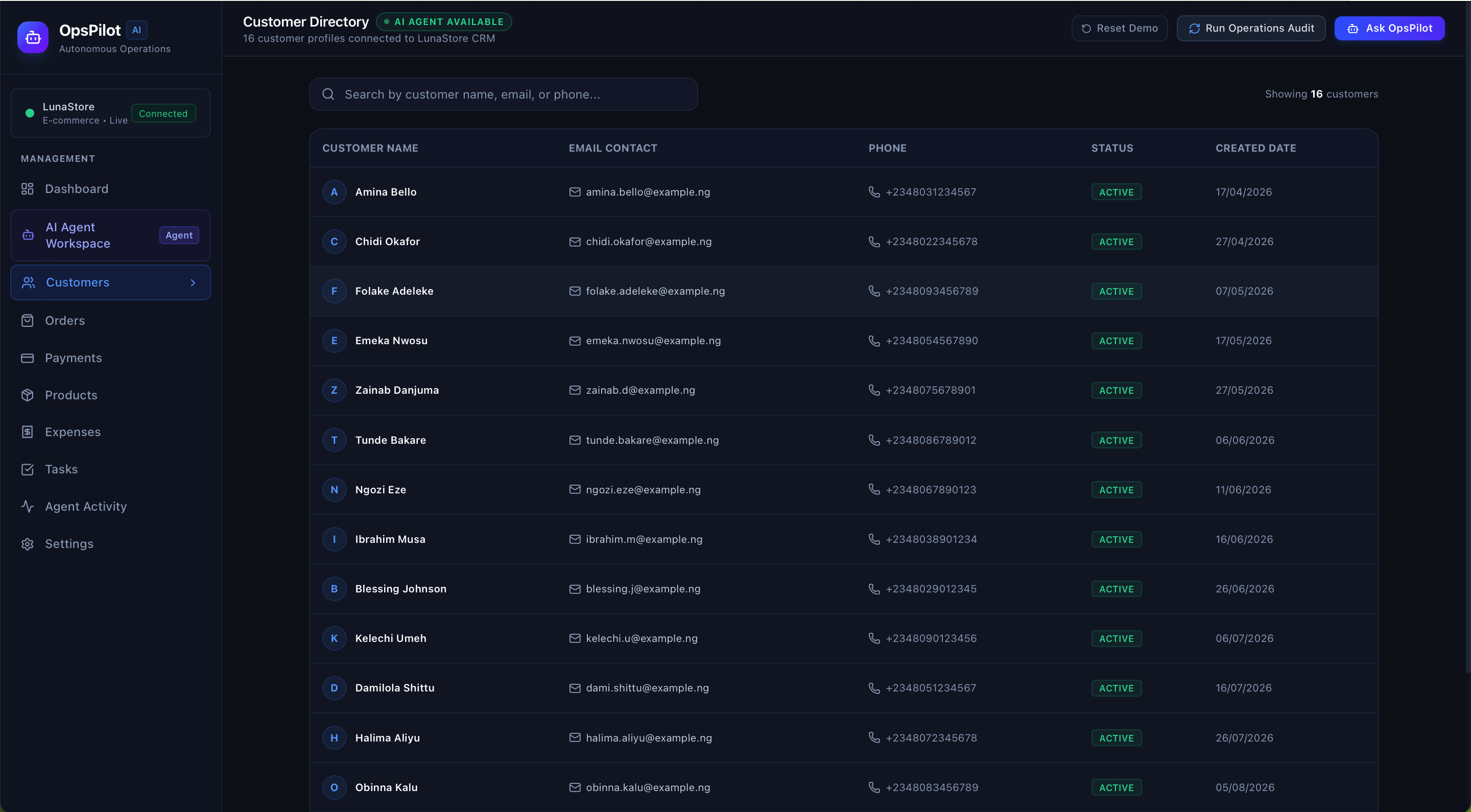
OpsPilot Customer Directory — connected CRM data gives the agent real customer context for investigations, prioritization, and safe actions.
-
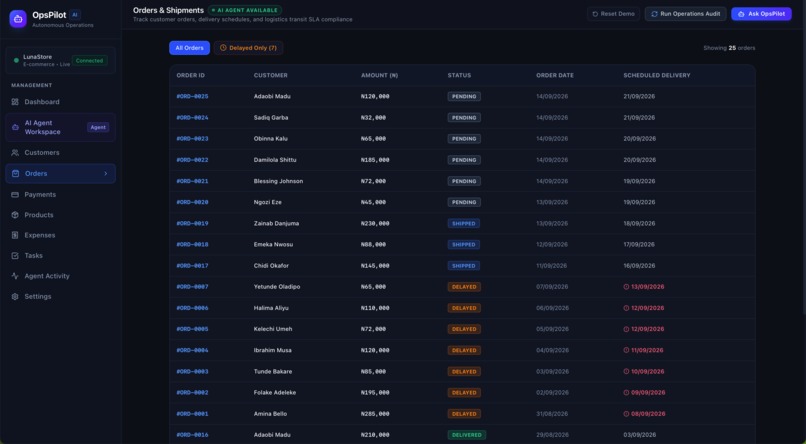
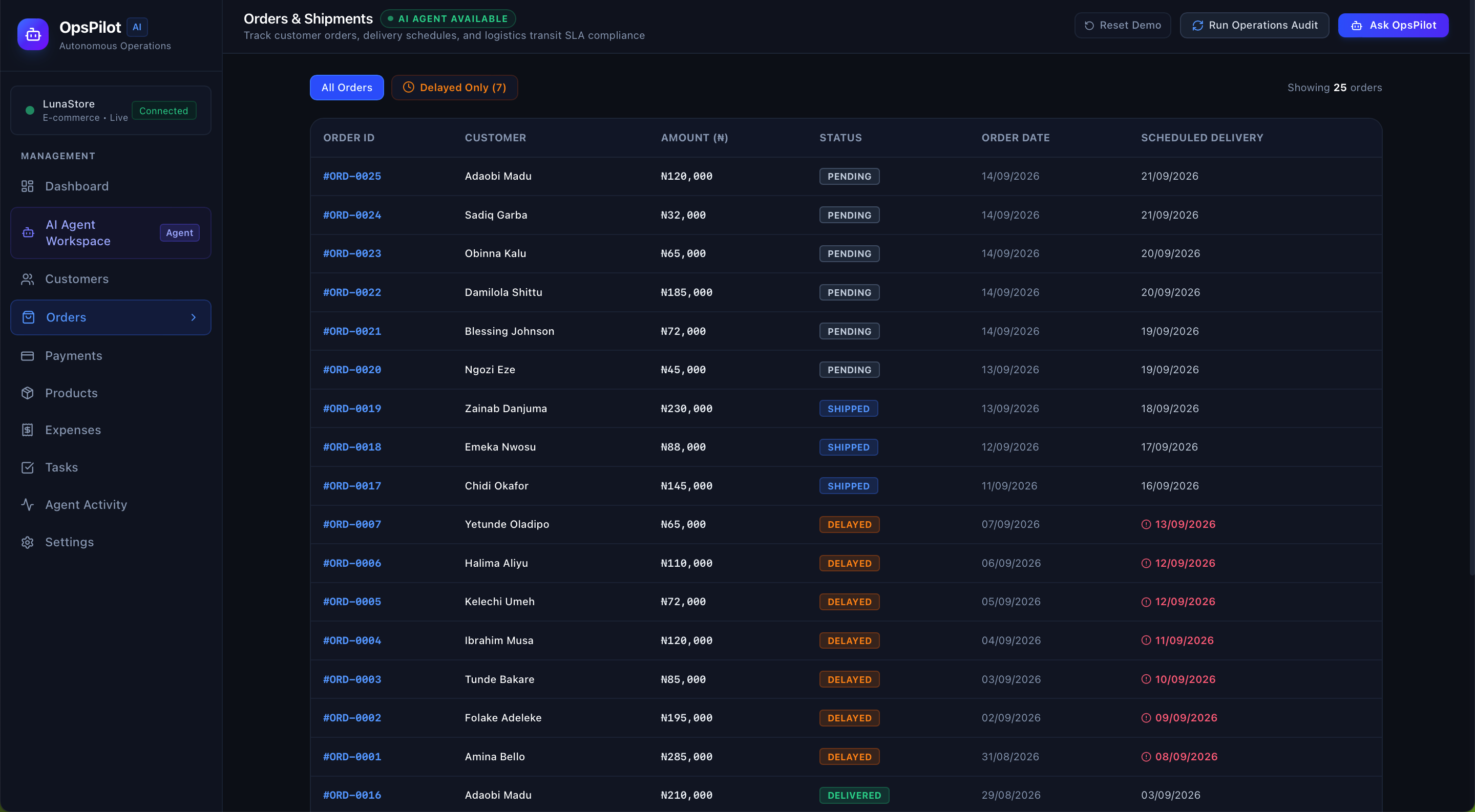
OpsPilot Orders & Shipments — live order data detects delays, prioritizes SLA breaches, and triggers safe remediation workflows.
-
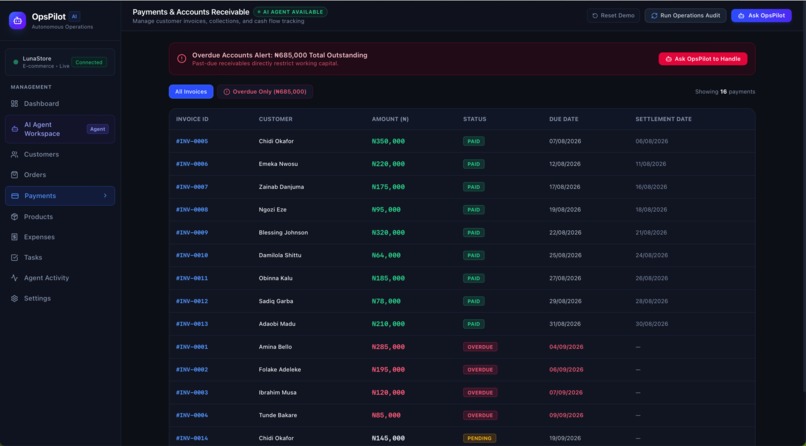
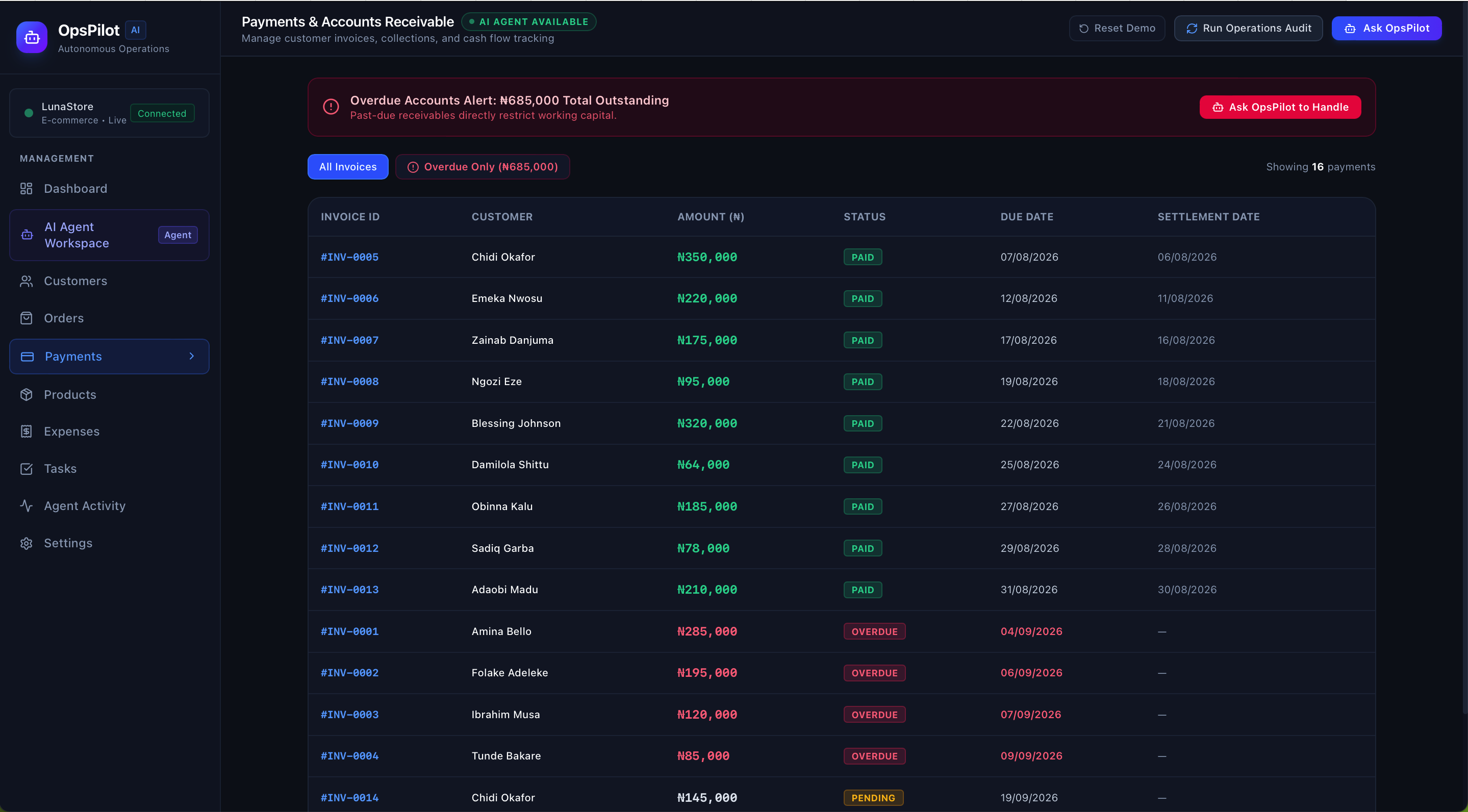
OpsPilot Payments — real receivables data helps the agent detect overdue accounts, prioritize cash-flow risk, and propose safe actions.
-
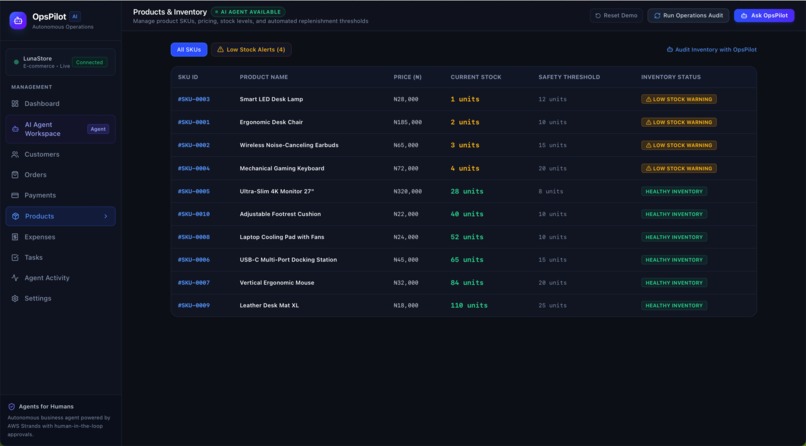
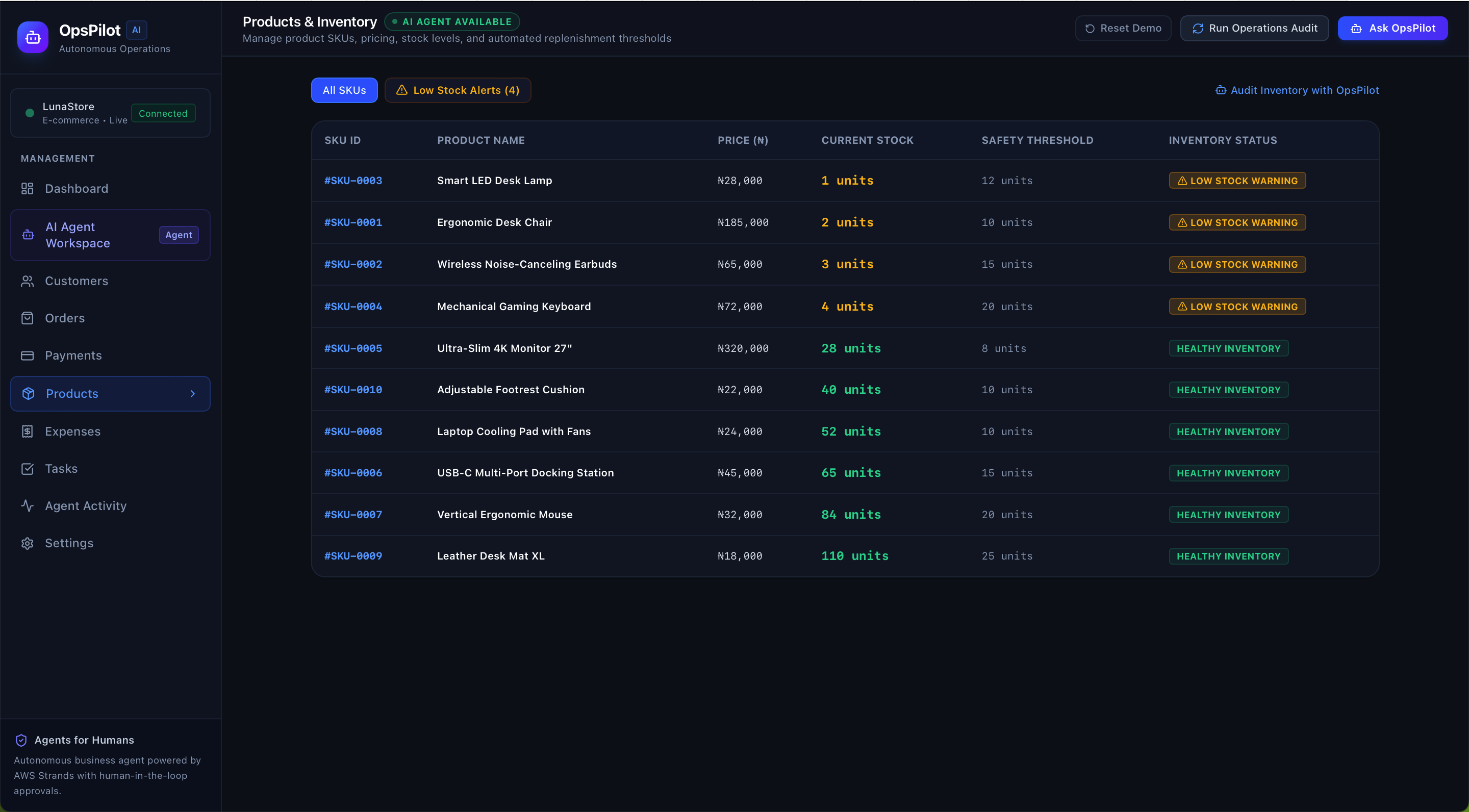
OpsPilot Inventory — live stock data helps the agent detect low-SKU risk, prioritize shortages, and recommend timely replenishment actions.
-
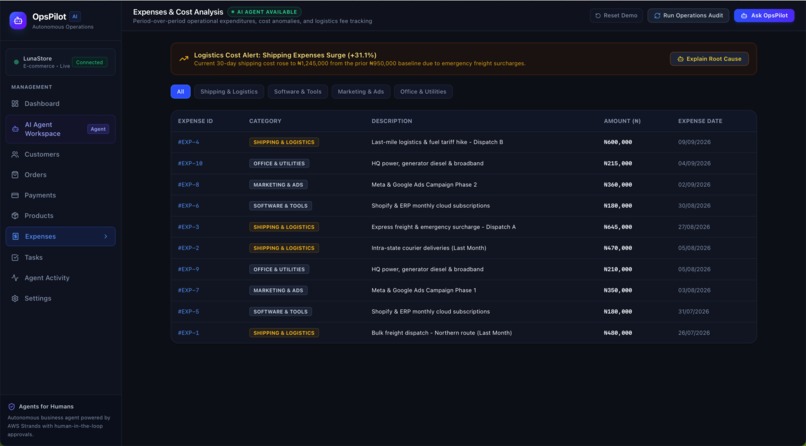
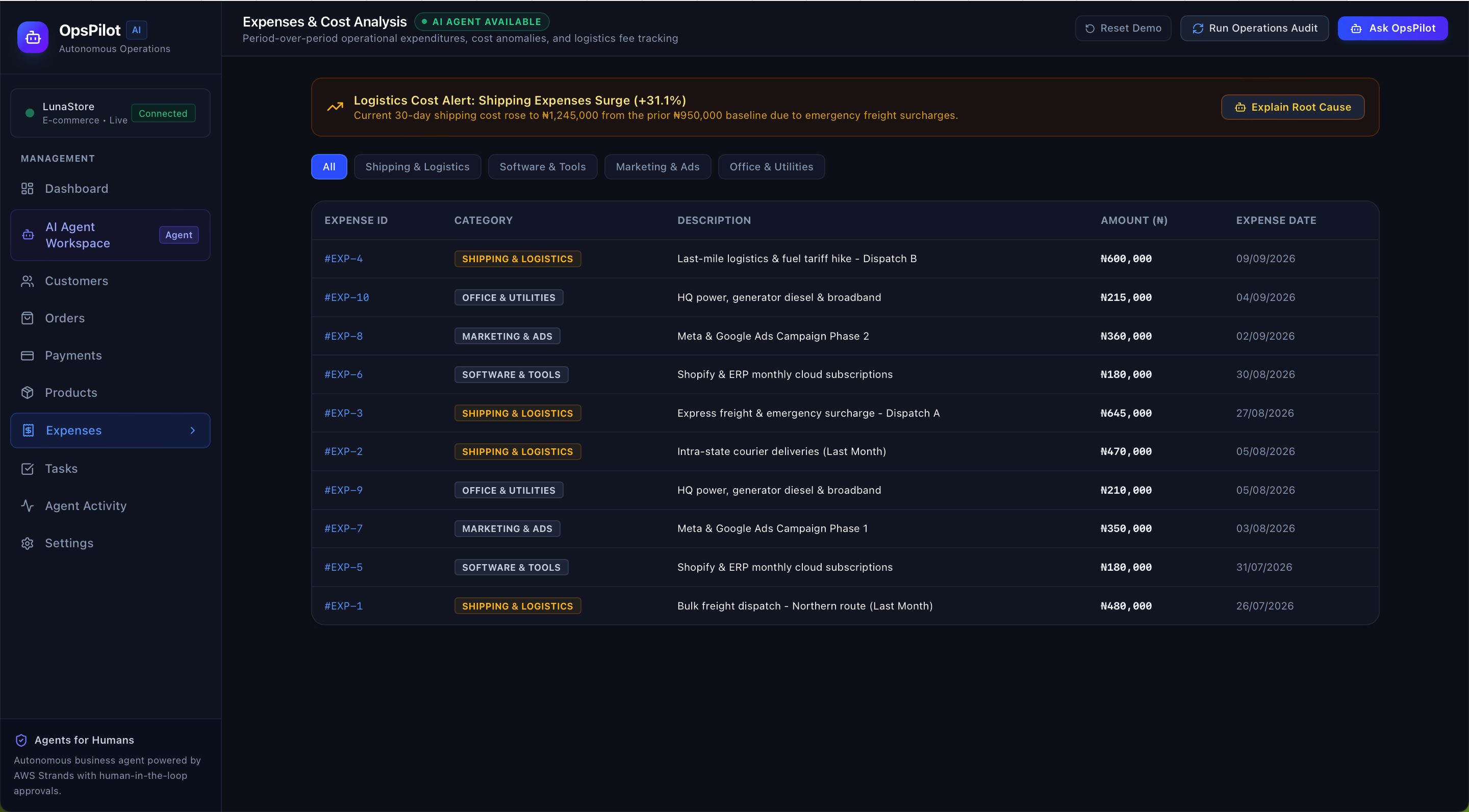
OpsPilot Expenses — real cost data helps the agent detect spending surges, explain root causes, and prioritize operational cost risks.
-
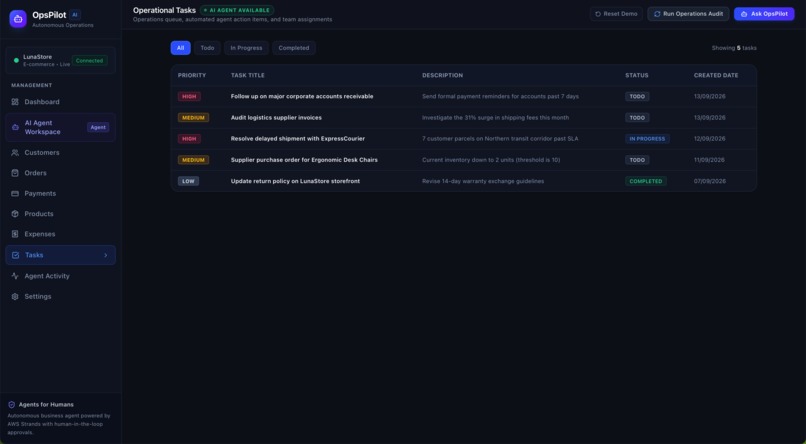
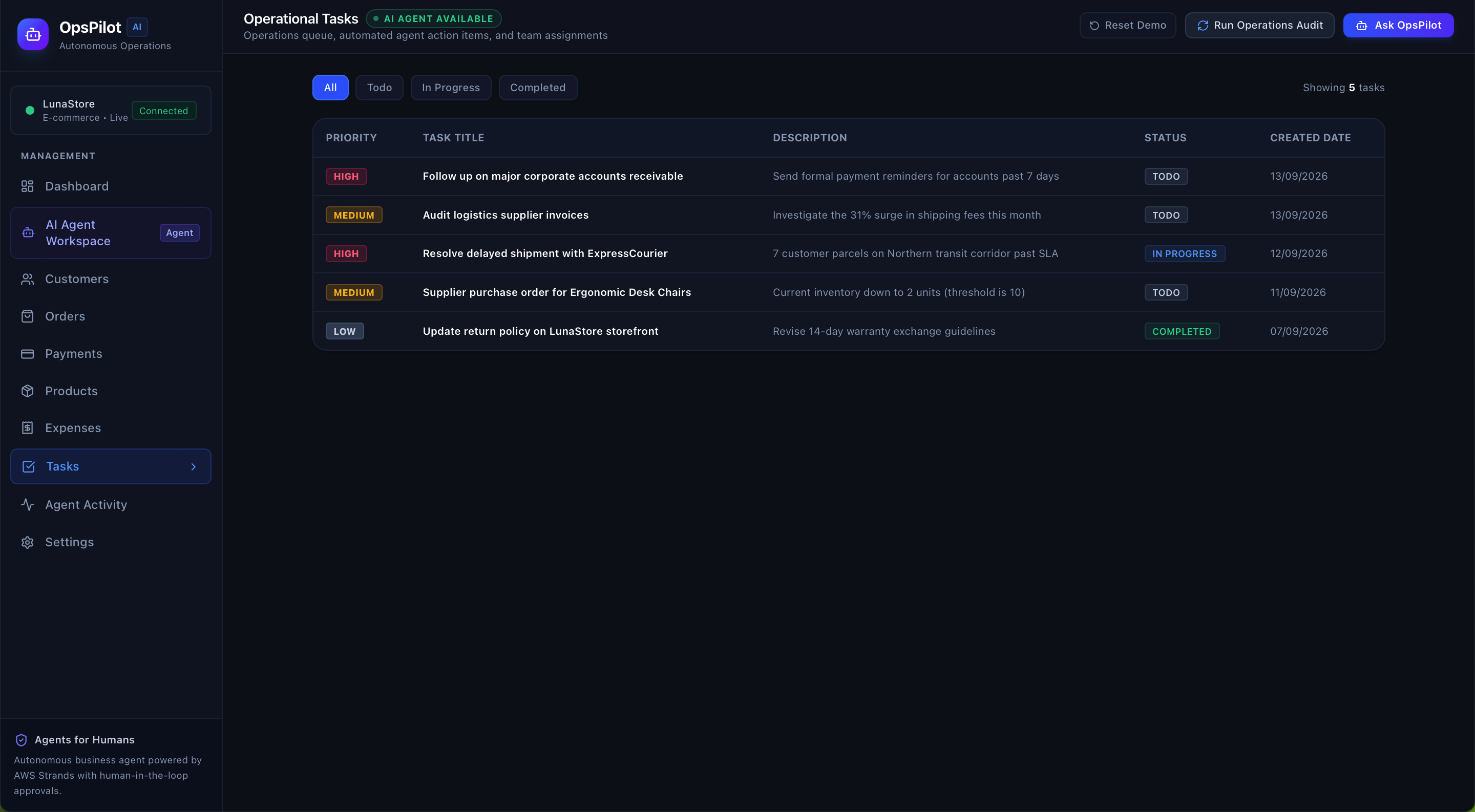
OpsPilot Tasks — prioritized operational work turns AI findings into trackable actions, assignments, and verified outcomes.
-
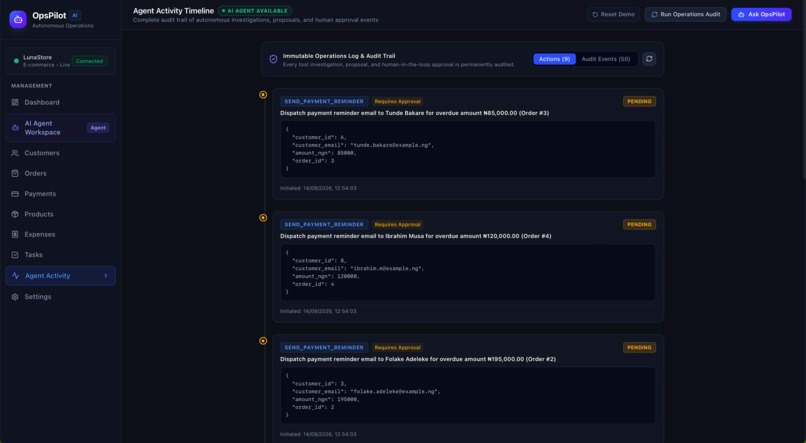
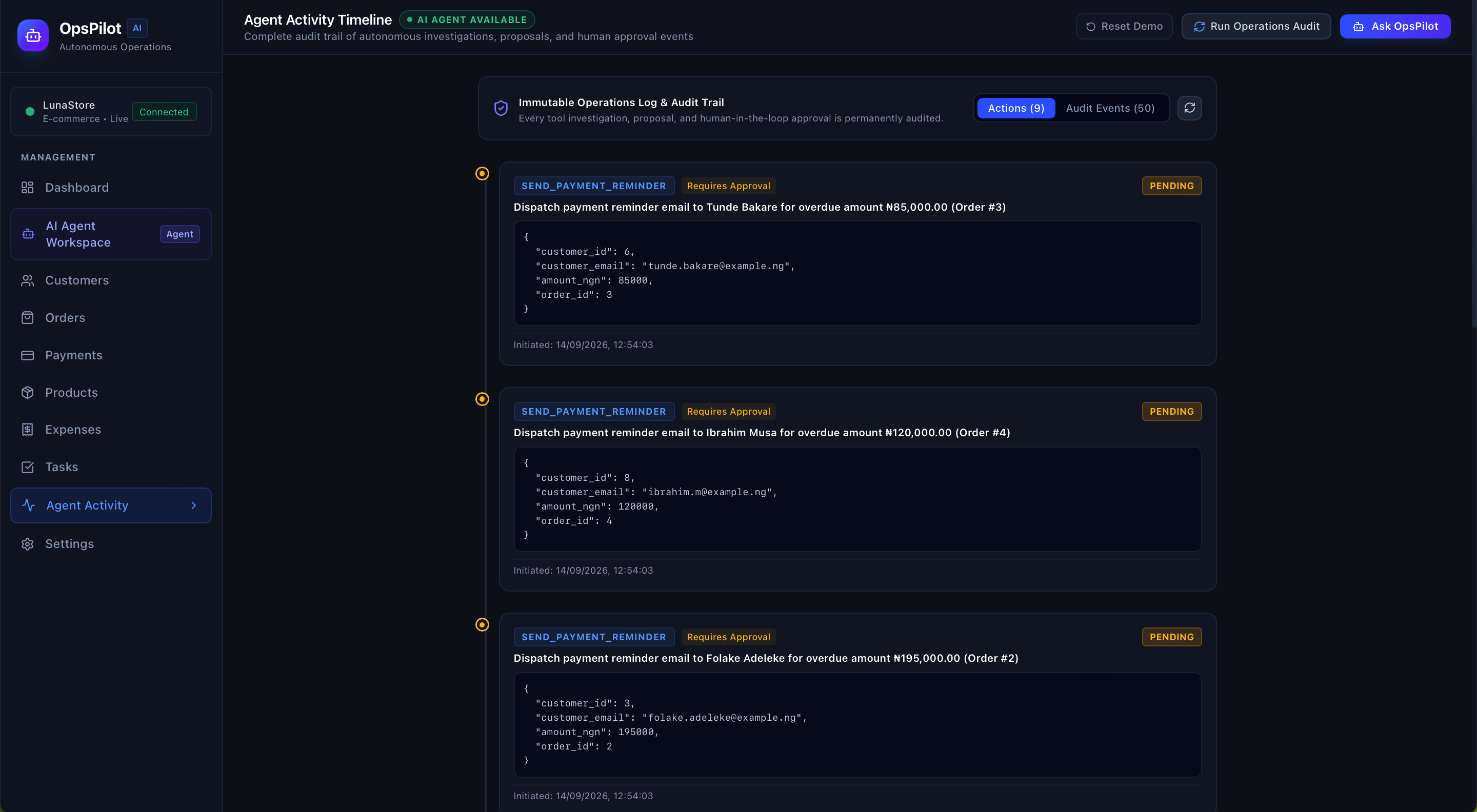
OpsPilot Activity — every proposed action, approval requirement, and execution event is tracked in a clear, auditable operations timeline.
Inspiration
Small-business owners often have the data they need, but not the time to constantly inspect dashboards, identify operational problems, decide what matters most, and take action.
Traditional dashboards show what happened. Generic AI chatbots can answer questions. But neither reliably handles the full operational workflow from investigation to safe execution.
We built OpsPilot to act as an AI operations agent for small businesses — one that can investigate real business data, identify problems, propose actions, keep a human in control of sensitive decisions, execute approved workflows, and record what happened.
What it does
OpsPilot connects an AI agent directly to business operations data and gives it a controlled set of real tools.
For our demo business, LunaStore, OpsPilot can investigate:
- overdue customer payments
- delayed orders
- inventory and low-stock products
- customers
- revenue and sales
- expenses
- operational tasks
Instead of simply returning an AI-generated answer, OpsPilot follows an operational lifecycle:
Observe → Investigate → Reason → Propose → Approve → Execute → Verify → Record
For example, when asked:
"What needs my attention today?"
the Strands agent selects relevant tools, queries the real application database, and prioritizes operational issues based on the returned data.
When asked:
"Handle the overdue payments."
OpsPilot investigates the affected accounts and prepares an operational action. Because sending customer communications is a sensitive action, execution is blocked behind a human approval gateway.
Only after approval does the ActionExecutor continue the workflow and record the result in the audit trail.
External message delivery in our hackathon environment is explicitly labelled DEMO_SIMULATION, while the agent reasoning interface, Strands tool calls, database queries, approval workflow, action state machine, and audit logging are real.
How we built it
OpsPilot uses AWS Strands Agents SDK as the core agent framework.
The active hackathon demo architecture is:
Next.js UI → FastAPI API → AWS Strands Agent → Gemini 2.5 Flash → OpsPilot tools → PostgreSQL → Human Approval → ActionExecutor → Audit Trail
The Strands agent has access to 14 real business tools backed by application data.
The frontend is built with Next.js, React, TypeScript and Tailwind CSS.
The backend uses FastAPI, Python, SQLAlchemy and Pydantic.
The action system includes:
- structured action proposals
- human-in-the-loop approval
- explicit action states
- idempotency protections
- execution verification
- auditable lifecycle events
We also built an agent activity view that exposes useful operational telemetry such as tool execution and action lifecycle events without exposing private chain-of-thought.
Challenges we ran into
One of the biggest challenges was ensuring OpsPilot behaved like a real agent rather than a chatbot with hardcoded business logic.
We specifically avoided keyword-based tool routing and hardcoded business answers. The model must choose tools through the Strands agent, and business figures must come from the database.
Another challenge was safe action execution. An autonomous agent should not be able to send customer communications or perform sensitive operations without appropriate controls, so we implemented a human approval gateway and explicit action state machine.
We also designed the system to remain honest about external integrations. Where a real external delivery provider is not connected during the hackathon, the interface clearly identifies the action as DEMO_SIMULATION instead of pretending a real customer message was sent.
Accomplishments that we're proud of
- Built a genuine agent using AWS Strands Agents SDK
- Connected the agent to 14 real business tools
- Verified live Gemini-initiated Strands tool calls
- Grounded business findings in actual database results
- Implemented human-in-the-loop approval for sensitive actions
- Built a real ActionExecutor and action state machine
- Added verification and audit events across the action lifecycle
- Created a judge-friendly operations dashboard and agent workspace
- Achieved 32/32 backend tests passing
- Completed the frontend production build with zero TypeScript errors ## What we learned Building an effective business agent is about more than connecting an LLM to a chat interface.
The most important part is giving the agent useful tools, reliable operational context, clear boundaries, and a safe way to transition from reasoning into real actions.
We also learned that human approval does not reduce the usefulness of an autonomous agent. For high-impact actions, it makes the system more practical and trustworthy.
What's next for OpsPilot — AI Operations Agent for Small Businesses
Next, we want to expand OpsPilot with:
- scheduled operational audits and event-driven monitoring
- additional accounting, logistics and CRM integrations
- configurable approval policies
- organization-level permissions and roles
- more production delivery providers
- broader multi-tenant support for SMEs
- richer agent performance and operational analytics
Our long-term goal is to give small businesses an AI operations layer that doesn't just explain their data — it helps them act on it.
Built With
- css
- fastapi
- google-gemini
- human-in-the-loop
- next.js
- postgresql
- pydantic
- python
- react
- sqlalchemy
- tailwind
- typescript

Log in or sign up for Devpost to join the conversation.