-
-
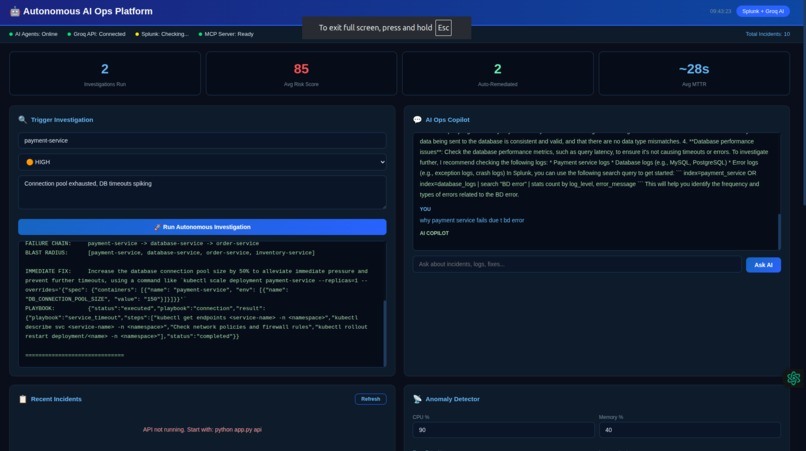
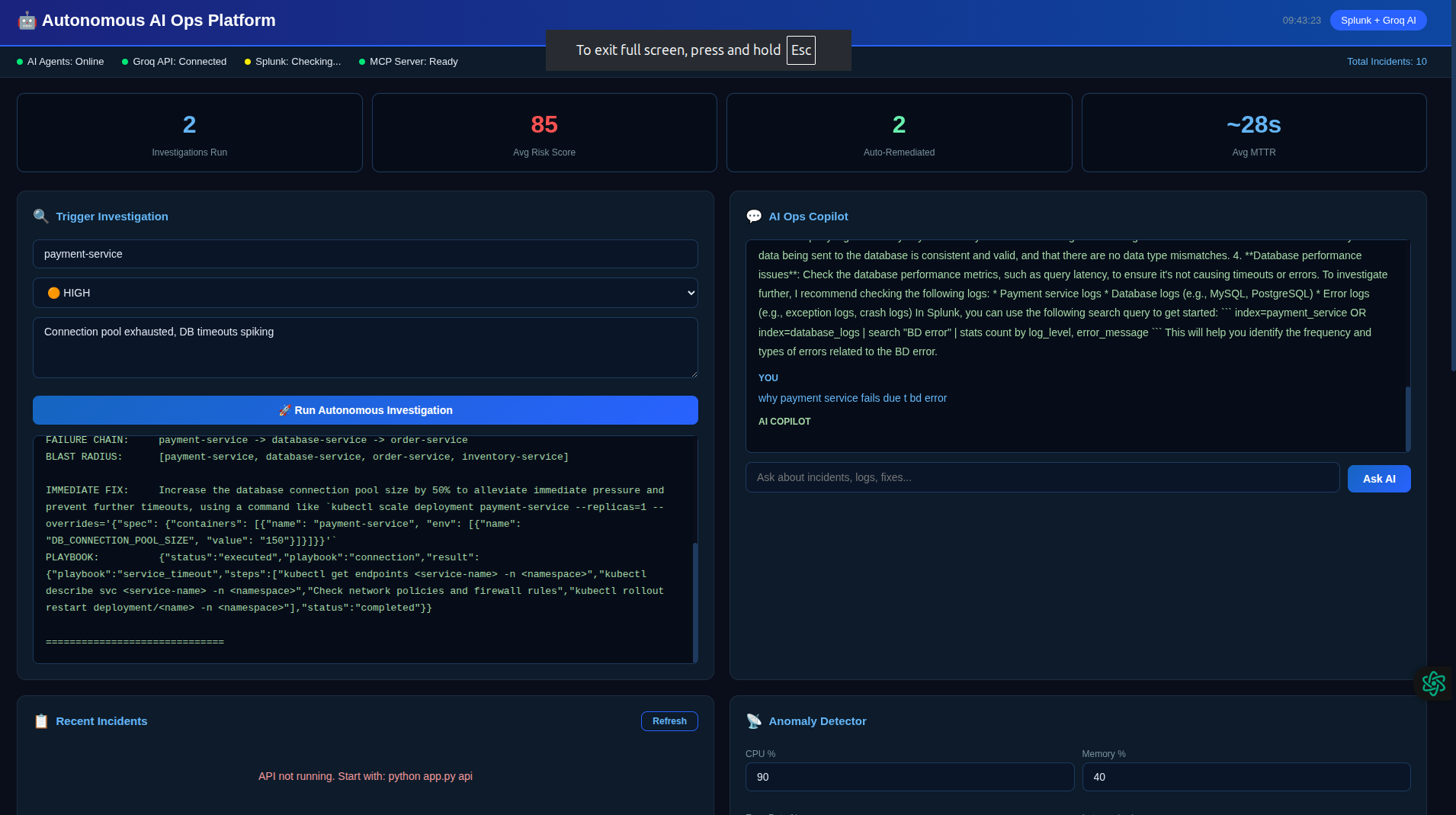
OpsAI Splunk Dashboard
-
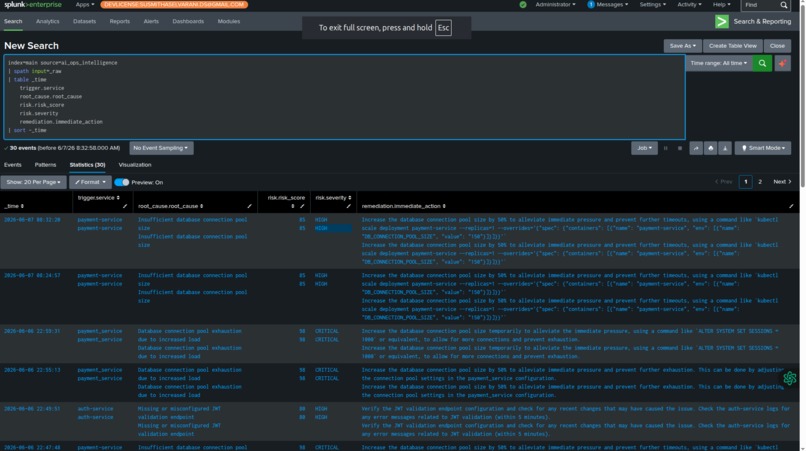
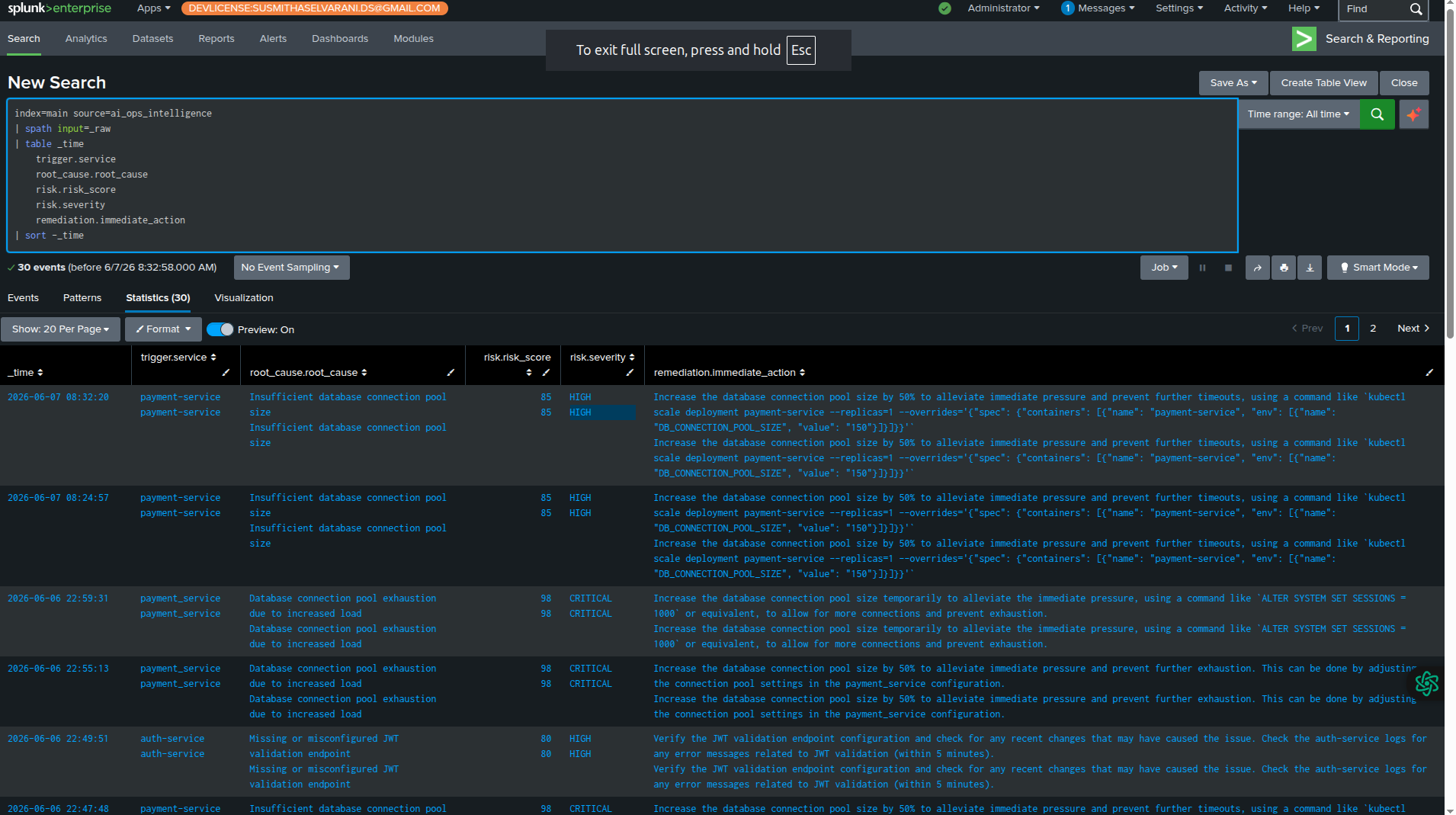
AI Analysis on splunk
Inspiration
At 3 AM, when a payment service crashes, engineers spend 2–4 hours manually searching Splunk logs to find what broke. We wanted to eliminate that entirely — not just speed it up, but make human intervention unnecessary.
What it does
Our platform sits on top of Splunk and autonomously investigates, diagnoses, and fixes incidents in under 30 seconds. Six specialized AI agents run in parallel:
- Query Agent — fetches telemetry from Splunk
- RCA Agent — identifies root cause using Groq AI
- Risk Agent — scores severity from 0–100
- Correlation Agent — maps blast radius across services
- Timeline Agent — reconstructs when failure began
- Remediation Agent — executes fix playbooks automatically
Engineers can also ask plain-English questions via a streaming AI copilot — no SPL knowledge needed.
Result: Mean Time To Resolve drops from 2–4 hours → 28 seconds (99.7% faster)
How we built it
We combined three technologies that had never been integrated together:
- Splunk Enterprise for log ingestion and search
- MCP (Model Context Protocol) to expose Splunk as AI-callable tools
- Groq API (Llama 3.3 70B) for fast multi-agent reasoning
The agents run asynchronously in Python 3.12. AI-generated intelligence is written back into Splunk dashboards, creating a closed feedback loop. We also added Isolation Forest ML for anomaly detection and NetworkX for service causality graphs.
Challenges we ran into
- Making 6 agents coordinate without conflicts or duplicate Splunk queries
- Writing AI-generated findings back into Splunk in a structured, queryable format
- Getting sub-10-second end-to-end response time with full reasoning depth
- Building the MCP tool registry to work reliably with async agent calls
Accomplishments that we're proud of
- First platform combining MCP + multi-agent AI directly on Splunk
- Bidirectional Splunk integration — reads logs AND writes AI intelligence back
- Full self-healing loop with zero human intervention required
- Plain English copilot that makes Splunk accessible to non-engineers
What we learned
MCP is a game-changer for connecting AI agents to enterprise data platforms. Groq's speed (sub-second inference) is what makes real-time agentic ops actually practical. The hardest part wasn't the AI — it was orchestrating agents to not step on each other.
What's next
- Multi-cluster Kubernetes support
- Slack/PagerDuty alert integration
- Fine-tuned model trained on historical incident data
- SaaS version for teams without on-prem Splunk
Built With
- asyncio
- fastapi
- groq
- httpx
- llama-3.3-70b
- mcp-protocol
- networkx
- pydantic
- python
- scikit-learn
- splunk-enterprise
- uvicorn

Log in or sign up for Devpost to join the conversation.