-
-
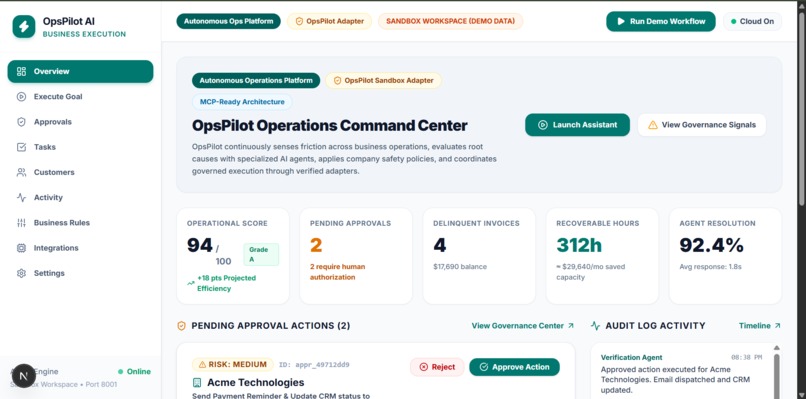
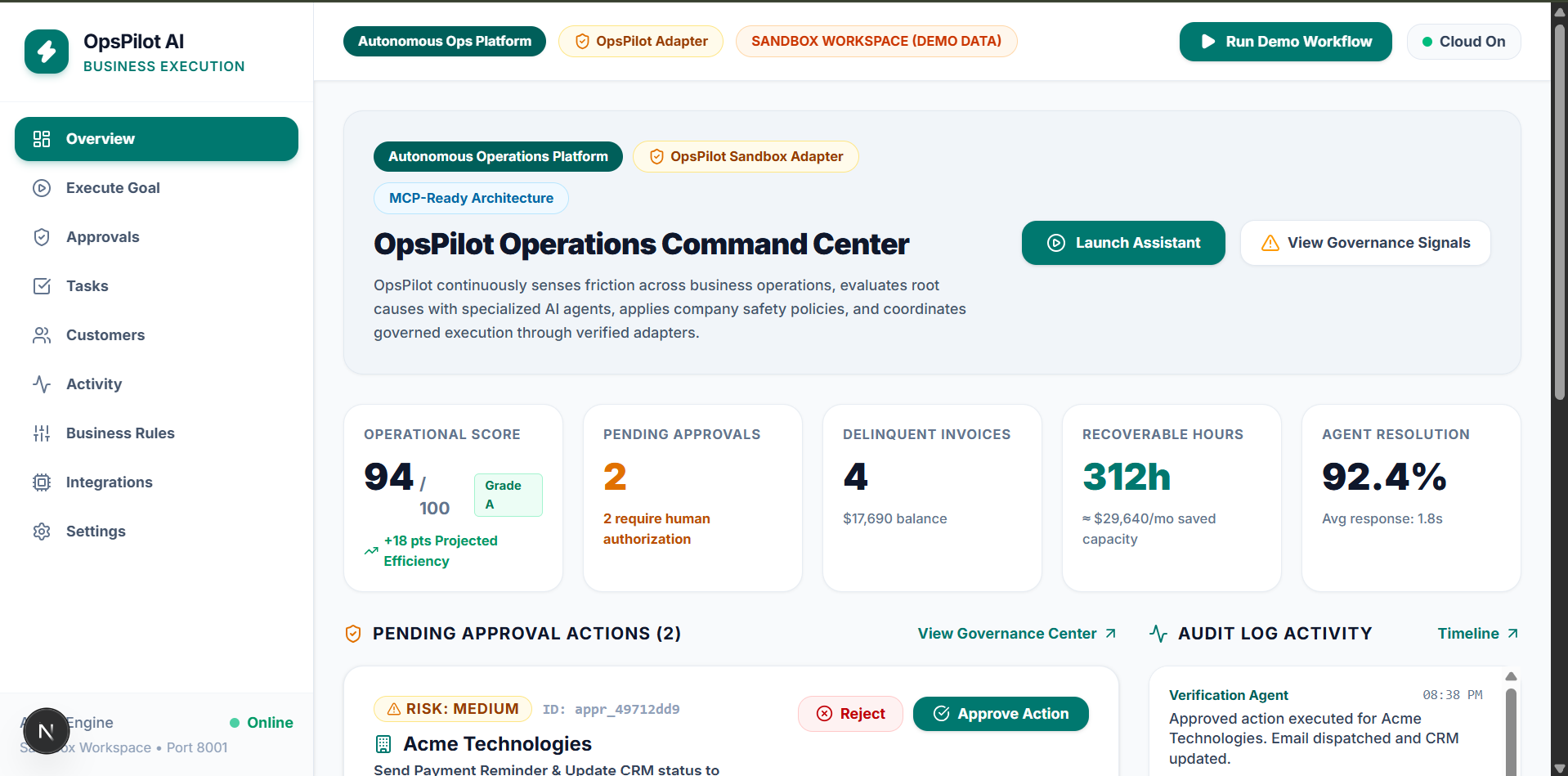
OpsPilot AI is a real-time operations command center that unifies business monitoring, approvals,and AI agent performance in one dashboard.
-
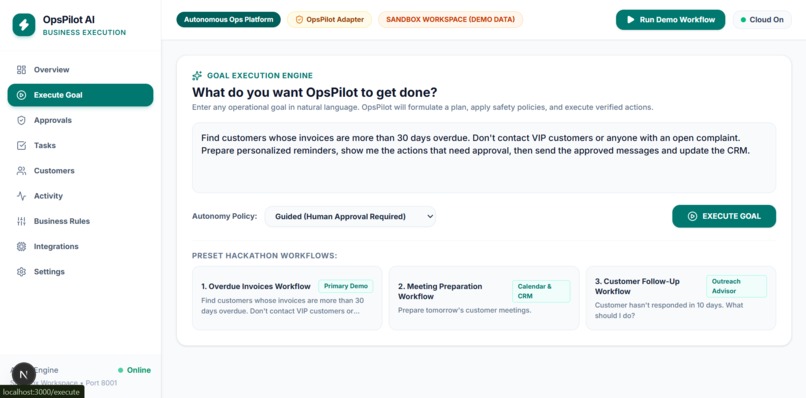
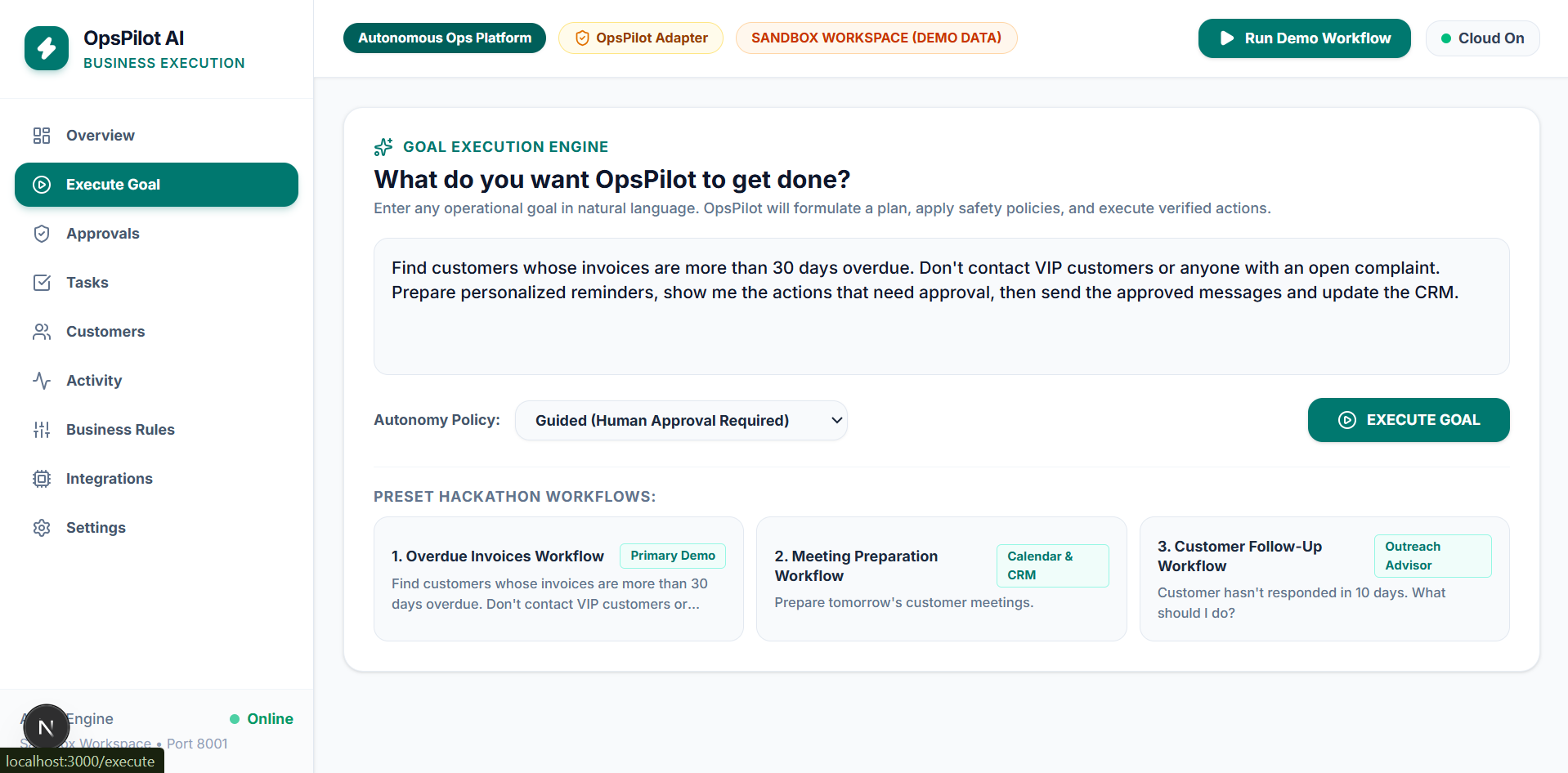
Natural-Language Goal Execution lets users describe business goals in plain language. OpsPilot plans, and coordinates actions automatically.
-
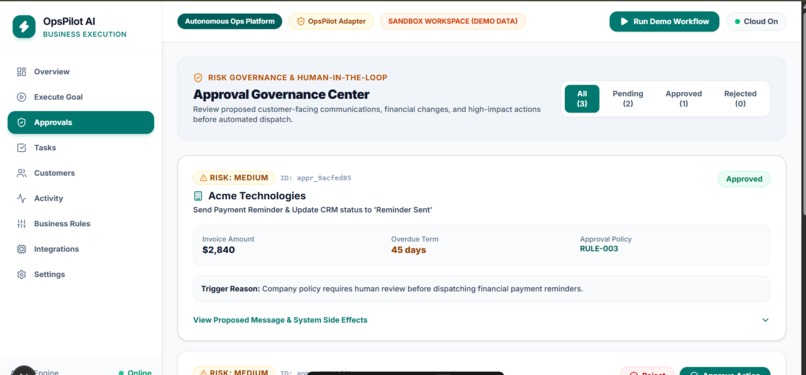
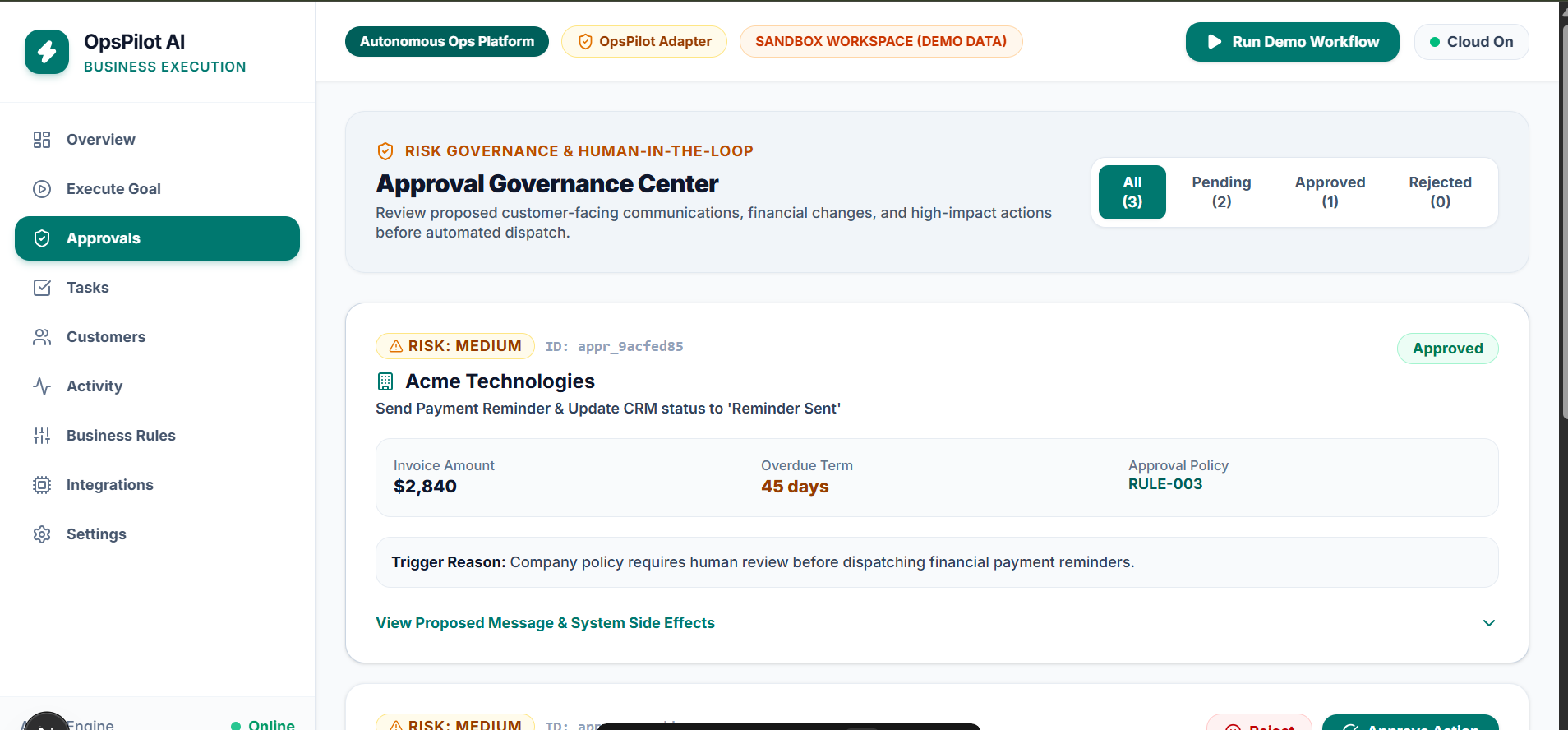
Human-in-the-Loop Governance ensures sensitive actions are reviewed before execution. OpsPilot shows context effects for informed approval.
-
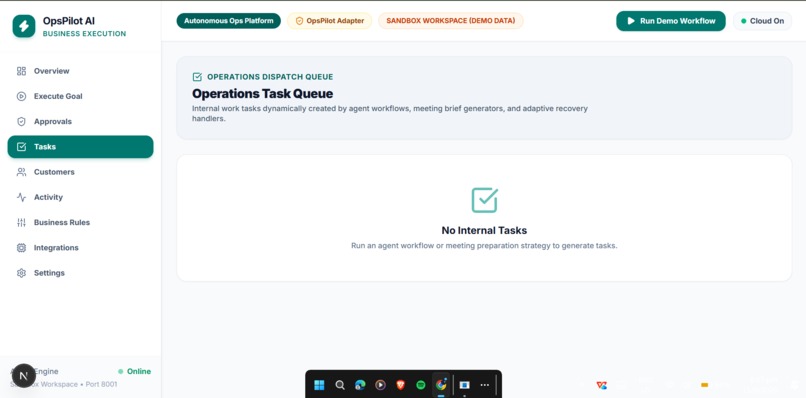
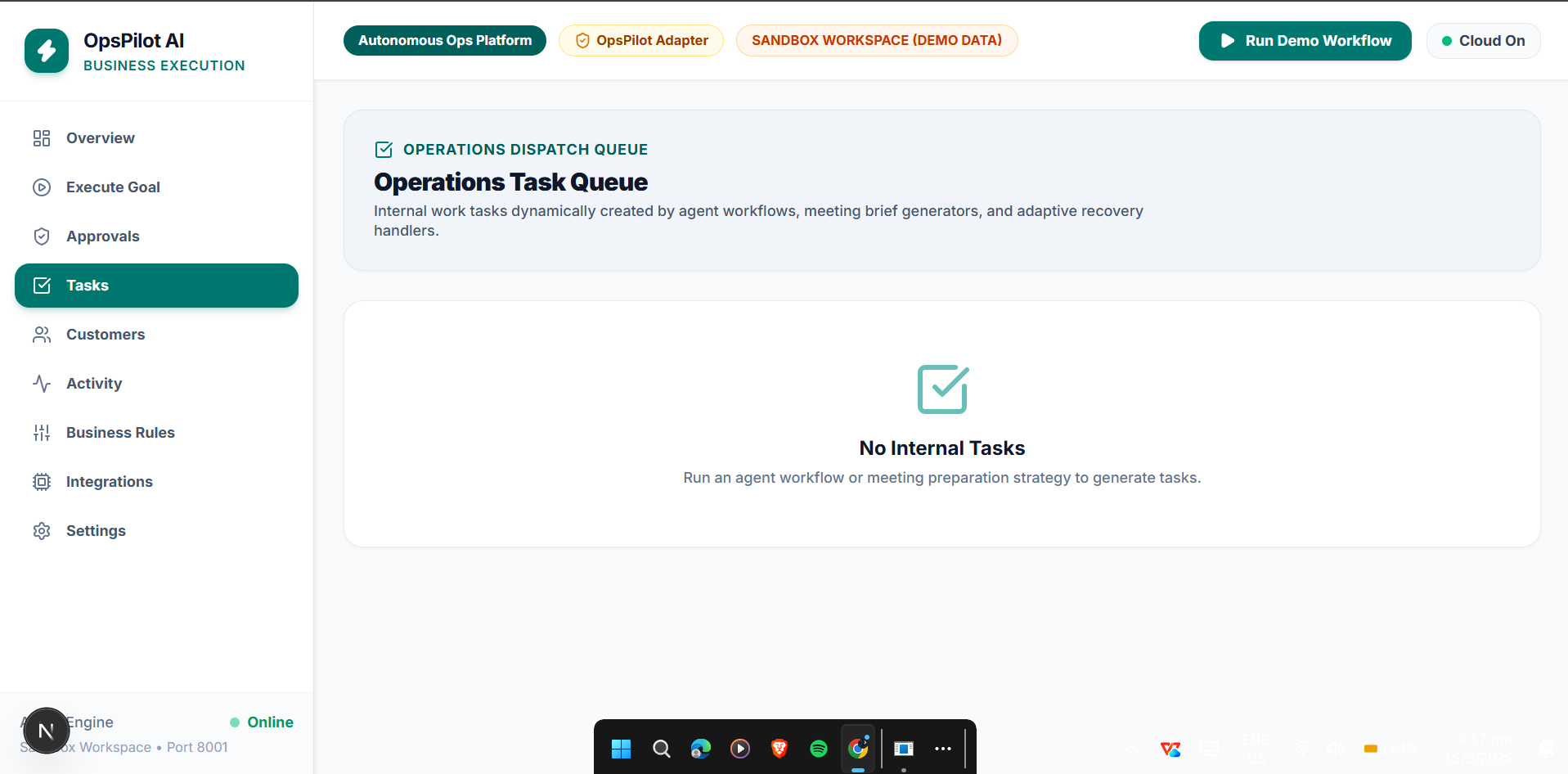
Centralized queue for AI-generated operational tasks, follow-ups, and recovery actions, helping teams track pending work efficiently.
-
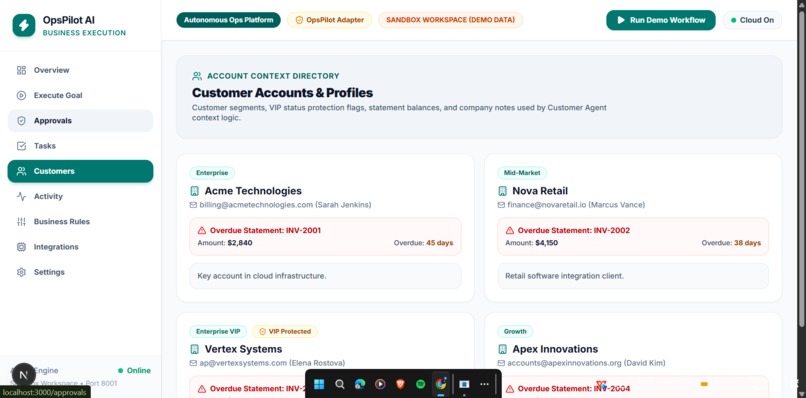
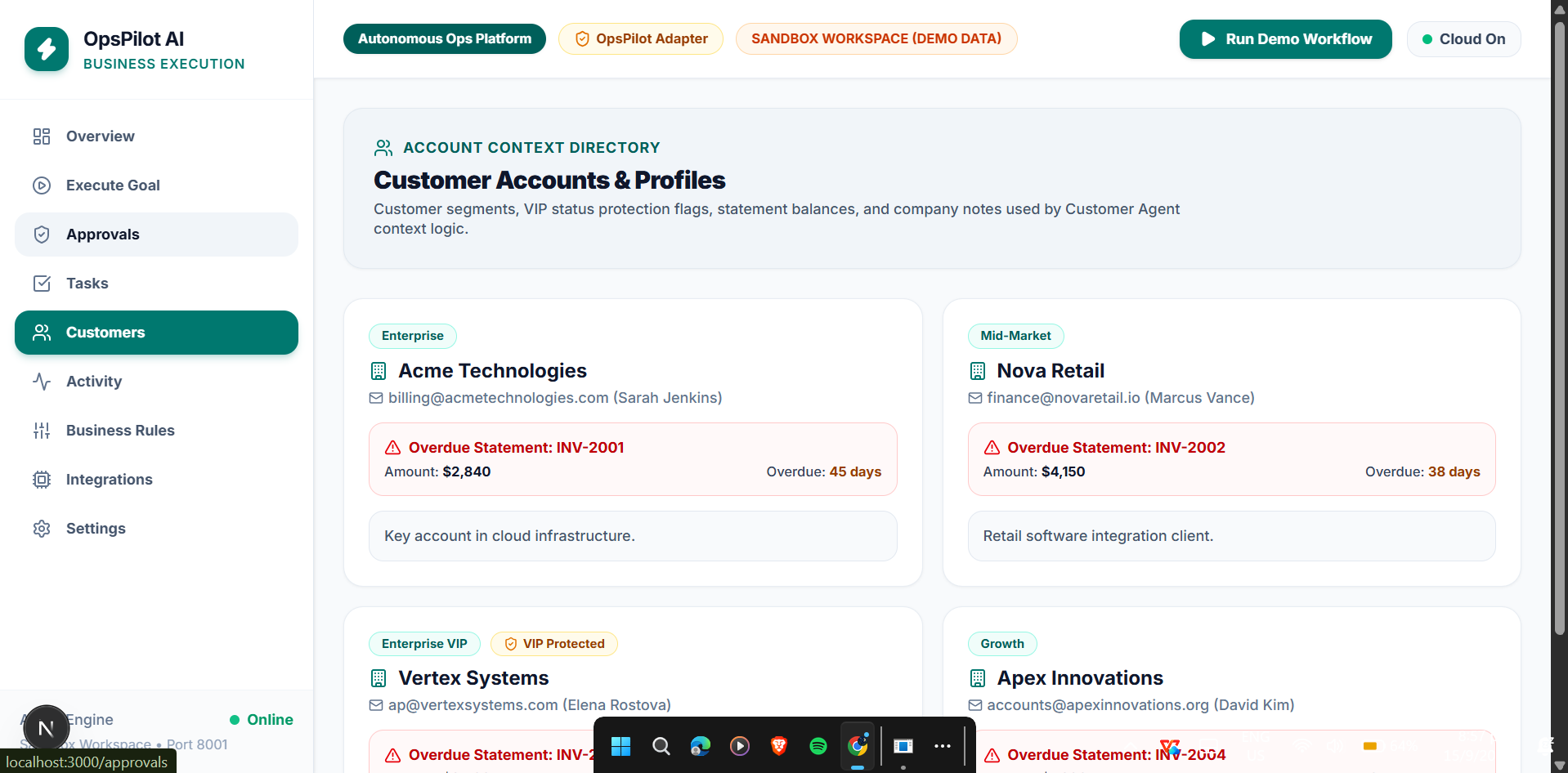
Provides customer profiles, overdue invoices, account information, and VIP status, enabling agents to make context-aware decisions.
-
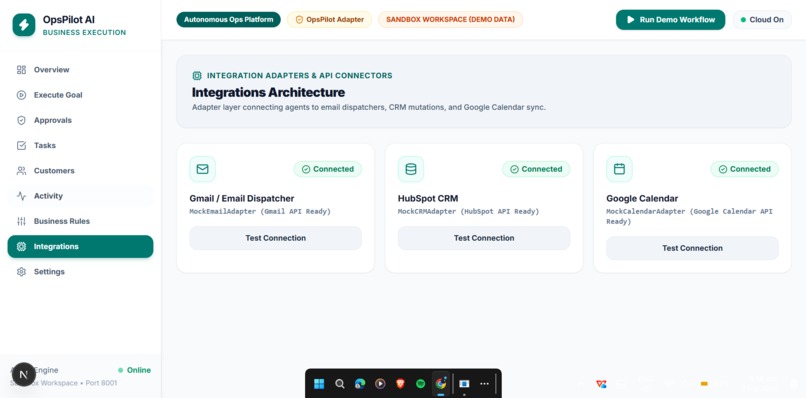
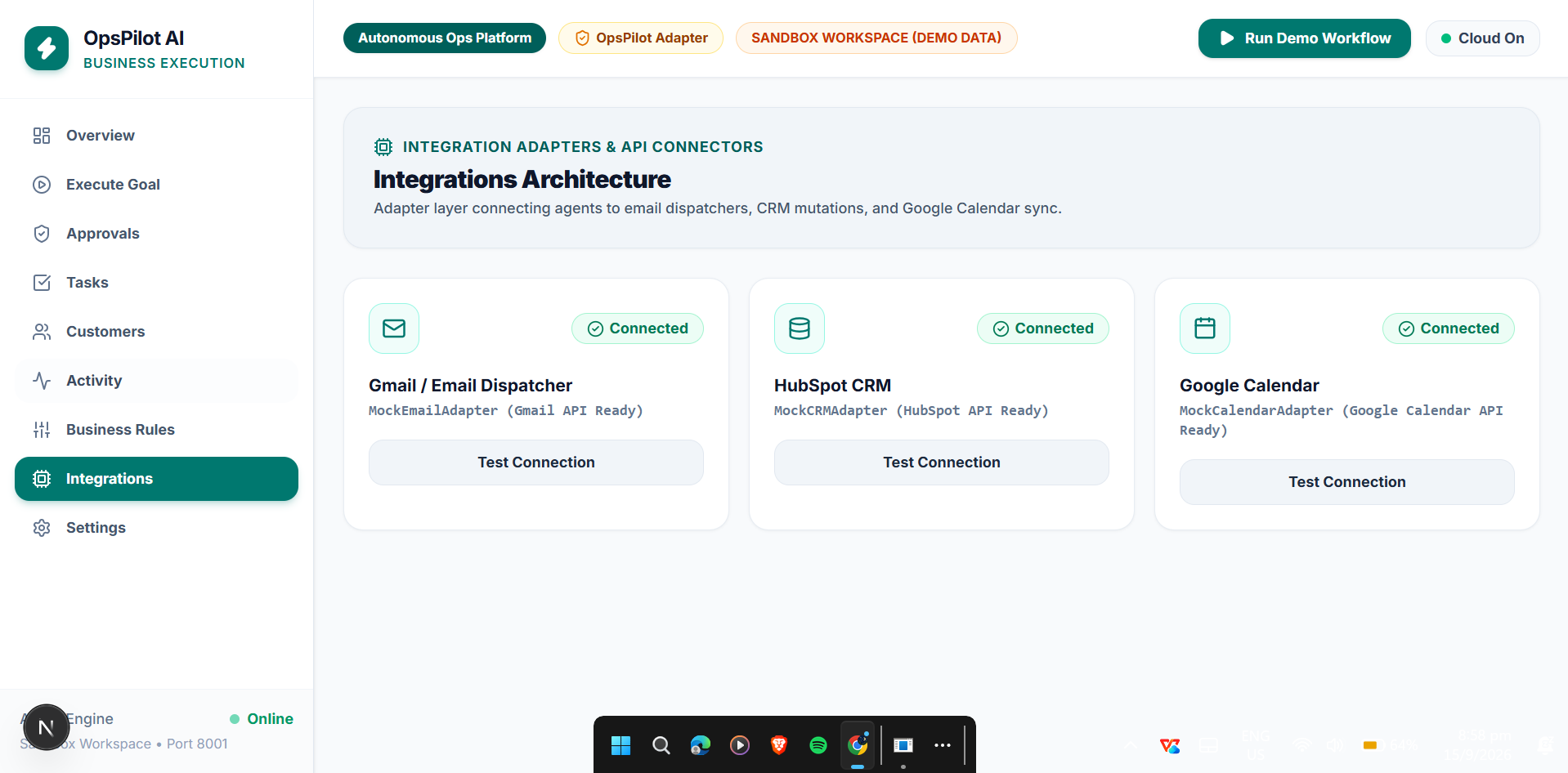
Connects OpsPilot with business tools such as Email, CRM, and Google Calendar through modular adapter-based integrations.
-
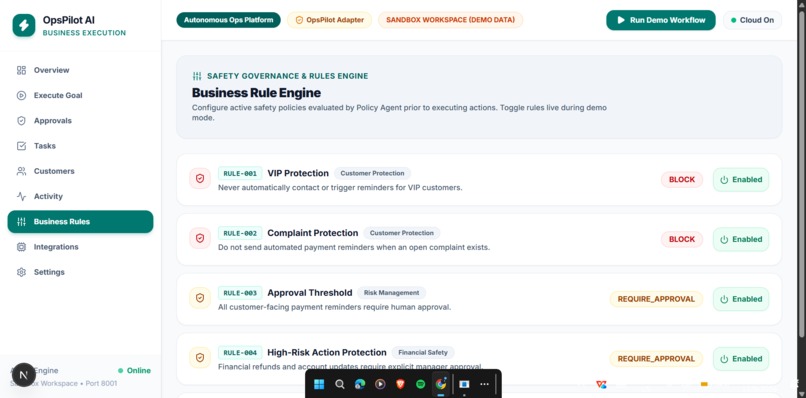
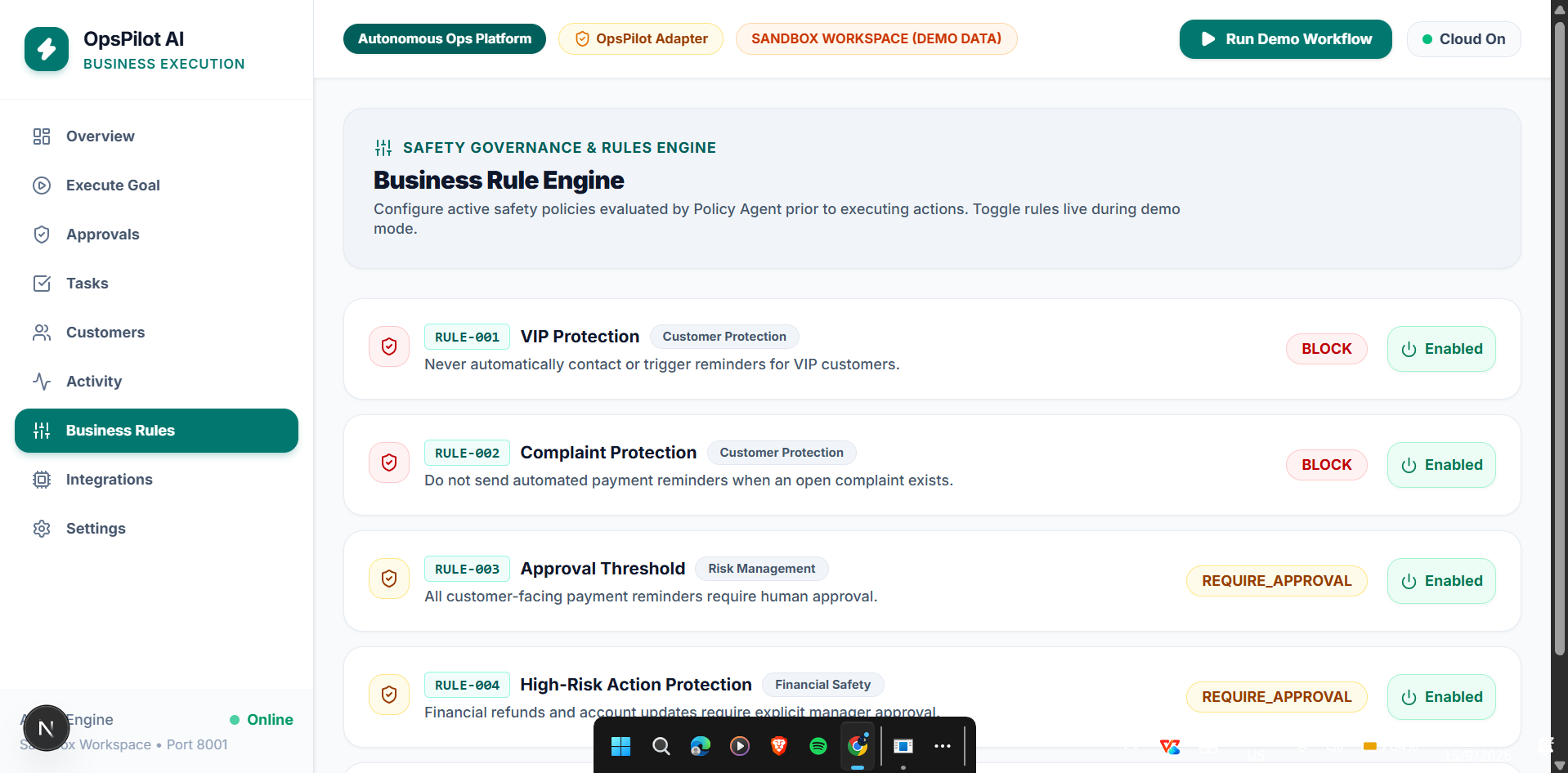
Enforces critical business policies such as VIP Protection, Complaint Protection, and Approval Requirements before actions are executed.
Inspiration
Most business software can store information, while automation platforms can execute predefined workflows. But real business work rarely follows a perfectly fixed sequence. Employees constantly make decisions based on customer context, company policies, risk, approvals, and what happened in previous steps.
We wanted to build an AI system that could understand a business goal, determine the actions required to achieve it, execute those actions across tools, and verify the outcome.
That idea became OpsPilot AI — an AI operations agent designed around Goal → Plan → Act → Verify → Recover.
Instead of asking users to configure every step of an automation, OpsPilot lets them describe the outcome they want and handles the execution while keeping humans in control of important decisions.
What it does
OpsPilot AI turns natural-language business goals into controlled, multi-step execution plans.
For example, a user can ask:
“Find customers with invoices more than 30 days overdue, exclude VIP customers and customers with open complaints, prepare personalized reminders, get approval where required, send the approved messages, and update the CRM.”
OpsPilot decomposes this goal and coordinates specialized agents:
- Orchestrator Agent — interprets the goal and coordinates execution.
- Finance Agent — identifies overdue invoices and calculates relevant payment information.
- Customer Context Agent — gathers customer status, VIP information, complaints, and communication context.
- Policy Agent — evaluates company rules before actions are taken.
- Communication Agent — prepares personalized business communications.
- Verification Agent — verifies that external side effects actually occurred.
OpsPilot also includes:
- Dynamic multi-step planning
- Business rule enforcement
- Risk-based action classification
- Human approval for sensitive actions
- Explainable decisions through a “Why?” panel
- Activity and execution monitoring
- Automatic failure recovery and retries
- Execution receipts showing what actually happened
The result is an operations system that doesn't simply generate an answer — it takes controlled action and verifies the result.
How we built it
OpsPilot was designed as a modular AI-agent system with a clear separation between reasoning, policy, execution, and verification.
Architecture
User Goal → Orchestrator → Specialized Agents → Policy/Risk Layer → Tools → Verification → Execution Receipt
The backend was built using Python and FastAPI, with modular services for agents, business rules, risk evaluation, recovery, and execution.
The frontend was built using Next.js, TypeScript, and Tailwind CSS as a SaaS-style operations console.
The system includes:
- Agent orchestration
- REST APIs
- Rule engine
- Risk engine
- Recovery service
- Mock business/tool integrations
- Approval workflows
- Execution telemetry
- Audit activity
- Verification services
We also created a synthetic business dataset containing customers, invoices, communications, meetings, and business rules so the complete workflow could be demonstrated without depending on production customer data.
The application was containerized using Docker and documented with architecture, workflow, API, and development documentation.
Challenges we ran into
The biggest challenge was going beyond a conventional chatbot.
It was relatively easy to make an AI respond to a business request. The difficult part was making the system decide what it should be allowed to do, execute multiple dependent actions, handle exceptions, and verify that the actions succeeded.
We faced several key challenges:
1. Dynamic planning
A natural-language goal does not provide a predefined workflow. The system needs to convert the goal into executable steps while maintaining dependencies between those steps.
2. Safe autonomy
We did not want the agent to blindly execute every action. Customer-facing and high-impact actions require additional controls.
We therefore introduced risk levels:
LOW → MEDIUM → HIGH → CRITICAL
and connected them to automatic execution, approval, or blocking behavior.
3. Business context
A technically valid action can still be a bad business decision. For example, an overdue invoice should not automatically trigger a payment reminder if the customer has an open complaint or is protected by a VIP policy.
4. Verification
An API returning successfully does not always mean the intended business outcome happened. OpsPilot therefore includes verification after execution and avoids falsely reporting successful actions.
5. Failure recovery
Real systems fail. APIs time out, integrations become unavailable, and actions can partially complete. We implemented retry and recovery handling so the system can respond to execution failures instead of silently ignoring them.
Accomplishments that we're proud of
We are proud that OpsPilot evolved from an agent concept into a working end-to-end product.
Our key accomplishments include:
- Built a modular multi-agent architecture.
- Implemented dynamic goal-to-action execution.
- Added a persistent business rule engine.
- Added LOW/MEDIUM/HIGH/CRITICAL risk classification.
- Implemented human-in-the-loop approval.
- Built explainable decision panels.
- Added adaptive failure recovery.
- Implemented post-action verification.
- Built a visual activity graph for agent execution.
- Created an execution receipt for operational accountability.
- Developed a complete SaaS-style frontend with multiple operational views.
- Added Docker support and technical documentation.
- Achieved 15 automated backend tests passing with 0 failures.
- Achieved a successful Next.js production build with all 9 routes compiling successfully.
Most importantly, the project demonstrates the complete concept:
Goal → Plan → Act → Verify → Recover
rather than stopping at AI-generated text.
What we learned
We learned that building an AI agent for real business operations is fundamentally different from building a chatbot.
The intelligence is not only in the model. A reliable agent needs several layers working together:
Reasoning + Context + Policies + Risk + Execution + Verification
We also learned that autonomy needs boundaries. Giving an AI more tools does not automatically make it more useful. The system becomes more trustworthy when it knows when to act, when to ask for approval, and when to stop.
Another important lesson was the value of observability. Users need to understand what the system is doing, which actions are blocked, why decisions were made, and whether the final result was actually verified.
This shaped OpsPilot into a system focused not just on AI autonomy, but on controlled and accountable autonomy.
What's next for OpsPilot AI — From Goals to Verified Actions
Our next goal is to move OpsPilot from a hackathon-ready prototype toward a production-grade AI operations platform.
Short term
- Connect real business integrations such as Gmail, Google Calendar, CRM systems, and Google Sheets.
- Replace synthetic data with secure connected data sources.
- Expand workflow templates for sales, finance, customer success, and internal operations.
- Improve real-time execution monitoring.
- Add stronger authentication, authorization, and audit controls.
Medium term
We plan to make the agent increasingly adaptive by learning from execution outcomes, failed actions, approval decisions, and changing business policies.
OpsPilot could support workflows such as:
- Preparing customer meeting briefs
- Following up with inactive leads
- Detecting unresolved customer issues
- Coordinating internal operational tasks
- Preparing finance follow-ups
- Escalating high-risk business situations
Long term
Our vision is to build an AI operations layer for businesses where employees describe outcomes instead of manually coordinating applications and repetitive workflows.
The future experience is simple:
Tell OpsPilot what needs to happen.
It plans the work.
It takes the appropriate actions.
It asks humans when necessary.
It verifies the outcome.
And it recovers when something goes wrong.
That is our vision for OpsPilot AI — From Goals to Verified Actions.
Built With
- ai-agents
- docker
- fastapi
- next.js
- python
- rest-apis
- tailwind-css
- typescript
