-
-
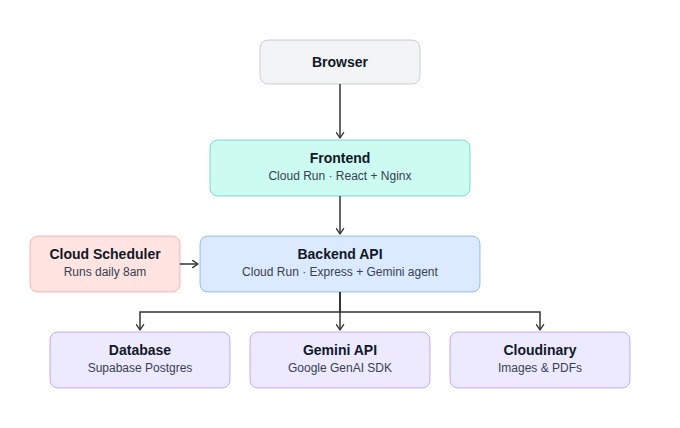
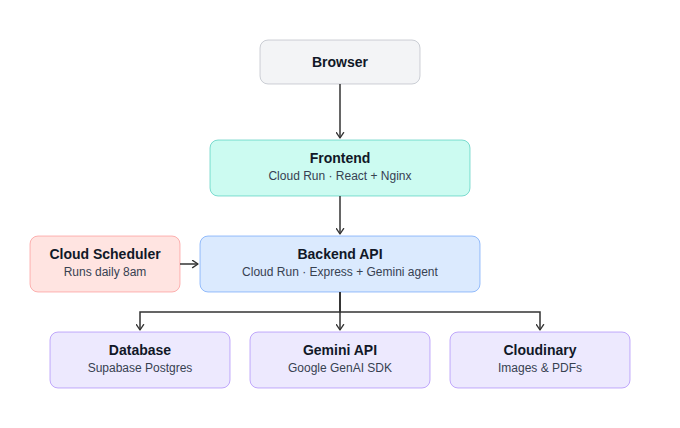
OpsPilot architecture diagram
Inspiration
Every small business owner knows the feeling: a customer owes money, the invoice is overdue, and somehow it just sits there. Not because anyone's negligent — because chasing payments is a job nobody has time for on top of actually running the business. I wanted to build something that doesn't just answer questions about a business, but genuinely does a piece of the operational work — the way a real Chief Operating Officer would.
What it does
OpsPilot is a business management platform — customers, sales, inventory, invoices, expenses — with an AI agent layer built on top of it. The centerpiece for this hackathon is the Overdue Invoice Agent:
- It scans every unpaid invoice and, for each one, sends Gemini the real context: how overdue it is, the customer's other outstanding invoices, their order history.
- Gemini decides — reminder, escalation, or nothing — with a stated reason, not a canned message.
- Every decision lands as a proposal in an approval queue. Nothing executes without a human saying yes.
- Once approved, the action is recorded and logged.
- And critically: it doesn't wait to be asked. Google Cloud Scheduler triggers this same review every day at 8am, for every user, with nobody logged in.
How I built it
- Frontend: React + Vite, deployed on Google Cloud Run behind nginx.
- Backend: Node.js + Express + Prisma, also on Cloud Run.
- AI: Gemini via Google's official
@google/genaiSDK — migrated off the deprecated@google/generative-aipackage specifically for this submission, preserving the existing tool-calling loop and function declarations. - Autonomy: a dedicated, secret-protected endpoint (separate from normal user auth) that Cloud Scheduler calls daily, looping every account with per-user error isolation.
- Database: PostgreSQL via Supabase.
- Trust layer: invoices and receipts get a SHA-256 hash anchored on Base Sepolia, so anyone can verify a document hasn't been tampered with.
Challenges I ran into
- Getting the scheduler to actually work wasn't as simple as just setting up a timer — Cloud Scheduler has no user login, so I built a separate secret-protected route, and had to get the setup order right so the normal login check couldn't block it first.
- A genuine race condition: reviewing invoices twice in quick succession could create duplicate proposals for the same invoice. Caught before the demo.
- Deploying two separate Cloud Run services correctly — Vite bakes environment variables in at build time, so the frontend needed a two-step Cloud Build + deploy flow instead of a simpler one-liner.
- I joined the hackathon a bit late and missed the window for the dedicated $150 Google Cloud hackathon credit — so this entire build, including all Cloud Run, Cloud Build, and Cloud Scheduler usage, runs on the standard free tier with a self-imposed budget cap. No paid infrastructure was used.
Accomplishments that I'm proud of
The agent's reasoning is genuinely context-aware, not just a day-count threshold — in testing, it independently noticed when a customer had multiple overdue invoices and escalated accordingly, without being explicitly told to check for that pattern. And nothing an agent proposes — a reminder, an escalation, a new customer, a sale — ever executes without a person approving it first.
What I learned
Making something "autonomous" is mostly about the boring infrastructure — auth models that don't assume a logged-in user, idempotency so a retry doesn't double-execute, and being honest in the UI about what actually happened (my agent explicitly tells the owner "no email/SMS provider is configured yet" rather than faking a sent message).
What's next for OpsPilot
Wiring up a real email/SMS provider so approved reminders actually reach customers, extending the same propose-then-approve pattern to inventory restocking and expense anomaly detection, and building a full multi-agent Business Health review that runs daily across the whole business, not just invoices.
Built With
- cloudinary
- docker
- ethers-js
- express.js
- gemini
- google-cloud-build
- google-cloud-run
- google-cloud-scheduler
- google-genai-sdk
- jwt
- nginx
- node.js
- postgresql
- prisma
- react
- solidity
- supabase
- tailwindcss
- typescript
- vite


Log in or sign up for Devpost to join the conversation.