-
-
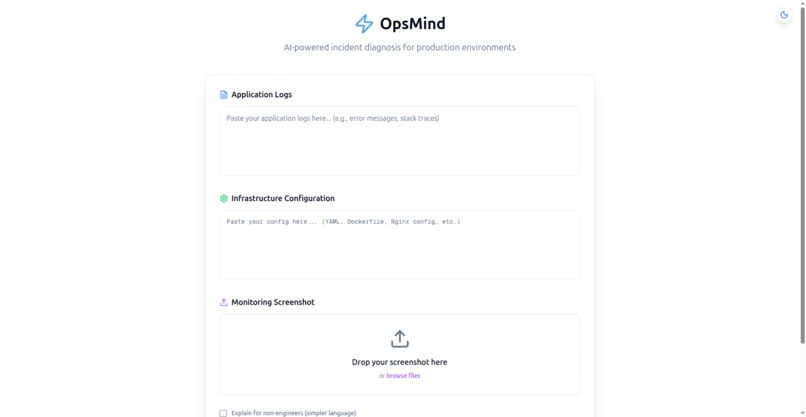
Landing Page
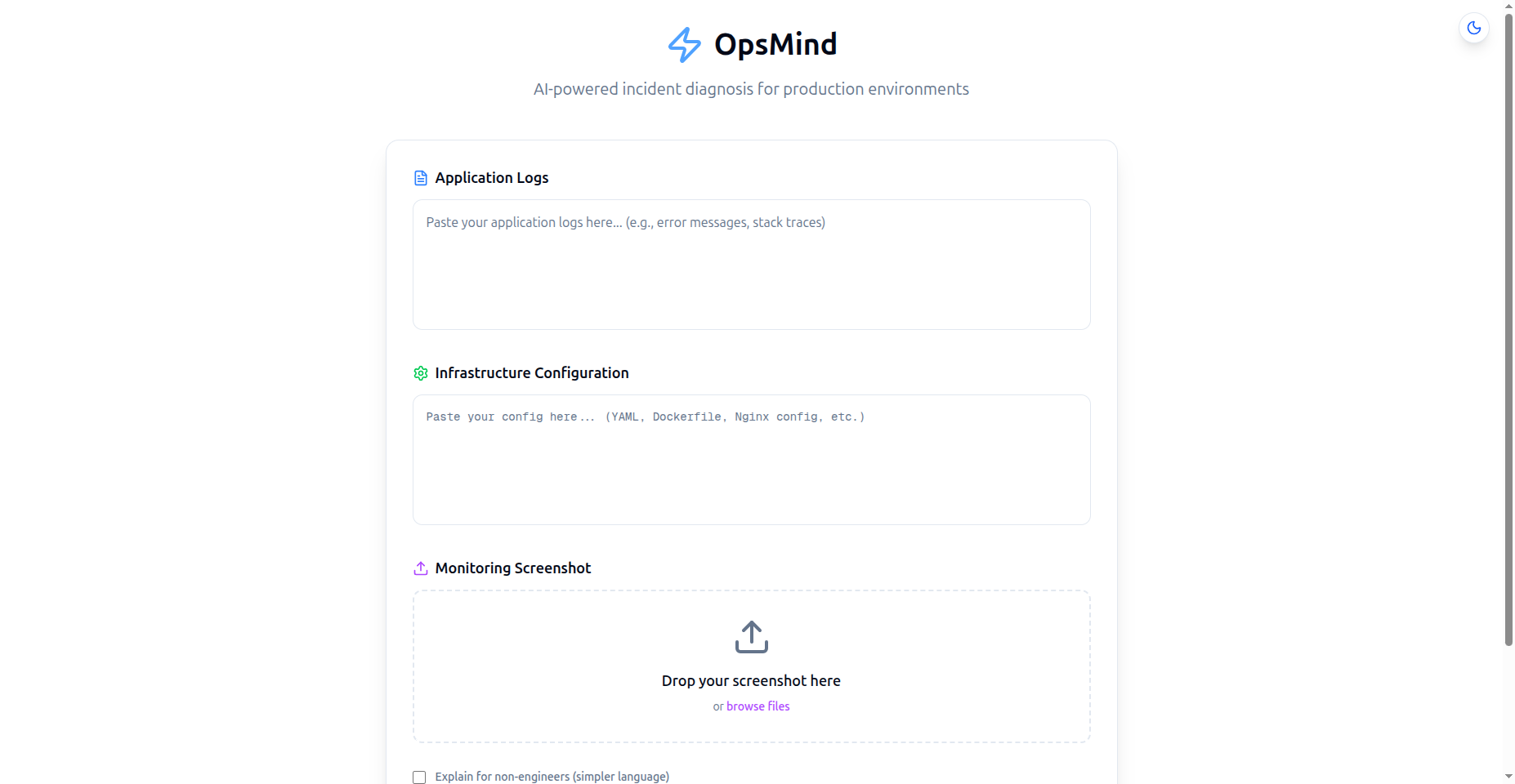
Inspiration
Modern software systems fail in complex ways. When an incident occurs, engineers must rapidly analyze logs, monitoring dashboards, and infrastructure configurations under pressure. This process is slow, error-prone, and often requires senior expertise that many teams, especially startups, may lack.
OpsMind was inspired by this gap: what if an AI could reason like a Site Reliability Engineer, instantly analyzing multiple signals and proposing concrete fixes? With Gemini 3’s multimodal reasoning, this vision became achievable.
What it does
OpsMind is an AI Operations Engineer that diagnoses production incidents. Users upload:
- Application logs (text)
- Monitoring dashboard screenshots (images)
- Configuration files (code snippets, e.g., Kubernetes YAML)
Gemini 3 reasons across all inputs simultaneously to:
- Identify the most likely root cause
- Explain why it occurred
- Generate actionable fix commands with risk and confidence levels
Low-latency inference ensures rapid feedback, making OpsMind suitable for time-sensitive incident response. The frontend renders results clearly and intuitively, highlighting evidence, fixes, and risks.
How we built it
OpsMind uses a Next.js frontend for collecting incident data and a Node.js backend to orchestrate Gemini 3 requests. Inputs are sent together in a structured multimodal prompt. The model outputs structured JSON including root causes, evidence, fixes, risk levels, and confidence scores.
The backend passes this directly to the frontend, which renders:
- Root cause analysis (highlighted)
- Evidence list
- Copyable fix commands
- Risk and confidence badges
This setup keeps the system stateless, fast, and hackathon-ready.
Challenges we ran into
The biggest challenge was designing prompts that encouraged deep reasoning rather than surface-level summarization. Gemini 3 occasionally returned vague or non-actionable advice initially, so we iteratively refined the instructions and structured output format.
Another challenge was ensuring that multimodal inputs—text logs, screenshots, and configs—were interpreted cohesively, producing a single, reliable diagnosis.
Accomplishments that we're proud of
- Built a fully functional multimodal AI engineer in under 2 weeks
- Demonstrated cross-modal reasoning on realistic production incidents
- Generated actionable remediation steps that are clear, structured, and risk-assessed
- Designed a demo that clearly showcases Gemini 3’s reasoning capabilities in a compelling, judge-friendly flow
What we learned
- Prompt engineering is critical for actionable outputs
- Multimodal AI can combine text, code, and images in meaningful ways
- Low-latency reasoning is achievable for time-sensitive tasks
- AI can move beyond assistance to specialized professional roles, providing value equivalent to senior engineers in some scenarios
What's next for OpsMind
OpsMind lays the foundation for AI-driven incident management. Next steps include:
- Proactive failure prediction and prevention
- Integration with real-time monitoring systems
- Expanded support for multiple infrastructure types (Docker, AWS, Azure, etc.)
- Multi-language support for logs and configurations
- Potentially extending to full AI-driven DevOps workflow automation, while maintaining safety and transparency
Built With
- express.js
- gemini
- javascript
- next.js
- node.js
- tailwind
- typescript

Log in or sign up for Devpost to join the conversation.