-
-
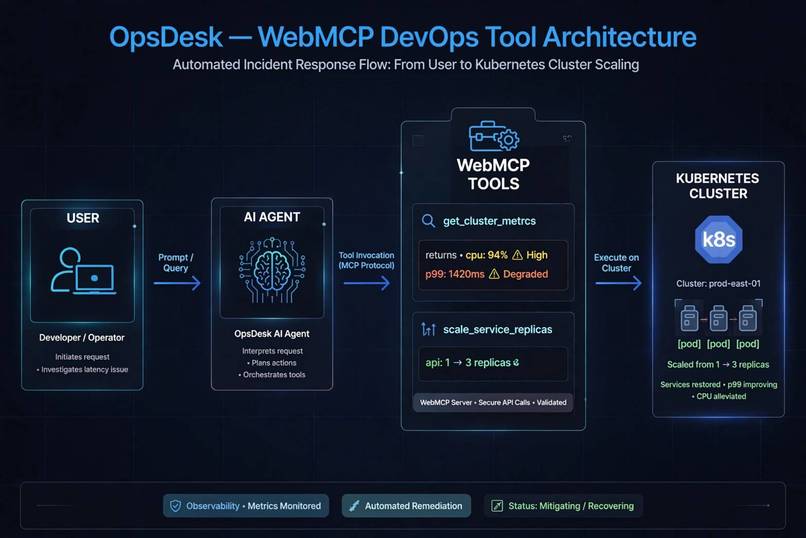
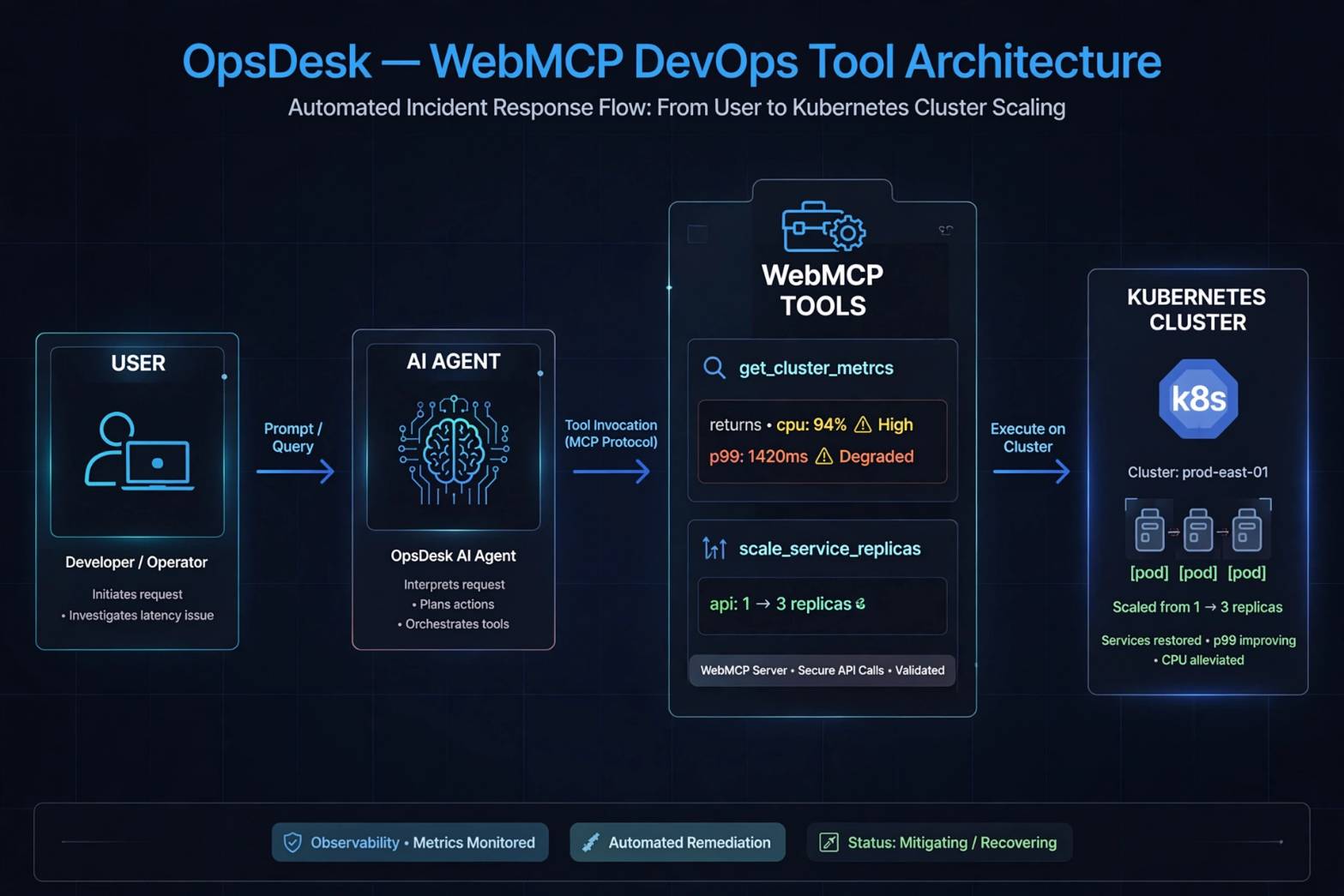
WebMCP Architecture Diagram: User query - AI agent
-
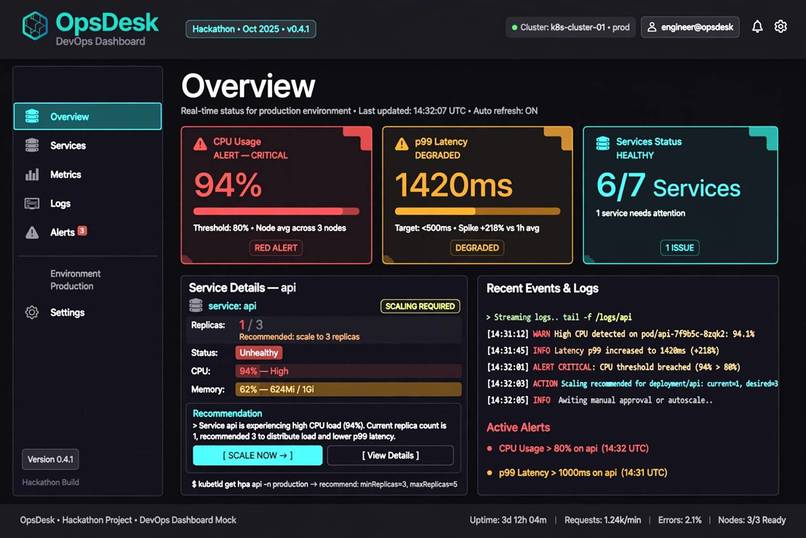
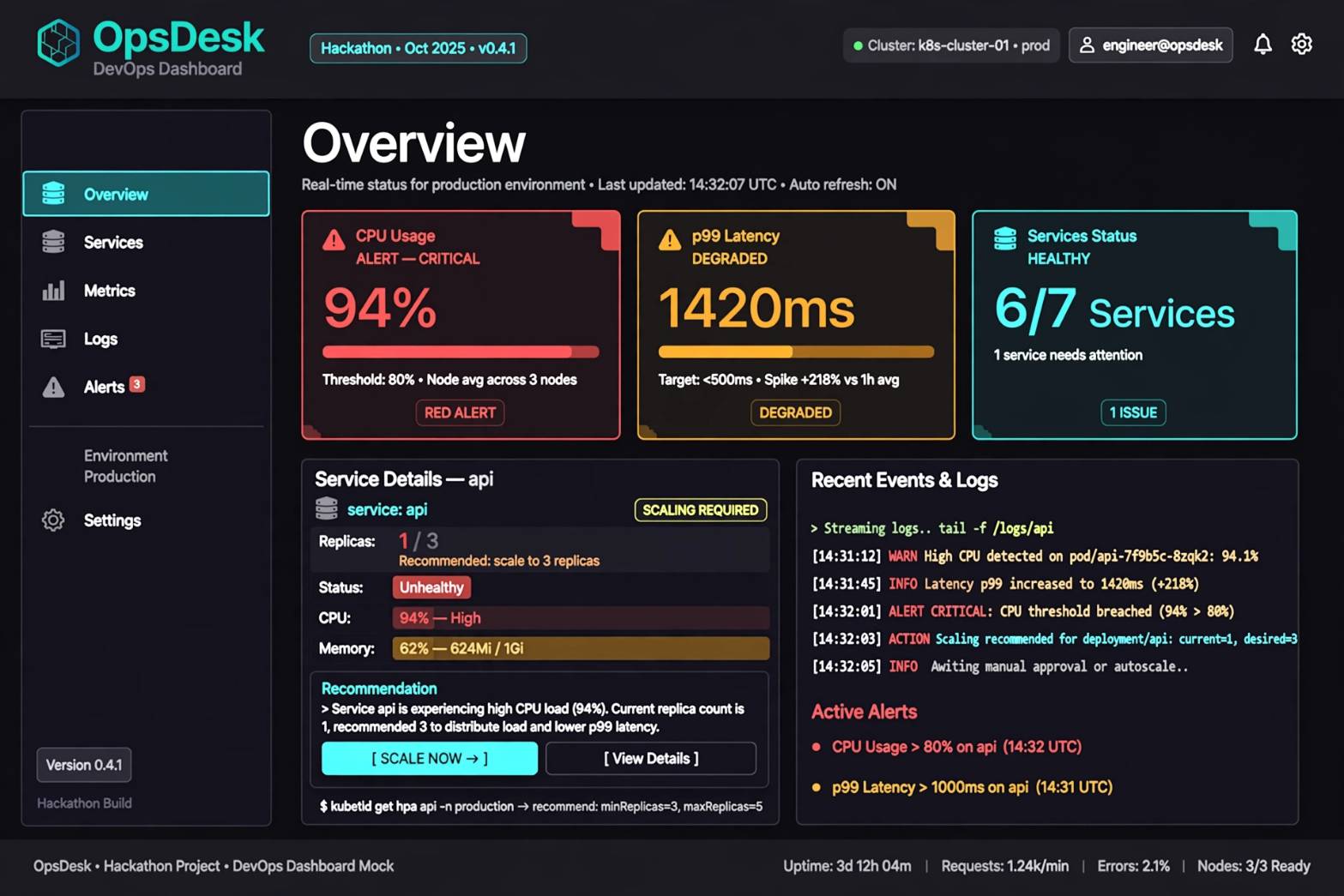
OpsDesk Dahboard: Real-Time Incident - CPU 94% CRITICAL, p99 Letency 1420Oms DEGRADED, api service needs scaling 1-3 replicas
Inspiration
During high-severity incident responses, engineers often spend critical minutes toggling between multiple monitoring dashboards, terminal windows, and cloud control panels. We wanted to build a web application designed specifically for the agent-native era—a unified workspace where human operators and AI agents collaborate seamlessly during system outages to diagnose latency spikes, inspect telemetry, and execute infrastructure remediation natively.
What it does:
OpsDesk WebMCP is an agent-native DevOps management workspace that exposes client-side operations directly to AI agents using the WebMCP standard (document.modelContext). Key functionalities include:
- Cluster Health Inspection (
get_cluster_metrics): Enables agents to fetch live CPU usage, memory footprint, p99 latency, and error rates for targeted microservices. - Dynamic Infrastructure Autoscaling (
scale_service_replicas): Allows agents to scale pod replica counts up or down to mitigate degraded service performance, updating the visual dashboard UI in real-time. - Synthetic Availability Testing (
run_synthetic_web_test): Triggers browser automation benchmarks to check UI accessibility and endpoint response times.
How we built it:
- Frontend & UI: Built using React and Tailwind CSS to render real-time service health, status indicators, and active pod replica counters.
- WebMCP Integration: Integrated
@modelcontextprotocol/sdkon the client side, exposing native tool signatures directly viadocument.modelContext.registerTool. - Agent Interoperability: Designed structured JSON input schemas and return payloads compatible with ChatGPT's in-app browser and WebMCP-enabled environments.
Challenges we ran into:
- Client-Side Tool Synchronization: Ensuring state changes executed by an agent tool call (e.g., scaling replicas) triggered immediate visual UI updates in the React component hierarchy without requiring page refreshes.
- Schema Precision: Crafting clear, deterministic tool descriptions and JSON schemas so LLMs select the correct diagnostic or action tool under varied prompting scenarios.
Accomplishments that we're proud of:
- Successfully implemented a functional browser-native WebMCP interface that allows an AI agent to execute end-to-end incident triage and infrastructure mitigation.
- Created a clean visual bridge where human engineers can monitor automated agent actions live on screen.
What we learned:
- How WebMCP transforms static web applications into interactive, agentic workspaces by standardizing client-side tool discovery.
- Best practices for structuring agent inputs and fallback handling for robust client-side execution.
What's next for OpsDesk WebMCP
- Adding multi-cluster support for cross-region failovers.
- Expanding tool execution security with human-in-the-loop confirmation prompts prior to executing high-impact scaling or rollback operations.
Built With
- model-context-protocol
- node.js
- react
- tailwind-css
- typescript
- webmcp


Log in or sign up for Devpost to join the conversation.