-
-
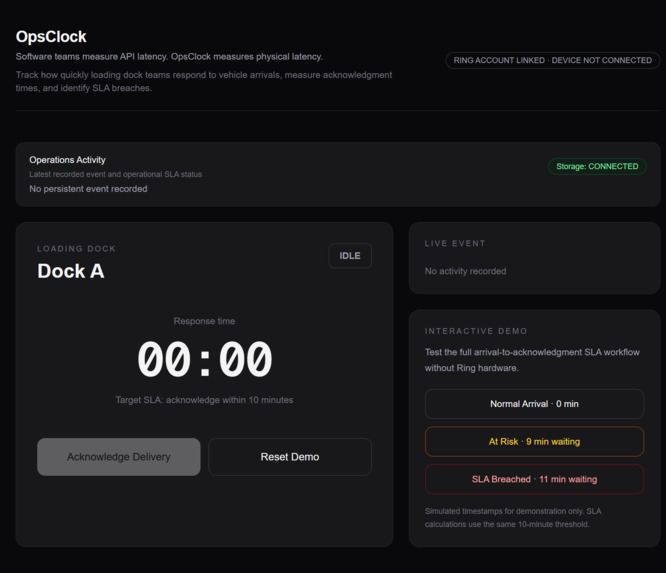
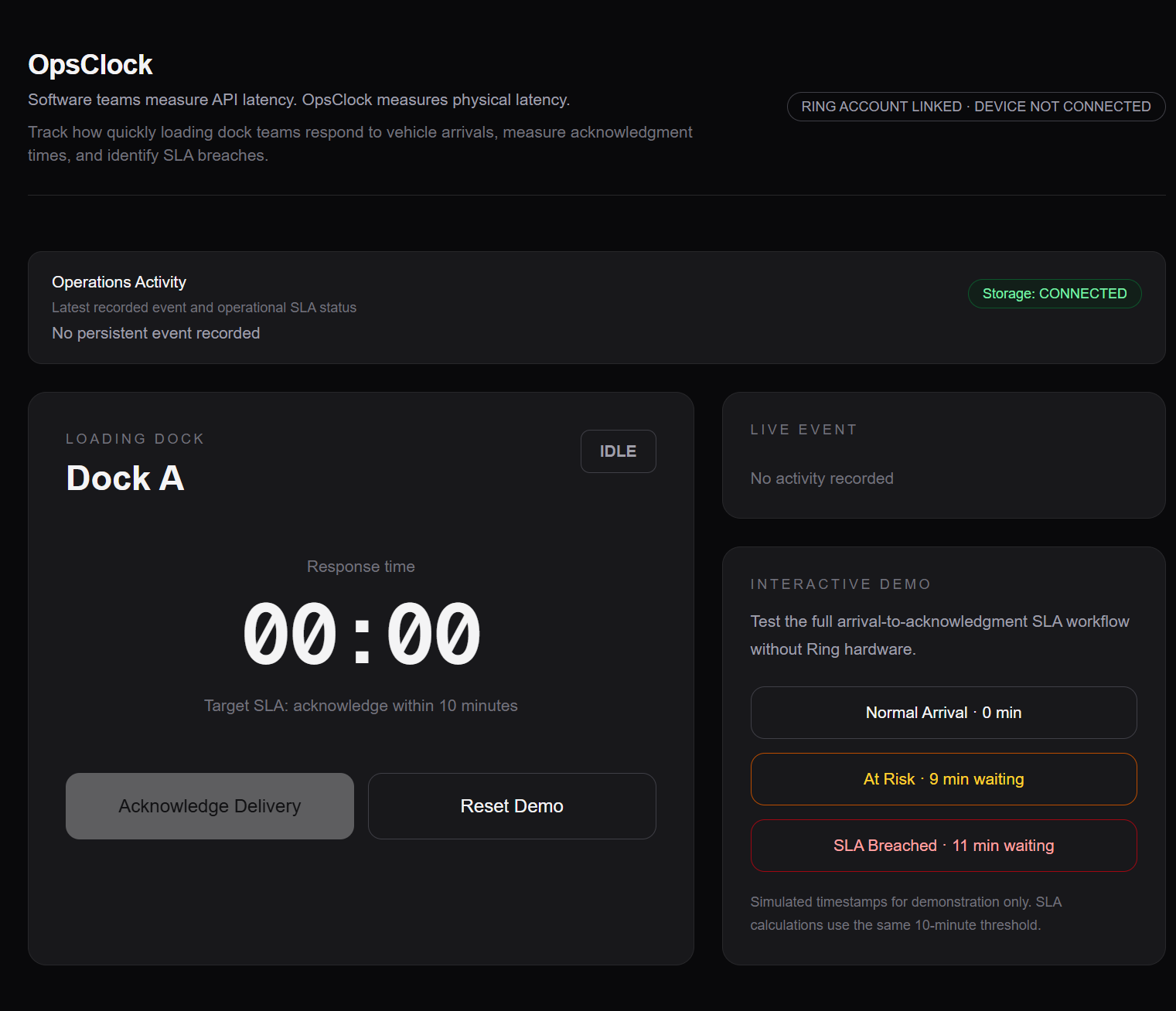
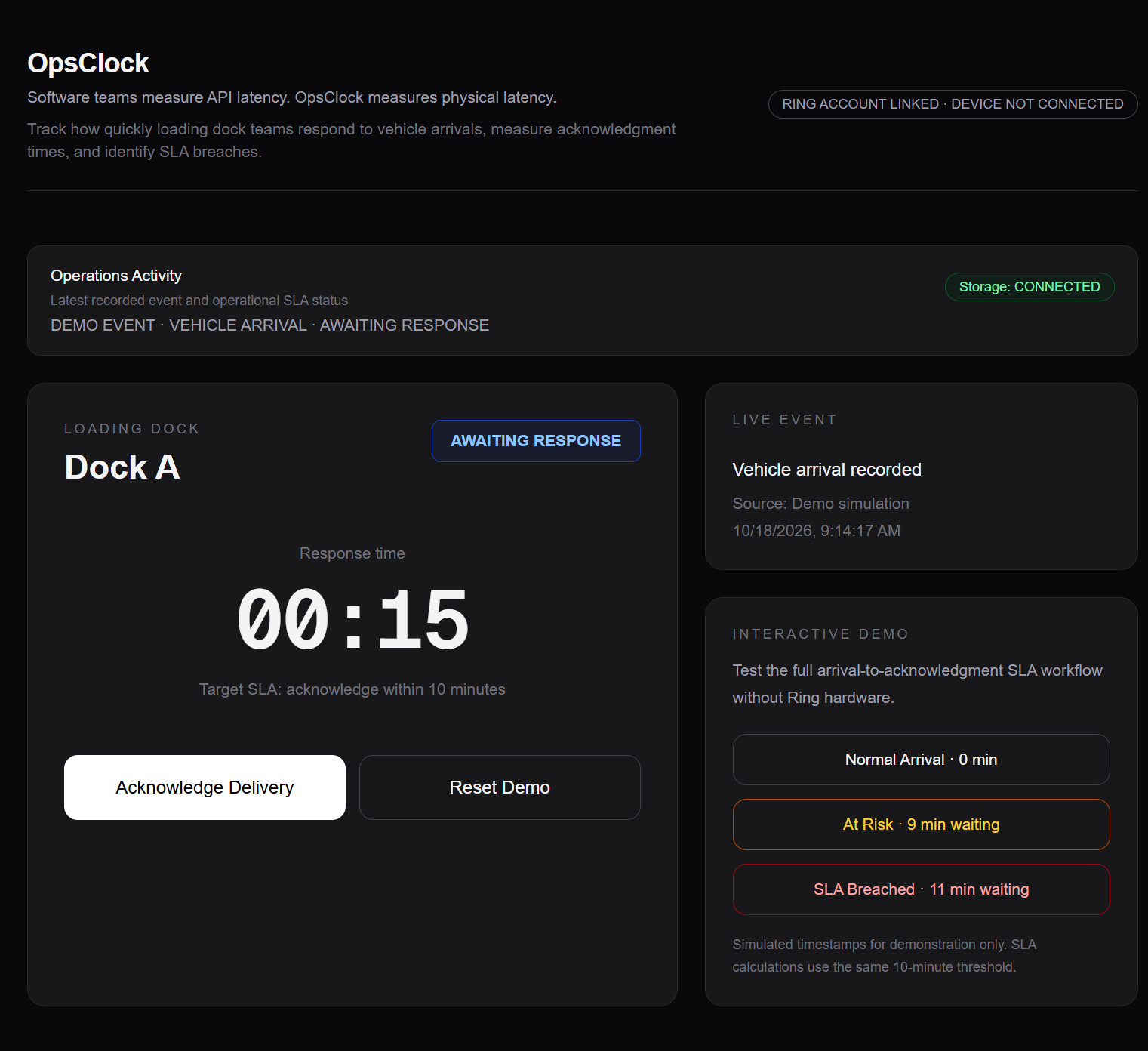
Operations Dashboard
-
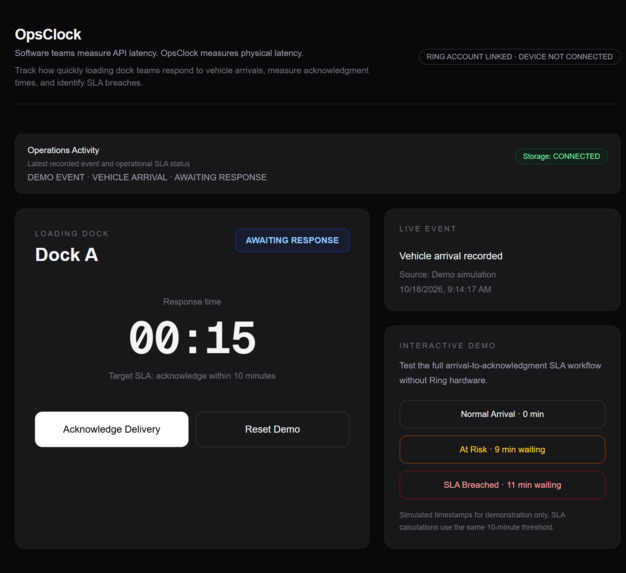
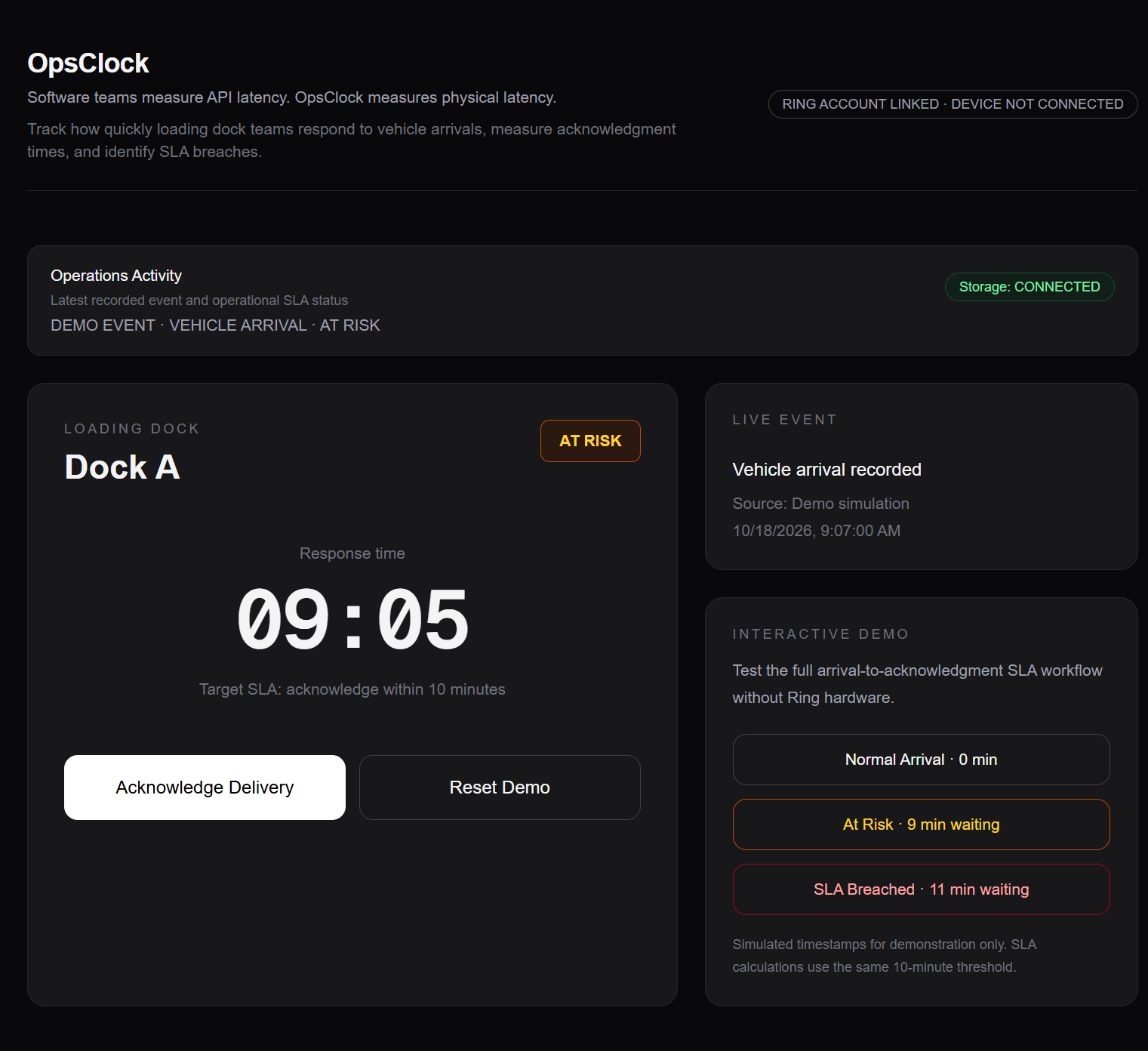
Normal Arrival — Awaiting Response
-
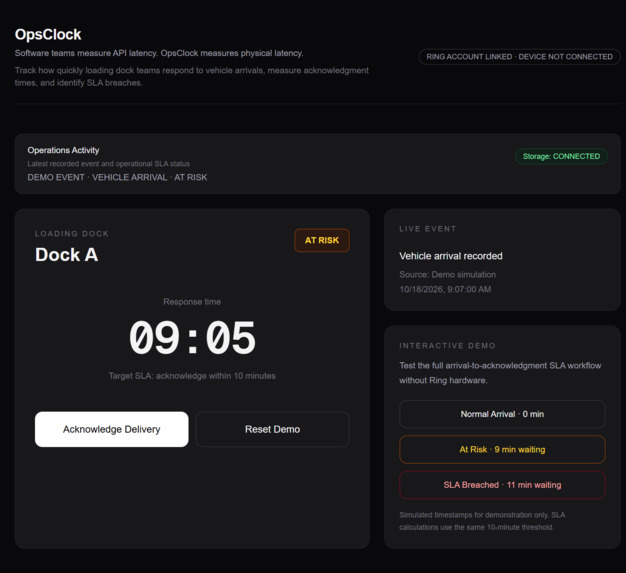
At Risk — Approaching SLA Deadline
-
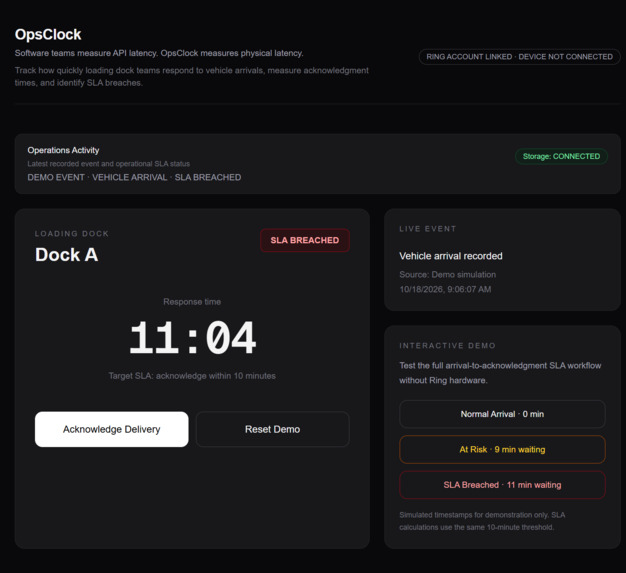
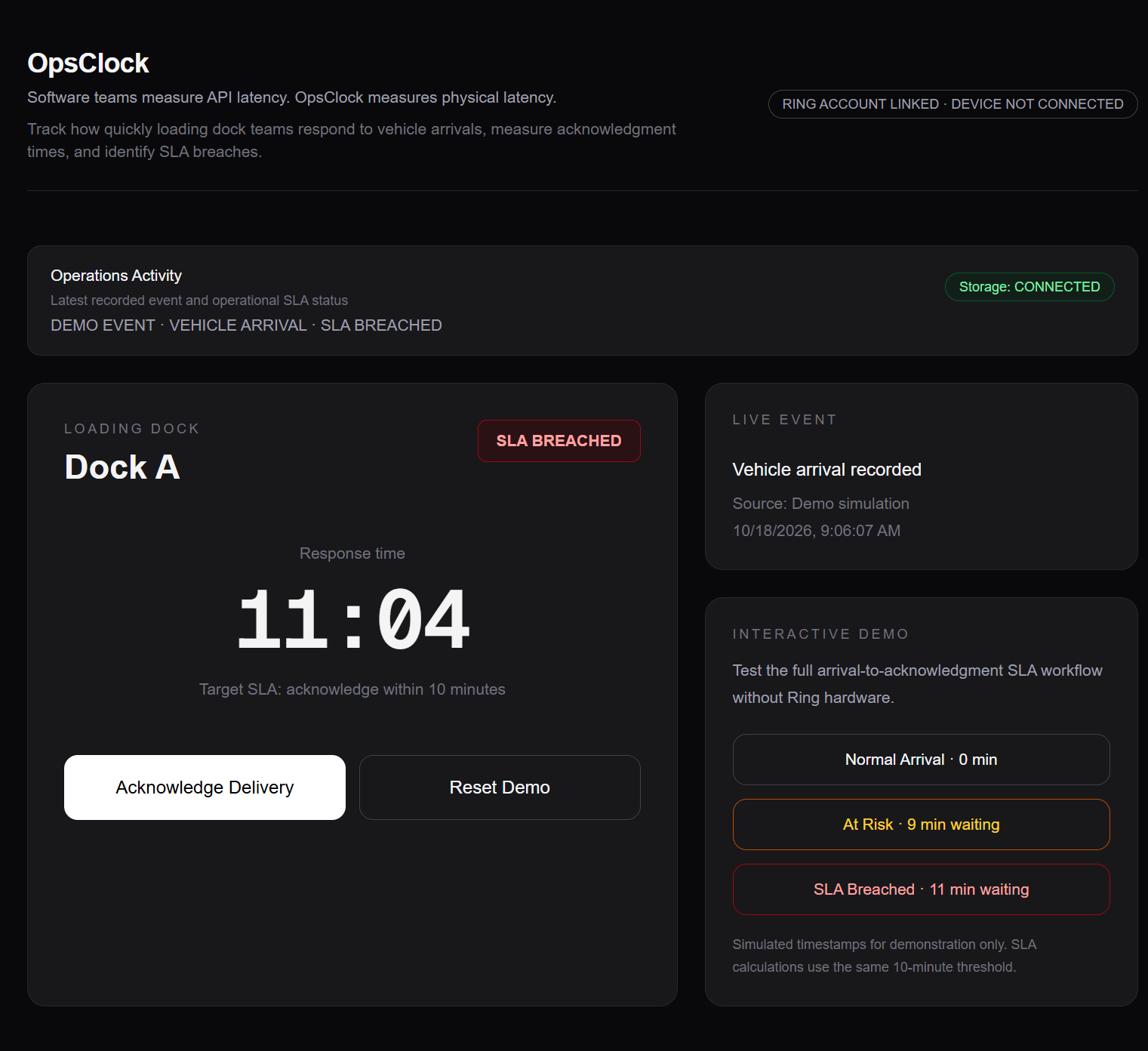
SLA Breached — Response Overdue
-
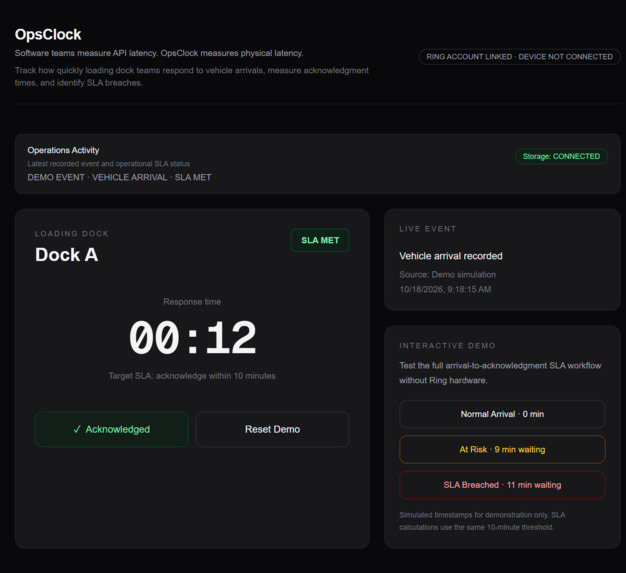
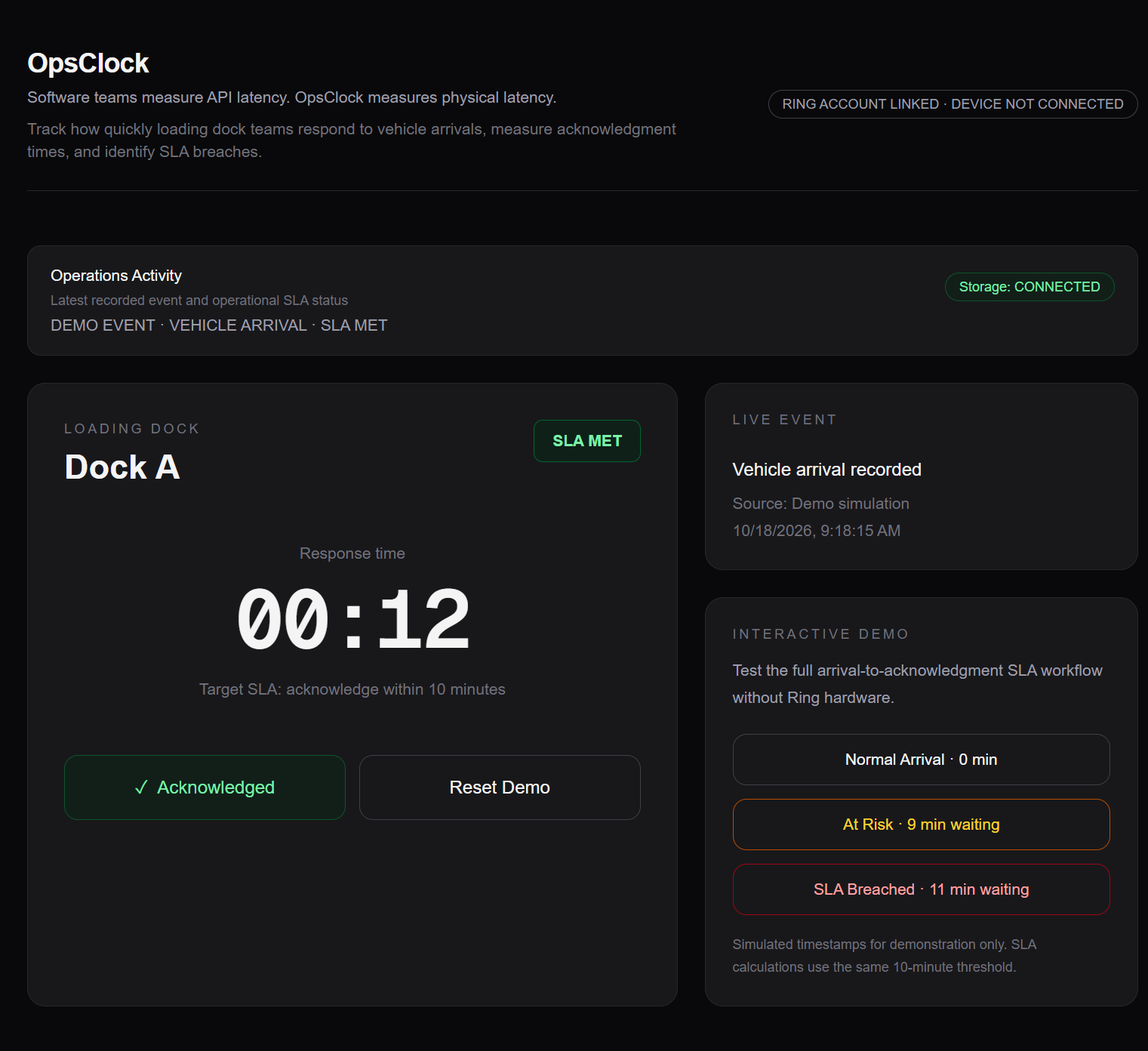
SLA Met — Acknowledged on Time
-
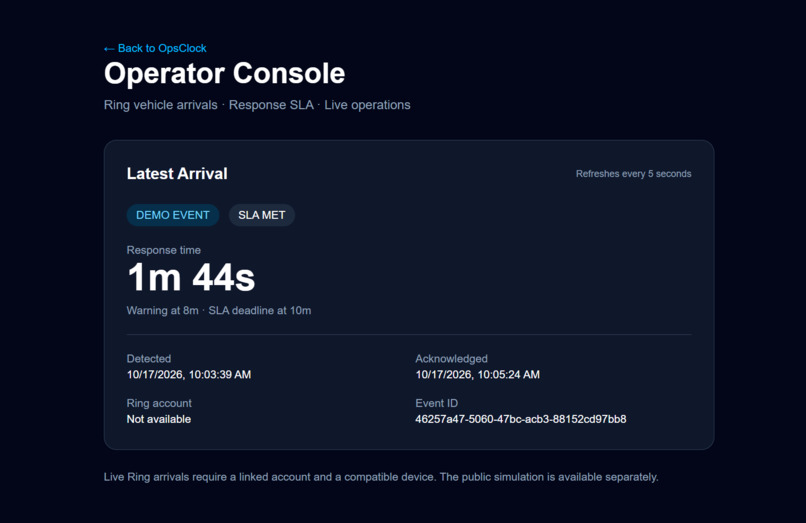
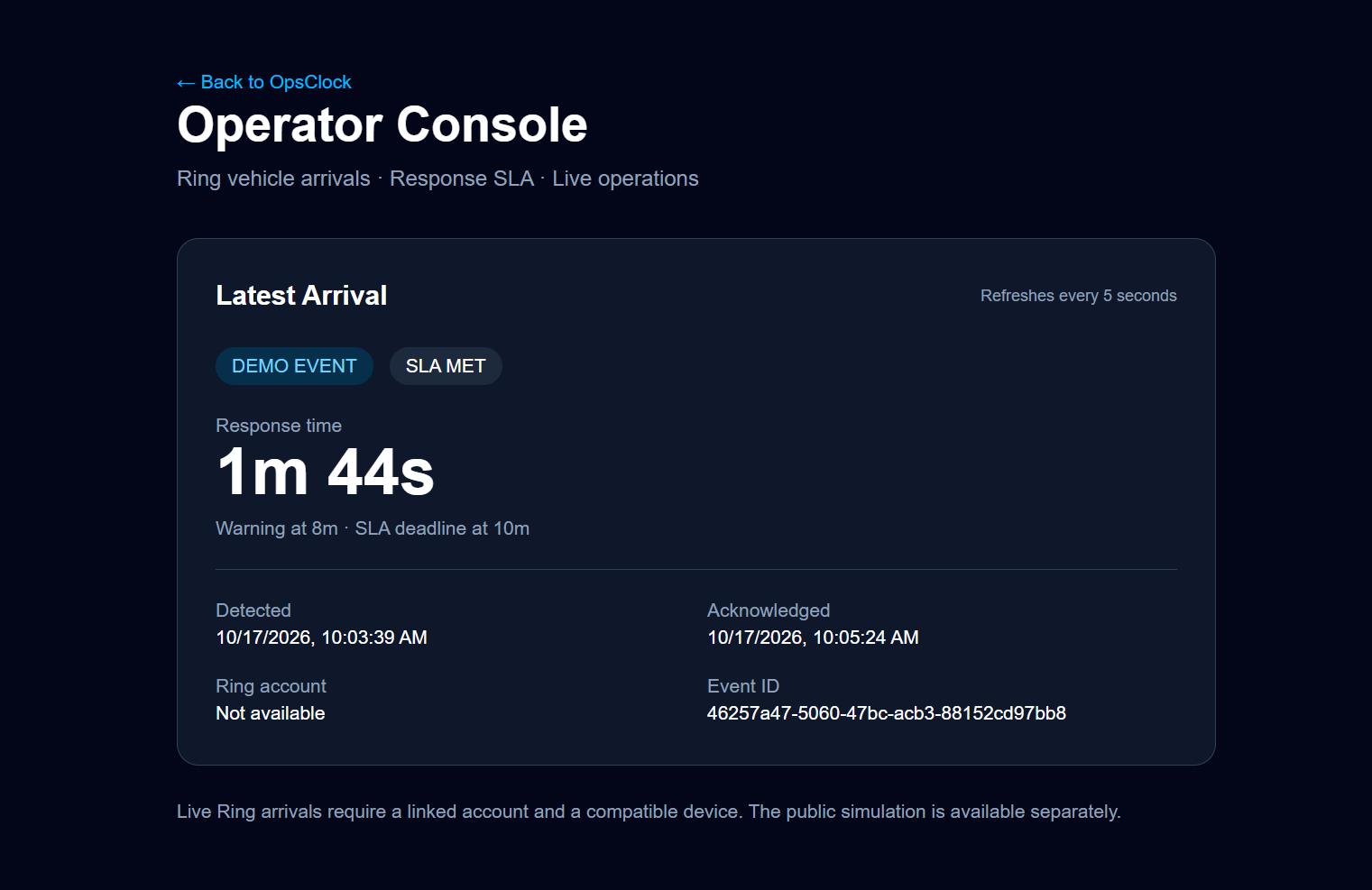
Operator Console
Inspiration
Software teams measure API latency down to milliseconds. But in physical operations, something just as important often goes unmeasured: how long does it take a team to respond when a delivery vehicle arrives?
At loading docks, delayed responses can create queues, disrupt schedules, and reduce operational efficiency. Existing camera systems can detect activity, but detection alone does not tell managers whether their teams responded on time.
We built OpsClock to bridge that gap: turning vehicle arrival signals into measurable operational response times.
What it does
OpsClock is a Ring-integrated loading dock SLA monitoring application that connects vehicle detection workflows with operator accountability.
The application provides:
- Vehicle arrival tracking: Creates timestamped operational events from supported Ring webhook payloads or interactive demo simulations.
- Live SLA monitoring: Tracks elapsed response time against a configurable operational workflow with an eight-minute warning and a ten-minute SLA deadline.
- At-risk alerts: Highlights arrivals approaching the response deadline.
- Persistent breach detection: Records SLA violations even when acknowledgment occurs after the deadline.
- Operator Console: Provides an authenticated dashboard for monitoring arrivals, response times, and SLA status.
- Acknowledgment workflow: Allows authorized operators to acknowledge pending events.
- Interactive public demo: Lets judges experience normal arrivals, at-risk conditions, SLA breaches, and acknowledgment without requiring Ring hardware.
How we built it
OpsClock uses Next.js, React, TypeScript, Tailwind CSS, Upstash Redis, and Vercel.
The Ring integration includes OAuth account linking, signed webhook verification, event validation, and idempotent event processing.
When a supported vehicle detection event is received from a linked Ring account, the backend can create a persistent SLA record. Redis provides event storage and atomic operations to prevent duplicate event creation and repeated acknowledgments.
The Operator Console uses authenticated sessions to protect operational actions. A separate public demo provides an accessible, interactive environment for judges.
The application is deployed on Vercel, allowing the public demo to remain available without a locally running development server.
Challenges we ran into
The biggest challenge was designing a reliable operational workflow around external events while keeping the system accessible to hackathon judges.
We addressed several technical problems:
- Validating webhook signatures before accepting event data.
- Preventing duplicate SLA records when webhook events are delivered repeatedly.
- Preserving SLA breaches even after late acknowledgment.
- Protecting operator actions with authentication.
- Providing a functional demo without requiring access to physical Ring hardware.
Another challenge was distinguishing implemented integration capabilities from verified physical-device behavior.
We successfully linked a Ring developer account and tested signed webhook processing using simulated payloads. However, no compatible Ring device was available for end-to-end physical event testing. We explicitly document this limitation.
Accomplishments that we're proud of
- Built and deployed a working operational SLA monitoring application.
- Implemented Ring OAuth account linking and signed webhook processing.
- Created an authenticated Operator Console.
- Added persistent, duplicate-resistant event handling.
- Built an interactive demo that judges can test immediately.
- Passed six automated tests covering SLA behavior, webhook security, and vehicle-event processing.
- Verified the public demo workflow on the deployed application.
What we learned
Building OpsClock reinforced an important lesson: detecting an event is only the beginning of an operational workflow.
To make detection actionable, teams need reliable timestamps, response tracking, clear deadlines, authenticated acknowledgment, and transparent reporting.
We also learned the importance of making integrations testable even when physical hardware is unavailable.
What's next for OpsClock
Future development could include:
- End-to-end validation with compatible Ring hardware.
- Multi-location and multi-operator management.
- Historical SLA analytics and reporting.
- Notifications and escalation workflows.
- Integrations with warehouse management systems.
Our long-term vision is to make physical operational response times as measurable and actionable as software performance metrics.
OpsClock — Every response matters. Every second counts.
Built With
- api
- css
- next.js
- react
- redis
- ring
- tailwind
- typescript
- upstash
- vercel
- webhooks

Log in or sign up for Devpost to join the conversation.