-
-
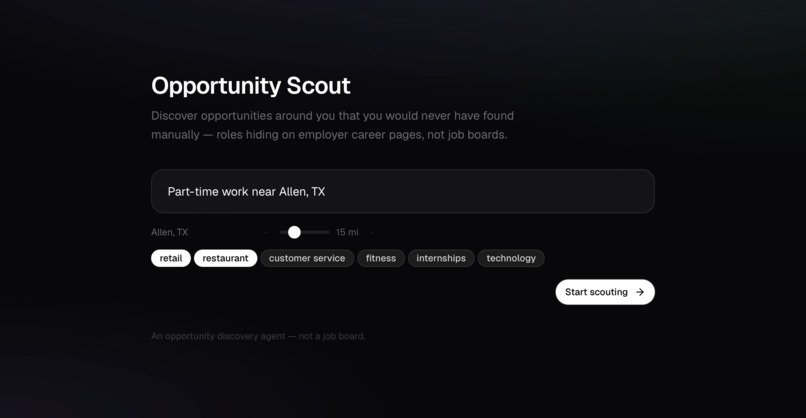
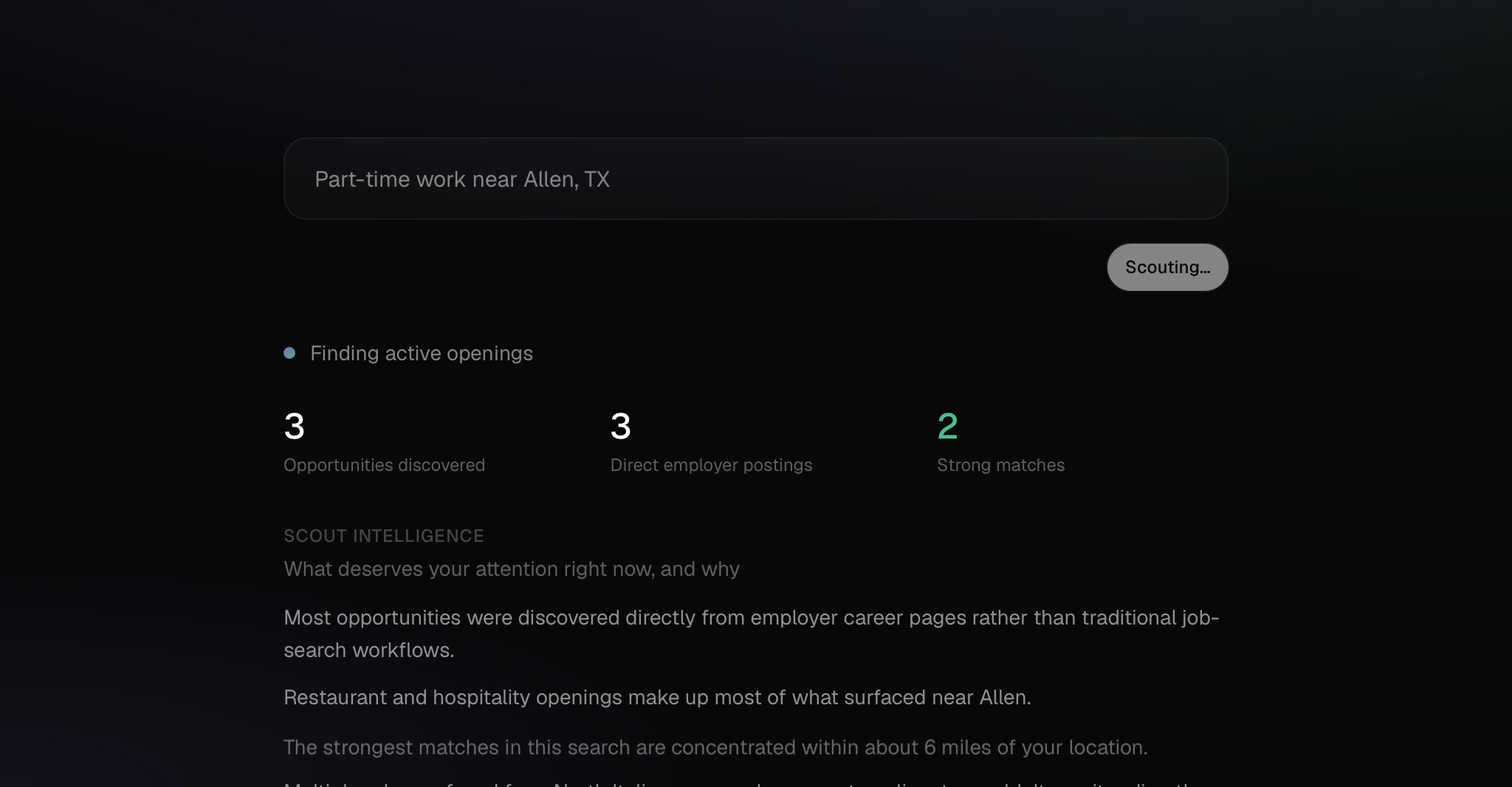
Opportunity Scout Search Interface
-
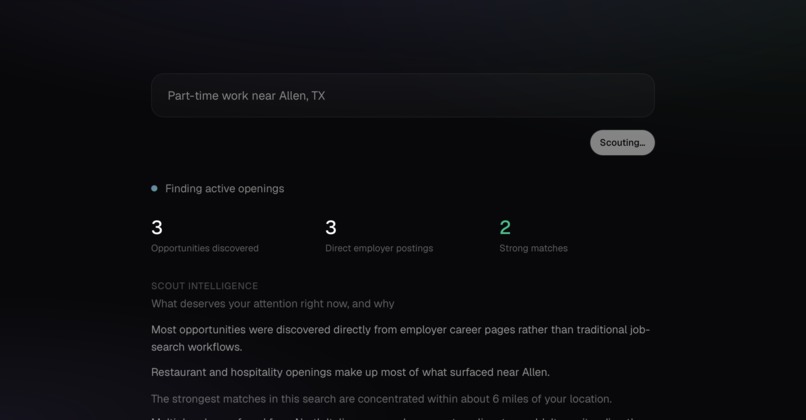
Multi-Step Opportunity Discovery Workflow
-
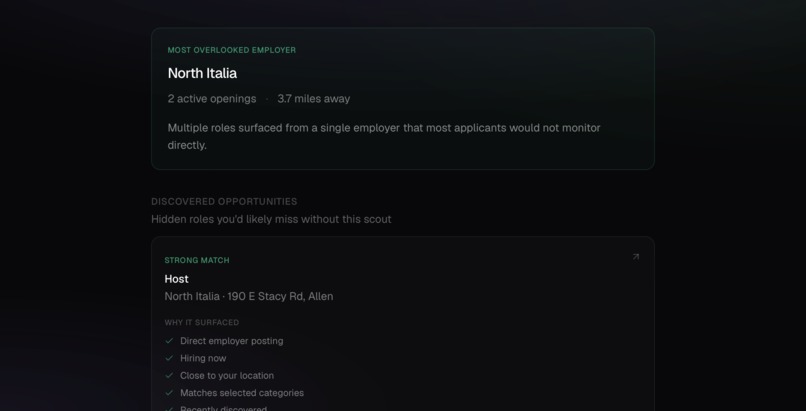
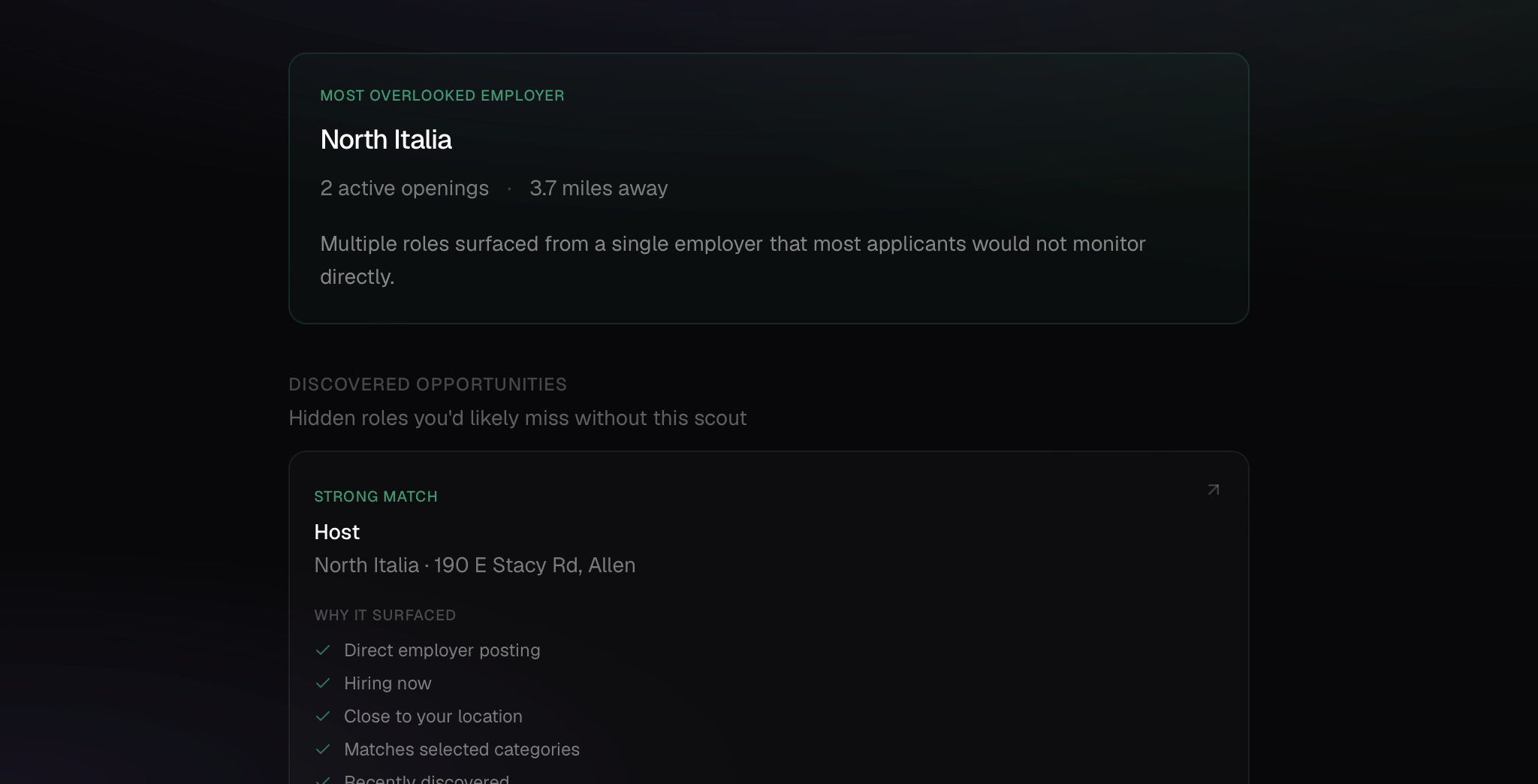
Ranked Opportunities Discovered From Employer Career Pages
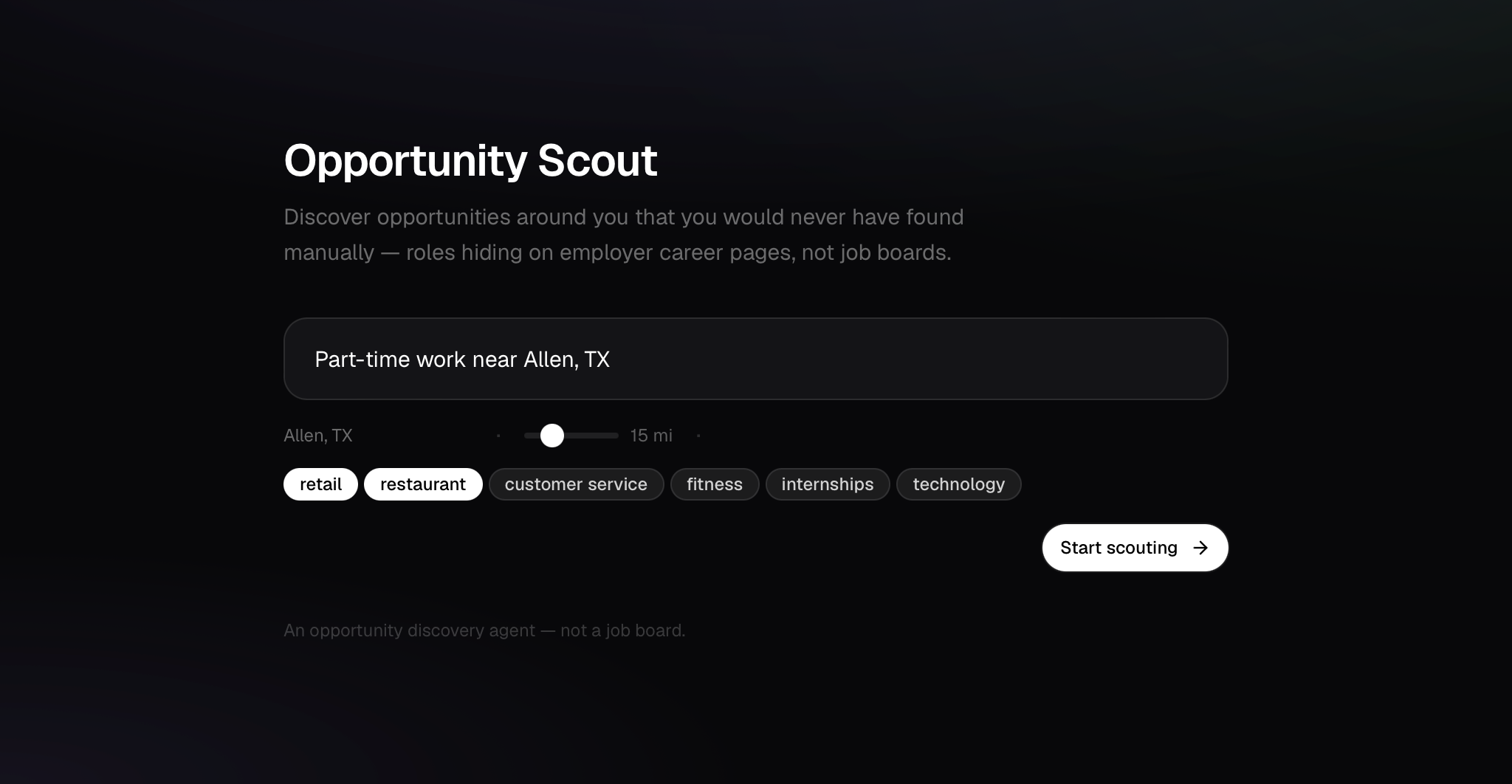
Opportunity Scout
Inspiration
Most job seekers rely on platforms like Indeed and LinkedIn, but many opportunities never make it to major job boards. Throughout my own job search, I repeatedly found opportunities by manually checking company career pages that I would not have discovered otherwise. Roles at local businesses, internships, student programs, and niche opportunities were often posted only on employer websites.
This inspired Opportunity Scout: an AI-powered agent that automatically researches employers, scans career pages, identifies hiring signals, and surfaces opportunities that traditional job-search workflows miss.
The goal is simple: help people discover opportunities they never would have found on their own.
What it does
Opportunity Scout acts as an autonomous scouting agent.
Users provide a location, search radius, and categories of interest. The system then:
- Discovers relevant employers
- Locates career pages
- Detects hiring signals
- Extracts opportunities
- Ranks opportunities by relevance
- Persists scouting sessions to MongoDB Atlas through MongoDB MCP
Instead of searching job boards, users receive a curated list of opportunities discovered directly from employer career pages.
How we built it
The project consists of three main layers:
Frontend
- Next.js
- React
- Streaming workflow UI
- Opportunity ranking and reporting interface
Agent Layer
We built an AI agent using Google's Agent Development Kit (ADK) and Gemini.
The agent orchestrates the scouting workflow by:
- Running employer discovery
- Collecting opportunity intelligence
- Managing workflow execution
- Saving results through MongoDB MCP
Data & Persistence
MongoDB Atlas serves as the persistence layer.
To satisfy the MongoDB challenge requirements, we integrated MongoDB MCP (Model Context Protocol). After each scouting session completes, the ADK agent uses MongoDB MCP to insert session data into MongoDB Atlas.
This creates a persistent record of employer research, opportunities found, and scouting reports.
Challenges we ran into
The largest challenge was integrating MongoDB MCP with the ADK runtime.
The scouting workflow worked early, but MCP tool execution introduced asynchronous runtime issues because ADK executes tools inside an active event loop. This caused failures when attempting to use nested asyncio execution.
We solved this by moving MCP operations into a dedicated worker thread and creating a safe execution path for both direct scripts and ADK tool calls.
Another challenge was maintaining compatibility with the existing application while introducing the agent architecture. Instead of rebuilding the product, we created an ADK orchestration layer that could call the existing scouting workflow and then persist results through MongoDB MCP.
This allowed us to integrate modern agent tooling without rewriting the entire application.
What we learned
This project taught us several important lessons:
- Many valuable opportunities exist outside traditional job boards.
- Agent architectures are most useful when coordinating multiple systems rather than replacing them.
- MCP provides a clean way for agents to interact with external services and databases.
- The hardest part of building AI products is often orchestration and reliability, not model intelligence.
We also gained hands-on experience working with:
- Google ADK
- Gemini
- MongoDB MCP
- MongoDB Atlas
- Next.js
- Agent workflows
- Event-driven application architecture
What's next
Future versions of Opportunity Scout will focus on improving data freshness, expanding beyond local jobs into internships and programs, and introducing community verification signals so users can confirm whether opportunities are still active.
Long-term, we believe opportunity discovery should extend beyond job boards and become a proactive, agent-driven process.
Opportunity Scout is our first step toward that vision.
Built With
- gemini
- google-adk
- mongodb-atlas
- mongodb-mcp
- next.js
- python
- react
- typescript
- vercel

Log in or sign up for Devpost to join the conversation.