-
-
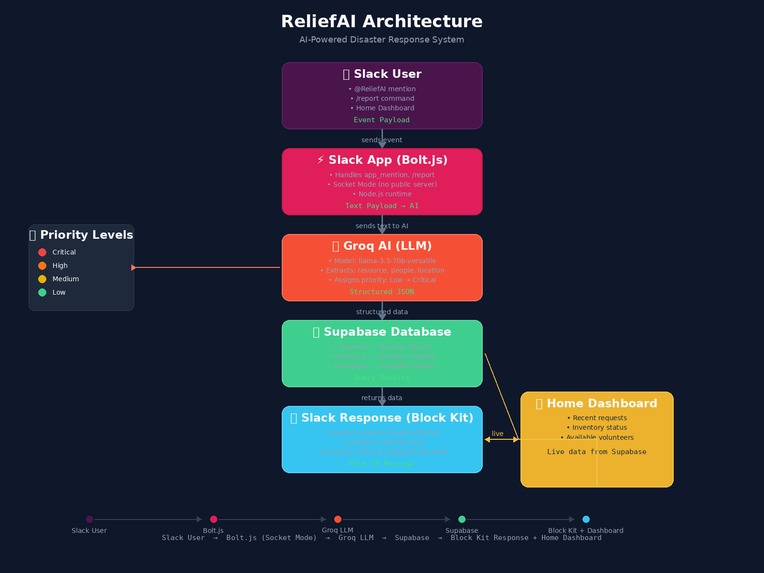
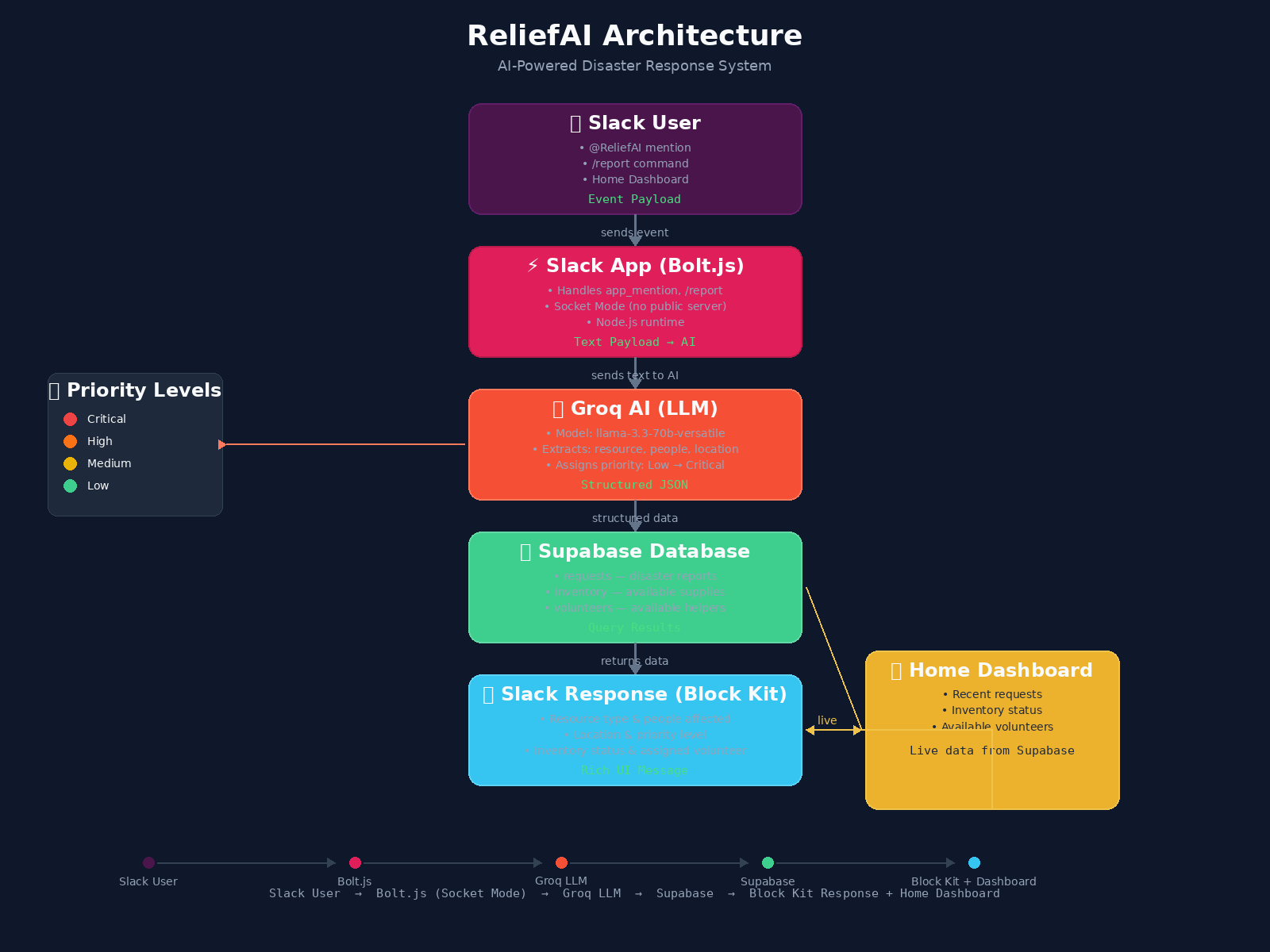
Architecture
Inspiration
What it does
How we built it
Challenges we ran into
About ReliefAI
Inspiration
Natural disasters such as floods, earthquakes, cyclones, and wildfires often overwhelm relief organizations with hundreds of requests for food, water, medical aid, and shelter. Much of this coordination still happens manually through phone calls, spreadsheets, and scattered messages, making it difficult to prioritize emergencies and respond quickly.
We wanted to build an AI-powered Slack agent that helps humanitarian organizations coordinate relief efforts more efficiently by automating request triage, volunteer assignment, and operational updates—all within Slack.
What it does
ReliefAI is an intelligent disaster response assistant built for Slack that helps nonprofits, emergency response teams, and volunteer organizations manage relief operations in real time.
Key capabilities include:
- Automatically analyzes incoming disaster reports using Slack AI.
- Extracts important details such as location, resource type, urgency, and number of people affected.
- Prioritizes requests based on severity.
- Assigns available volunteers to high-priority incidents.
- Connects to external inventory systems through an MCP server to check the availability of food, water, blankets, medicines, and other supplies.
- Uses the Real-Time Search API to provide the latest weather alerts, government advisories, and emergency updates.
- Generates AI-powered daily summaries of completed tasks, pending requests, volunteer activity, and resource usage.
By bringing communication, AI assistance, and operational data together in Slack, ReliefAI enables faster and more organized disaster response.
How we built it
- Slack App and Slack Agent
- Slack AI capabilities for intelligent understanding and summarization
- MCP server integration for inventory and resource management
- Real-Time Search API for live emergency information
- Backend built with Node.js (or Python) and a cloud database for storing requests, volunteers, and operational data
Challenges we ran into
One of the biggest challenges was designing workflows that accurately prioritize emergency requests while keeping interactions simple for volunteers. Integrating AI reasoning with external data sources and ensuring that responses remained clear and actionable also required careful planning.
Accomplishments that we're proud of
- Built an AI-powered Slack agent focused on real-world humanitarian impact.
- Automated disaster request classification and prioritization.
- Integrated external systems through MCP for resource tracking.
- Added live emergency intelligence using real-time search.
- Created a seamless workflow that helps organizations coordinate volunteers and relief efforts more efficiently.
What we learned
This project reinforced how conversational AI can simplify complex operational workflows. We also gained valuable experience integrating Slack's agentic capabilities with external services to build a practical solution that supports mission-driven organizations.
What's next for ReliefAI
Future improvements include:
- GIS-based mapping of incidents and volunteer locations.
- Multi-language support for disaster reporting.
- SMS and WhatsApp integration for communities without Slack access.
- Predictive analytics for estimating resource shortages.
- Integration with emergency management systems and nonprofit platforms.
- Offline reporting capabilities for areas with limited internet connectivity.
Our vision is to make ReliefAI a scalable coordination platform that helps humanitarian organizations respond to disasters faster, more accurately, and with greater confidence.

Log in or sign up for Devpost to join the conversation.