-
-
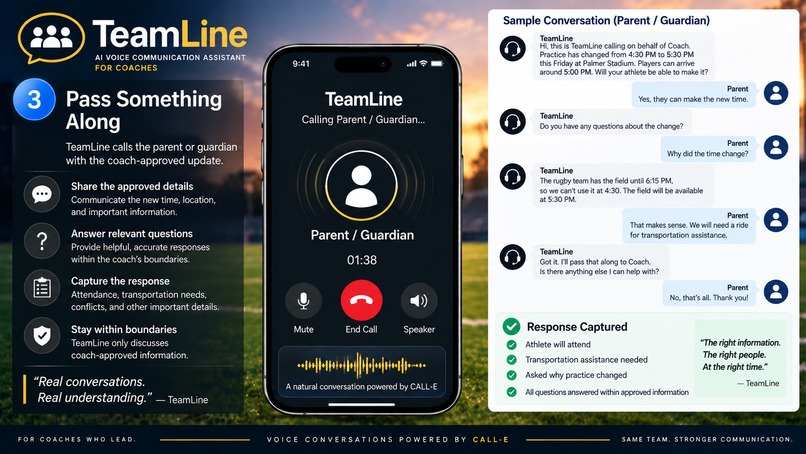
TeamLine uses CALL-E for natural two-way voice conversations while staying within the coach's authorization.
-
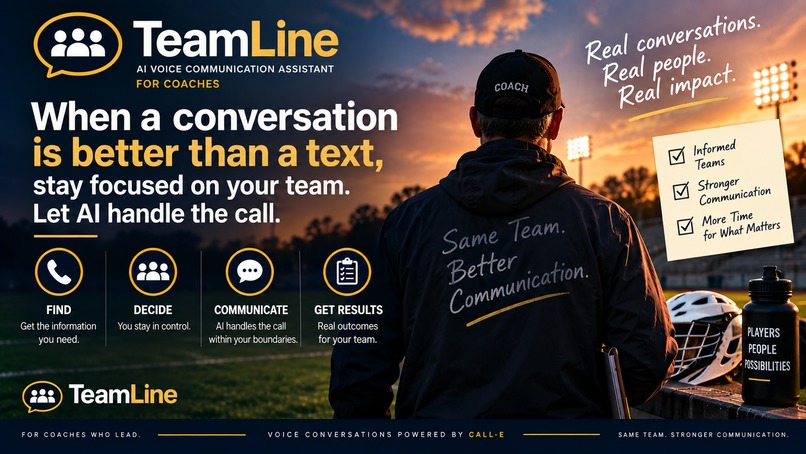
TeamLine turns moments that need two-way communication into coach-authorized AI voice conversations.
-
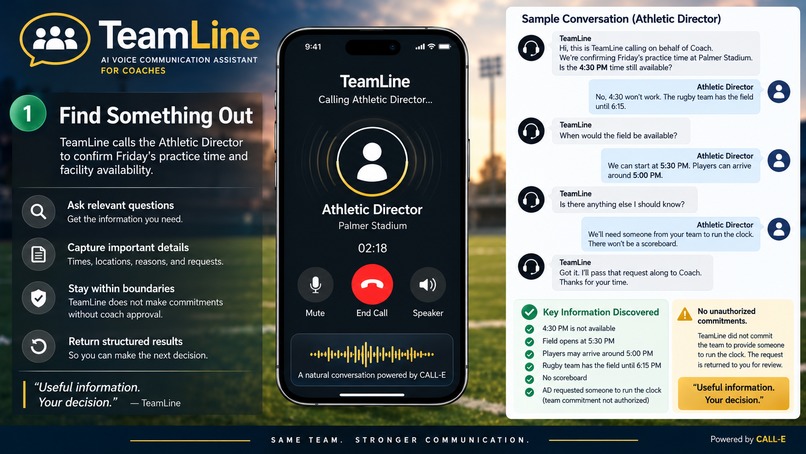
After approval, TeamLine can communicate the decision and capture actionable responses from the recipient.
-
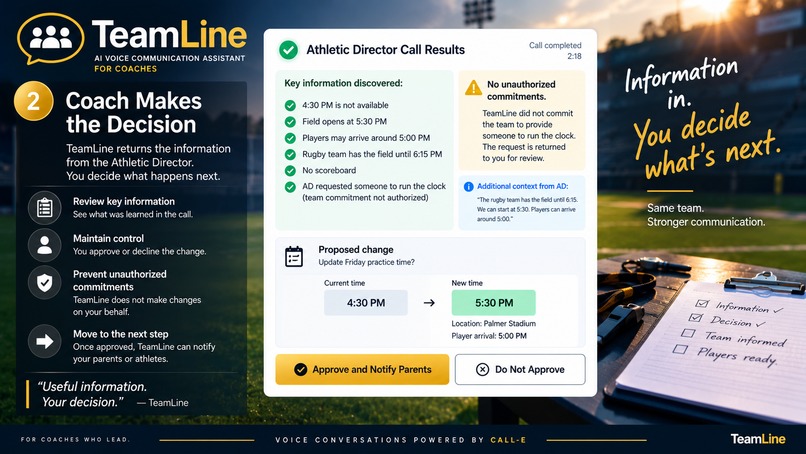
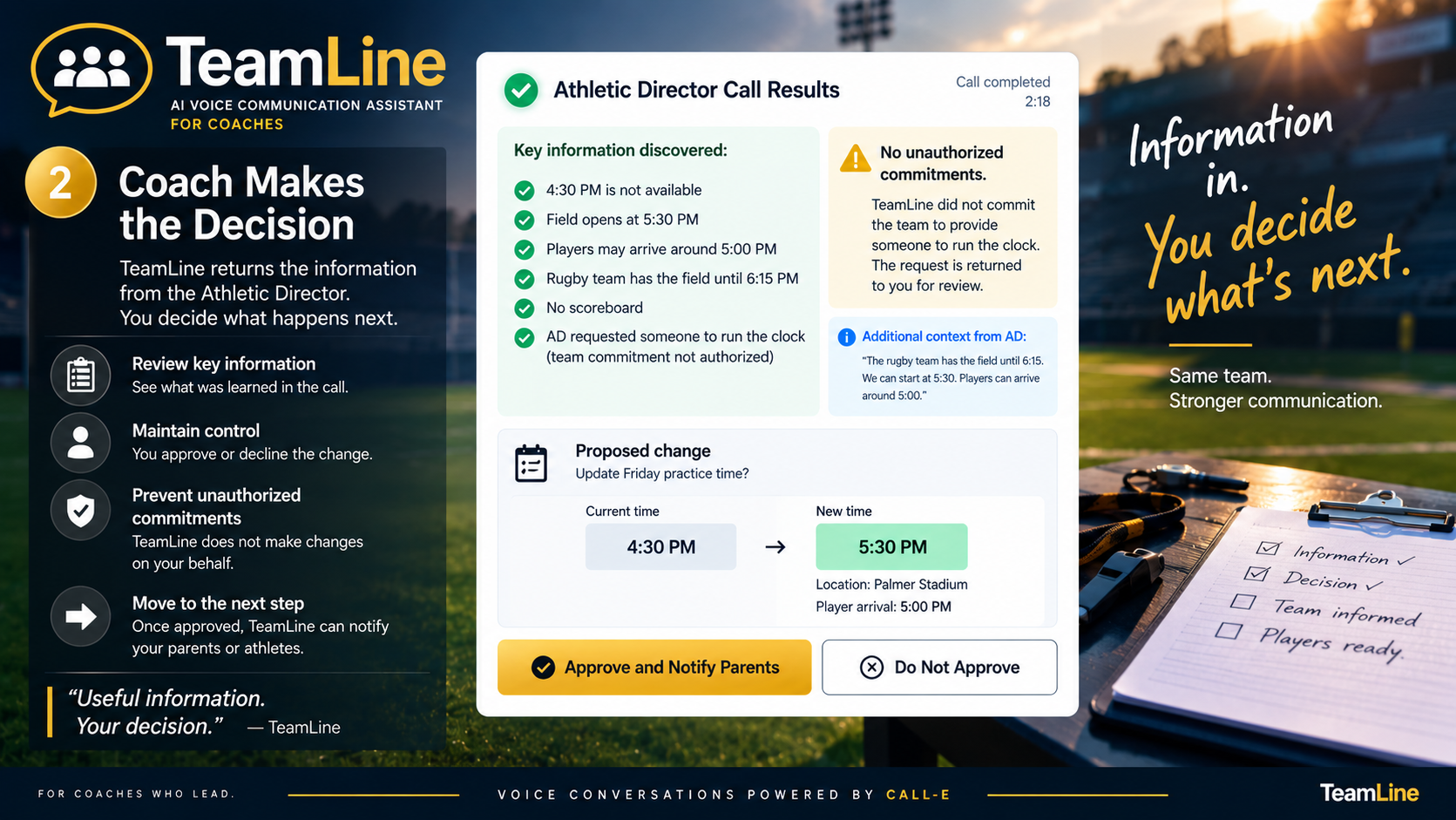
When a decision exceeds TeamLine's authority, it returns to the coach for explicit human approval.
-
Capture the situation, define the boundaries, and give TeamLine a clear communication assignment.
-
TeamLine turns moments that need two-way communication into coach-authorized AI voice conversations.
Inspiration
I am a teacher and lacrosse coach, and team communication is a constant part of coaching. Texts and notifications work well when information only needs to move in one direction. But some situations require more than delivery. You need an answer, clarification, confirmation, or information you can act on.
That led to a simple idea:
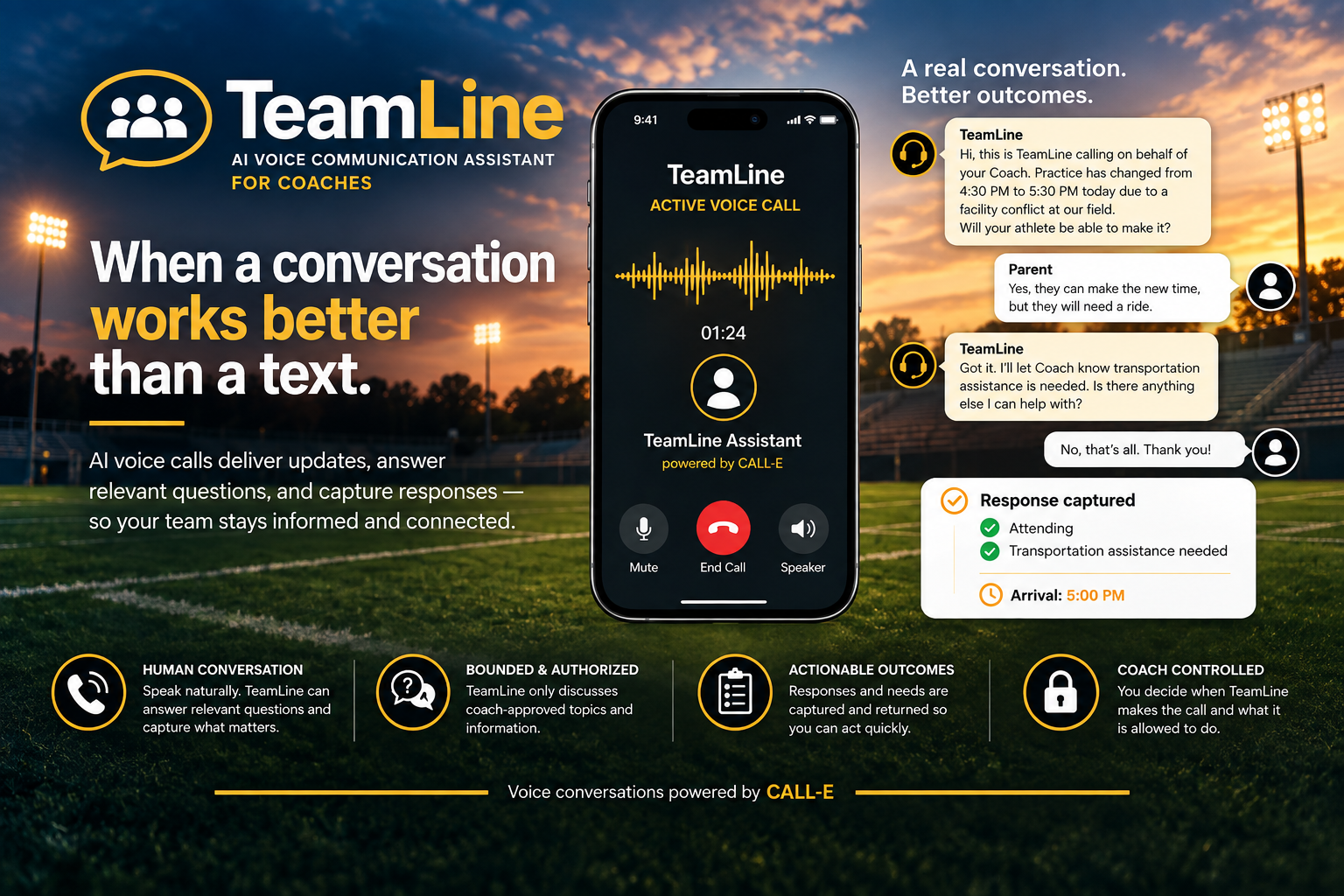
When a conversation works better than a text, use a conversation.
The CALL-E Hackathon gave me the opportunity to build that idea into TeamLine: an AI voice communication assistant that can handle a bounded conversation for a coach while keeping the coach in control.
What it does
TeamLine supports two complementary communication jobs:
Find something out.
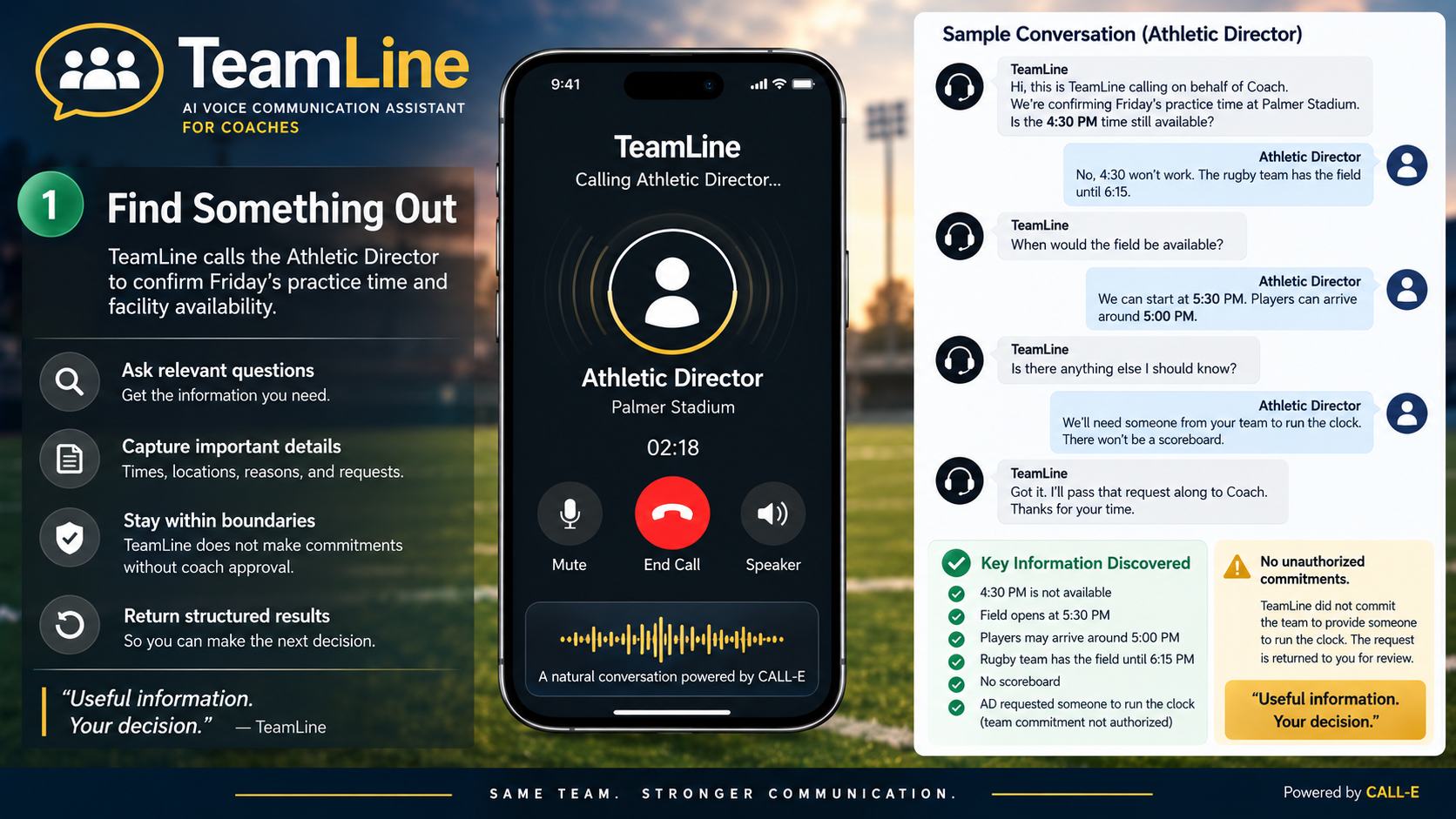
A coach can authorize TeamLine to call someone and gather specific information. TeamLine can ask questions, listen to natural responses, clarify relevant details, and return structured results to the coach.
Pass something along.
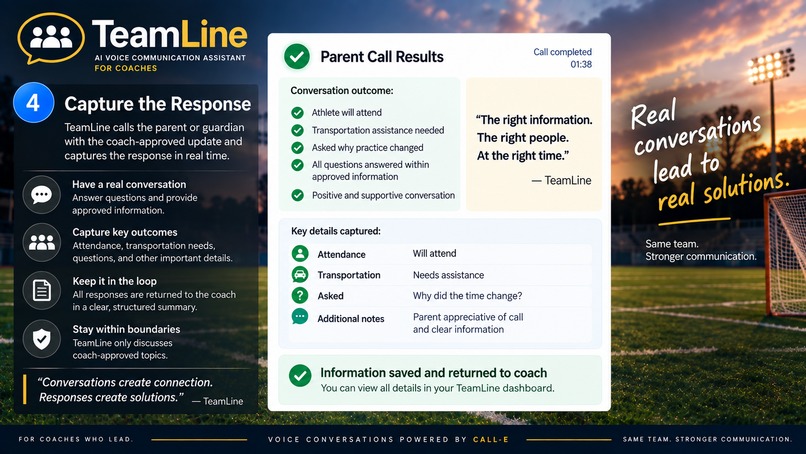
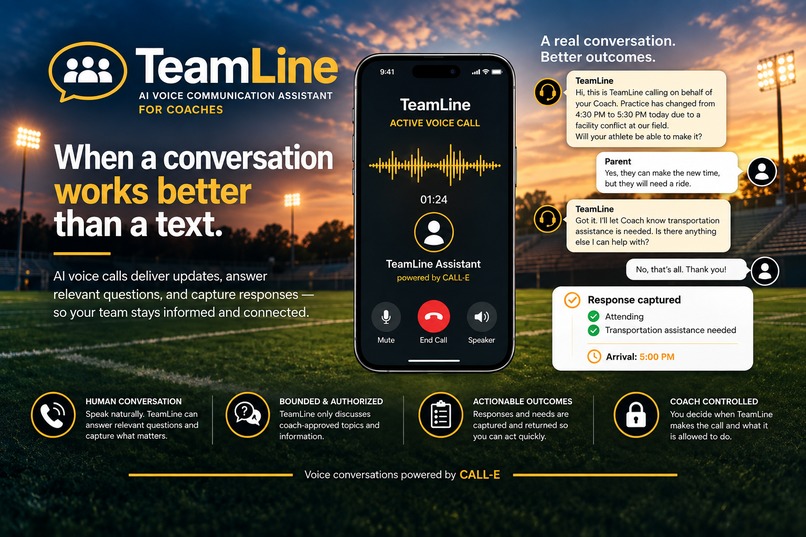
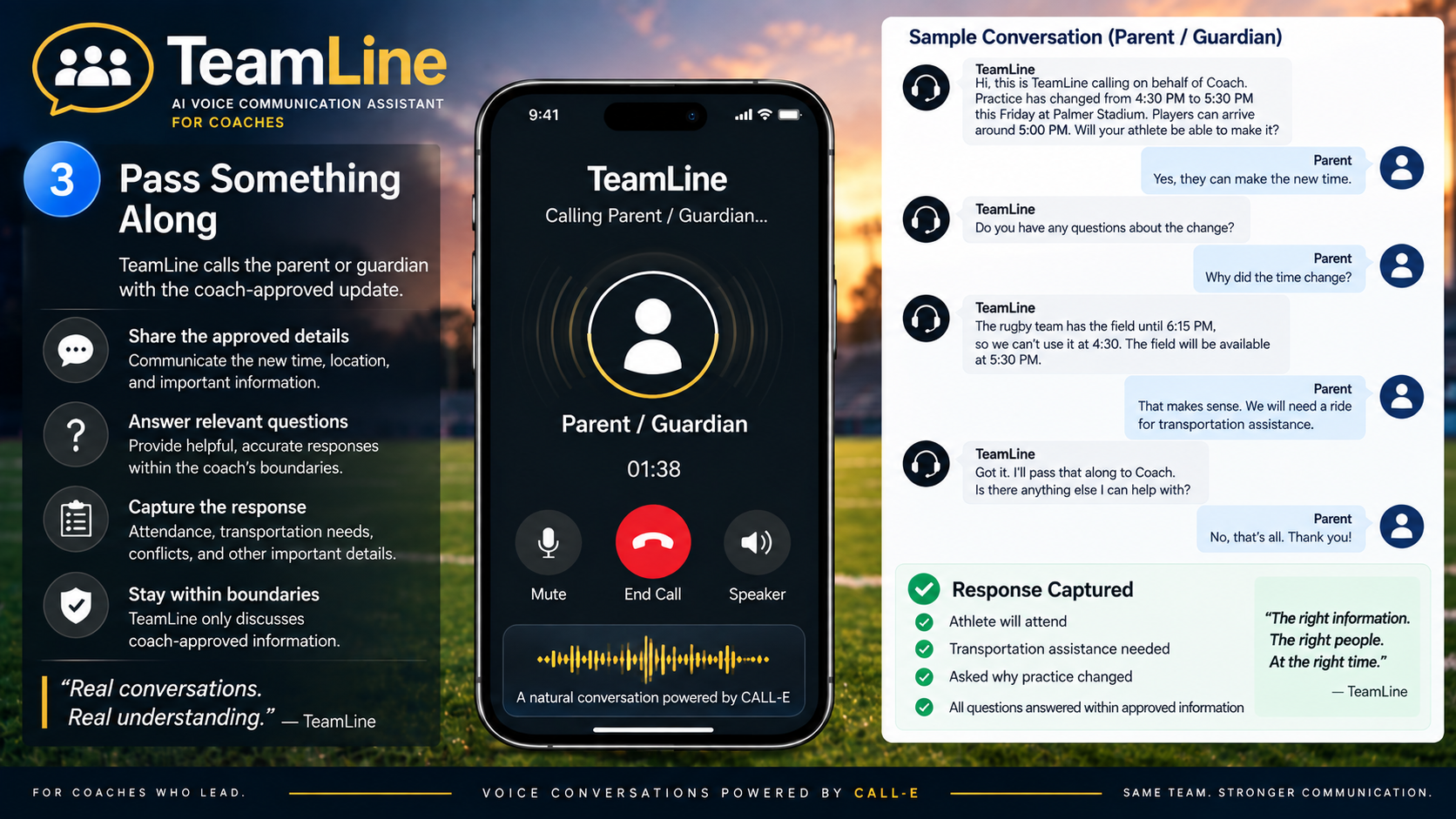
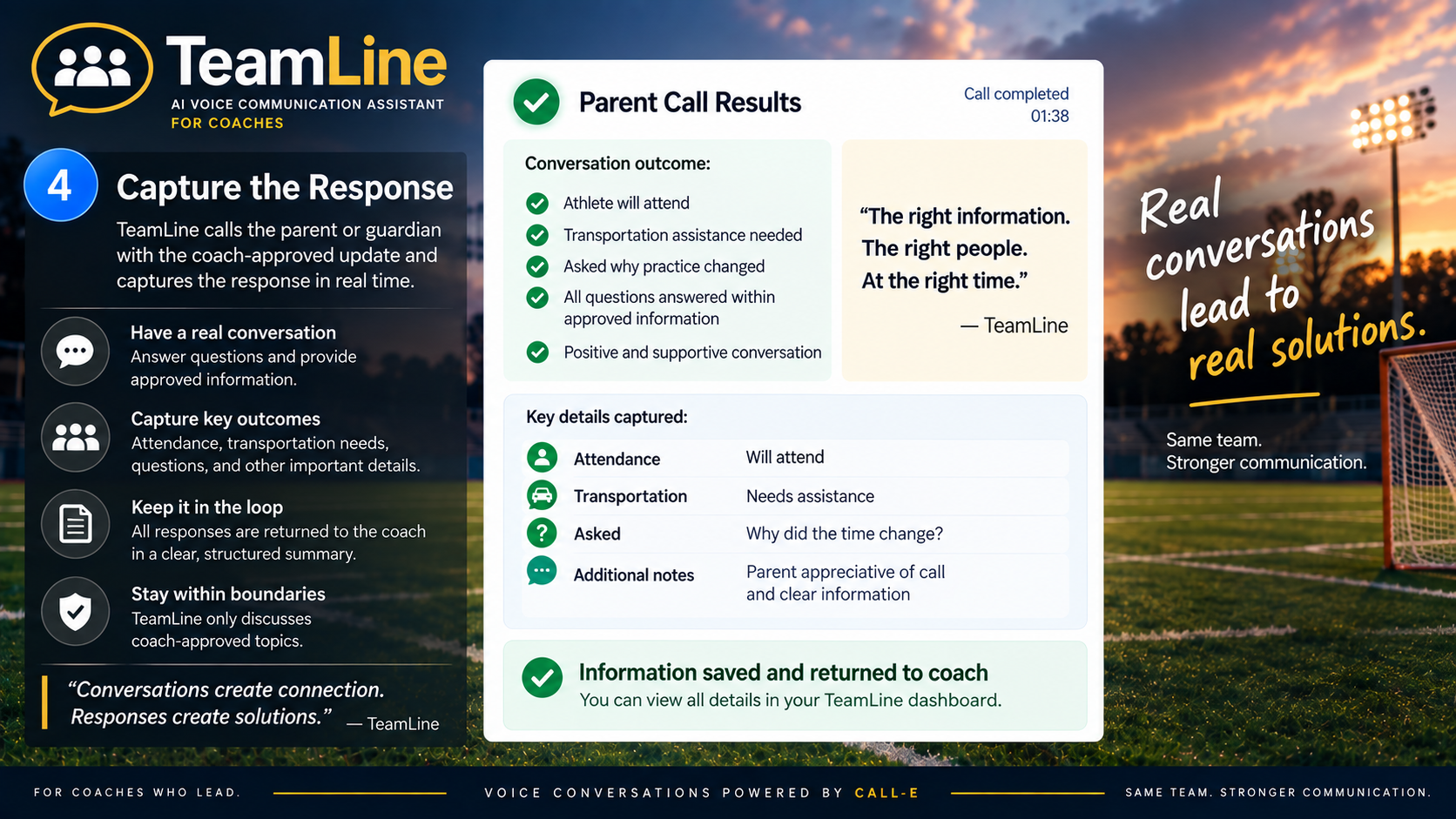
After the coach makes a decision, TeamLine can communicate the approved information through a voice conversation, answer relevant questions within its authorized boundaries, and capture actionable responses.
Our demonstration connects both workflows.
TeamLine contacts an athletic director to determine whether a practice facility is available. It gathers the relevant facts and returns them to the coach. When the conversation produces a request outside TeamLine's authority, TeamLine does not make a commitment. It returns the request to the coach.
The coach then explicitly approves the practice change.
TeamLine can then call a parent or guardian, communicate the approved change, answer relevant questions, and capture outcomes such as attendance or a transportation need.
The result is a simple loop:
Find out → Coach decides → Communicate → Capture the response.
How we built it
TeamLine uses the CALL-E API for natural AI-powered phone conversations.
The application creates bounded call assignments and sends them to CALL-E. Rather than treating the phone call as the final output, TeamLine uses structured result schemas to turn the conversation into information the coach can review and act on.
The workflow includes:
- Natural two-way AI voice conversations powered by CALL-E
- Coach-defined communication boundaries
- Structured result capture
- Explicit human approval before consequential changes
- Escalation of requests outside TeamLine's authority
- Separate information-gathering and information-delivery workflows
- Judge-entered phone numbers for the competition demonstration
- Server-side handling of CALL-E credentials
The competition interface is designed specifically to make the complete workflow easy to understand and test.
Challenges we ran into
One of the biggest design challenges was deciding how much authority the AI should have.
A natural conversation can go somewhere the coach did not anticipate. During testing, an athletic director could provide the requested facility information and then ask TeamLine to provide someone to operate a scoreboard. TeamLine needed to recognize that the request was useful but outside the authority it had been given.
That became an important design principle:
Conversation can be flexible. Authority cannot be assumed.
We also worked through practical challenges involving call state, result retrieval, unanswered calls, retry behavior, structured data extraction, duplicate-call protection, and keeping phone numbers and API credentials appropriately protected.
What we learned
The most important lesson was that an AI phone call becomes much more useful when it is treated as part of a decision workflow rather than as an isolated call.
The conversation itself can be natural and flexible. The authority surrounding it can still be explicit and bounded.
CALL-E made it possible to combine those two ideas: let AI conduct a useful conversation while returning meaningful decisions to the human responsible for making them.
What's next for TeamLine
TeamLine could support many recurring coaching situations where a response matters: schedule changes, facility coordination, transportation, attendance, event logistics, volunteer needs, and other time-sensitive communication.
The broader opportunity is not to replace coaches or human relationships. It is to give coaches another communication tool for situations where sending another message is not enough.
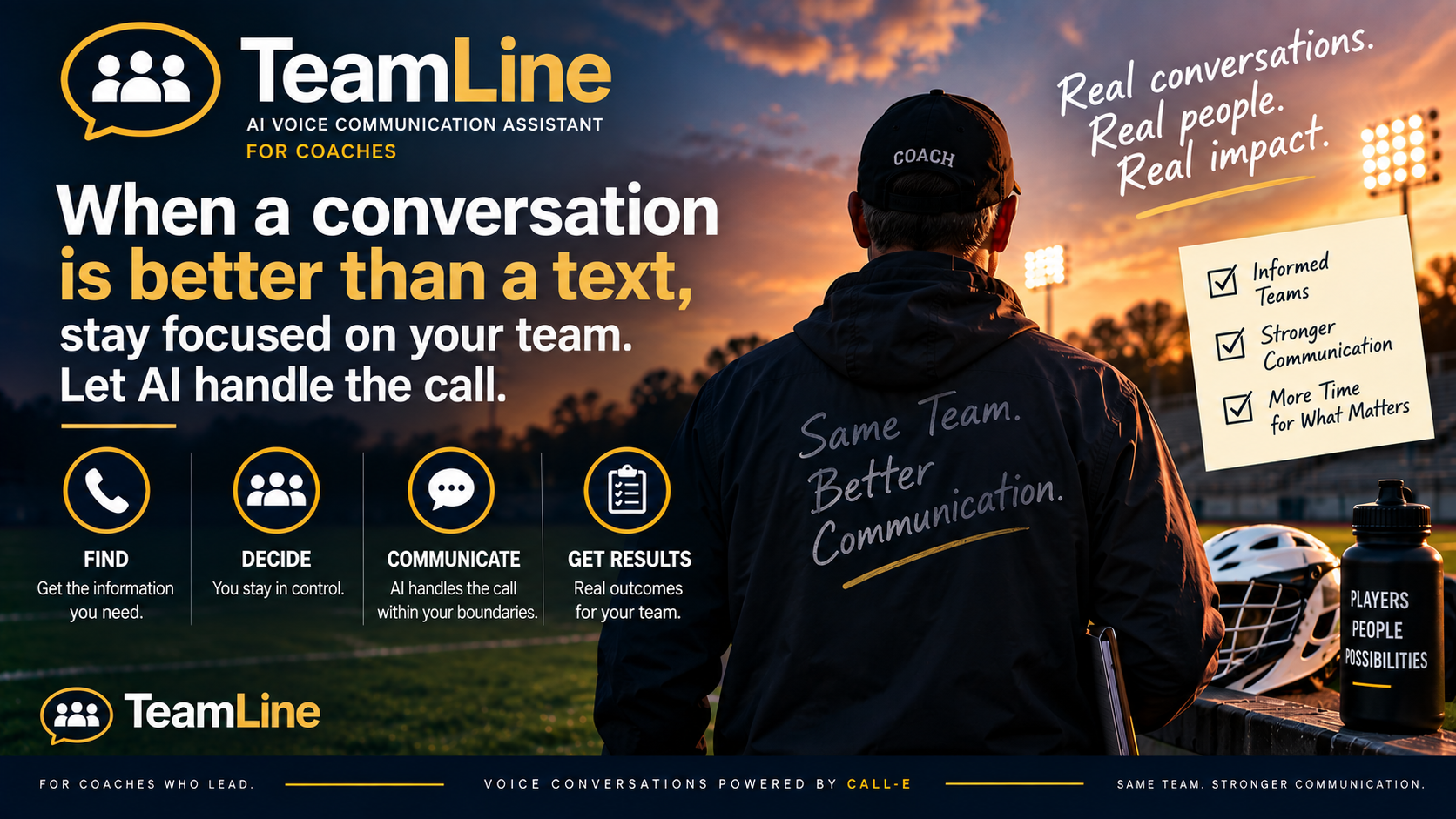
When a conversation is better than a text, stay focused on your team. Let AI handle the call.ion
What it does
How we built it
Challenges we ran into
Accomplishments that we're proud of
What we learned
What's next for TeamLine — AI Voice Communication for Coaches
Built With
- call-e
- netlify
- react
- typescript

Log in or sign up for Devpost to join the conversation.