Inspiration
The success of the global market depends on modern warehouses, but they remain largely reliant on people performing the same tasks for sorting and moving products. Our ideas came from superconductors, autonomous cars and groups of small robots. We aimed to create a robot that could be used in warehouses by adapting future technology so that it remains practical and could be expanded as needed. The RoboSort Mini (Lite) is leading toward fully automated warehouse work, by lifting one product at a time.
What it does
RoboSort Mini is small enough to fit inside a warehouse while it uses HOVER™ alloy to travel smoothly over floor covered by HOVER™ alloy. The drone maps the area using LiDAR, decides what to do with AI and relays data to a central server to coordinate with other bots. The Lite version is also missing the robotic arm, but it is very energy efficient and can still help in accurately managing and sorting your bins.
How we built it
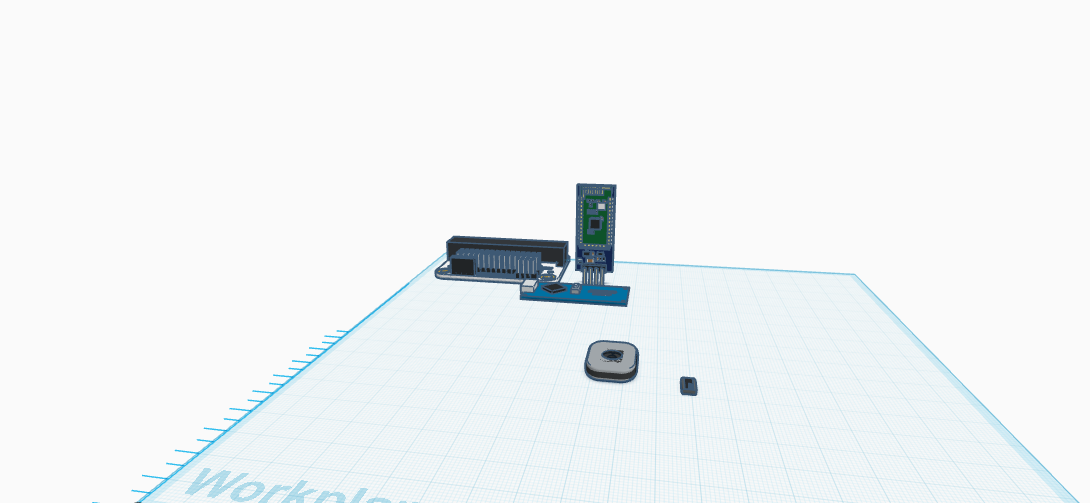
With TinkerCAD, we carefully designed the RoboSort Mini’s hover base, CPU, sensors and its system of modules. Our main emphasis was on having an efficient layout, a compact size and realism. We explored the integration of LiDAR, AI pathfinding and cloud syncing with what quantum computing and superconductors might offer in a near-future setting. Since the main task was CAD and conceptual design, nothing was built.
Challenges we ran into
One of the hardest parts was designing something plausible and detailed while working with time pressure. The design system made it necessary for us to adjust parts such as the robotic arm, as we had little knowledge on assembly and modeling. It wasn’t easy to make the robot’s moves futuristically exciting while still ensuring they were possible using technology available today.
Accomplishments that we're proud of
We are happy to have developed a robot that looks stylish and is equipped for tomorrow’s logistics. Working on the hover tech, AI, LiDAR and power supply together and creating a cohesive structure in just a short time was truly challenging for us. Another thing I am proud of is how we crafted such an in-depth view of how the robot would operate in a logistics warehouse.
What we learned
I learned how to quickly solve problems and come up with creative solutions with the aid of new technologies. CAD modeling, planning major operations and storytelling allowed us to share new ideas with others more effectively. During this project, we learned more about current trends in warehouse automation and how new technologies might influence them.
What's next for Ophis RoboSort Mini (Lite Version CAD)
The subsequently important task is to build up some key sub-systems with actual parts, first with a hover system or temporary wheels. It would be useful to create a simulation to test both AI pathfinding and LiDAR mapping in virtual warehouse settings. The full edition of RoboSort could add arms for robots, more sensors and a smart touchscreen display. In the future, we plan to construct a swarm simulation using a quantum server to present how warehouse automation can work in real time.

Log in or sign up for Devpost to join the conversation.