-
-
-
-
-
-
-
-
-
-
-
-
Ophi vs the Status Quo
-
An annotated case
-
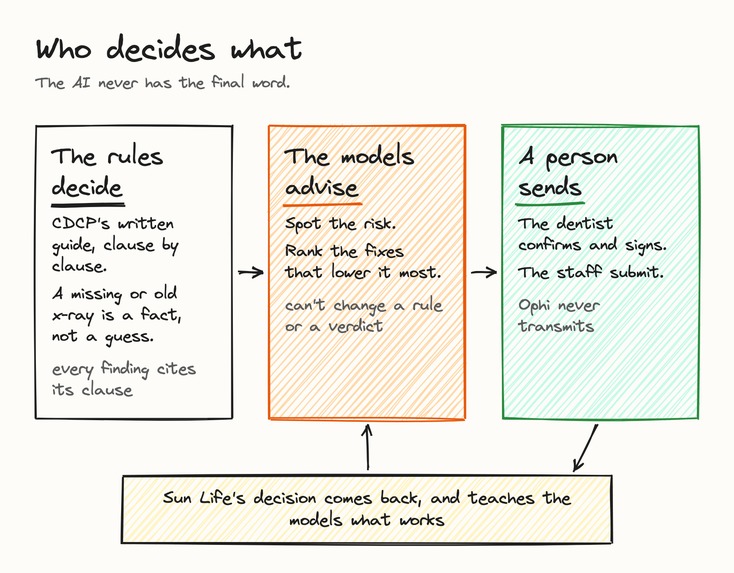
The AI model loop
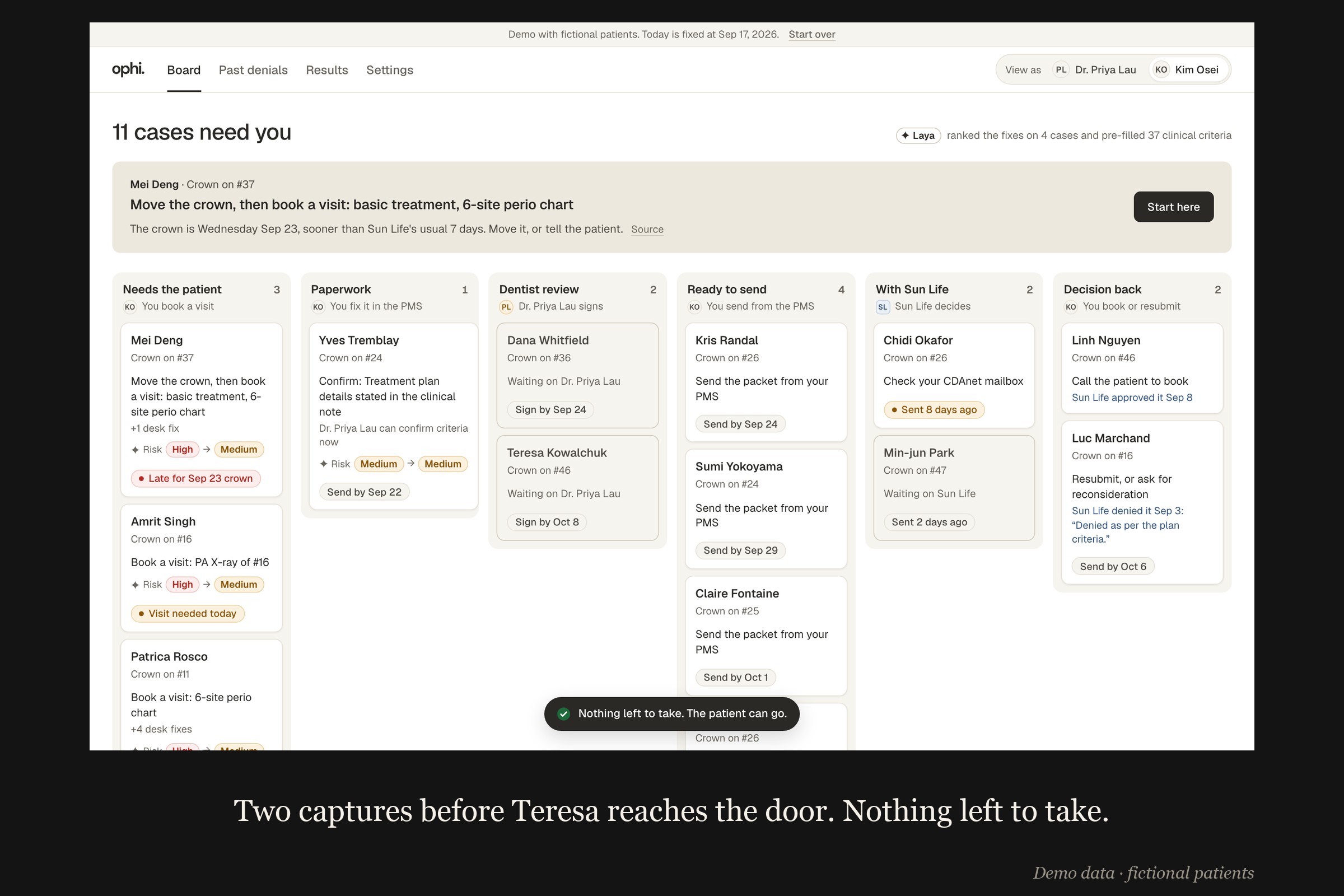
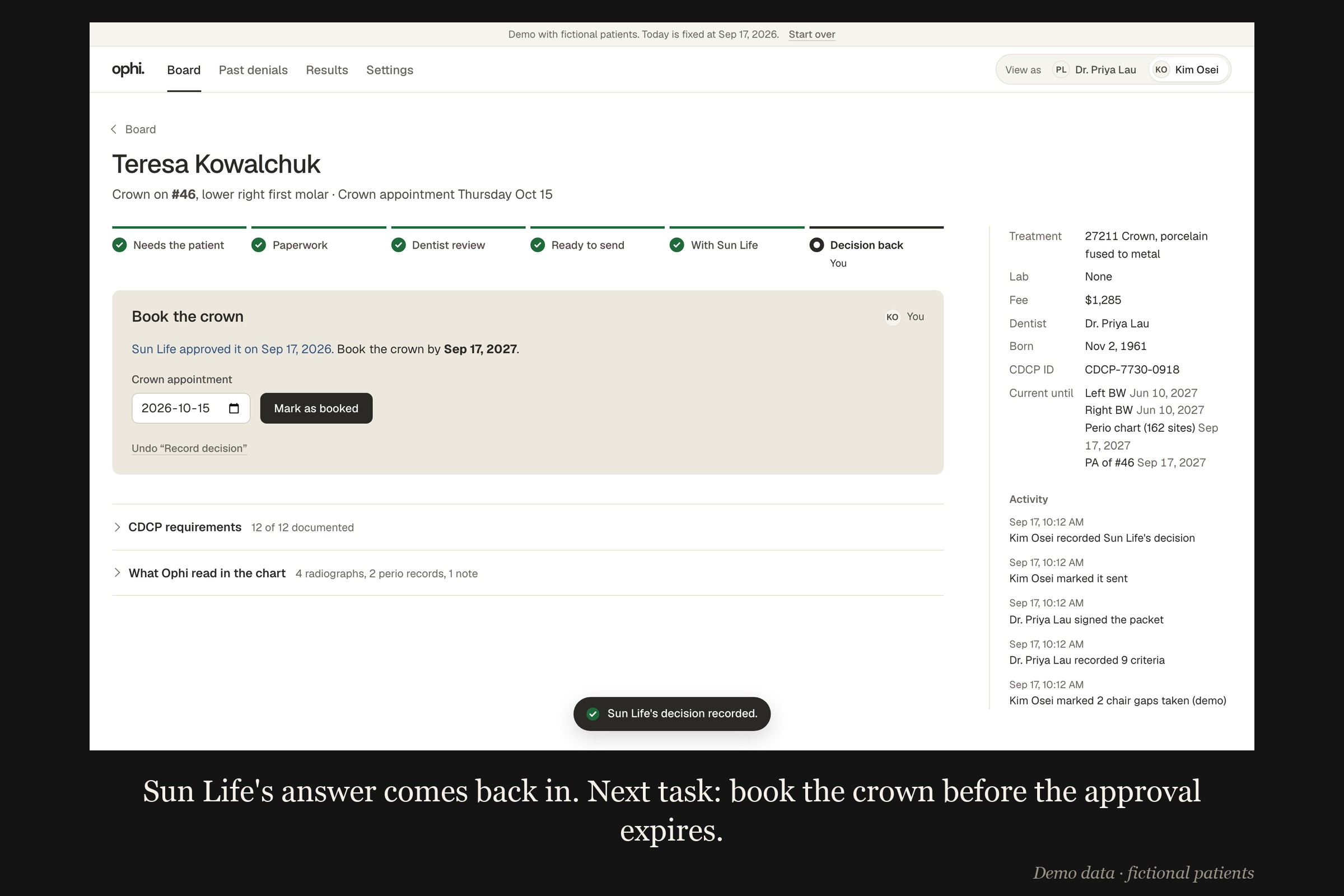
Canada committed $13 billion to the Canadian Dental Care Plan, and more than 7.5 million people have enrolled. Before a clinic can book a crown for one of them, Sun Life, which runs the plan, has to review a preauthorization request. Fewer than half of those requests make it. Health Canada says the most common reason is an incomplete submission: a missing x-ray, or not enough evidence that the criteria are met.
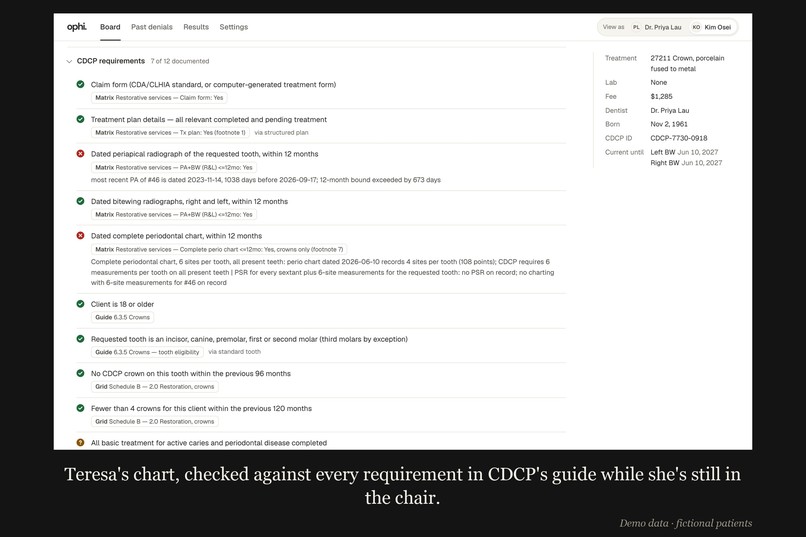
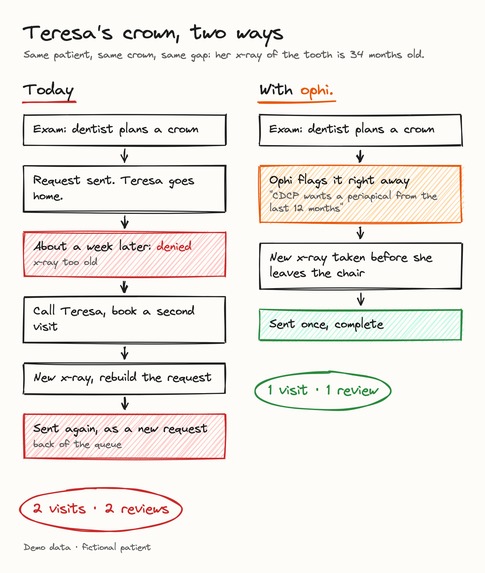
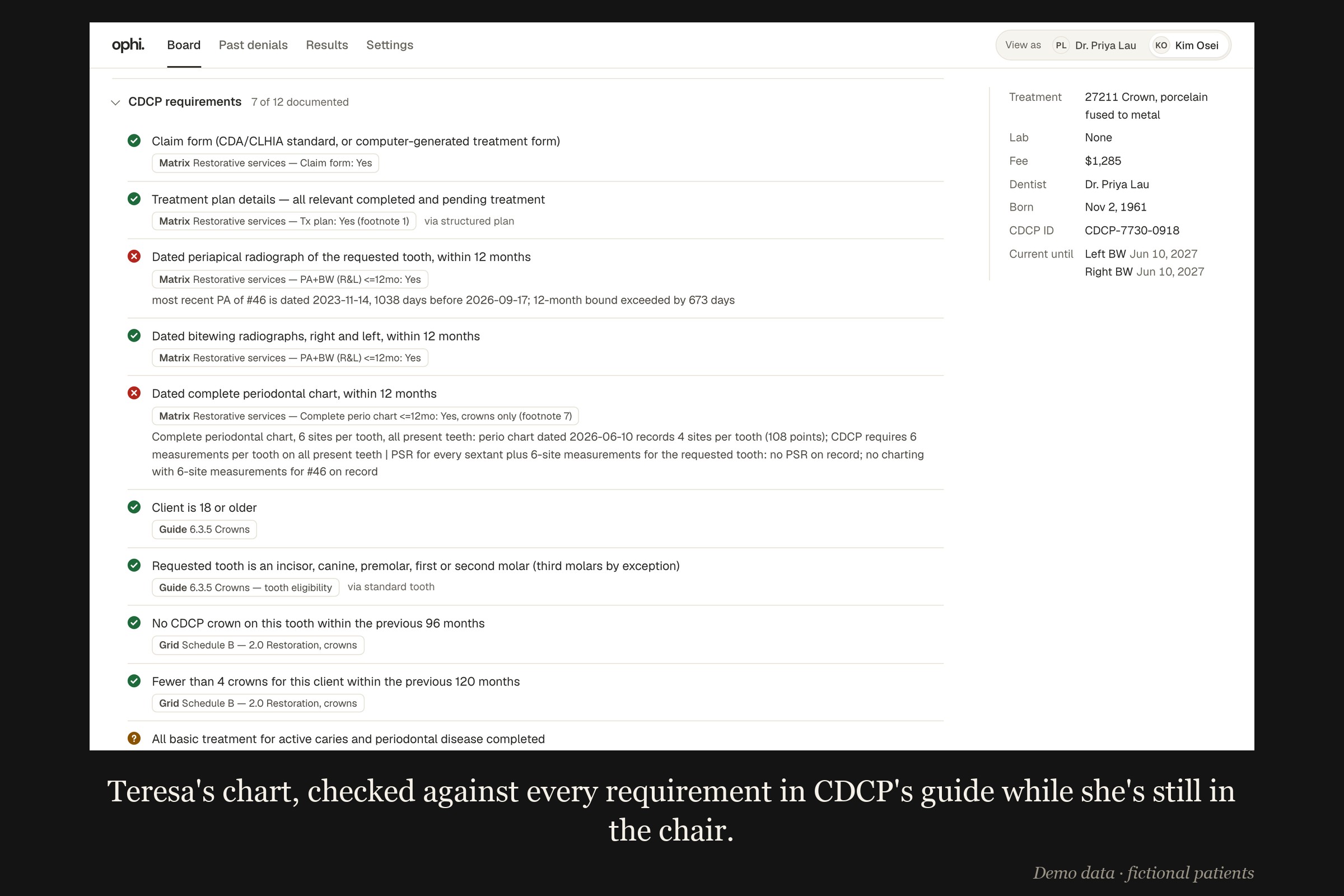
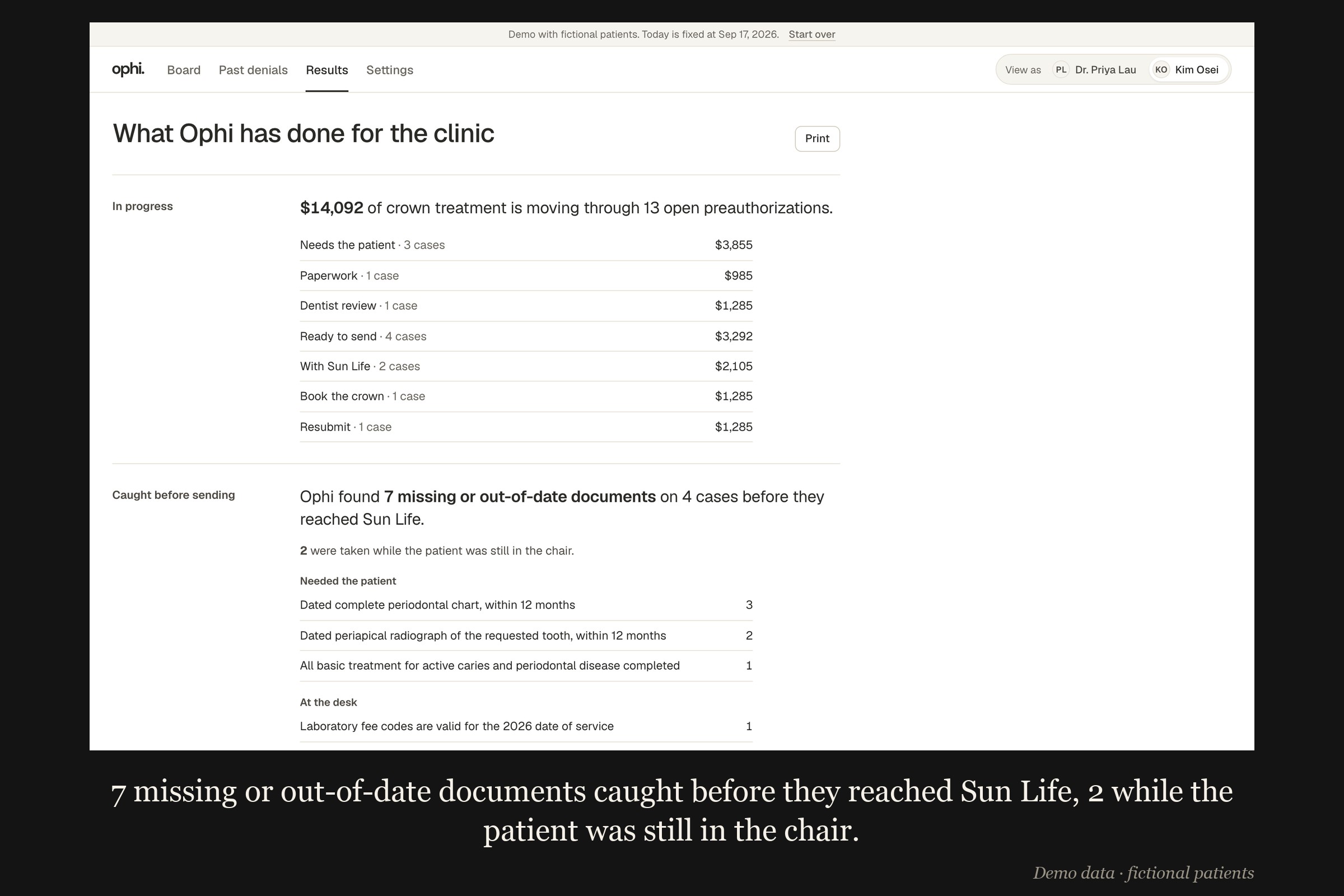
Ophi reads the patient's chart, checks the request against every documentation rule in CDCP's guide, and tells the clinic what's missing while the patient is still in the chair, when fixing it takes minutes instead of a second visit.
Why does this matter for Canada?
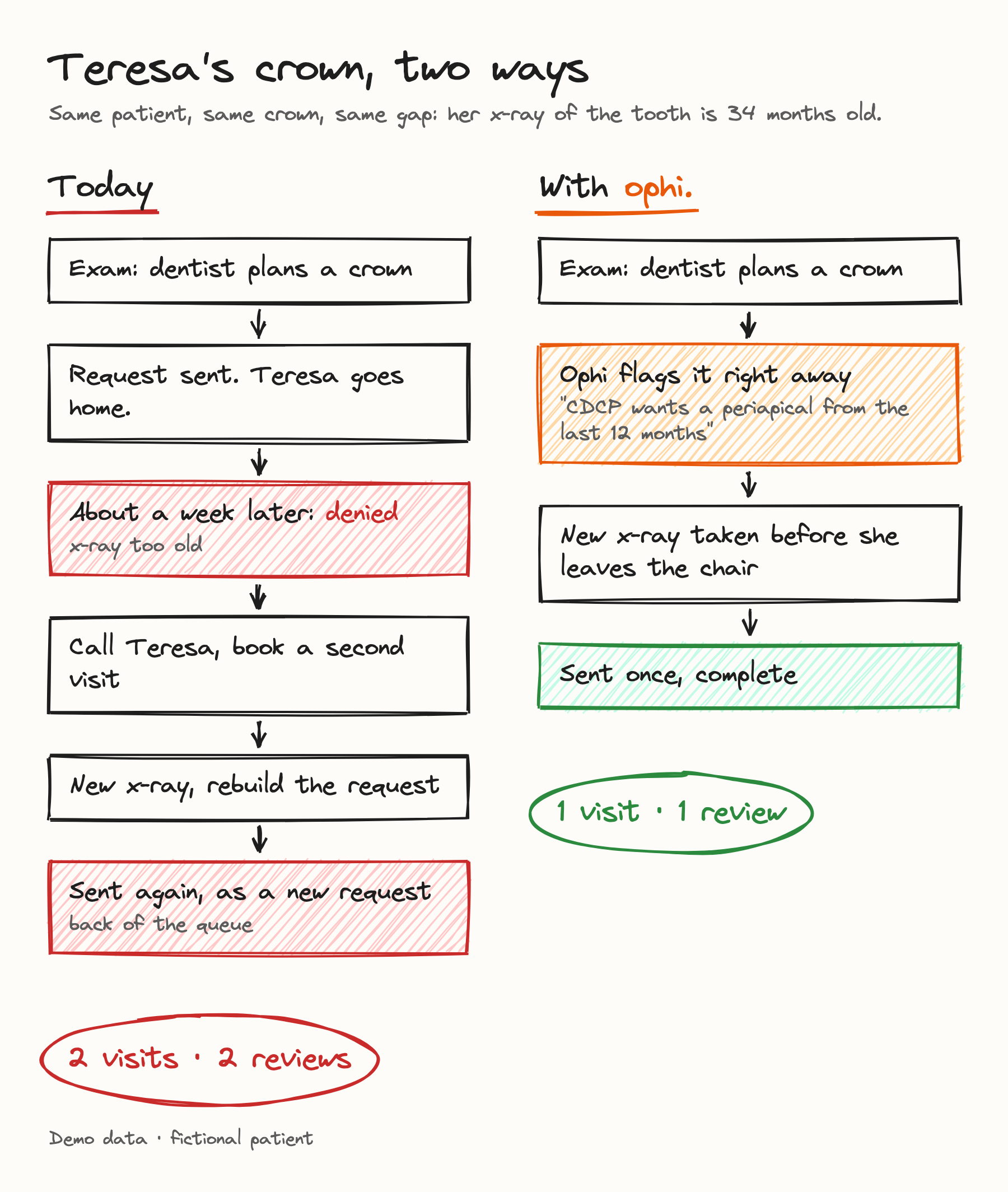
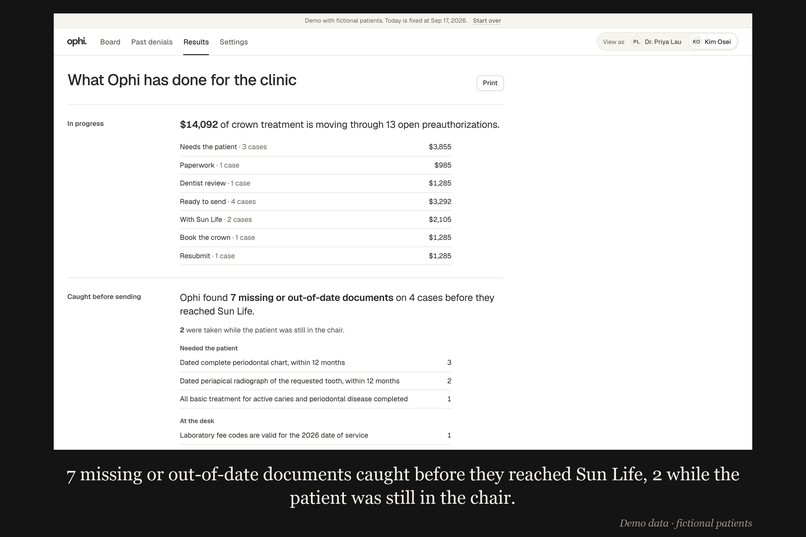
- Most denials start as paperwork. Sun Life decides more than 95% of requests within 7 days, so speed isn't the problem. What comes back is: 54% of complete requests are not approved, and about 63% for crowns.
- A fix costs the patient another visit. The clinic finds the gap only after the patient has gone home. The patient comes back for a new x-ray, and the request goes to the back of the queue as a brand-new request. This costs the clinic time, valuable appointment, and lost revenue.
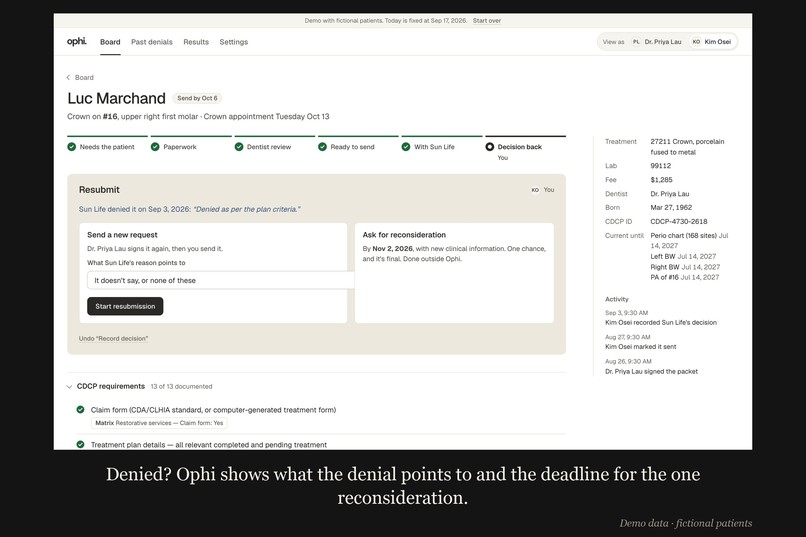
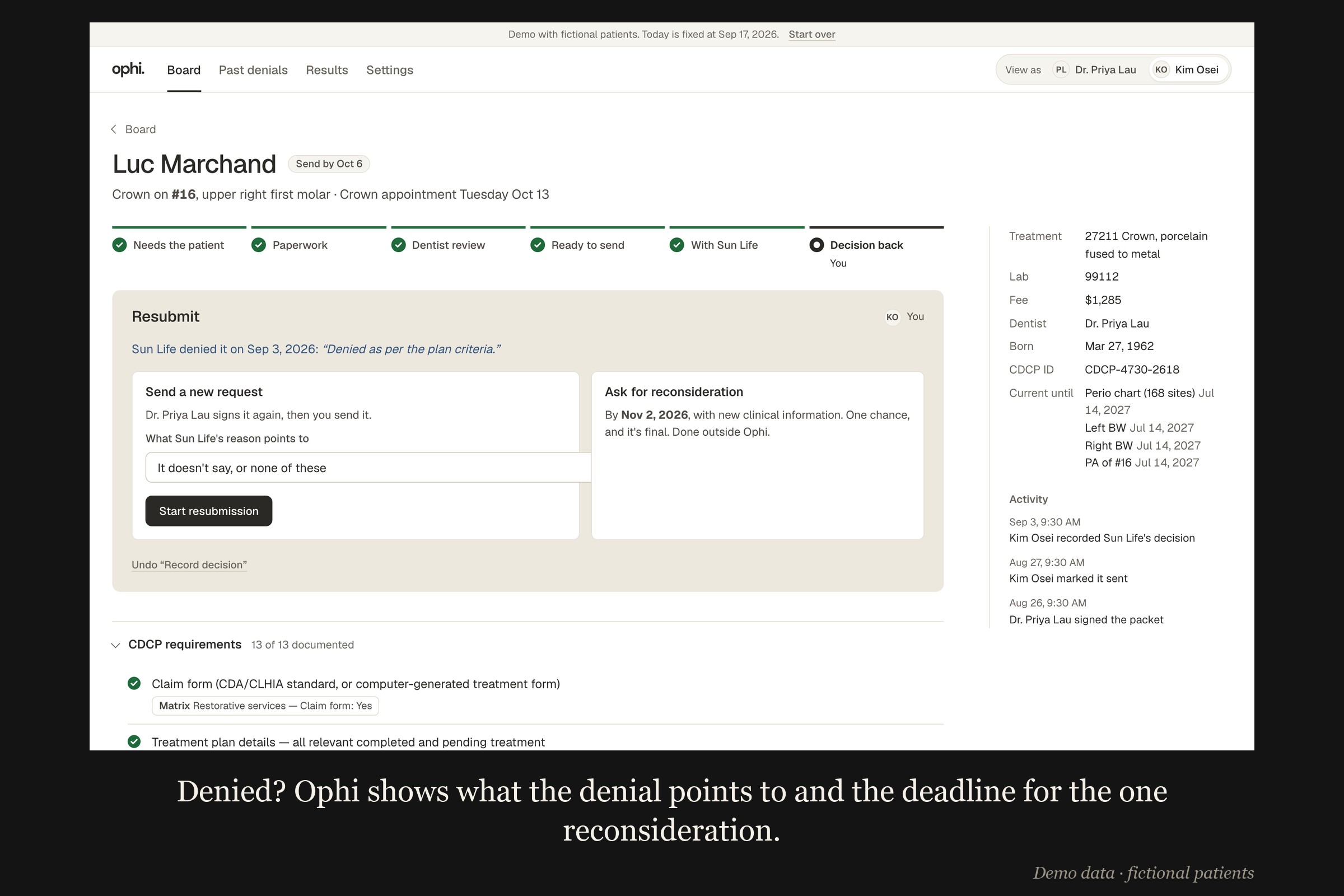
- A second chance is narrow. A reconsideration has to be filed within 60 days, must include new clinical information, and gets one try. That decision is final.
- Public money pays for the same review twice. Every avoidable resubmission is one more review on a $13 billion program.
- Front desks are stretched. Staff hunt through charts, judge whether a film is recent enough, and retype the same facts. That's time not spent on patients. The rules keep moving too: CDCP's guide changed twice in ten months.
What it does
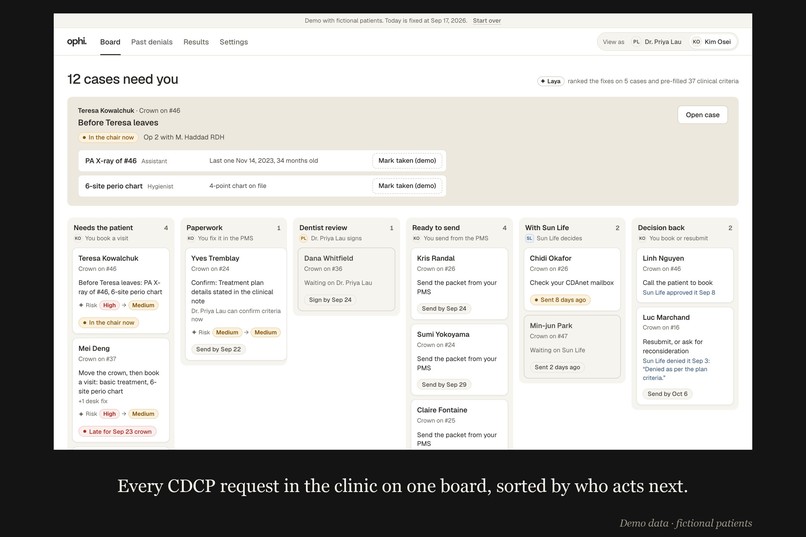
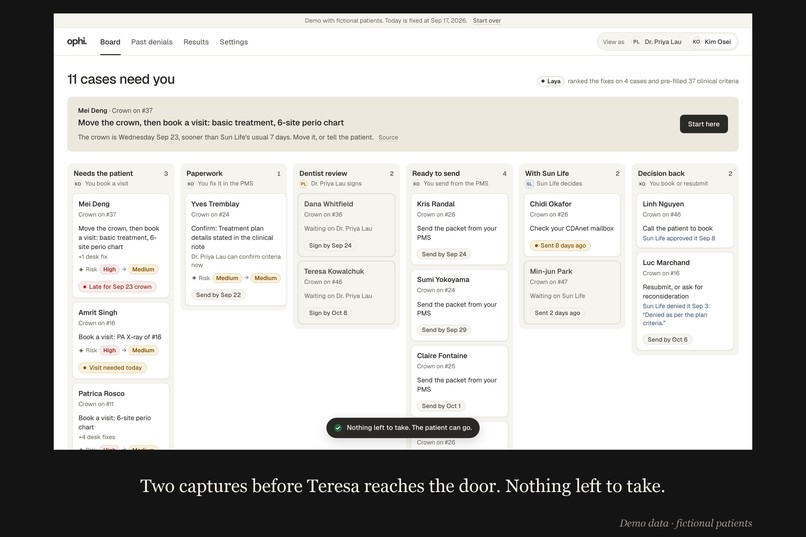
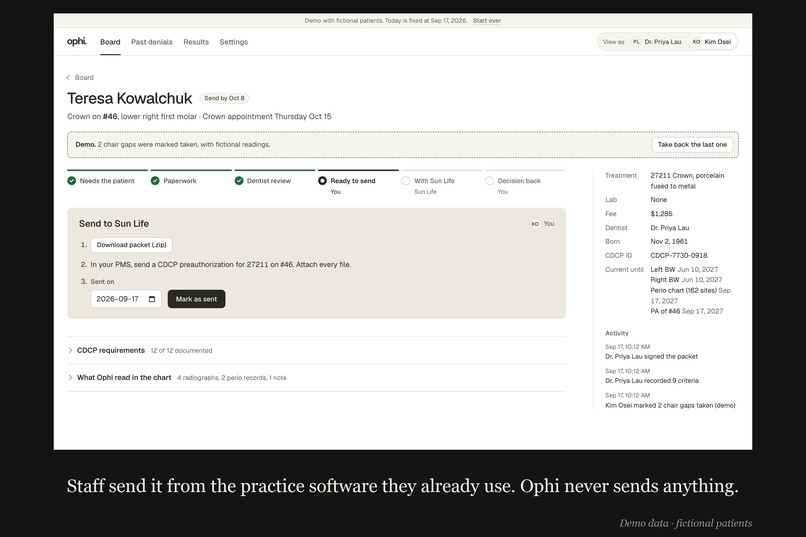
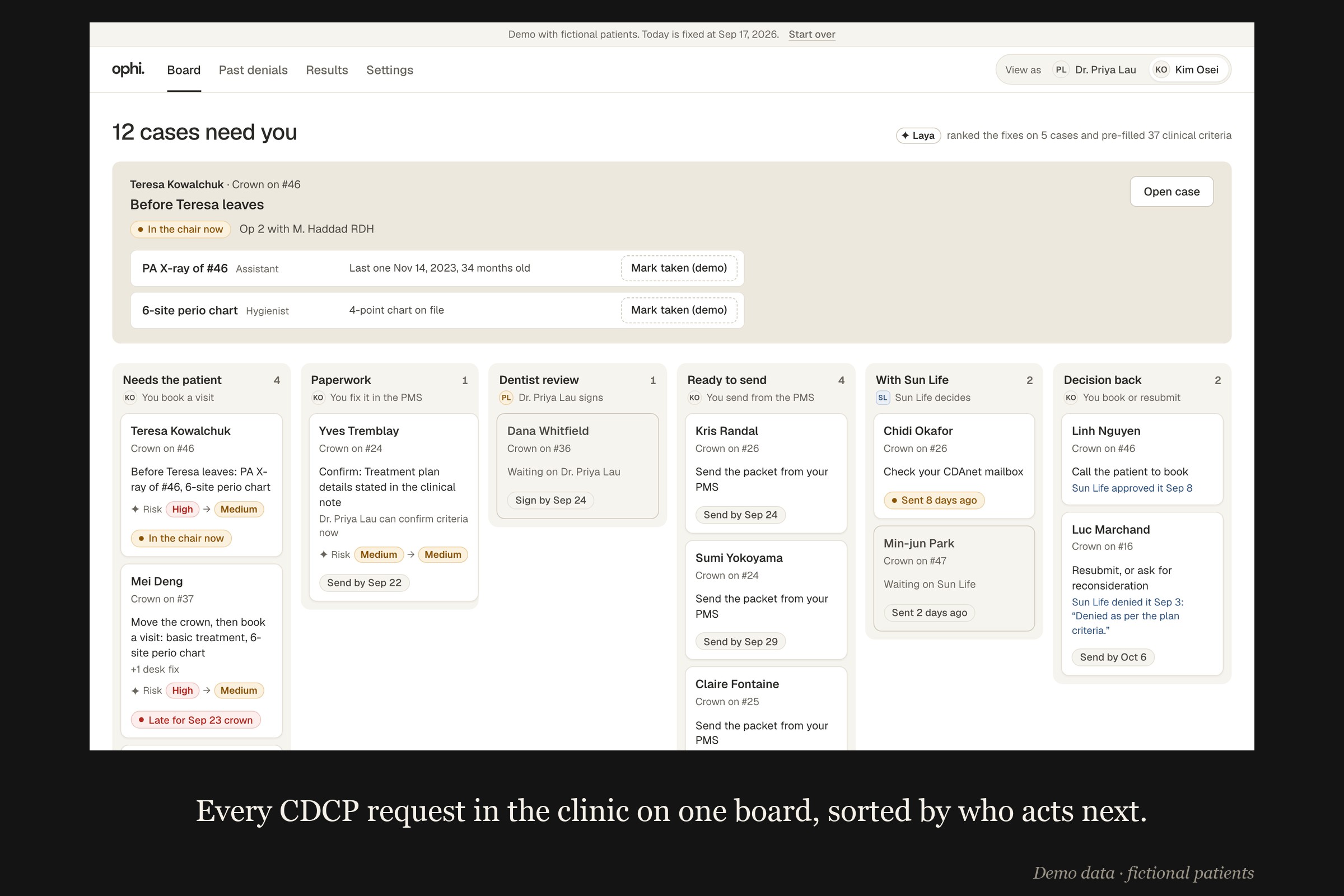
- One board for every CDCP request in the clinic, sorted by who acts next: needs the patient, paperwork, dentist review, ready to send, with Sun Life, decision back.
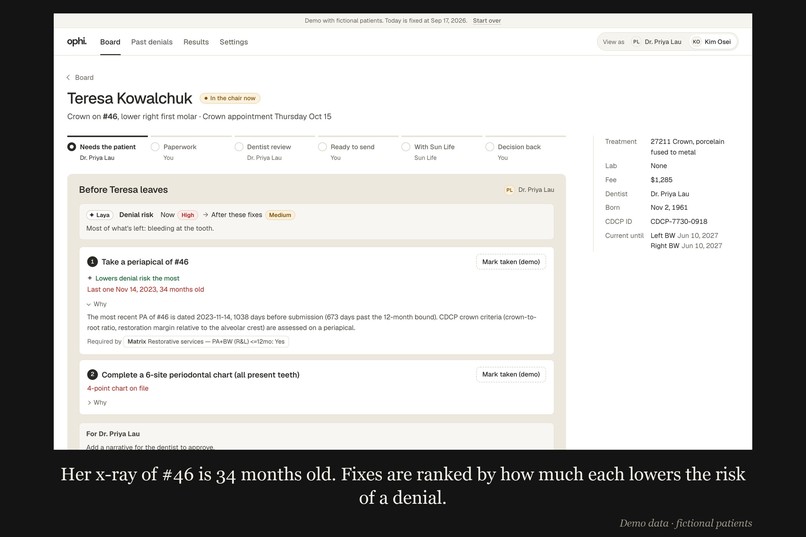
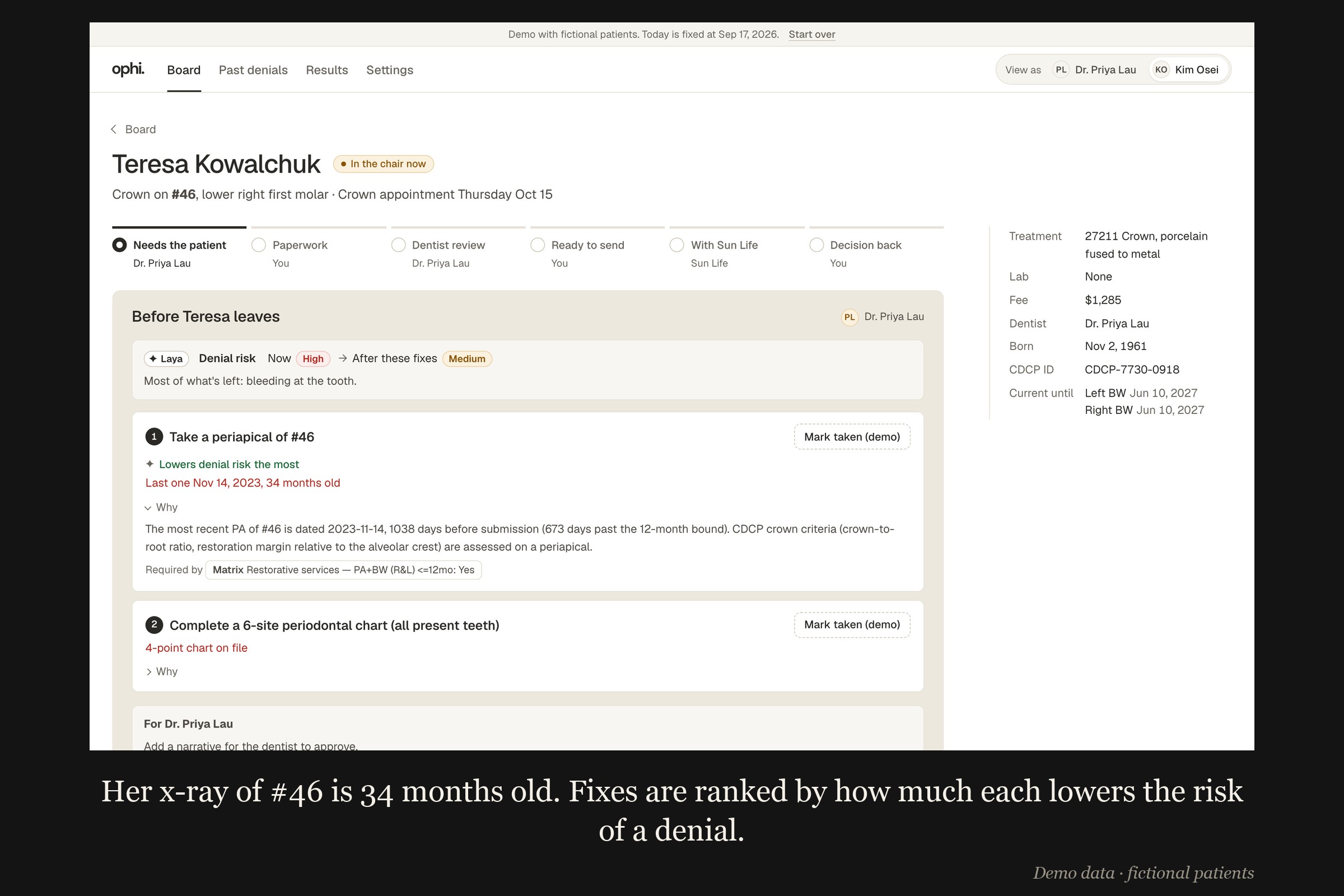
- When a patient with a gap is still in the chair, their checklist comes first, so the x-ray gets taken before they walk out.
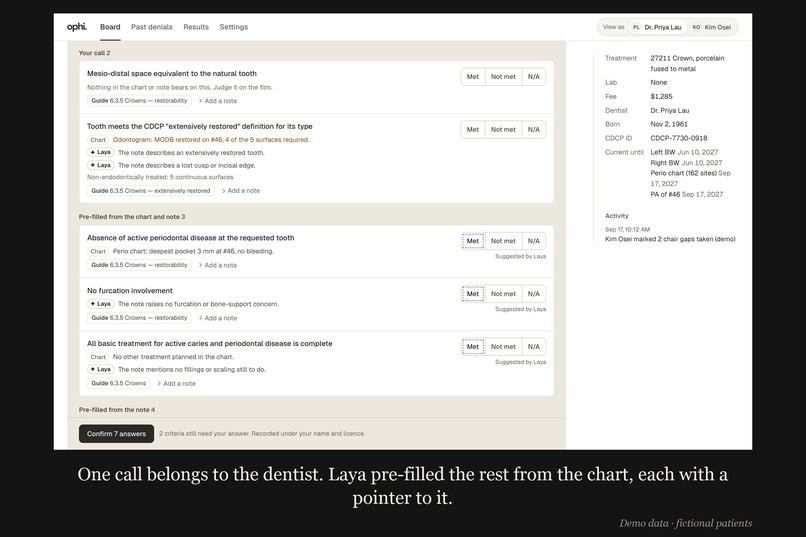
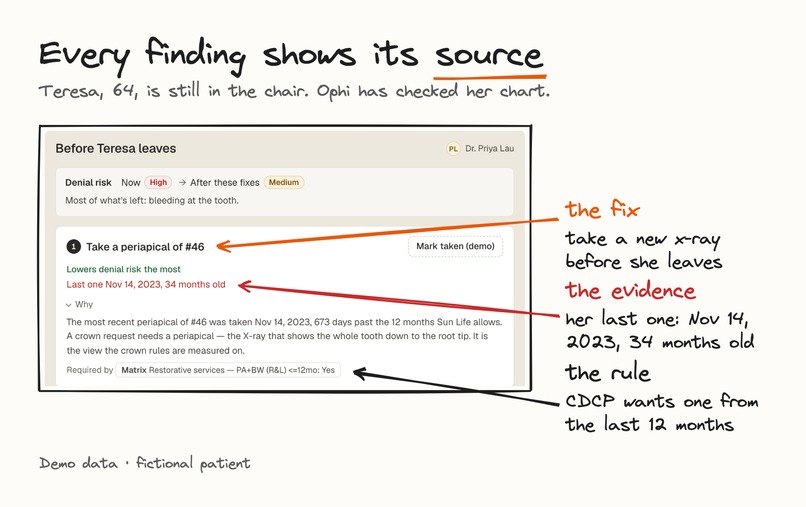
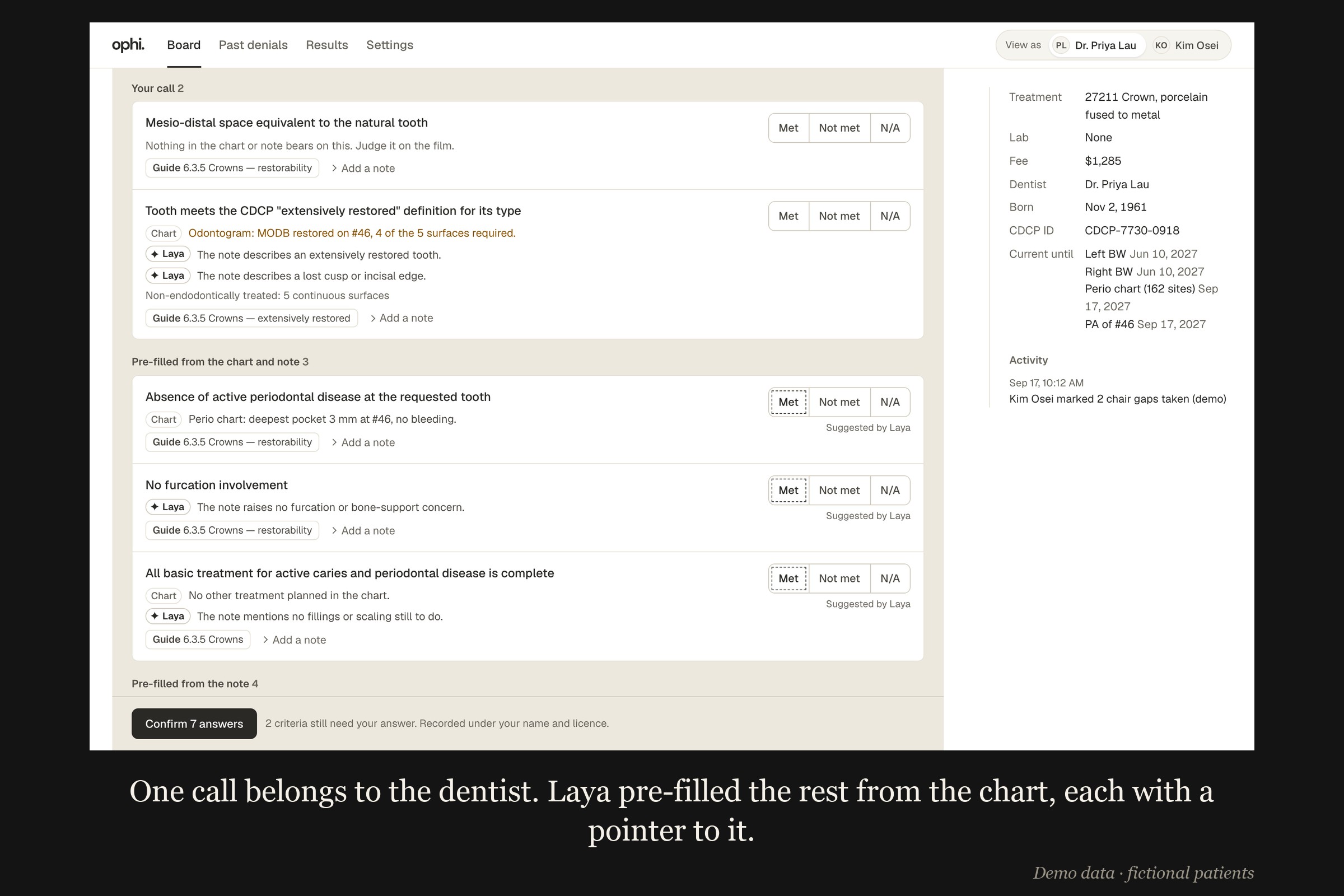
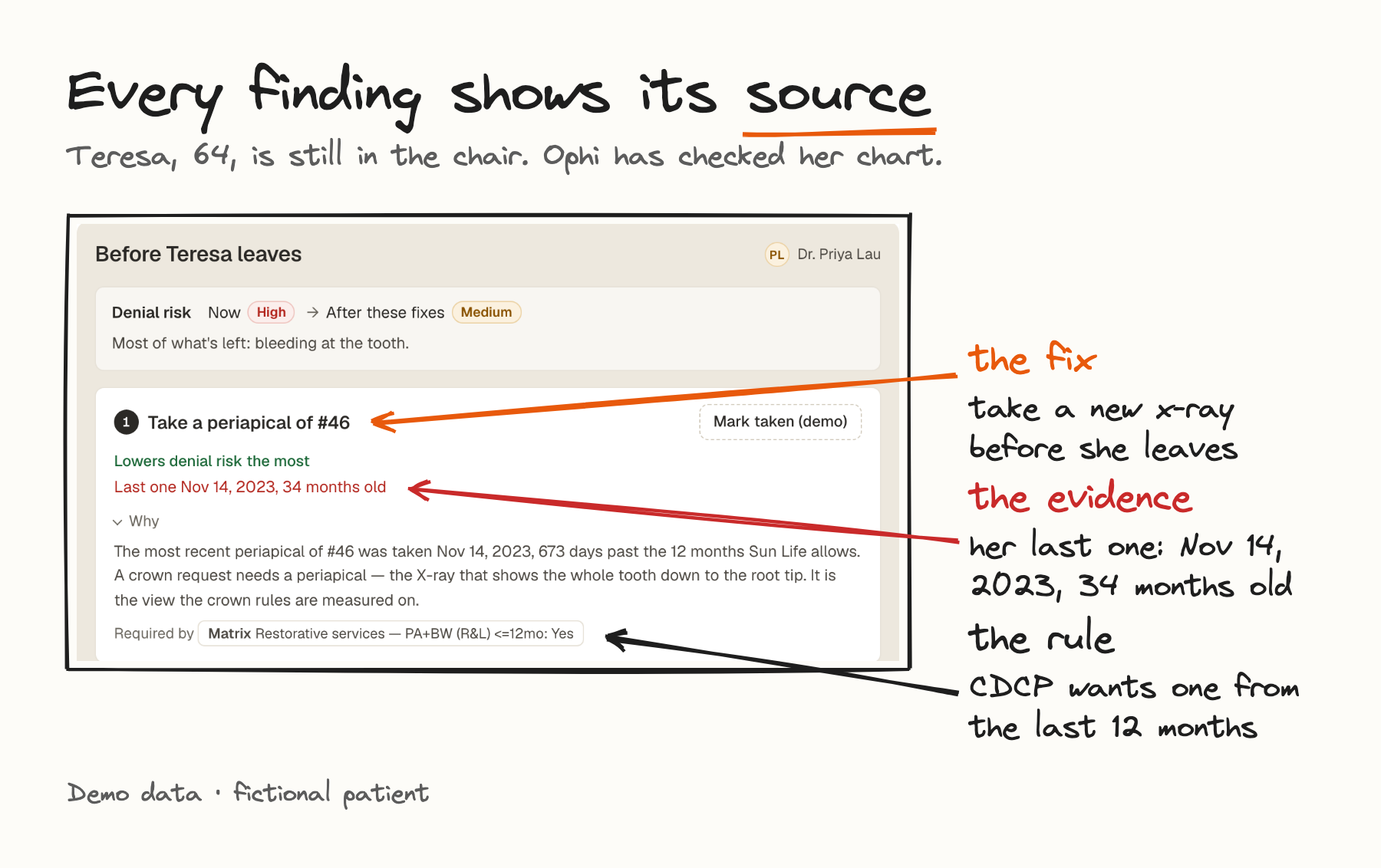
- Every finding shows its source, the rule it comes from and the chart entry it's based on. Nothing is a black box.
- Ophi estimates how risky the request looks now and after each fix, then lists the fixes that help most first, each labelled by who does it.
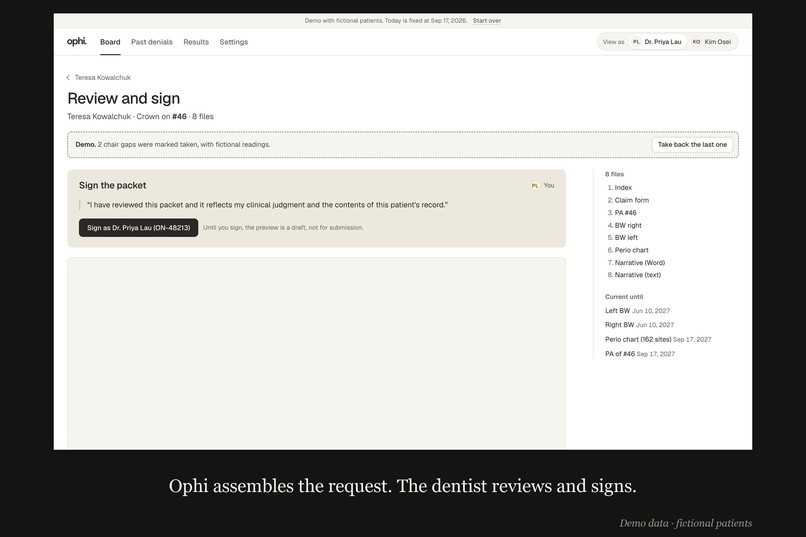
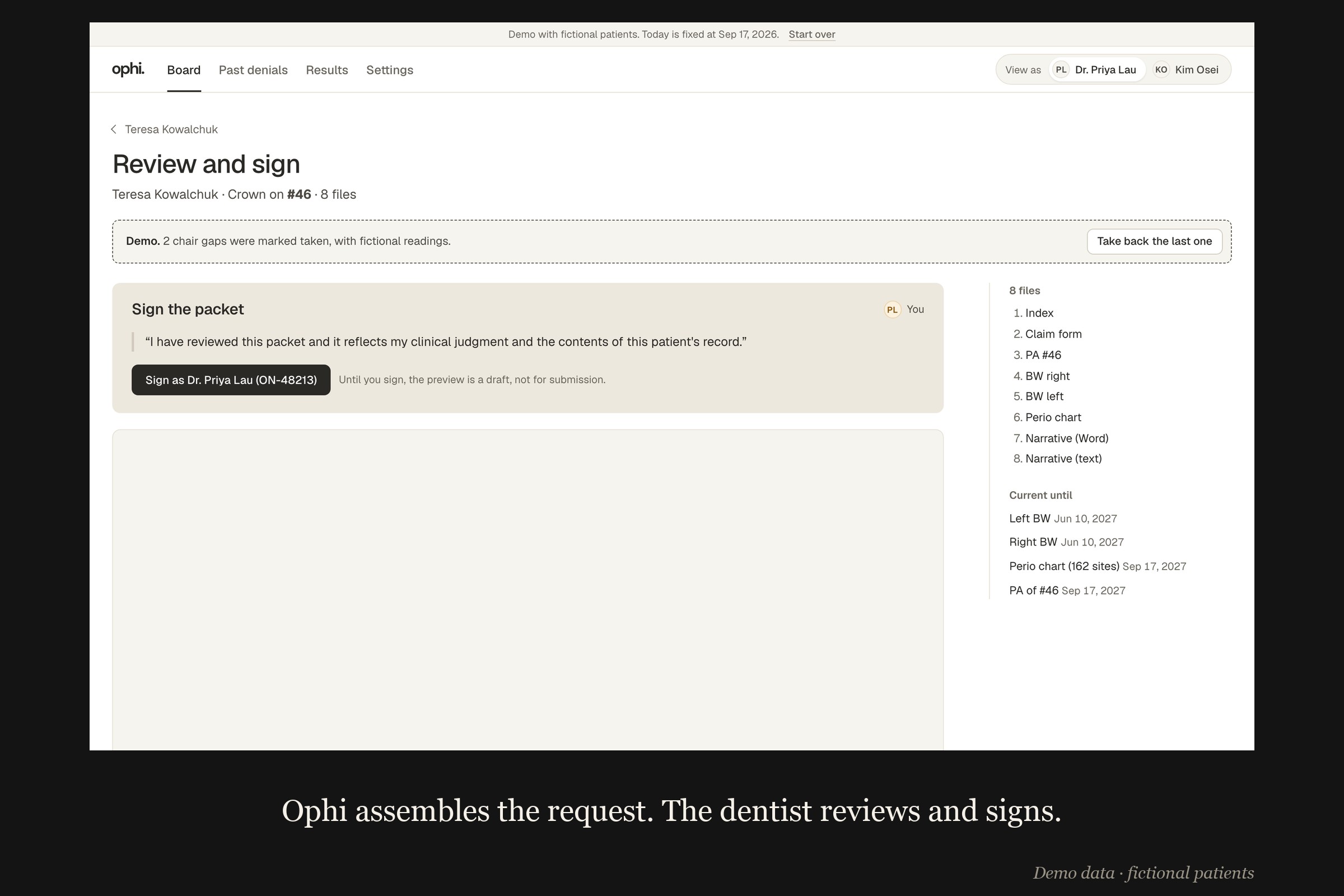
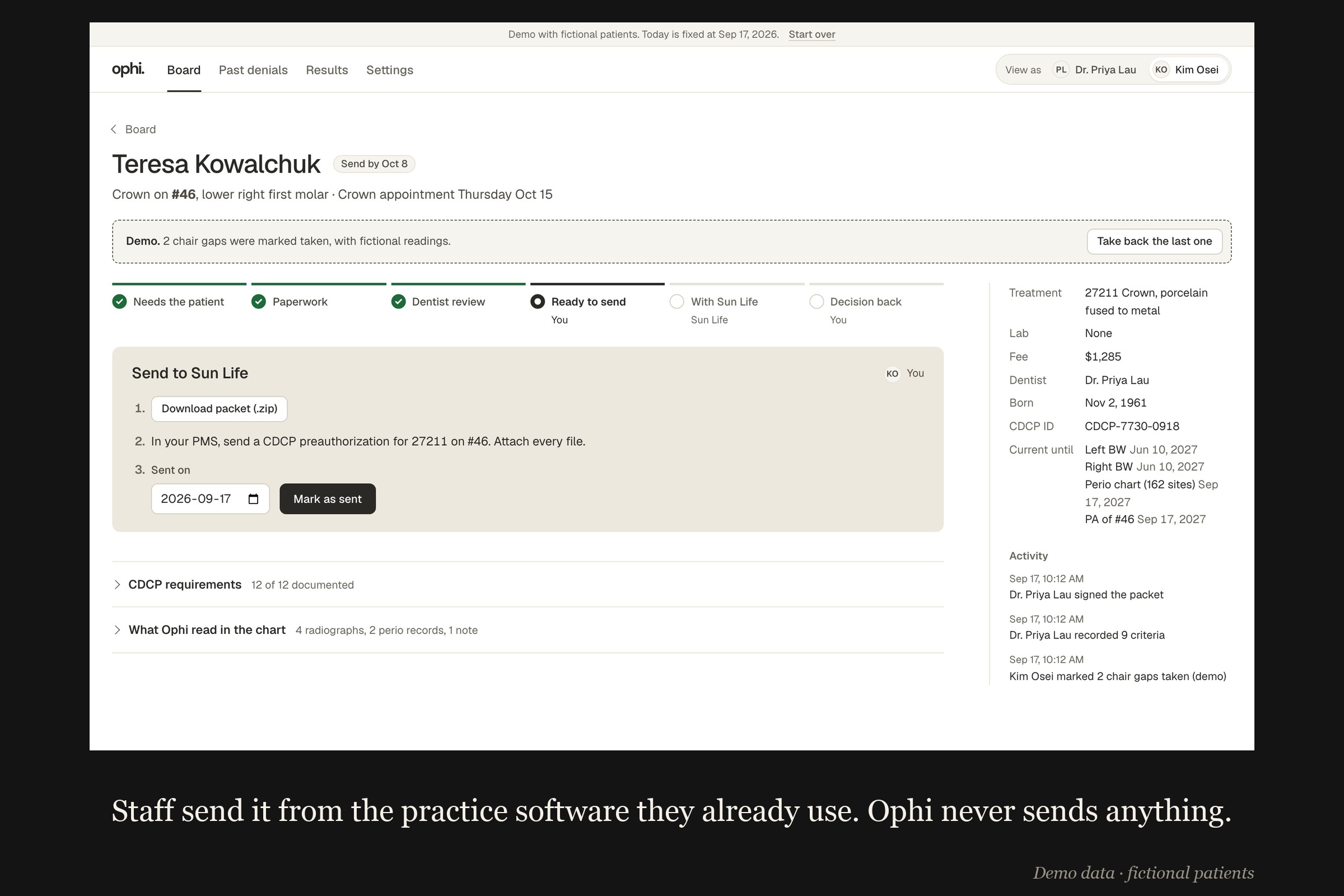
- Ophi assembles the form, x-rays, gum chart and narrative, and double-checks every file against the submission limits. The dentist signs and the staff send it. Ophi never submits on its own.
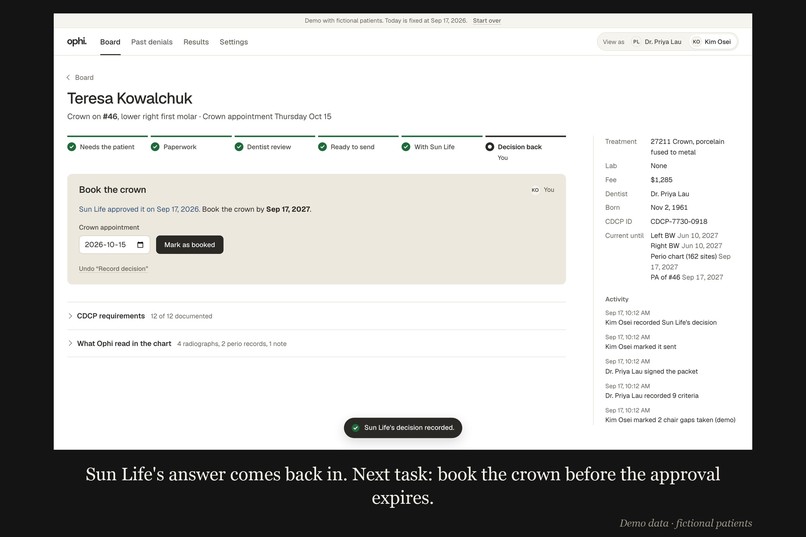
- When Sun Life answers, Ophi routes a denial to whoever can fix it, and every past denial the clinic never resubmitted becomes a call list.
- Ophi also ensures it's using the latest CDCP guide so all the rule checks it's doing are always up-to-date.
Who are we selling to?
Dental clinics.
Close to 100% of active dentists in Canada now treat CDCP patients, so every clinic has this problem. Dental is also one of the most fragmented corners of Canadian health care: federal programs, provincial plans and dozens of private carriers, each with its own rules. A tool that learns those rules once and applies them to every request is worth more with every payer it adds.
Why start with CDCP crowns? Crowns have a lower approval rate (about 37%) than root canals or dentures and a high fee (about $884 to an Ontario clinic, before lab fees). Canadian tools today verify benefits and track submitted requests. None we've found checks a request's documentation against CDCP's rules before it goes out.
Market size
- 17,857 dental clinics in Canada, and close to every active dentist treats CDCP patients.
- About 1.9 million CDCP preauthorization requests a year,
- At $199 a month, that's a $42.6 million-a-year market for our first product alone, before any other payer.
- Dental groups roll out fast. dentalcorp (~630 Canadian practices) and 123Dentist (~510 clinics) can each bring hundreds of clinics at once.
- The return is simple: one more crown every four months pays for Ophi. The dentist we interviewed sees 10 to 12 CDCP crown patients a month, and at a 37% approval rate most of those requests don't make it fast.
- The same engine grows past CDCP: NIHB ($380 million a year in dental), provincial plans, and private insurers, who paid $12.6 billion in dental claims in 2024.
What is our main differentiator?
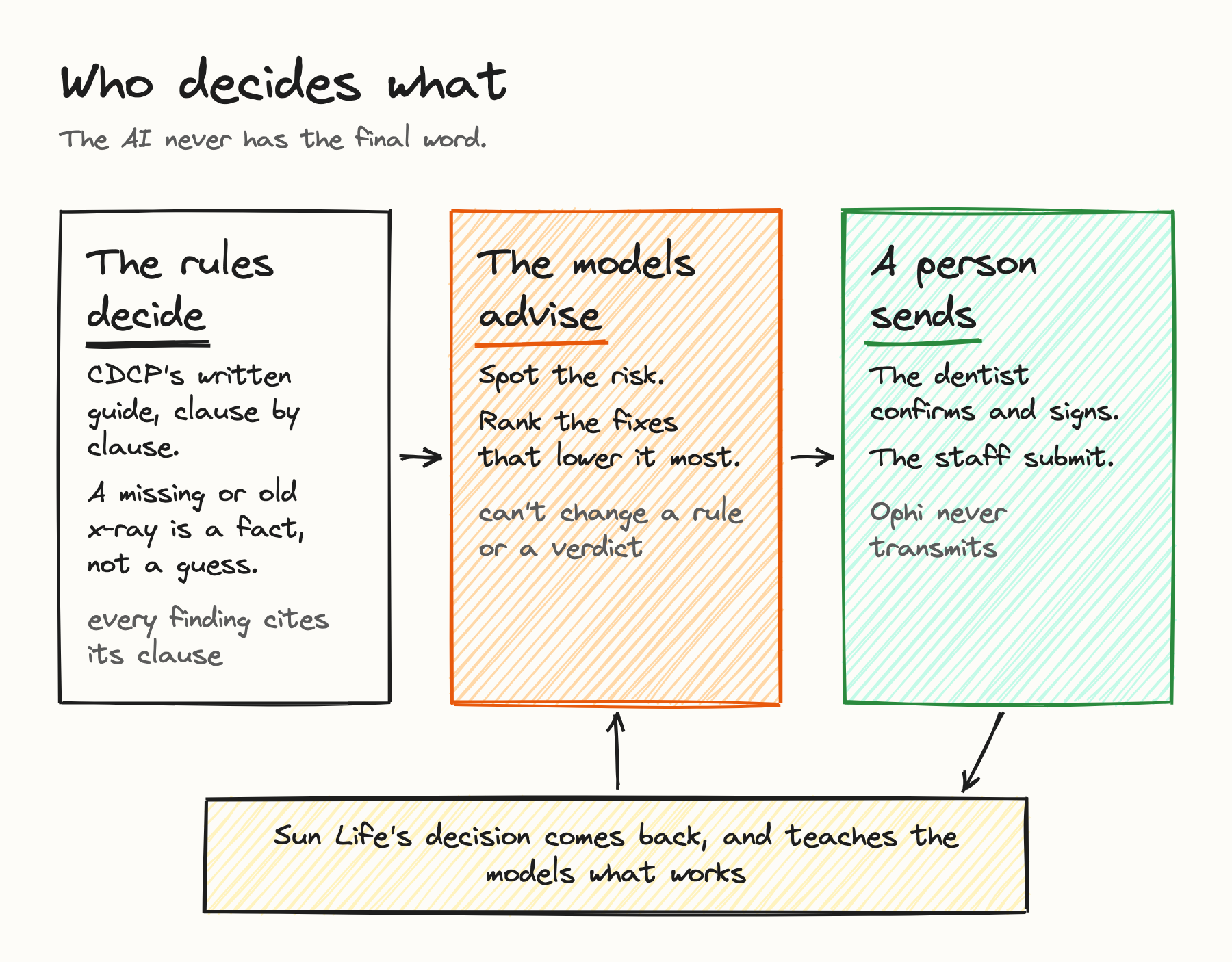
The rules are public. The decisions aren't. Anyone can read CDCP's guide and turn it into a checklist. Nobody else has a record of what clinics actually sent, what came back, and why, tied to the chart behind each request.
Every decision a clinic records trains Ophi: more clinics, more decisions, better checks, more clinics. That matters because denial letters are often vague ("does not meet the criteria"). Over time, Ophi learns which gaps actually lead to a denial and ranks the fixes that matter most.
Real evidence
- A dentist interview. They see about 2 CDCP crown patients a week, 8 to 10 a month, and said many denials come from easy-to-miss gaps that could be caught early. They called a self-learning model a major opportunity. They also said clinics are busy enough that a tool which reliably removes manual work, prevents avoidable mistakes or cuts follow-up is very attractive: the same admins can serve more patients.
- Clinic surveys. We reached out to 251 dental clinics and the ones that responded named preauthorization as one of the biggest point of friction in the admin workflow.
- Two clinics have booked demos.
- Health Canada's own numbers back the problem: fewer than half of requests approved, and incomplete submissions named as the most common reason.
- A working product on real practice software. We ran Ophi end to end on ABELDent, a Canadian practice management system, with its patient data: chart read, rule check, fix list, dentist sign-off, verified packet, and the decision coming back.
How we built it
- Reading the chart: Ophi connects to the clinic's practice software read-only. We mapped ABELDent's database (454 tables) to find where x-rays, gum charts, notes and Sun Life's answers live. Every fact keeps a pointer to where it came from.
- The rules as data: CDCP's crown requirements live in a versioned rule file, each citing its clause. When the guide changes, a person approves the new version, and every check records which version it used.
- The models: a small note-reading model we fine-tuned (Laya) answers questions like "is this tooth extensively restored?" from the dentist's note, and a second model ranks fixes by how much they lower the risk.
- Safety nets: a set of hand-checked trap cases runs on every change, and the build fails if Ophi ever calls an incomplete request ready.
What's next for Ophi
- Demo Ophi to the dentist we're working with, and to the two clinics that booked demos.
- Sign a PHIPA agreement. Under Ontario's health privacy law, it makes Ophi the clinic's agent, so the dentist stays in control of patient data and authorizes Ophi to read it.
- Pilot at a local dental clinic, at a steep lifetime discount in exchange for feedback and data.
- Expand across Kitchener-Waterloo-Cambridge, then Ontario, then Canada, adding practice software beyond ABELDent (ClearDent and Open Dental first) and working through dental groups.
- Grow the payer tree: CDCP crowns, then root canals, then NIHB, provincial plans, private insurers, and audit-ready records for claims already paid. The same approach could later reach other clinics that deal with preauthorizations, such as optometry.
Sources
| Claim | Source |
|---|---|
| 46% of complete preauth requests approved (54% not); crowns ~37%; >95% processed within 7 days | Health Canada via Oral Health Group, 2026-06-18 |
| "The most common reasons for denials are incomplete submissions…" | Health Canada spokesperson to CBC, 2026-05-27 |
| 7,535,054 enrolled (Aug 31, 2026) | canada.ca CDCP statistics |
| $13B over five years | Budget 2023, Department of Finance |
| ~1.9M requests a year (480,000 in Mar–May 2026, ×4) | Health Canada via Oral Health Group; annualized by us |
| ≈2 a week per clinic (1.9M ÷ 17,857 ÷ 52) | derived |
| 17,857 dental clinics | ISED Canadian Industry Statistics, 2025 |
| "Close to 100% of active dentists … caring for patients covered under the CDCP" | Health Canada, 2026-04-17 |
| Reconsideration: within 60 days, new information required, one level, final | CDCP Dental Benefits Guide, Appendix C |
| Guide changed Dec 7, 2025 and Apr 1, 2026 | CDCP Dental Benefits Guide, previous and current versions |
| Crown 27211 ≈ $884 (Ontario GP, before lab fee) | Sun Life CDCP Ontario benefit grid 2026 |
| $42.6M/yr (17,857 × $199 × 12) | derived |
| dentalcorp ~630 Canadian practices; 123Dentist ~510 clinics | dentalcorp 2026-07-21; 123Dentist clinic map |
| $379.9M NIHB dental, 2023–24 | Indigenous Services Canada |
| $12.6B dental claims paid by private insurers, 2024 | CLHIA Canadian Life and Health Insurance Facts, 2025 edition |

Log in or sign up for Devpost to join the conversation.