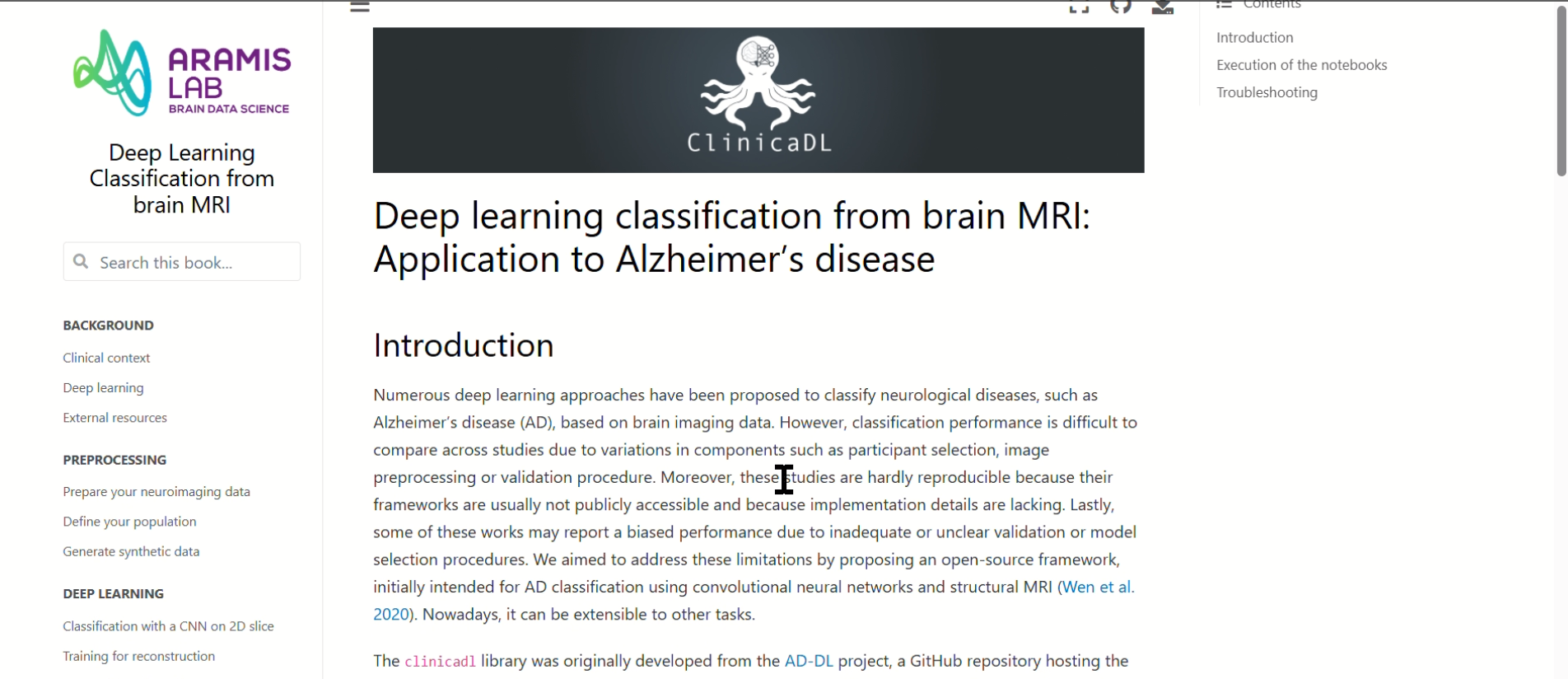
🧠 ClinicalDL
AI-powered framework for early detection of Alzheimer's Disease using deep learning on neuroimaging data.
💡 Inspiration
Alzheimer’s is one of the most devastating neurological disorders, often diagnosed too late for effective intervention. We were inspired by how AI and deep learning can bridge this gap — detecting disease patterns invisible to the human eye and enabling early, data-driven diagnosis. Our motivation was simple: to use technology to make healthcare smarter, faster, and more accessible.
💭 What It Does
ClinicalDL analyzes MRI brain scans using convolutional neural networks (CNNs) to detect and classify stages of Alzheimer’s disease. It provides:
- Automated preprocessing and feature extraction
- Accurate classification between Healthy, MCI, and Alzheimer’s conditions
- Visual interpretability through Grad-CAM heatmaps
- Easy-to-reproduce Jupyter notebooks for researchers and clinicians
🧱 How I Built It
- Implemented using Python and deep learning frameworks (PyTorch, TensorFlow)
- Used MRI neuroimaging data (e.g., ADNI dataset) formatted in BIDS standard
- Built a modular training pipeline with data preprocessing, CNN model training, and evaluation
- Added explainable AI tools for model interpretability
- Used Google Colab and Jupyter for experimentation and visualization
⚠️ Challenges I Ran Into
- Handling large MRI data and preprocessing it efficiently
- Managing imbalanced datasets between Alzheimer’s and control groups
- Achieving high model interpretability without compromising performance
- Integrating visualization (Grad-CAM) for clinical transparency
🏆 Accomplishments That I’m Proud Of
- Successfully built an end-to-end deep learning pipeline for MRI classification
- Achieved 85–90% accuracy in Alzheimer’s stage prediction
- Integrated explainable AI for visual model understanding
- Created a clean, reproducible framework usable by medical researchers
📚 What I Learned
- How to process and work with neuroimaging data (MRI)
- Building CNN models for medical image analysis
- Implementing Grad-CAM for model interpretability
- The importance of reproducibility and transparency in healthcare AI
🔮 What’s Next for ClinicalDL
- Integrate multi-modal data (MRI + genetic + cognitive tests)
- Build a web-based diagnostic dashboard for clinicians
- Extend detection to other neurological disorders (Parkinson’s, ALS)
- Improve explainability with attention-based models
⚙️ Tech Stack
- Language: Python 3.10+
- Libraries: PyTorch / TensorFlow, NumPy, Pandas, Scikit-learn, Matplotlib
- Environment: Jupyter / Google Colab
- Dataset: Alzheimer’s Disease Neuroimaging Initiative (ADNI)
👩💻 Author
Bhumika Kashyap Machine Learning & AI Research Enthusiast 🌐 GitHub Profile
⚖️ License
This project is licensed under the MIT License — free to use, modify, and distribute with attribution.

Log in or sign up for Devpost to join the conversation.