-
-

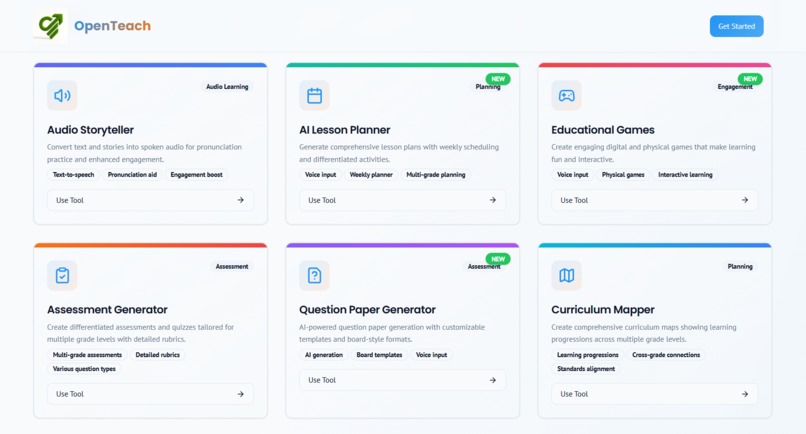
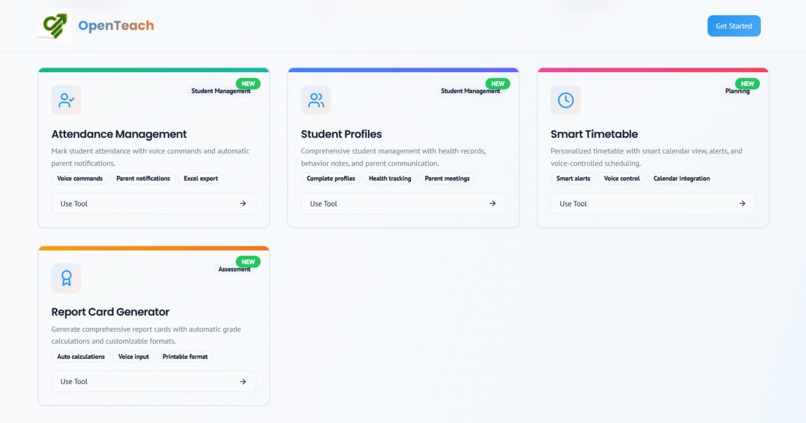
15 Powerful AI Tools
-
15 Powerful AI Tools
-
15 Powerful AI Tools


🧠 Inspiration
We found a significant gap while working with educators: most AI Technologies are made for kids, but teachers, particularly in underfunded schools, find it difficult to oversee courses, customise instruction, and overcome language obstacles. Even though there are 1.5 million schools and more than 22 major languages in India alone, the majority of digital tools still use English interfaces.
OpenTeach, a comprehensive AI-based teaching platform made for multilingual, voice-first classrooms, was inspired by this. It is powered by Ziya AI. The objective was straightforward: let AI handle management, customisation, and accessibility while enabling educators to concentrate on what really counts—teaching and building relationships with students.
🚀 What it does
OpenTeach is an AI-powered teaching and learning ecosystem that supports teachers and students through intelligent, multilingual, and voice-driven tools.
Key highlights:
🗣️ Ziya AI – The Voice-to-Learning Loop: An AI teaching assistant that listens, understands, and responds in 50+ languages, enabling voice-based learning and management.
📚 15+ AI Teaching Tools: -> Lesson Planner, Question Paper Generator, and Report Card Creator -> Visual Aid Designer and Flowchart Creator -> Assessment Generator with rubrics -> Student Attendance and Profile Management 🧏 Accessibility for All: Converts voice to text, text to speech, and supports regional dialects to make learning inclusive. 🎮 Engagement Through Gamification: Builds interactive classroom games and activities using AI. 🌐 Offline Ready: Works seamlessly in low-connectivity environments with smart network detection.
How we built it
We built OpenTeach using a modern AI-first full-stack architecture designed for scalability, speed, and accessibility. Frontend: -> Developed in React.js with Tailwind CSS for a clean, responsive, and teacher-friendly interface.
Backend: -> Powered by Flask (Python) and Firebase, handling authentication, AI request routing, and real-time data. -> The backend is hosted on Render for high availability.
Database: -> A combination of Supabase (for structured user data and authentication) and Firebase Firestore (for real-time classroom data).
AI & ML Layer: -> Google Gemini 2.0 Flash Model—core multimodal engine for text, image, and voice-based interactions. -> Speech Recognition API—enables voice input in 50+ Indian languages. -> Text-to-Speech Models—generate spoken lessons and explanations. -> Custom Recommendation Engine—combines decision tree and contextual bandit algorithms for adaptive learning.
Framework & Integration: -> Google Genkit Framework for AI orchestration, prompt management, and server action flows. -> Zod Validation ensures type-safe input/output for reliable AI responses.
Deployment: -> Hosted the live version on Netlify → https://openteach.netlify.app/
Challenges we ran into
AI Model Integration: -> Managing multiple Gemini AI variants, complex Genkit flows, API rate limits, and error handling.
Multimodal Processing: -> OCR accuracy, speech-to-text in 50+ languages, PDF/PPT extraction, and large Base64 handling.
Real-time Conversational AI: -> Maintaining context, consistent AI personality, voice synthesis quality, and sub-second response latency.
Multi-language Support: -> Localization of UI, cultural relevance, font rendering for Indian scripts, and accurate regional voice recognition.
Low-Resource Contexts: -> Offline functionality, network optimization, device compatibility, and minimizing data usage.
Educational Complexity: -> Multi-grade differentiation, AI-generated assessment accuracy, adaptive learning paths, and teacher workflow integration.
Development & Performance: -> Type-safe schema management, state handling, bundle size, memory usage, concurrent users, and API cost optimization.
Production Deployment: -> Secure environment management, edge deployment, monitoring AI performance, and prompt iteration control.
Accomplishments that we're proud of
AI Features -> 14+ AI tools, including voice-enabled content creation and adaptive learning.
Multilingual Support -> Supports 50+ Indian languages.
Real-Time Management -> Student management, attendance, and reporting in real time.
Adaptive Learning -> Personalized learning with Decision Tree + Contextual Bandit engine.
Deployment -> Live platform on Netlify with offline support.
What we learned
-> Managing multiple AI models and APIs -> Handling text, images, and voice inputs -> Maintaining context and AI personality -> Supporting 50+ Indian languages -> Optimizing for offline use and low-resource devices -> Personalizing learning paths with AI
🚀 What's next for OpenTeach—AI-Powered Adaptive Learning Assistant
-> Scale to more schools and classrooms -> Expand AI features and personalization -> Enhance offline and multilingual support -> Add interactive and gamified learning tools

Log in or sign up for Devpost to join the conversation.