Inspiration
I built openspec-shipper because I became the bottleneck in my own AI-assisted development workflow.
I had started using OpenSpec, a spec-driven software/product development tool, to describe changes as structured proposals: intent, design, tasks, and a definition of done. Instead of asking an AI to improvise a large feature from a vague prompt, I could give it a clear, reviewable unit of work. That made the promise of AI-assisted development feel much more practical.
But even when the AI could write the code, I was still doing a surprising amount of manual coordination: creating branches, preparing worktrees, checking Git state, installing dependencies, pushing branches, opening pull requests, waiting for merges, synchronizing main, archiving OpenSpec changes, and cleaning up old worktrees.
While one agent was coding, I was already writing the next specification. Then something would interrupt my mental flow: a dirty checkout, a stale branch, a merge conflict, a missing dependency, or a GitHub authentication problem. I had to stop thinking about the product and start managing the machinery around the agents.
That was the problem I wanted to fix. I wanted AI to give me back time for the parts of software development where I have the most impact: understanding problems, making product decisions, and deciding what should be built next.
What it does
openspec-shipper adds a delivery layer on top of OpenSpec. I can write several changes, add them to a queue, and let Shipper move each one through a complete lifecycle:
prepare worktree
-> implement with Codex
-> refresh branch
-> push
-> wait for human review and merge
-> archive the OpenSpec change
-> clean up
Each change is implemented in its own isolated Git worktree, so my main checkout remains available for planning and writing the next specification. Codex gets a focused task and a clean working environment. Git and GitHub operations are handled by the runner, while the AI is reserved for the parts that require judgment: implementing the specification and reconciling OpenSpec archives.
The broader idea is harness engineering: the model is only one part of the system. The harness gives it context, boundaries, tools, feedback, and a safe path from generated code to reviewed software. This turns AI from an occasional coding assistant into a repeatable collaborator that can keep making progress while a developer focuses on the product.
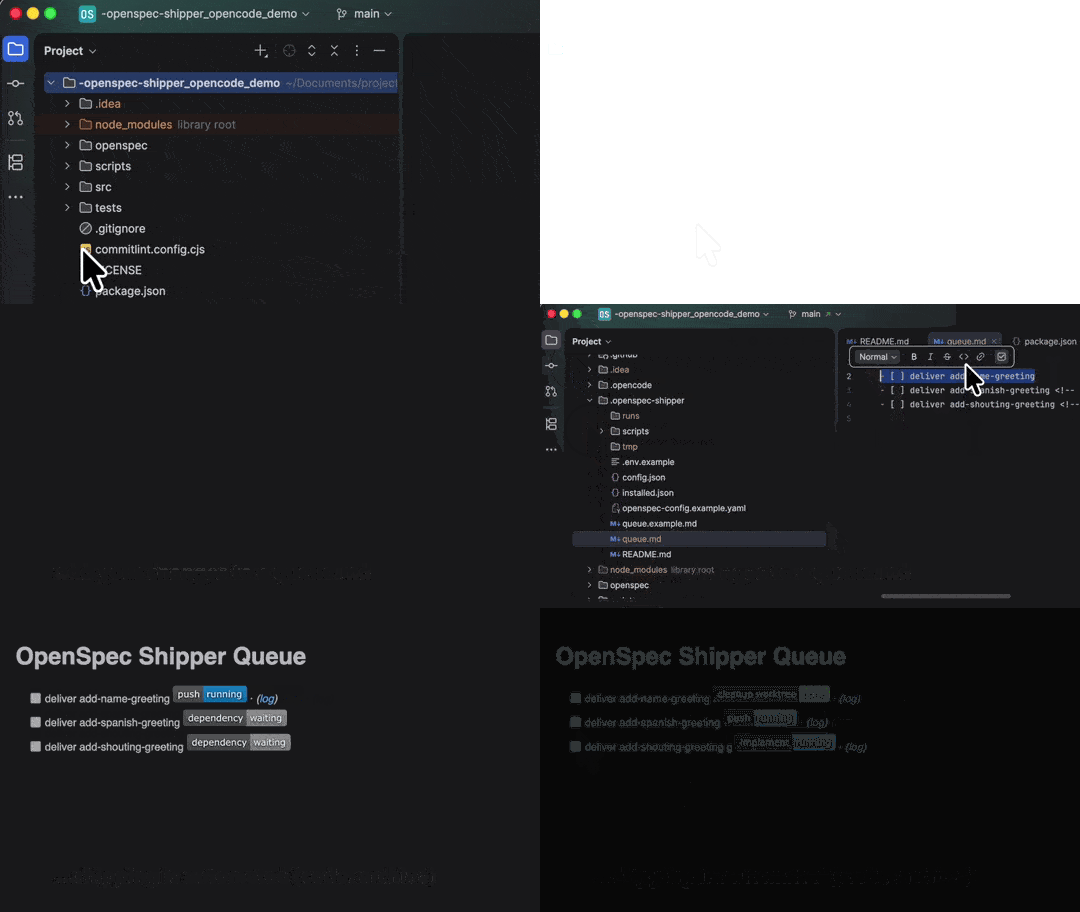
The queue remains visible as a Markdown file. It shows what is pending, what is running, what is waiting for a pull request, and what is blocked. Before every operation, Shipper reconciles the evidence available in Git, GitHub, worktrees, branches, and archived specs instead of blindly trusting a stale status marker.
How we built it
I built Shipper as an npm package so developers can add it to an existing OpenSpec repository instead of adopting a new platform or cloning a separate orchestration project. Under the hood, it has a TypeScript codebase and a domain-driven architecture. The domain models queue tasks, delivery phases, dependencies, and reconciliation rules. The application layer coordinates the workflow, while infrastructure adapters handle the filesystem, Git, GitHub CLI, environment configuration, and AI providers.
Codex is the primary coding provider for the hackathon workflow, but the provider boundary also supports OpenCode and Claude Code. This keeps the orchestration logic independent from the particular AI executor.
The runner deliberately owns the mechanical phases: preparing worktrees, refreshing branches, validating and pushing changes, publishing archives, and cleaning up. The AI handles the phases that require software judgment: implementing a specification and performing the semantic OpenSpec archive. This division improves both reliability and efficiency: Codex spends tokens on decisions and code, not on repetitive Git ceremony.
The queue/backlog is the human-readable Markdown file interface, while reconciliation is the recovery mechanism. Shipper continuously derives the most advanced valid phase from repository evidence, so it can recover after an interrupted run without relying on a second hidden state database.
Challenges we ran into
The hardest challenges were not making an agent write code. They were the edge cases around real repositories. A fresh worktree has no dependencies installed, while main can be dirty or out of date with origin/main. Remote branches can change while a queue is running, and GitHub authentication or permissions can prevent pushes and pull requests.
A pull request can be open, merged, conflicted, or missing. OpenSpec archive operations require semantic understanding, not just file movement. A model can report a blocker using unpredictable language, and a queue can appear to be waiting even when another independent change could still proceed. Git processes can also hang while waiting on SSH or network authentication.
These problems forced me (advised by GPT 5.6 Sol) to separate native operations from agent work, add pre-checks and post-checks to phases, record useful logs, make blocked tasks visible, and design reconciliation to be safe to run repeatedly. They also changed my definition of successful automation. A system is not truly useful if it only works in the happy path; it must make failure understandable and recovery simple enough that a developer does not lose their train of thought.
Accomplishments that I'm proud of
The biggest accomplishment is that a change can now travel from an OpenSpec proposal to a merged pull request and an archived specification with very little manual coordination. Me (and any developer, could be you!) can define the problem, start the queue, and return later to review meaningful work instead of spending that time supervising branches, terminals, and agent sessions.
I am especially proud of the worktree isolation. My normal checkout is never used as the agent's workspace, so I can continue planning the next change while Codex implements the current one.
I am also proud that the system does not hide failure. When Shipper cannot continue, it marks the task as blocked, records the reason, links to the complete run log, and waits for human help. After the problem is fixed, the human can remove the blocked marker and run the queue again. Shipper reconciles the current state and resumes from the correct phase.
Finally, the project is distributed as a public npm package. In its first week, it reached 2,788 npm downloads. I am especially proud of that number because it means this is no longer only a personal productivity experiment. Other developers are discovering a way to make their own AI workflows more effective, spend their model tokens more deliberately, and devote more of their attention to building products.
Every developer who avoids a frustrating coordination task gets a little more time for creative and valuable work. At a larger scale, tools like this can help small teams and individual builders access a level of development leverage that previously required much larger engineering organizations.
What I learned
The project taught me that the difficult part of agentic software development is building the system around the agent. A capable model is only one part of the workflow.
I also learned to separate thinking from execution. I use powerful models to create and refine good OpenSpec changes, especially when a large idea needs to be divided into smaller independent pieces. Once the specification is clear, Codex can execute those tasks in a controlled workflow with less powerful (and cheaper) models. This keeps planning quality high while making the coding phase more efficient (faster and cheaper).
I learned how AI could help me build such project, it was not only coding, it was about: defining the architecture, refactoring, testing, documenting, building marketing materials, translating, distributing, assessing security and more. I really want to know what is next helping me keep in shape this product that is already in production.
What's next for openspec-shipper
The current workflow is intentionally opinionated. It reflects what works for me as a solo developer using OpenSpec, Codex, GitHub, branches, worktrees, and small pull requests. It is not intended to prescribe the right process for every team. I already used AI to brainstorm alternative flows that other users may need, and it help but I really need human feedback at this point.
The next step is to learn from people who use it in different environments. I want to improve support for parallel changes, protected branches, different GitHub policies, richer provider capabilities, and team workflows without losing the simplicity of a visible Markdown queue.
My ambition is for openspec-shipper to become a small but meaningful piece of the new software development stack for anyone using OpenSpec: a way for people to turn clear intent into working software with less operational friction. If it helps more developers spend their days solving meaningful problems instead of coordinating AI tools, then it will have achieved something much bigger than automating my own queue.
How Codex and GPT-5.6 helped me building the project
I used Codex with GPT-5.6 as a hands-on engineering partner to turn an internal OpenSpec workflow into openspec-shipper: a distributable npm CLI that can drive a queue of software changes from planning through implementation, PR creation, merge, archive, and cleanup.
Rather than asking for a one-shot implementation, I used it as an iterative collaborator. I shared real logs, broken queues, GitHub Actions failures, and demo repositories; Codex investigated the evidence, proposed architectural changes, implemented them, added regression tests, and made small commits throughout. We repeatedly pressure-tested the tool in clean demo repositories, which exposed practical problems around Git worktrees, dirty checkouts, PR state, branch conflicts, dependency installation, permissions, provider sandboxes, and stale local state. Actually, it was Codex who build the platform to generate multiple demo repositories and scenarios to test against, that was brilliant.
GPT-5.6 was especially useful for moving between levels of abstraction: from debugging a single failed git push or missing PR, to redesigning the delivery flow so the human checkout remains available for planning while the shipper operates in its own worktrees. It helped shape a markdown-first interface where queue.md remains editable by humans but is reconciled against real Git and GitHub evidence before every action.
The result supports OpenCode, Codex CLI, and Claude Code through a provider architecture. Codex investigated the standards of the other CLI tools and replicated the skills and commands to make the m work (and it nearly worked out of the box). The collaboration was not just code generation: it was continuous design review, implementation, verification, and learning from real failures.
Built With
- bun
- codex
- codex-cli
- typescript

Log in or sign up for Devpost to join the conversation.