# 🚀 OpenPilot

## Inspiration

Open source is one of the best ways for developers to learn, collaborate, and grow. However, contributing to a new repository can be intimidating, especially for first-time contributors.

Questions like *"Where do I start?"*, *"Which issue should I pick?"*, and *"What do maintainers expect?"* often discourage developers before they even write their first line of code.

We wanted to build a tool that acts like an experienced open source maintainer, guiding contributors throughout the entire contribution journey instead of simply generating code.

---

## What it does

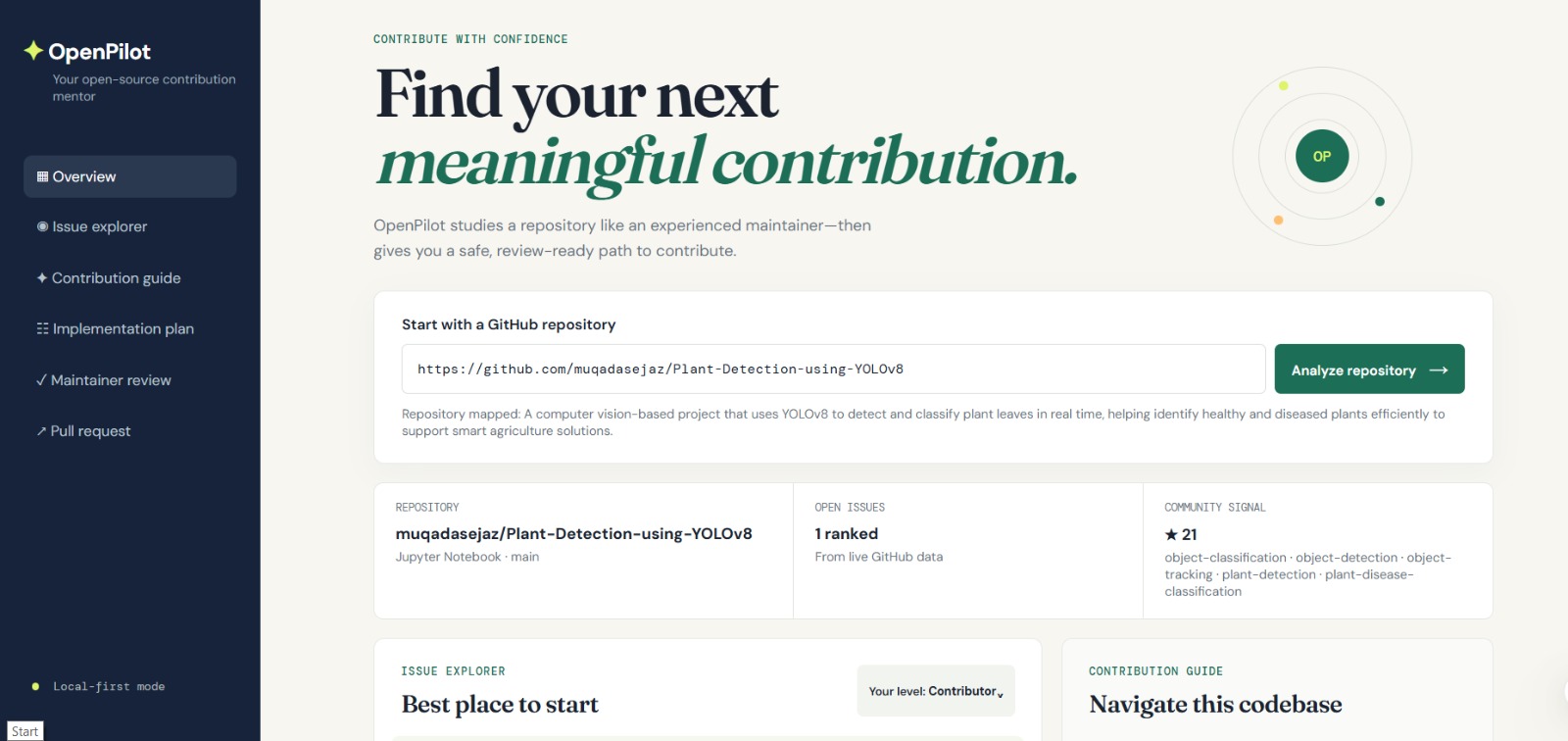
OpenPilot is an AI-powered Open Source Contribution Mentor that transforms any public GitHub repository into an interactive contribution workspace.

Given a GitHub repository, OpenPilot can:

- Analyze repository metadata and project information
- Retrieve live GitHub issues
- Recommend beginner-friendly issues
- Explain repository structure and project context
- Generate a step-by-step contribution plan
- Simulate AI-powered maintainer feedback
- Generate a professional GitHub pull request draft

Rather than replacing developers, OpenPilot helps them understand unfamiliar codebases and contribute with confidence.

---

## How we built it

The project consists of a lightweight frontend and a Python backend integrated with the GitHub REST API.

Our workflow included:

- Building a repository analysis pipeline
- Fetching repository information and open issues from GitHub
- Designing an issue ranking system
- Creating an AI-guided contribution workflow
- Building interfaces for repository exploration and contribution planning
- Designing an architecture that can later support multiple specialized AI agents

Throughout development, **GPT-5.6** was used for reasoning, planning, product design, and workflow generation, while **Codex** accelerated implementation, code generation, refactoring, debugging, and iterative development.

---

## Challenges we ran into

One of the biggest challenges was balancing ambition with the limited timeframe of a hackathon.

Some of the challenges included:

- Designing a contribution workflow that feels practical instead of overwhelming
- Creating an intuitive developer experience
- Integrating GitHub repository data into a meaningful contribution pipeline
- Defining clear responsibilities for future AI agents
- Prioritizing core features while leaving room for future expansion

We focused on delivering a polished MVP rather than attempting to implement every planned feature.

---

## Accomplishments that we're proud of

- Built a working MVP during OpenAI Build Week
- Designed an end-to-end contribution workflow
- Integrated live GitHub repository analysis
- Created a structured contribution planning experience
- Developed a clean, developer-friendly interface
- Designed a scalable architecture for future AI agent collaboration
- Successfully demonstrated how GPT-5.6 and Codex can work together to accelerate software development

---

## What we learned

Building OpenPilot reinforced an important lesson:

AI is most valuable when it helps developers understand problems rather than simply generating code.

We also learned the importance of product design, user experience, and workflow orchestration when building AI-powered developer tools.

Using GPT-5.6 and Codex together significantly accelerated ideation, implementation, and iteration throughout the project.

---

## What's next for OpenPilot

Our vision extends far beyond the current MVP.

Future plans include:

- Repository cloning and local code analysis
- Semantic code search
- Repository knowledge graphs
- Multi-agent collaboration
- AI-generated implementation suggestions
- Automatic code generation
- GitHub Pull Request creation
- CI/CD integration
- VS Code extension
- Support for enterprise repositories
- Team collaboration features
- Personalized contributor recommendations

Our long-term goal is to make contributing to open source significantly easier for developers of every experience level.
OpenPilot
An AI-powered mentor that helps developers understand GitHub repositories, discover the right issues, and create high-quality pull requests with confidence.
Updates

Leave feedback in the comments!
Log in or sign up for Devpost to join the conversation.