-
-
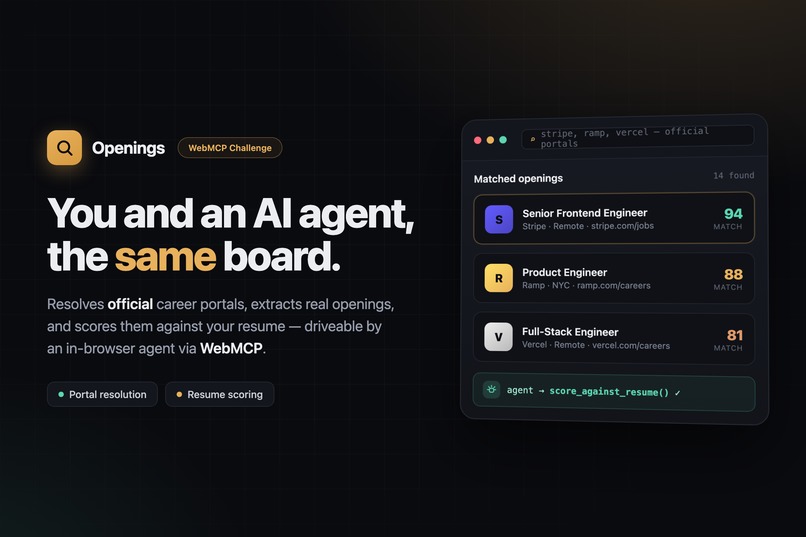
Openings — Agent-Native Job Discovery
Inspiration
Job hunting is a two-surface problem. Aggregators like Naukri and Indeed are great at telling you which companies are hiring — but they surface only a fraction of each company's roles and bury the link to the company's own careers page, where the complete, current list actually lives. Bridging those two surfaces — take a company name, find its official portal, extract every matching role, repeat, twenty times over — is exactly the repetitive, multi-step web work a human dreads and an agent is good at.
We wanted to see what happens when an AI agent and a human work the same job board, live, on the same page — not a chatbot bolted on the side, but an agent driving the app's real functions. That's the promise of WebMCP, and job discovery turned out to be a perfect fit.
What it does
Openings is an agent-native job-discovery workspace. You start from a Naukri search or just name a few companies, and Openings:
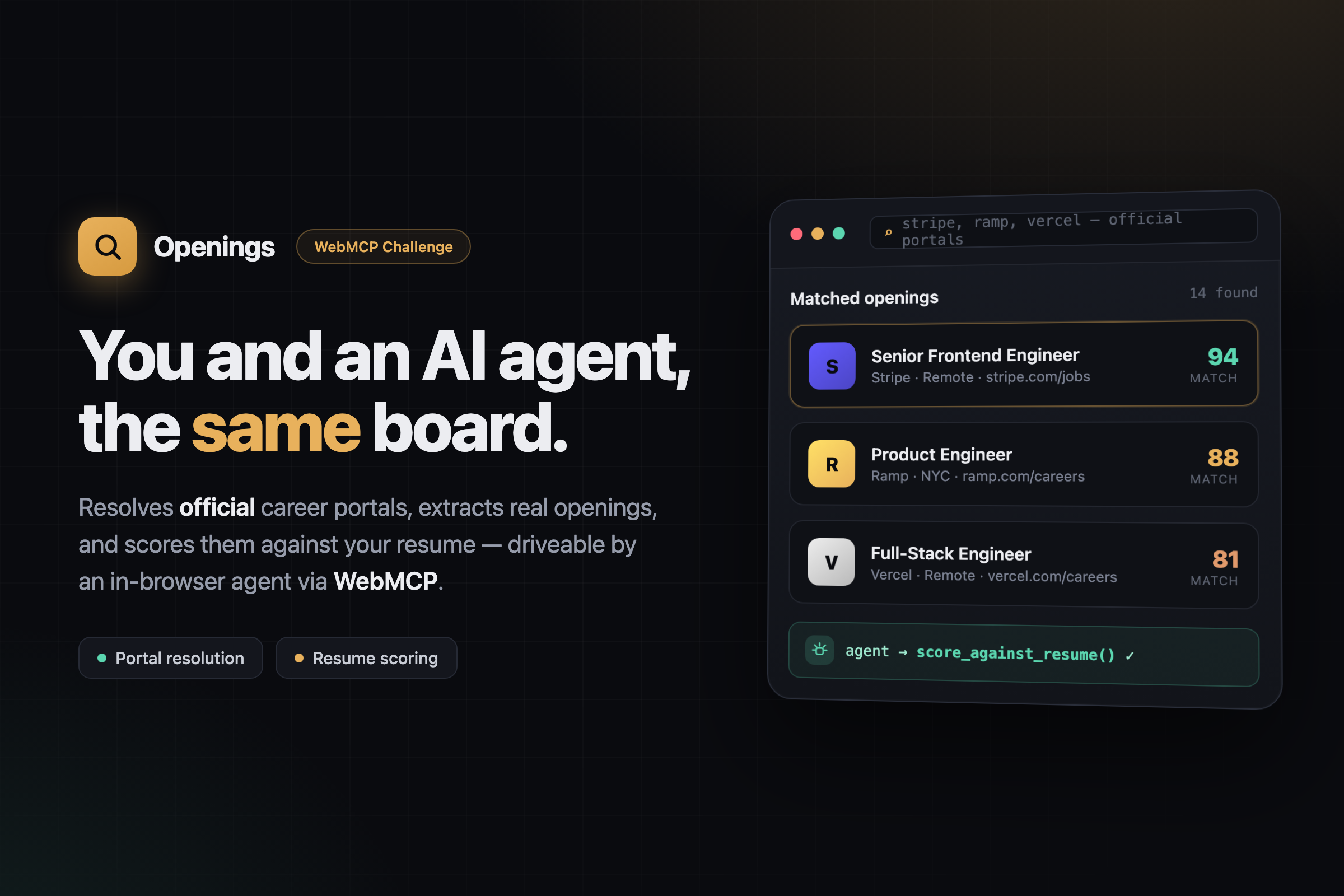
- Resolves each company's official career portal — skipping aggregators, going straight to the source (e.g.
stripe.com/jobs,ramp.com/careers). - Extracts the real, current openings from that portal via a server-side crawl and structured extraction.
- Scores every role 0–100 against your resume, with honest strengths, gaps, and tailored bullet rewrites that reframe your real experience — never fabricated.
- Keeps everything on one shared board with a live activity feed.
The key idea: nothing is "agent-only" or "human-only." Every WebMCP tool is a thin wrapper over the same store action a UI button calls, so the human and the agent drive identical code and see one shared state. Paste companies and click Import, or ask the agent to do it — the outcome is the same. The agent handles the breadth (opening twenty portals in seconds); the human keeps the judgment (shortlisting, accepting resume edits).
How we built it
- Frontend: Vite + React + TypeScript + Tailwind CSS — a split-screen workspace (pipeline board on the left, resume canvas + activity feed on the right).
- State: a framework-agnostic observable store (
src/store.ts) shared by both the UI and the agent, persisted to the browser'slocalStorage. - WebMCP: five tools registered on
document.modelContext.registerTool(...)—import_from_naukri,discover_company_jobs,add_job_to_board,match_with_resume,list_board_jobs. Each is a thin wrapper over a store action, and registration no-ops gracefully when WebMCP is absent, so the app still works as an ordinary web app. - Serverless: Netlify Functions handle portal resolution, career-page crawling, structured extraction, and resume scoring — so no API key ever touches the browser, and the SPA and functions share one origin (which WebMCP requires).
- AI: a pluggable provider facade — Mistral (
mistral-small-latest, default) or Google Gemini (gemini-3.6-flash) — behind onegenerateJsoncontract, swappable with a single env var.
Challenges we ran into
- JS-only career SPAs that can't be crawled. We added a knowledge-based fallback that returns the model's best-known roles, clearly flagged
unverifiedin the activity feed so the user is never misled. - Structured-output reliability. Gemini's JSON mode could stall, so we built a circuit breaker: structured output is throttled independently, and if it trips, the helper falls back to plain-text JSON and skips the slow path on later calls.
- Bounded latency. SDK retries are capped and every attempt is timed out, so a request never hangs for minutes during a live demo.
- One-origin constraint. WebMCP requires the SPA and its functions on the same origin — we run everything through
netlify devlocally so the tools connect exactly as they do in production.
Accomplishments that we're proud of
- A genuinely shared human–agent surface: one code path, one board, no "demo-only" wiring.
- Going past aggregators to the official source for every role, with a direct link on every card.
- Honest resume scoring with truthful bullet rewrites — sharpening real experience, never inventing it.
- A backend that stays resilient even on free API tiers, so the demo doesn't fall over.
What we learned
WebMCP changes how you architect an app: the moment your UI actions and your agent tools are the same functions, "agentic" stops being a bolt-on and becomes the natural shape of the code. The hard part isn't exposing tools — it's designing a store clean enough that a button and an agent can safely share it.
What's next for Openings — Agent Native Job Discovery
- More ATS adapters (Greenhouse, Lever, Ashby) for deeper, verified extraction.
- Application tracking and status stages on the board.
- Multi-resume profiles and per-role tailoring.
- Swappable persistence (Netlify Blobs) so a board can sync across devices.
Built With
- ai
- context
- css
- functions
- gemini
- mistral
- model
- netlify
- protocol
- react
- serverless
- tailwind
- typescript
- vite
- webmcp

Log in or sign up for Devpost to join the conversation.