Inspiration
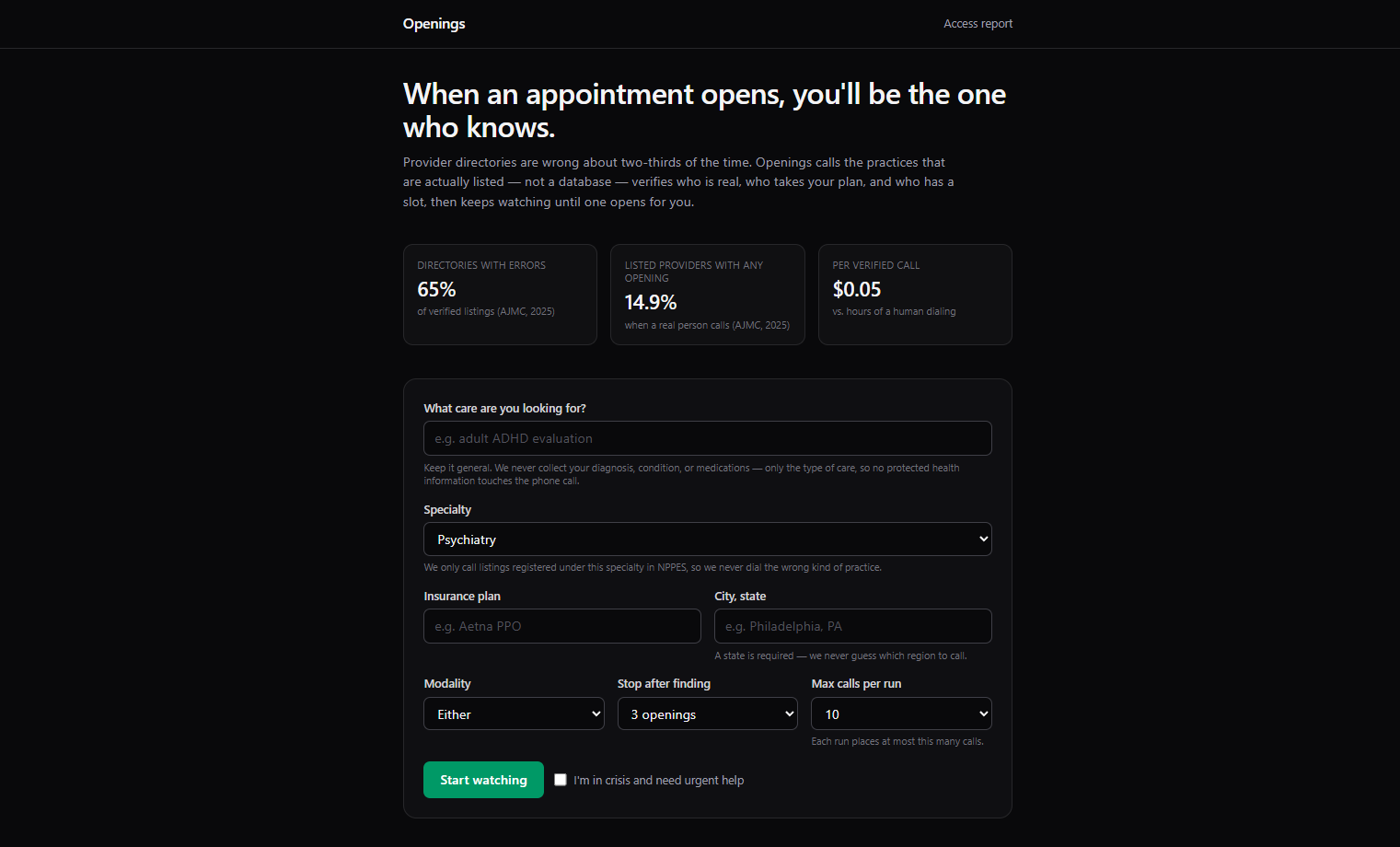
Provider directories are wrong about two-thirds of the time. A 2025 secret-shopper study of the Pennsylvania ACA marketplace (8,306 behavioral-health providers) found that 65.2% of verifiable listings had at least one inaccuracy, 56.6% had a wrong phone number, and appointments were actually available for only 14.9% of listed providers. When you need care, a directory tells you to dial twenty numbers to find one real opening.
Directory data cannot be trusted — only a phone call establishes the truth. That was always true, but it was too expensive to do at scale. CALL-E changes the economics: at a few cents a call, dialing every listing — and re-dialing until a slot opens — is affordable for the first time. So we built Openings, a standing availability watch for care access.
What it does
Openings takes the care you need, your insurance plan, your city, and a specialty, then calls the practices that are actually listed — not a database — to verify who is real, who takes your plan, and who has an opening. If nothing is open, it keeps watching until a slot appears, then stops.
- Frame — builds the candidate list from the federal NPPES NPI Registry (by specialty and city/state). Every number carries provenance; none is synthesized.
- Gate — screens the request for crisis language (diverts to 988) and for PHI (rejected; the app never collects a diagnosis or medication details, so no protected health information ever touches the phone call).
- Verify — a wave engine dials practices in controlled waves and stops the moment the target number of openings is confirmed. Each call identifies itself as an automated assistant and asks only two questions: do you accept this plan, and do you have an opening?
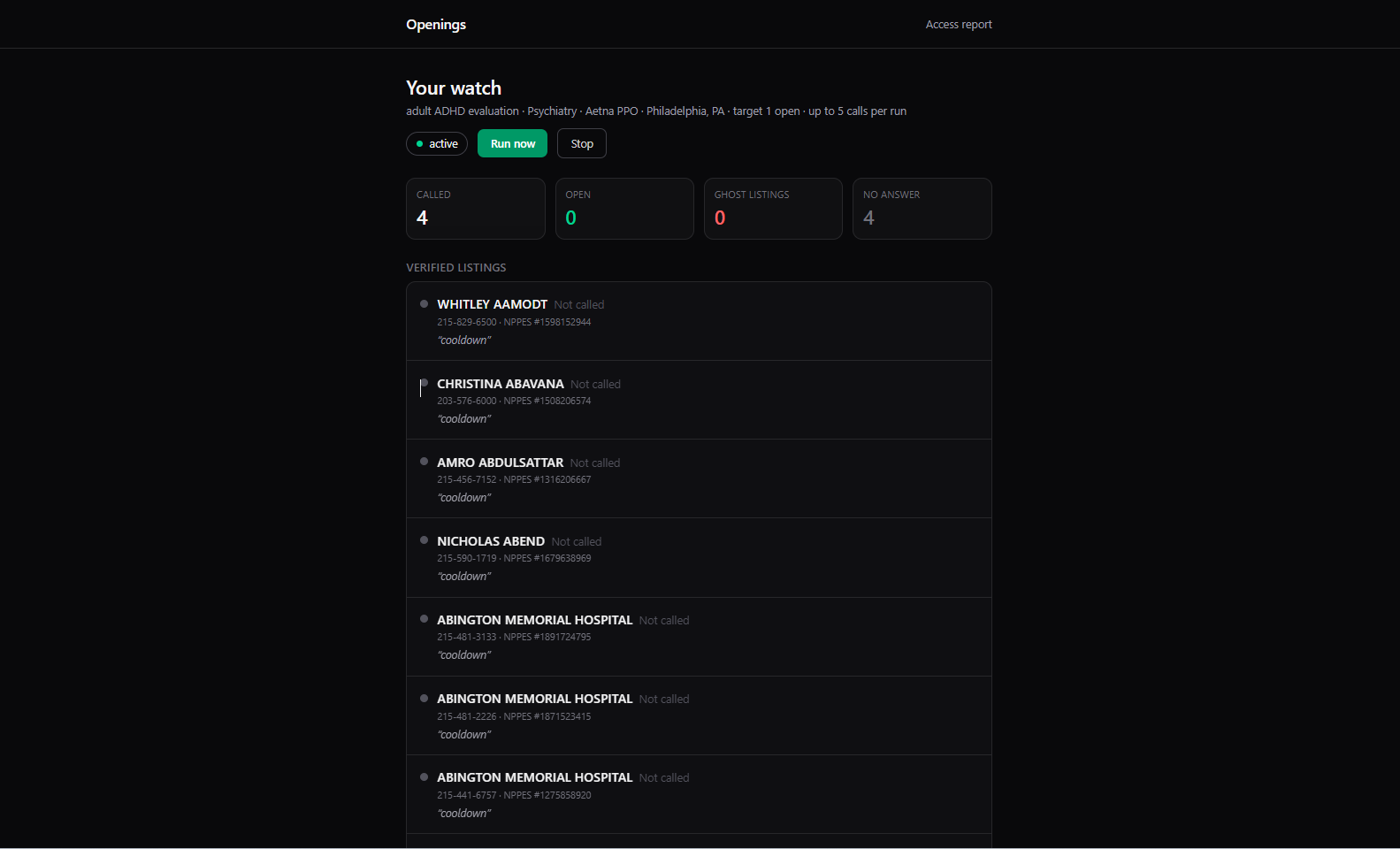
- Watch — when nothing is open, the host scheduler re-calls on a decaying cadence until an opening appears or the user stops it.
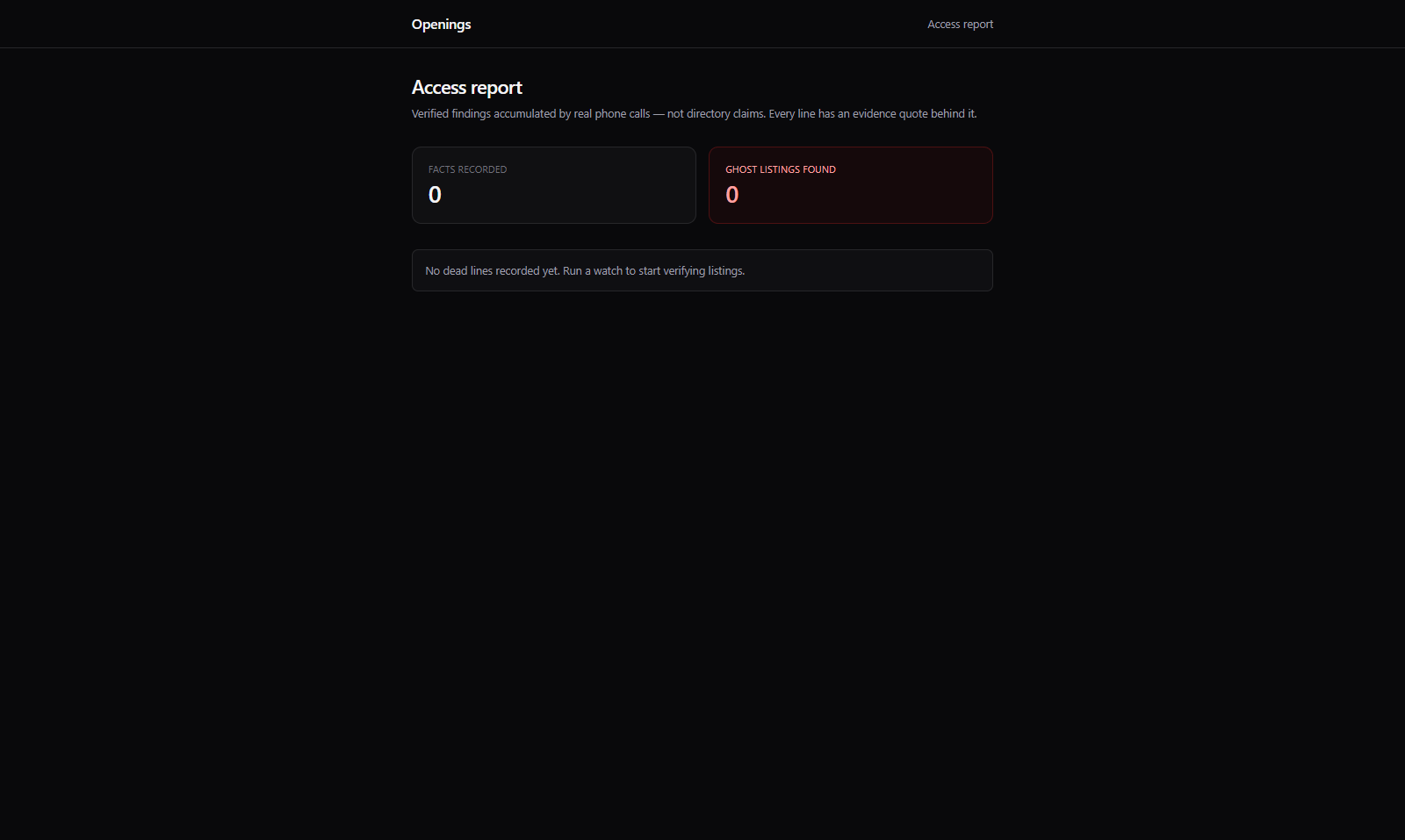
Every call returns a verdict with a verbatim evidence quote and CALL-E's post-call summary, so nothing is taken on faith. Dead and misrouted lines accumulate into a verifiable access report — facts proven by calls, not by claims.
How we built it
- Next.js 15 (App Router + server actions), TypeScript, React 19, SQLite (WAL), Tailwind CSS.
- CALL-E SDK (
@call-e/calle) viacreateAndWait, with a strict result schema — enums that includeunknownplus a requiredevidence_quote— stable idempotency keys, and a 6-minute timeout so calls can survive IVR/hold. - Local, pure classifier. Verdicts are computed by a unit-tested pure function, never in the prompt.
unknownis never upgraded to a confident verdict. - Host-owned recurrence (the CALL-E community's Design Principle 1): a separate scheduler process triggers exactly one CALL-E call per scheduled run; the provider is never asked to recur.
- Safety as a first-class layer: E.164 normalization, a 24-hour cooldown per practice, permanent opt-out, and a hard per-run call cap so cost and blast radius are always bounded.
Challenges we ran into
- Real calls are slow. A call spends 1–6 minutes in IVR/hold, so a synchronous "Run now" server action blocked the request until the browser dropped the connection (EOF). We moved dispatch to a background job with client-side polling and a live "calling" state.
- Honest classification is hard. We had to distinguish reached a human but got no answer (inconclusive) from no one answered (unreachable) from the directory lied (ghost) — a human saying "How can I help you?" is not the same as a voicemail.
- Two processes, one container. Running the Next.js server and the scheduler together over one SQLite file worked, until an
unref()'d scheduler timer left an empty event loop — the scheduler exited instantly andwait -ntook the whole container down. - Directory rot is the product. NPPES's
enumeration_typewas silently discarding organizations (NPI-2), and the specialty filter had to be a closed, explicit choice — inferring it from free text would mean dialing the wrong kind of practice.
Accomplishments that we're proud of
- An honest classifier. Unknown is never upgraded to a confident verdict; "reached a human, no answer", "no one answered", and "the directory lied" are three distinct outcomes, each with an evidence quote behind it.
- A "keep calling until it opens" product that stays safe. The 24-hour cooldown, permanent opt-out, per-run call cap, and host-owned recurrence keep it a feature instead of a nuisance.
- A test suite you can run blind. 54 tests pass with no credentials, no network, and no native-module build; live calls are strictly opt-in.
- Verified live, end to end. Real calls to Philadelphia psychiatry practices produced honest verdicts and an access report — including ghost listings — not a scripted demo.
What we learned
The big one: structured results with an evidence quote beat prompt-based judgment. When the model has to commit to a schema (line_outcome, accepts_plan, accepting_new_patients, a quoted evidence_quote), the system can classify honestly and show its work. The decaying watch is a simple idea with sharp edges — cooldowns, opt-outs, and a per-run cap are what keep it from becoming harassment.
What's next for Openings
- More sources, more specialties. Frame from multiple directories (not just NPPES) and add a consent-gated paste/CSV import.
- Alert the human when a slot opens. SMS/email notifications, and a booking handoff (Openings never books on the caller's behalf).
- Business-hours-aware scheduling. Call practices during their timezone's business hours instead of whenever the watch ticks.
- Supply-side directory health. The accumulated access report is data payers, health systems, and state marketplaces want but don't have.
- Navigator/employer tier. Multi-user accounts, scheduling integrations, and HIPAA hardening for care-coordination teams.
Built With
- ai-agents
- call-e
- call-e-sdk
- docker
- healthcare
- nextjs
- node.js
- pnpm
- react
- sqlite
- tailwindcss
- typescript

Log in or sign up for Devpost to join the conversation.