
Inspiration
Every headliner tour stop needs the right local opener.
For independent venues, finding that artist is surprisingly difficult. A talent buyer has to balance three questions: Does this artist fit the headliner's audience? Are they genuinely connected to the city? Are they appropriate for the room?
Today, much of that work happens manually—searching streaming platforms, asking around, checking old articles, and trying to establish whether an artist is still active or based locally.
Generic AI doesn't solve the problem. In our tests, an LLM confidently described artists such as Mitski, Soccer Mommy, and Snail Mail as currently based in Atlanta, despite our research finding no reliable support for those claims.
We wanted to build something different: an agent with cultural taste, evidence-based research, and the judgment to say no.
What it does
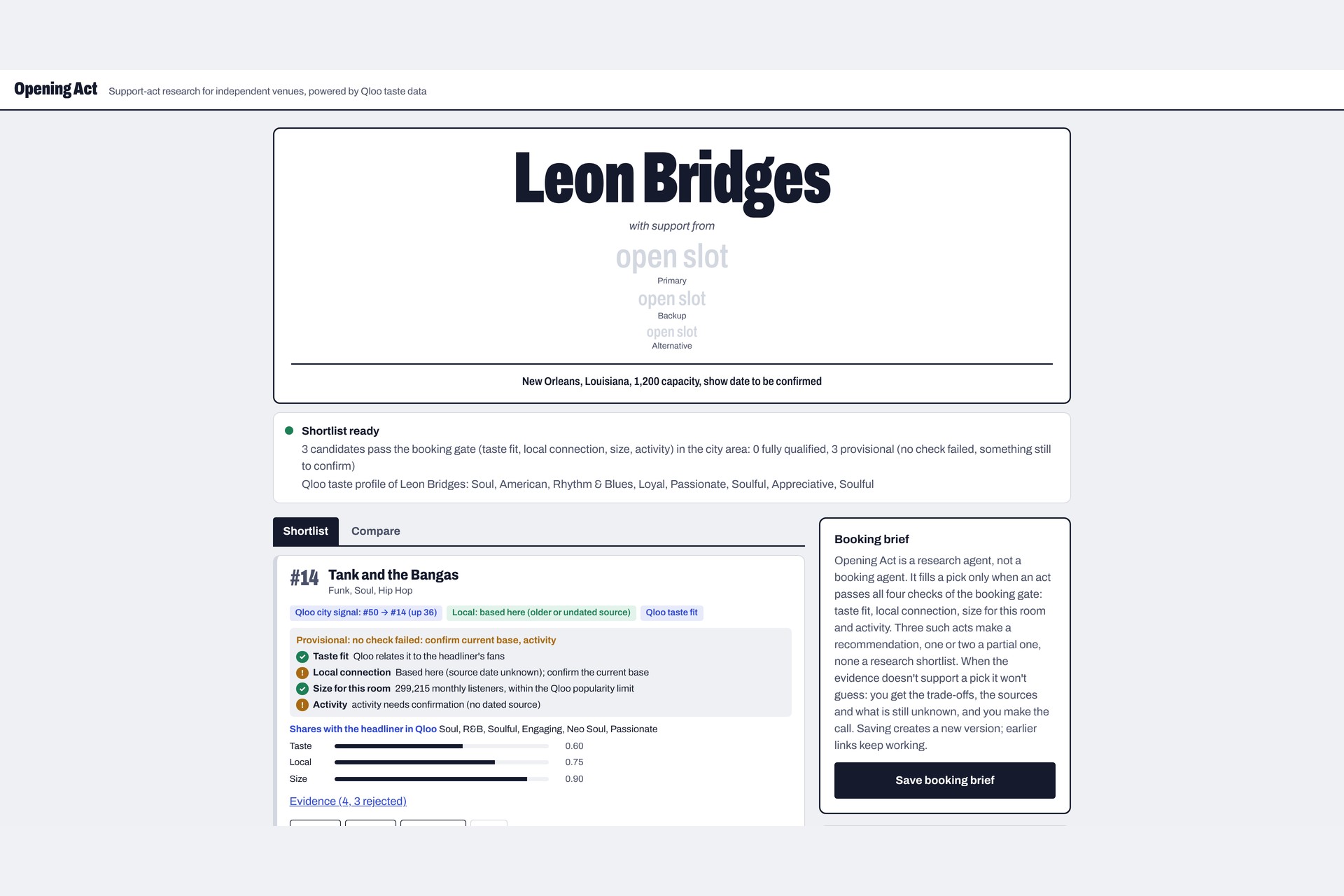
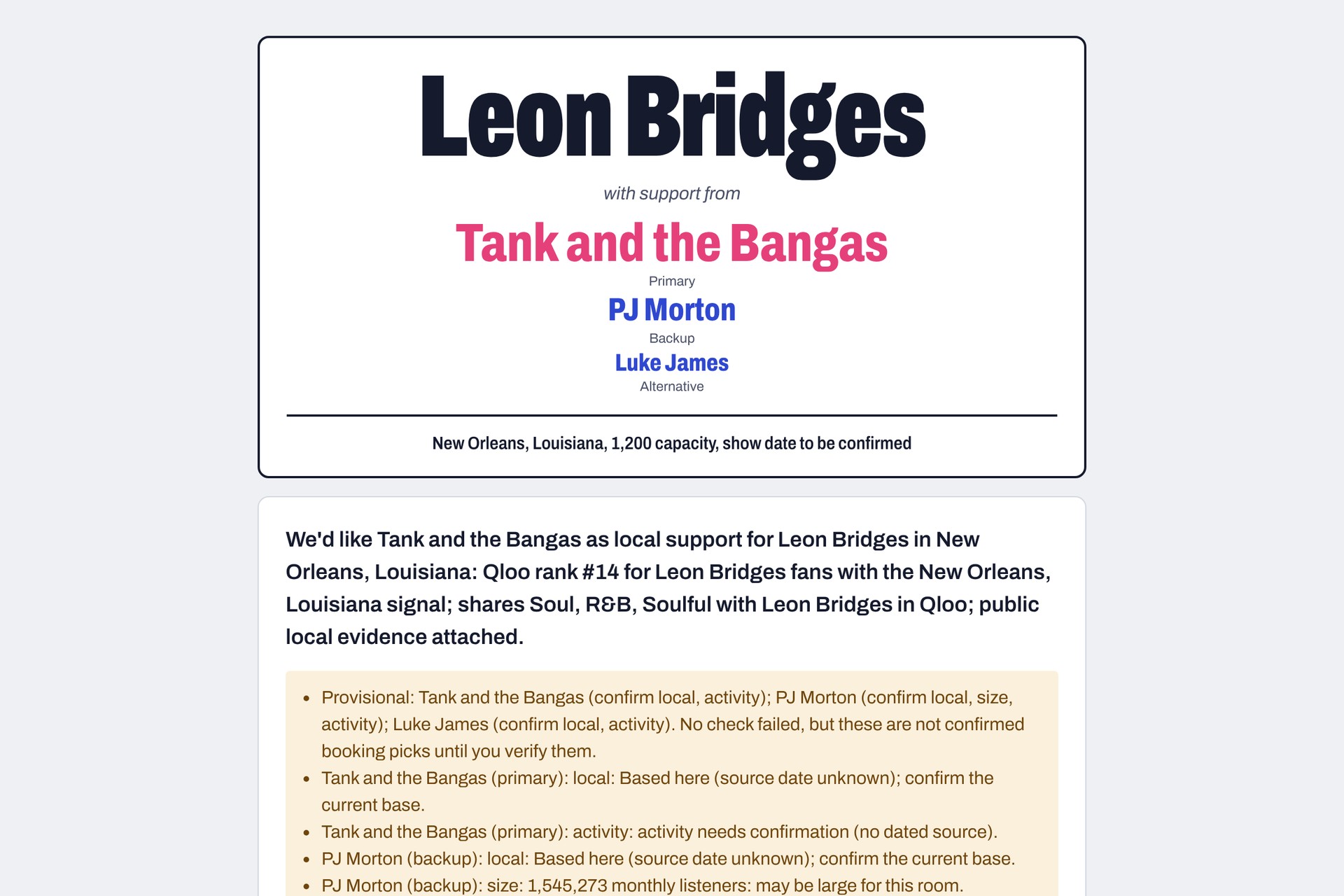
A talent buyer enters a headliner, a city, and a venue capacity. Opening Act investigates the local music scene and produces an evidence-backed booking brief.
Discover with Qloo
Opening Act uses Qloo Taste AI to discover artists whose audiences and cultural signals connect with the headliner.
Crucially, it uses the requested show city as a location signal—not just the headliner's musical genre.
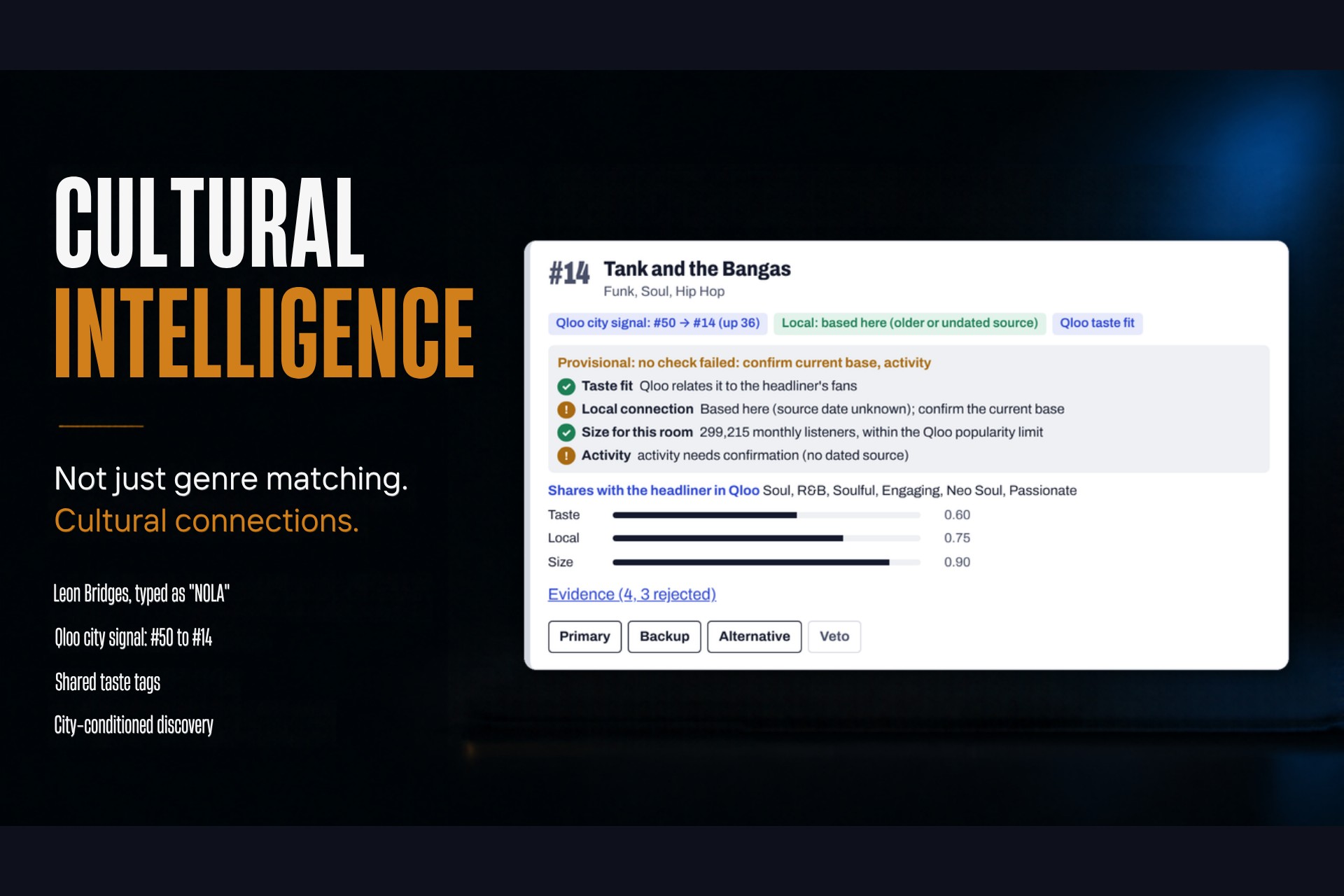
In our Leon Bridges / New Orleans experiment, Tank and the Bangas moved from #50 in the baseline results to #14 with the city signal. This illustrates how location-conditioned cultural discovery can change the candidate pool.
Investigate like a researcher
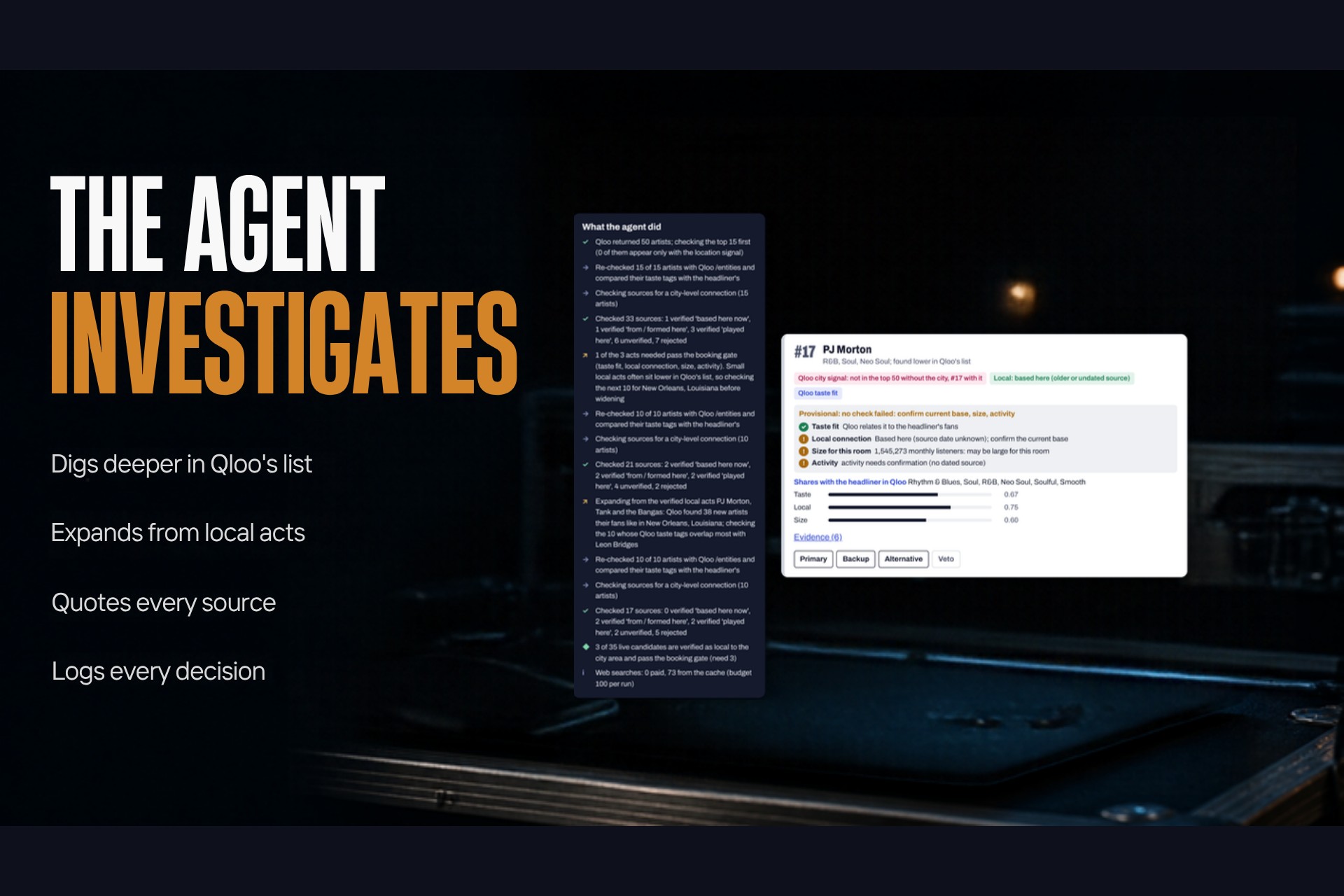
If the initial results don't produce enough suitable local acts, the agent expands its investigation.
It can:
- Explore deeper into Qloo's related-artist results.
- Use verified local artists as seeds for Qloo scene expansion.
- Explore additional local names using the headliner's cultural signals as guidance.
- Widen the search from city to metropolitan area and, when necessary, state.
The agent logs its actions and explains why it expands the search. It doesn't silently replace missing evidence with guesses.
Verify the local connection
Finding an artist associated with a city is not the same as establishing that the artist is local.
Opening Act checks candidate identity and investigates local claims using web sources, MusicBrainz, and available Qloo data.
Its evidence process distinguishes between:
- A current local base.
- A historical or hometown connection.
- An older or undated source.
- A performance in the city, which does not establish residency.
- Conflicting or insufficient evidence.
A source must support a claim about the artist itself—not an unrelated artist with the same name, another band member, or a venue where the artist performed.
The system also searches for potentially contradictory information, such as evidence that an artist has moved away. When the evidence is incomplete, the candidate is flagged rather than presented as definitively local.
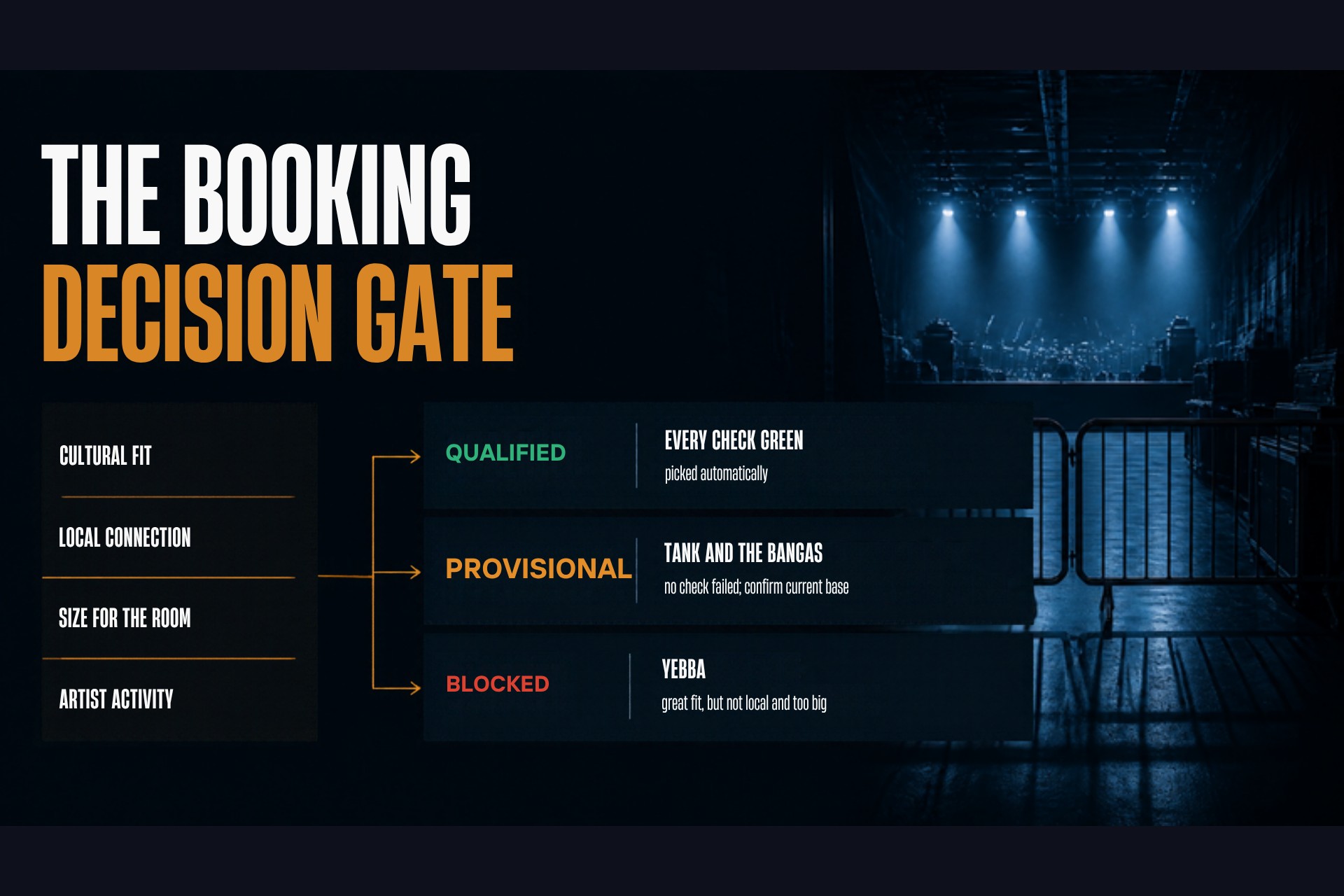
The Booking Decision Gate
This is the central decision-making feature.
Every candidate is evaluated against four dimensions:
- Taste fit: Qloo affinity or shared cultural taste signals.
- Local connection: Evidence supporting the artist's relationship with the requested area.
- Venue suitability: A popularity-based heuristic informed by Qloo and available listener data, sized to the venue capacity.
- Artist activity: Whether there is sufficient evidence to support current activity.
Candidates receive one of three outcomes:
- Qualified: Clears all four checks.
- Provisional: No check has failed, but one or more details still need confirmation.
- Blocked: Fails at least one booking requirement.
Only candidates that satisfy the booking rules can be automatically selected. If there aren't enough suitable candidates, Opening Act produces a partial recommendation or research shortlist instead of filling the brief with weak matches.
The buyer stays in control
The buyer can:
- Adjust the relative importance of taste, local connection, and room size.
- Veto candidates.
- Mark candidates as primary, backup, or alternative.
- Expand the search area.
- Enable or disable the size filter for exploration.
- Compare Opening Act against an LLM-only approach and raw Qloo results.
- Save and share versioned booking briefs.
Opening Act is a research agent, not an autonomous booking agent. It helps the buyer make a better-informed decision; the buyer makes the final call.
How we built it
Qloo Taste AI
We integrated the Qloo hackathon API into the discovery and cultural intelligence pipeline.
/searchresolves the headliner. Ambiguous identities require clarification./v2/insightsdiscovers related artists using cultural affinity and the requested location signal.- A baseline query without the city allows us to compare how location changes discovery.
filter.popularity.maxsupports room-size filtering based on the venue capacity.- Verified local artists can become seeds for additional scene discovery.
/entitiesretrieves candidate identity and cultural taste information for further evaluation.
Backend
- Python and FastAPI.
- Background agent workflow.
- SQLite persistence.
- Versioned booking briefs and share links using random tokens.
Evidence and AI
- Tavily for web research.
- MusicBrainz and available Qloo data for supporting artist information.
- OpenAI GPT-4o-mini for interpreting retrieved material as a research aid.
- Deterministic backend rules make the final evidence and booking decisions; the language model does not independently decide whether an artist is local or eligible.
Search results are cached for 14 days, with a limit of 100 paid searches per run.
Frontend
- React and Vite.
- A gig-poster-inspired booking interface.
- Candidate cards with evidence, score breakdowns, and decision-gate status.
- A live agent activity log showing what the system investigated and why.
Quality and evaluation
- 144 automated tests.
- Live end-to-end smoke testing.
- An evidence evaluation using hand-labelled development cases and two held-out cities.
Challenges we ran into
Locality is harder than it looks
Early versions made mistakes that a real talent buyer could not afford.
We encountered false matches involving the band Whitney and Whitney Houston, an unrelated reference to someone's mother living in Atlanta, and a bandleader incorrectly assigned a keyboardist's relocation history.
Each discovery led to a change in the evidence rules and a regression test.
Old sources can create misleading confidence
An article describing an artist as Austin-based in 2017 does not establish that they are still based there today.
We introduced dated evidence statuses and additional checks for current-base claims. When the available sources cannot establish a current connection, the system says so.
Local does not automatically mean suitable
One early version recommended a local country artist as an opener for Khruangbin simply because the locality evidence was strong.
That exposed a fundamental weakness: a local connection alone is not enough.
We introduced the Booking Decision Gate so that cultural fit, locality, venue suitability, and activity all matter before an automatic recommendation is made.
Accomplishments that we're proud of
We audited our own system—and published what we found.
An earlier version reported that 8 out of 8 local acts were correct. When we re-evaluated those same cases using stricter evidence standards, only 1 of the 8 remained fully supported. Three acts had moved away, two had conflicting sources, and two could not be re-checked.
Rather than hide that result, we rebuilt the evidence layer.
On our subsequent 37 hand-labelled evaluation cases:
- The evidence layer produced 15 correct local classifications out of 15 local calls, with no false local claims in that sample.
- Recall was 67% on development cases.
- Recall was 82% across two held-out cities that were not used for tuning.
These are results from a limited, manually labelled evaluation—not a claim of universal accuracy. We include the evaluation material in the repository under eval_pack/ so the approach can be inspected.
We are particularly proud that the system can expose uncertainty instead of disguising it as confidence.
What we learned
- Cultural relevance and geographic relevance are different problems. Qloo's location signal helps connect cultural discovery to the requested city.
- Evidence quality matters as much as discovery quality. Finding a candidate is only the beginning; establishing why they belong on the shortlist is harder.
- A useful agent must know when not to recommend. A provisional candidate is not a confirmed booking, and a blocked candidate should not be quietly promoted to fill an empty slot.
- Transparency builds trust. Showing evidence, rejected claims, trade-offs, and uncertainty makes the buyer part of the decision rather than asking them to trust a black box.
What's next for Opening Act
- More recent, dated sources to help candidates progress from provisional to qualified.
- Real ticketing, attendance, and draw data to improve venue-suitability estimates beyond popularity proxies.
- Better geographic normalization, including nearby suburbs and metropolitan areas.
- Evaluation with working talent buyers and real booking workflows.
Honest limitations: Our evaluation labels are manually created, the venue-size check is a heuristic rather than an attendance forecast, and many available sources are undated. Consequently, some candidates remain provisional. Artist availability, fees, and willingness to perform are not established by this system.
Opening Act does not promise a perfect lineup. It gives talent buyers a more transparent, evidence-backed way to discover and evaluate the right local opener.
Discover the scene. Verify the connection. Make the call.
Built With
- fastapi
- gpt-4o-mini
- hetzner
- javascript
- musicbrainz
- nginx
- openai
- playwright
- python
- qloo
- react
- sqlite
- tavily
- vite

Log in or sign up for Devpost to join the conversation.