-
-
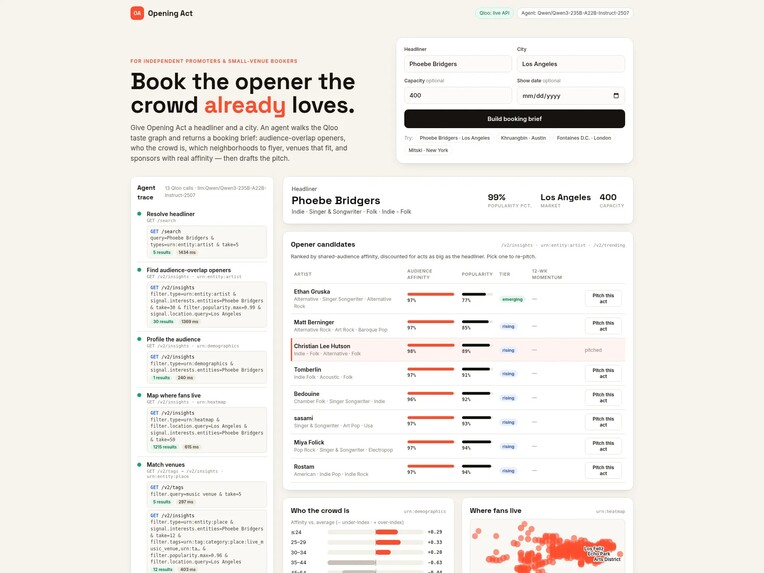
Live run: Phoebe Bridgers · LA — agent trace (13 Qloo calls) and ranked audience-overlap openers
-
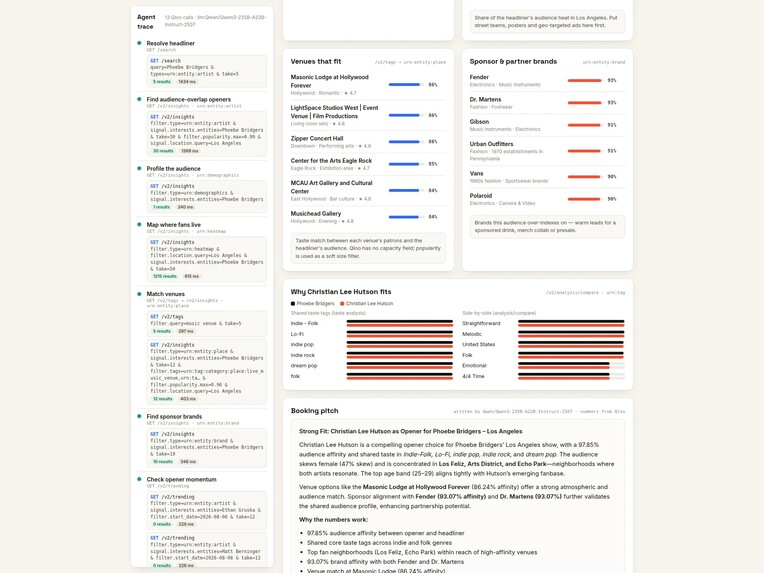
Venues, sponsor brands, overlap analysis and the LLM-written booking pitch
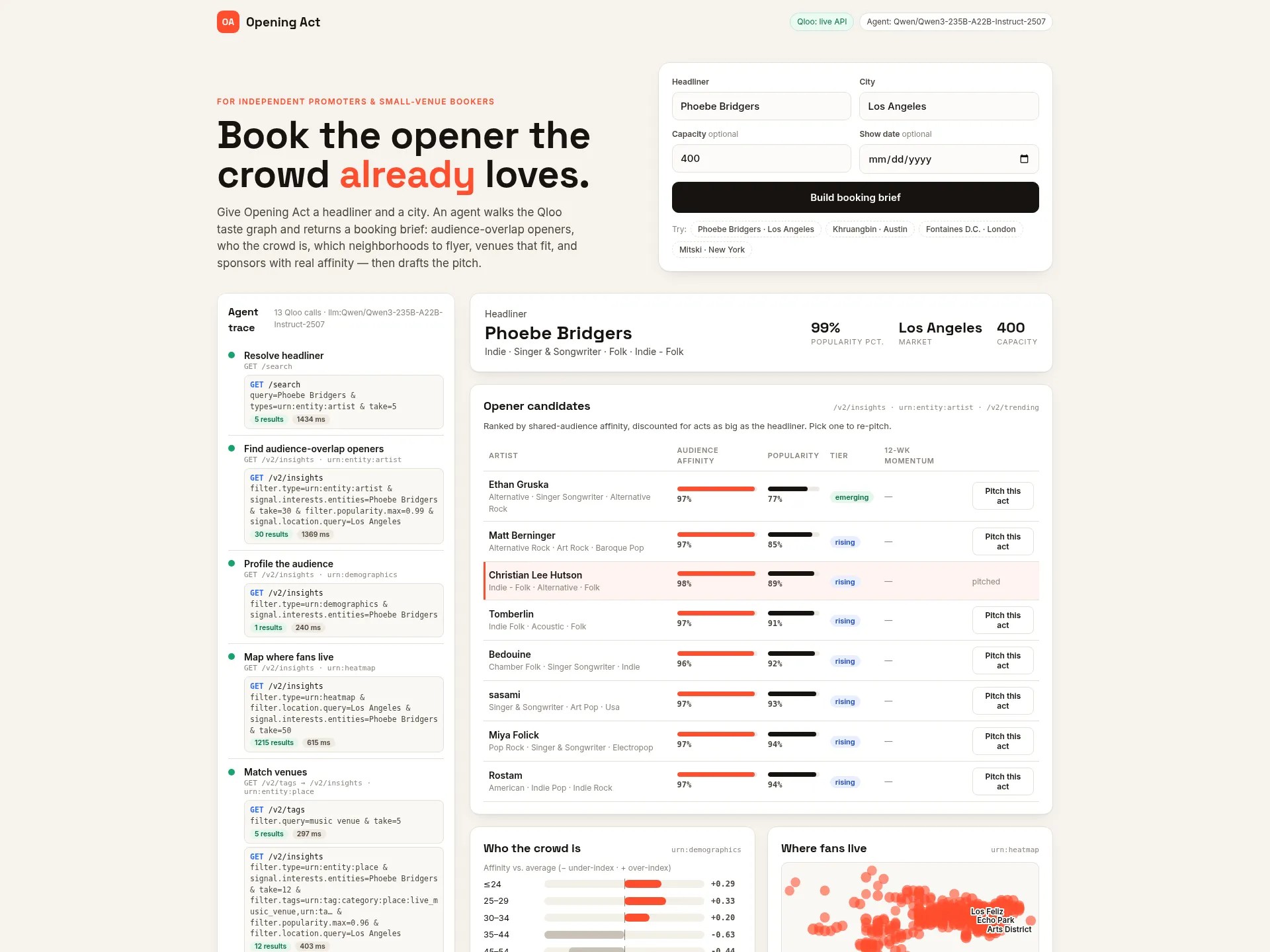
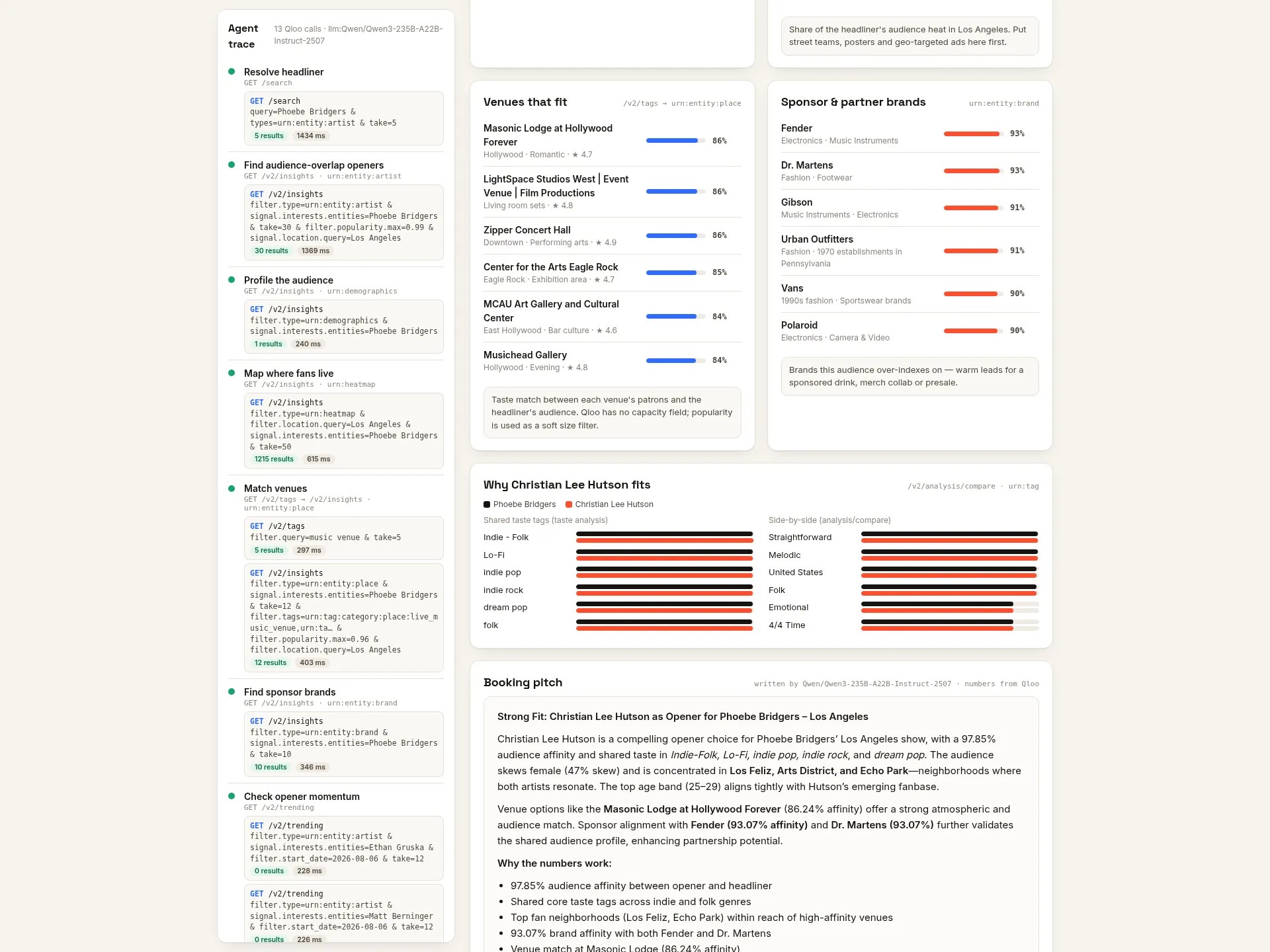
Try it: https://opening-act.onrender.com Code: https://github.com/taku629/opening-act (MIT) The live demo runs on the real Qloo hackathon API. Try "Phoebe Bridgers" + "Los Angeles" or "Mitski" + "Tokyo". (Free instance: the first request after idle can take ~30 s.)
Inspiration
Most live music happens in small rooms, and the people booking them — independent promoters, club talent buyers, DIY collectives — pick openers and plan promo from gut feel, "Fans also like" lists and DMs. The questions that decide whether a night sells are measurement questions: which smaller act already shares my headliner's audience, which neighborhoods does that audience live in, and which local brands want to reach exactly these people? Big promoters have data teams for this. Small promoters have none. Qloo's taste graph answers all three.
What it does
Enter a headliner and a city (optionally venue capacity and date). An agent walks the Qloo taste graph in a visible, multi-step tool-calling loop and returns a one-page booking brief:
- Openers whose fans already overlap with the headliner's, ranked by Qloo audience affinity, capped below the headliner's popularity and biased toward emerging acts
- 12-week momentum for each opener (rising / steady / cooling) from /v2/trending, shown when Qloo has trend data for the act
- Who the crowd is: age and gender affinity (urn:demographics)
- Where the crowd lives: a heatmap of the city (urn:heatmap) rolled up into neighborhoods with their share of audience heat — where to put posters, street teams and geo-targeted ads
- Venues whose patrons share the headliner's taste, filtered to live-music venue, concert hall and club tags
- Sponsor and partner brands the audience over-indexes on
- Why the opener fits: shared taste tags, side by side
- A booking pitch for the opener's agent or a sponsor that cites the Qloo numbers, with copy, Markdown export and print view Swap the opener and the brief rebuilds. A "Without Qloo vs. With Qloo" panel shows what an LLM alone would say next to the evidence-backed answer.
How we built it
- Backend: Python, FastAPI, Server-Sent Events streaming each agent step and each Qloo call to the UI live.
- Agent: an OpenAI-compatible tool-calling loop (Qwen3-235B on Nebius Token Factory) planning across 8 tools. If the model fails or skips a step, a deterministic planner fills the gap, so every run finishes with a complete brief.
- Qloo: a single client that only talks to https://hackathon.api.qloo.com with X-Api-Key, uses GET /v2/insights, /search, /v2/tags, /v2/trending and /v2/analysis/compare, and never the legacy recs endpoints. A full brief makes about 13 Qloo calls. Every /v2/insights request is checked against an allow-list built from Qloo's parameter guide per entity type, because invalid parameters are silently ignored; anything stripped is flagged in the trace. Timeouts, bounded retries, error categories, a private memory + SQLite cache, and per-IP rate limiting protect the public demo.
- Frontend: plain HTML/CSS/JS with inline SVG charts, mobile-friendly, no build step.
- 15 offline tests cover the API, streaming, opener swap, export, parameter hygiene, retries/auth/caching, rate limiting, the LLM loop and its fallback.
Challenges we ran into
- Qloo ignores parameters that don't apply to a filter.type and can return empty results, so we built parameter validation and location fallbacks (filter vs. signal location, then no location) with the fallback noted in the brief.
- Raw affinity favors huge artists who would never open; we re-rank with a popularity penalty relative to the headliner plus a filter for non-music acts.
- Turning heatmap geohash cells into something a promoter can act on: the live API returns the whole city grid (1,000+ cells), so we rank named neighborhoods on the hottest 10% of cells.
- Qloo's artist type also contains comedians and podcasters; we filter them out so the opener list is bookable musicians. A generic "music venue" tag search returned hotels, so we switched to Qloo's place-category tags (live music venue, concert hall, night club) after testing them against the live API.
Accomplishments that we're proud of
- On live data it gets real-world bookings right: for Phoebe Bridgers in Los Angeles the agent's top pick is Christian Lee Hutson, her longtime collaborator, with venues like the Masonic Lodge at Hollywood Forever and Fender as the top sponsor lead; for Mitski in Tokyo it suggests sasami and rooms like FORESTLIMIT.
- Every number in the brief is traceable: the UI shows each Qloo call with endpoint, key parameters, result count, latency and cache status.
- The brief answers questions an LLM alone cannot: audience overlap, where fans live, and brand affinity.
- It always finishes — robust to LLM failure, API errors and unresolved cities.
What we learned
Taste overlap is a far better booking signal than genre similarity, and the most useful output for a small promoter is not a list of names but a plan: who to book, where to promote, and who to pitch for sponsorship.
What's next for Opening Act
Multi-night season planning, tour routing across cities, ticketing/CRM integration to close the loop on what actually sold, and venue-side mode (find headliners whose crowd matches my room).
Built With
- css
- fastapi
- html
- javascript
- nebius
- python
- qloo
- qwen
- render
- server-sent-events
- sqlite
