See everything. Expose nothing.
OpenHello Vision is the OpenCV 5 agent that gives OpenHello its eyes. It makes every photo safe before any AI sees it: it blurs faces, hides ID-card details, catches risky QR codes, re-checks its own work, asks a human before anything risky goes further, and never identifies a person.
Inspiration
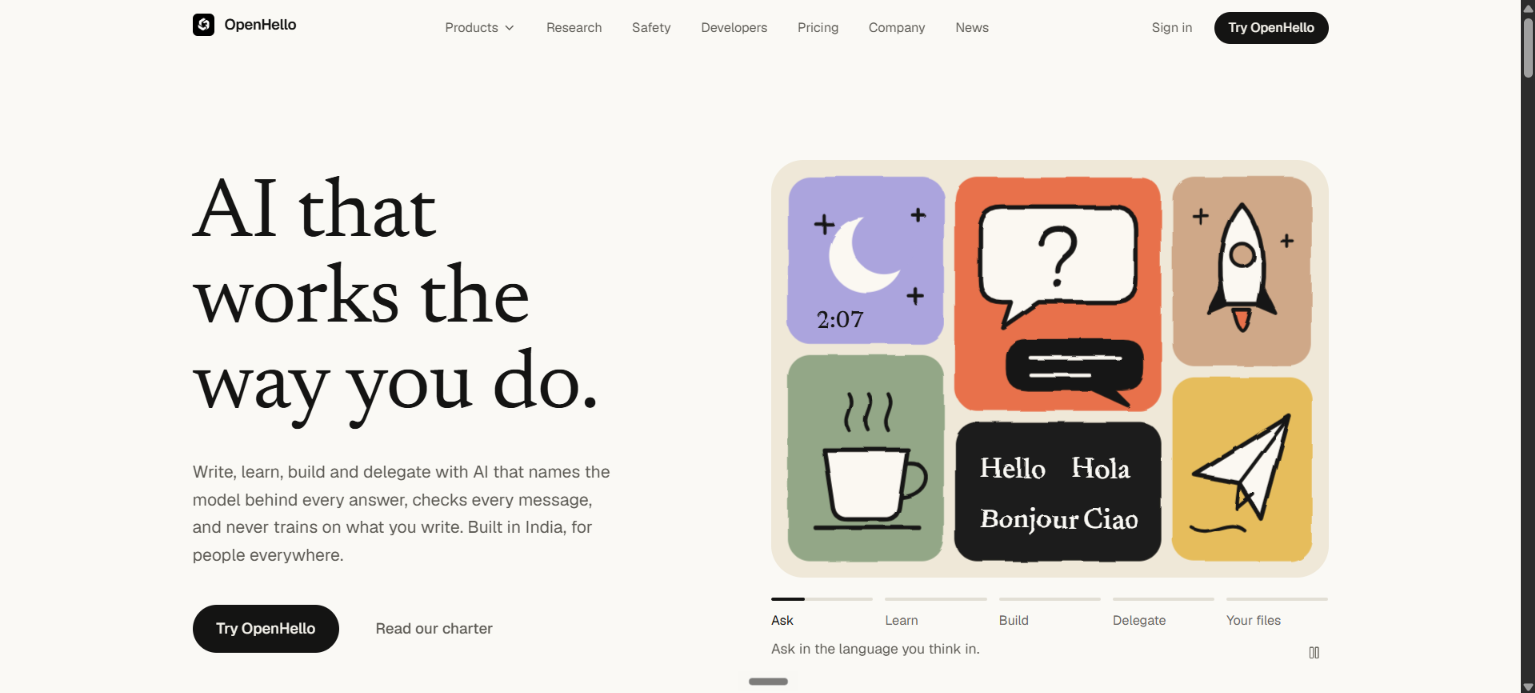
People hand AI their most private things every day: ID cards, bills, family photos, Wi-Fi posters, UPI payment QR codes. Most AI apps send all of it straight to a model. We're building OpenHello (openhello.in), a privacy-first AI platform from India for people everywhere. Its tagline is AI that works the way you do, and its promise is private by default. Text already had that promise. Images didn't, so we built Vision.
OpenHello at a glance
- Live today at openhello.in, free during the preview, in any browser, with no install and no card.
- Built in India, for people everywhere: ask in English, Hindi, Hinglish, Spanish, Arabic, Japanese and more.
- Private by default: nothing you write trains a model, and the providers that answer may not train on it either. Deleting a chat deletes it. History can be switched off. We handle privacy requests under GDPR, CCPA and India's DPDP Act.
- Safety in both directions: every message is checked on the way in and on the way out, and refusals are logged without your words.
- Honest by design: every answer names the model that wrote it, and every unfinished product says "coming soon" until it works. Our rule: ship it or don't claim it.
Every OpenHello product
| Product | What it does | Status |
|---|---|---|
| OpenHello Chat | A thinking partner for writing, learning and working things through. Auto picks the model; you can also choose one. Model name on every reply, safety checks both ways, history on or off. | Live |
| OpenHello Code | A real Node.js runtime in your browser, with an assistant that writes code into it and runs it. Licence-free runtime, no install. | Live |
| OpenHello Vision | This entry: an OpenCV 5 agent on AWS that makes images safe before AI sees them. Going into Chat. | Demo working, joining Chat |
| OpenHello Flows | A company of AI teammates. Each gets its own private computer to run code and build files, plans the work, and asks before anything with consequences. Auto mode runs long tasks to completion. | Coming with the desktop app |
| OpenHello Work | An agent that works inside one folder you choose on your own computer: sorting, drafting and building files. | Coming |
| OpenHello Design | Posters, visuals and app screens from a prompt, with original layouts. | Coming |
| OpenHello Ember | A private AI engine that runs on your own device, so your words never leave it. Built to run large open models on an ordinary laptop with no GPU. | Coming |
| OpenHello AI desktop app | Chat, Code, Work and Flows in one app, with live voice and live thinking steps. | Coming |
| OpenHello Route (Auto) | Picks the right model for each message, so users don't have to. | Live as Auto |
Every OpenHello model
Served today in Chat (20+ open models): Gemma 4 26B, Llama 4 Scout, Llama 3.3 70B, Llama 3.2 1B and 3B, Llama 3.1 8B, Qwen3 30B, Qwen3 235B, QwQ 32B (reasoning), Qwen2.5 Coder 32B, DeepSeek R1 Distill 32B, Mistral Small 3.1 and 3.2, GLM-4.7 Flash, Granite 4.0 Micro, Nemotron 3 Super, GPT-OSS 120B and 20B. They run on Cloudflare Workers AI, Groq and OpenRouter, and every one is listed with its context window on openhello.in/developers/models.
Coming through Amazon Bedrock: Claude Haiku 5.5, and OpenAI GPT-6 Luna (fast) and GPT-6 Sol (deep). We're working with the AWS startup team on access.
OpenHello's own models (in development):
- OpenHello Doha: fast everyday model, fine-tuned from DeepSeek V4 Flash (MIT licence).
- OpenHello Sutra: deep-reasoning model, fine-tuned from DeepSeek V4 Pro (MIT licence).
- OpenHello Shastra: our flagship, built for India's 22 scheduled languages and 200+ lanuages across the world with a planned 2M-token context. It reads text, code and images, sends each request to the right specialist, and has a "Deep" mode where several specialists draft and one checked answer comes back.
Every model's chain of thought will be safety-checked, and we measure honesty instead of promising "zero hallucination".
What Vision does
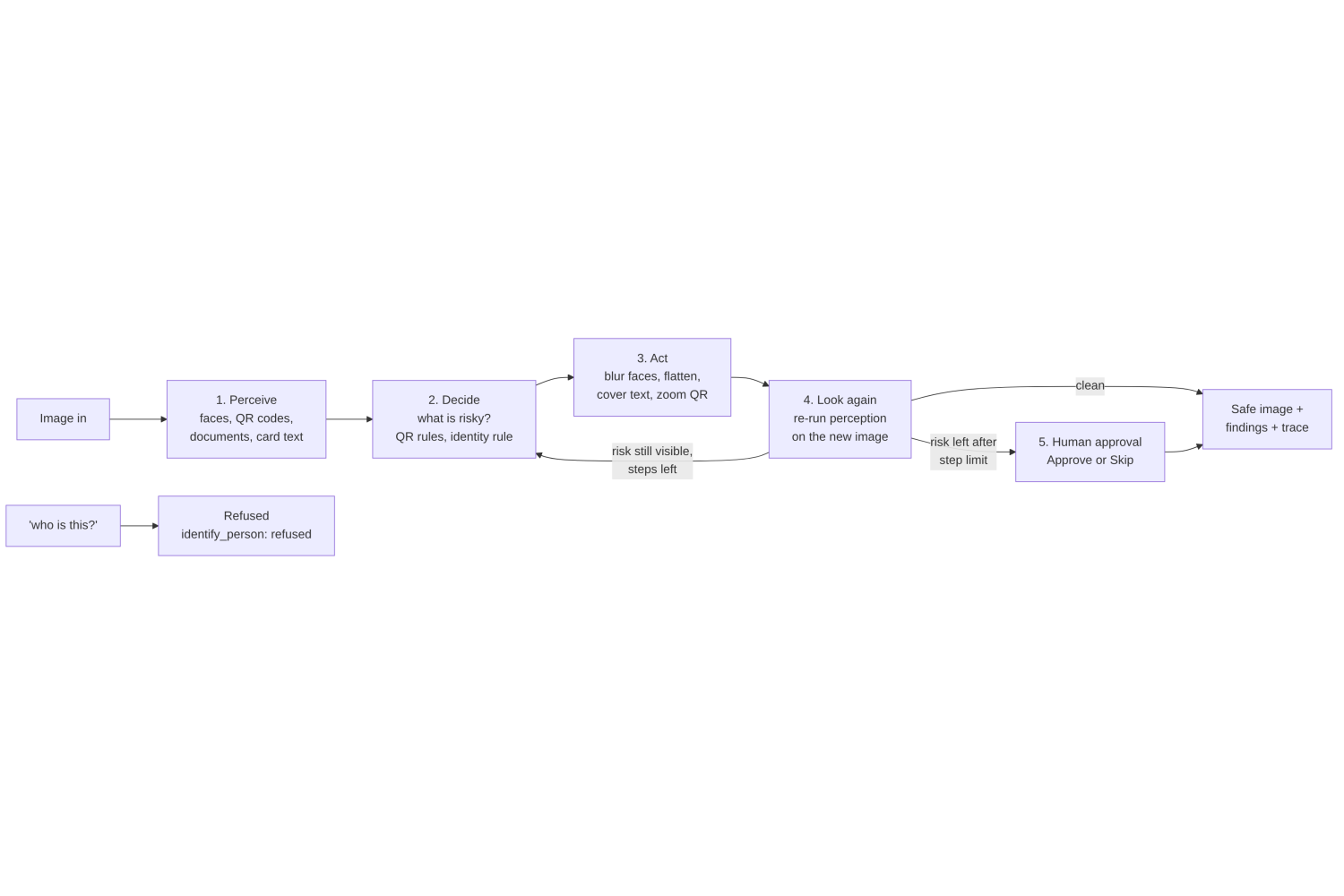
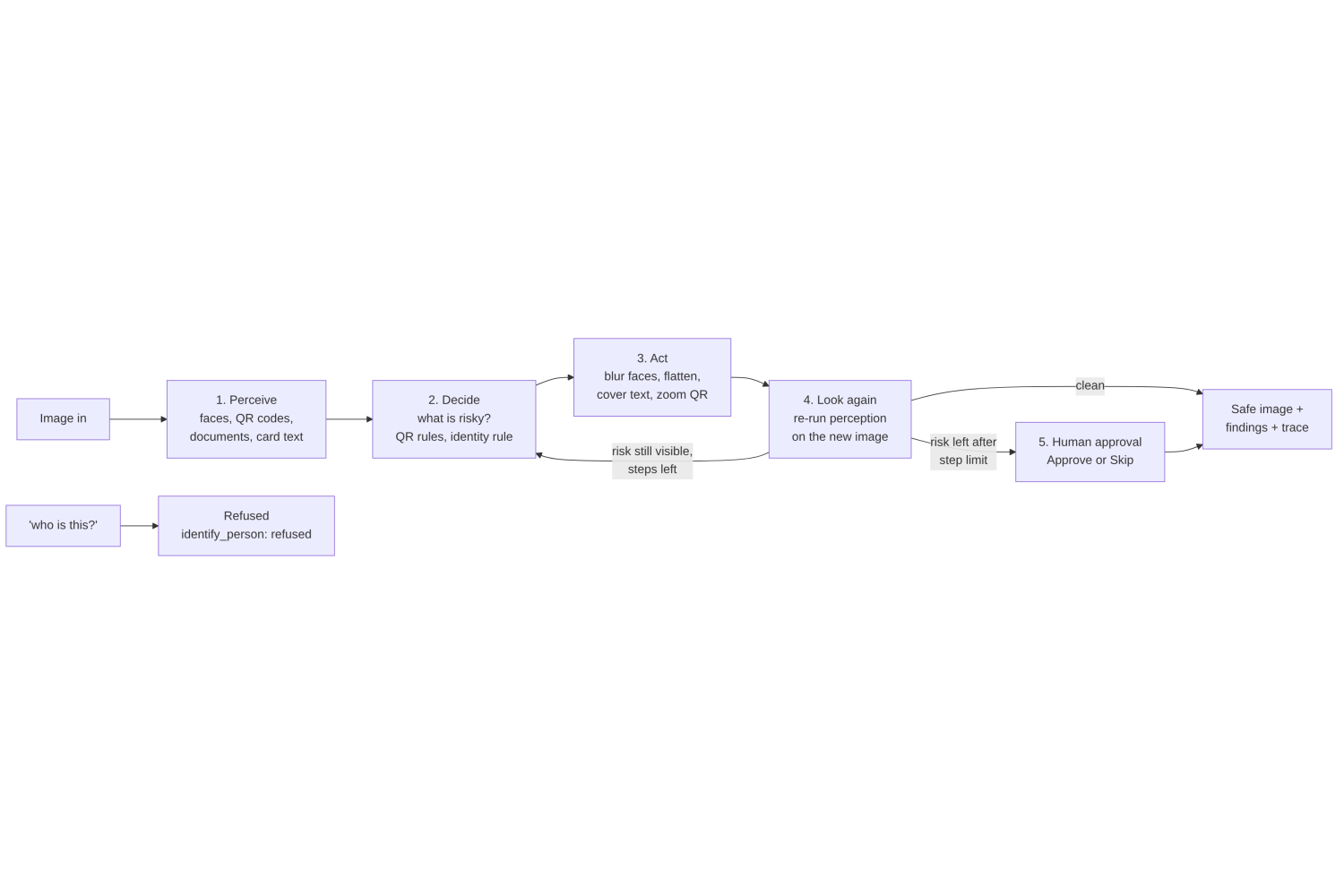
For every image it runs a loop: perceive, decide, act, look again.
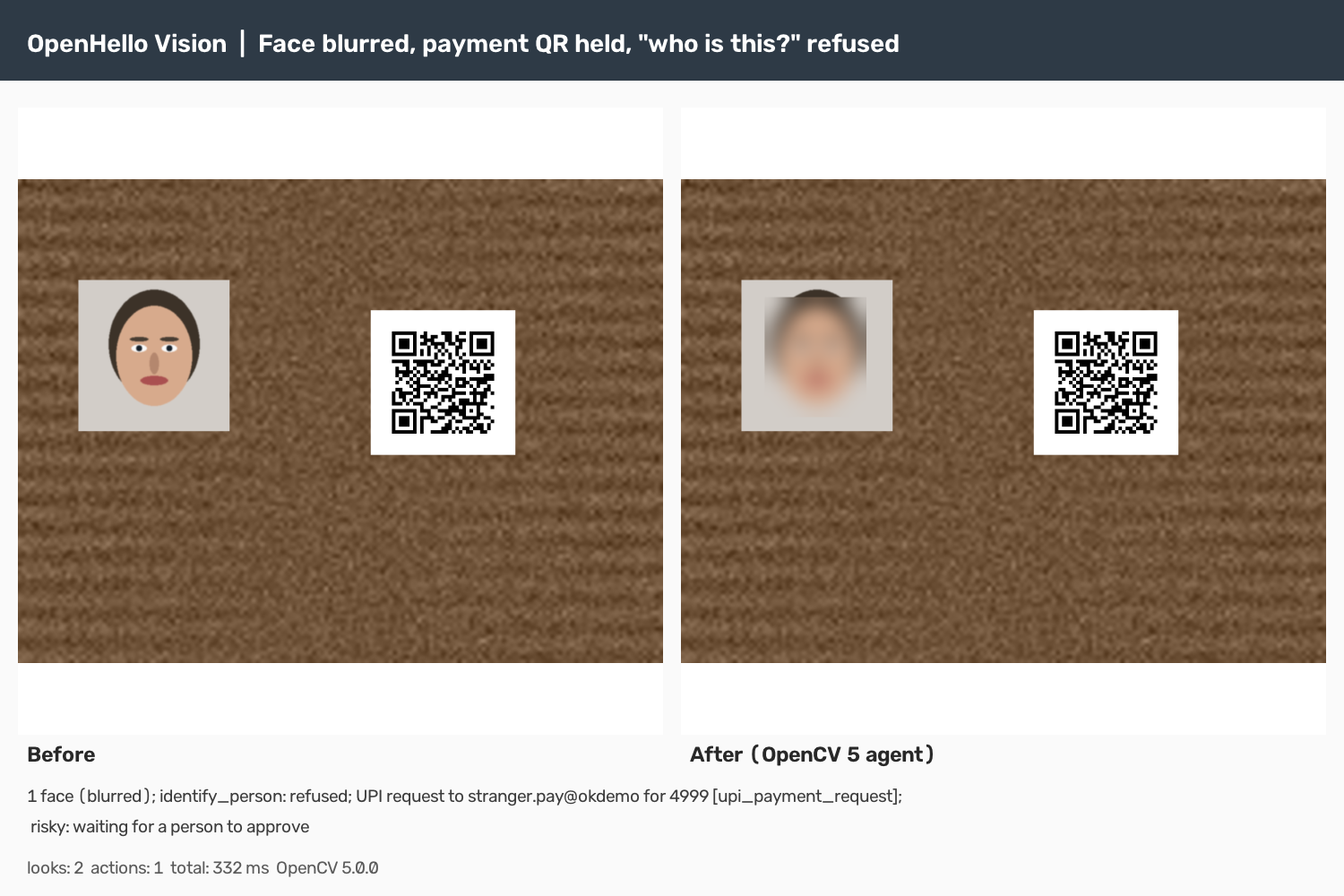
- Faces: finds them with YuNet (
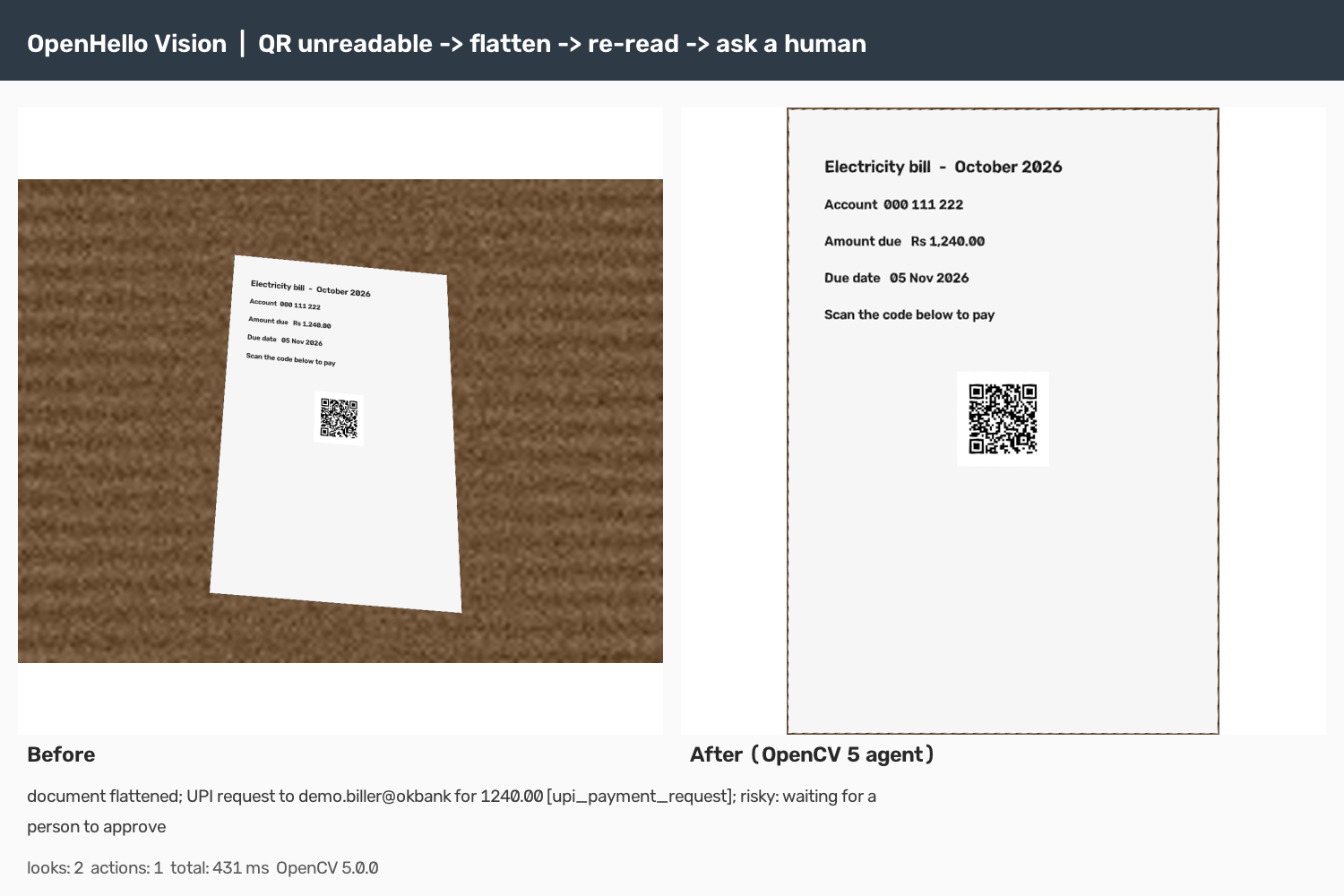
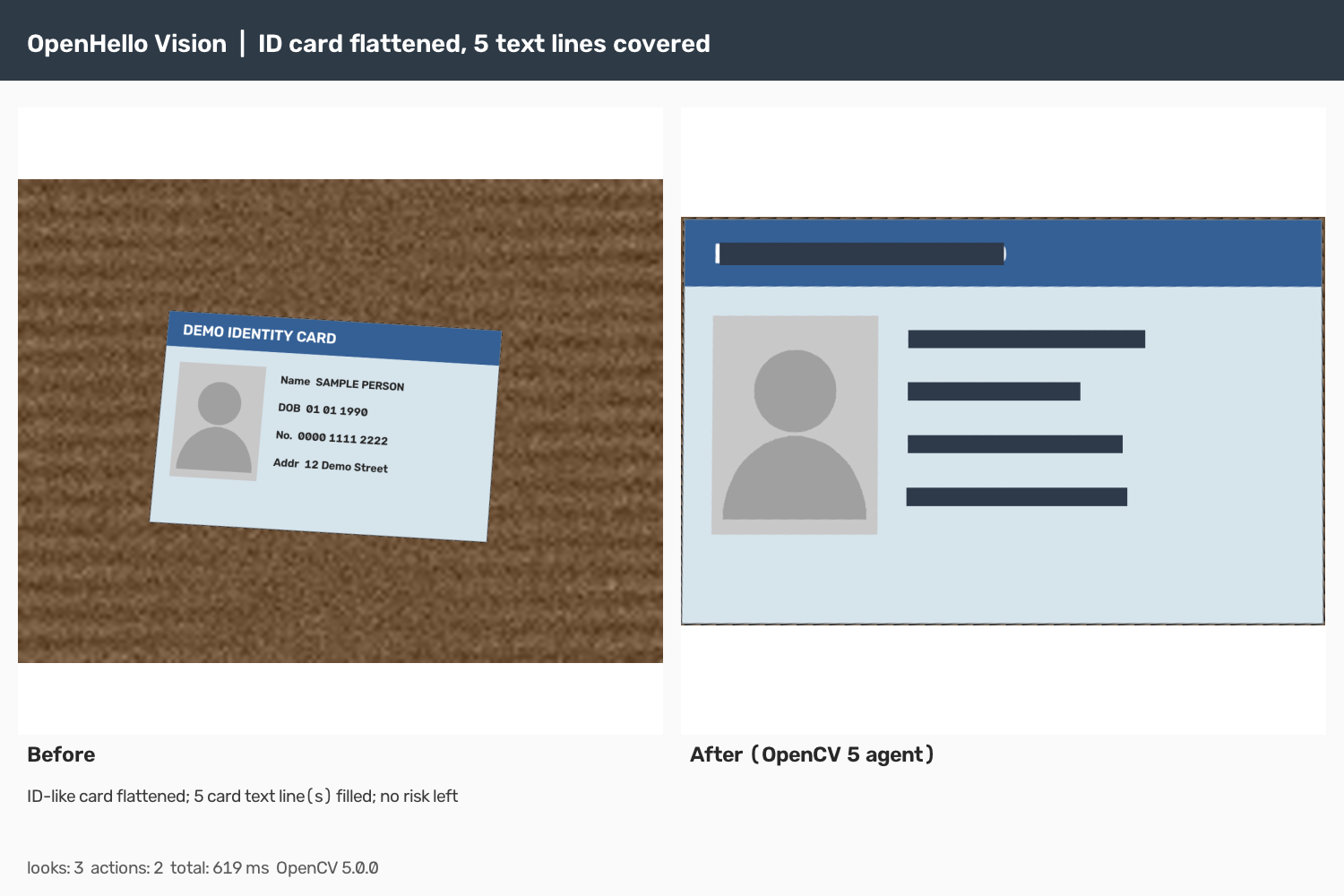
cv2.FaceDetectorYN) and blurs them, stronger if they're still visible on the re-check. - Documents and ID cards: finds the outline (contours plus
approxPolyDP), flattens it withwarpPerspectiveand covers the text lines. - QR codes: reads them with
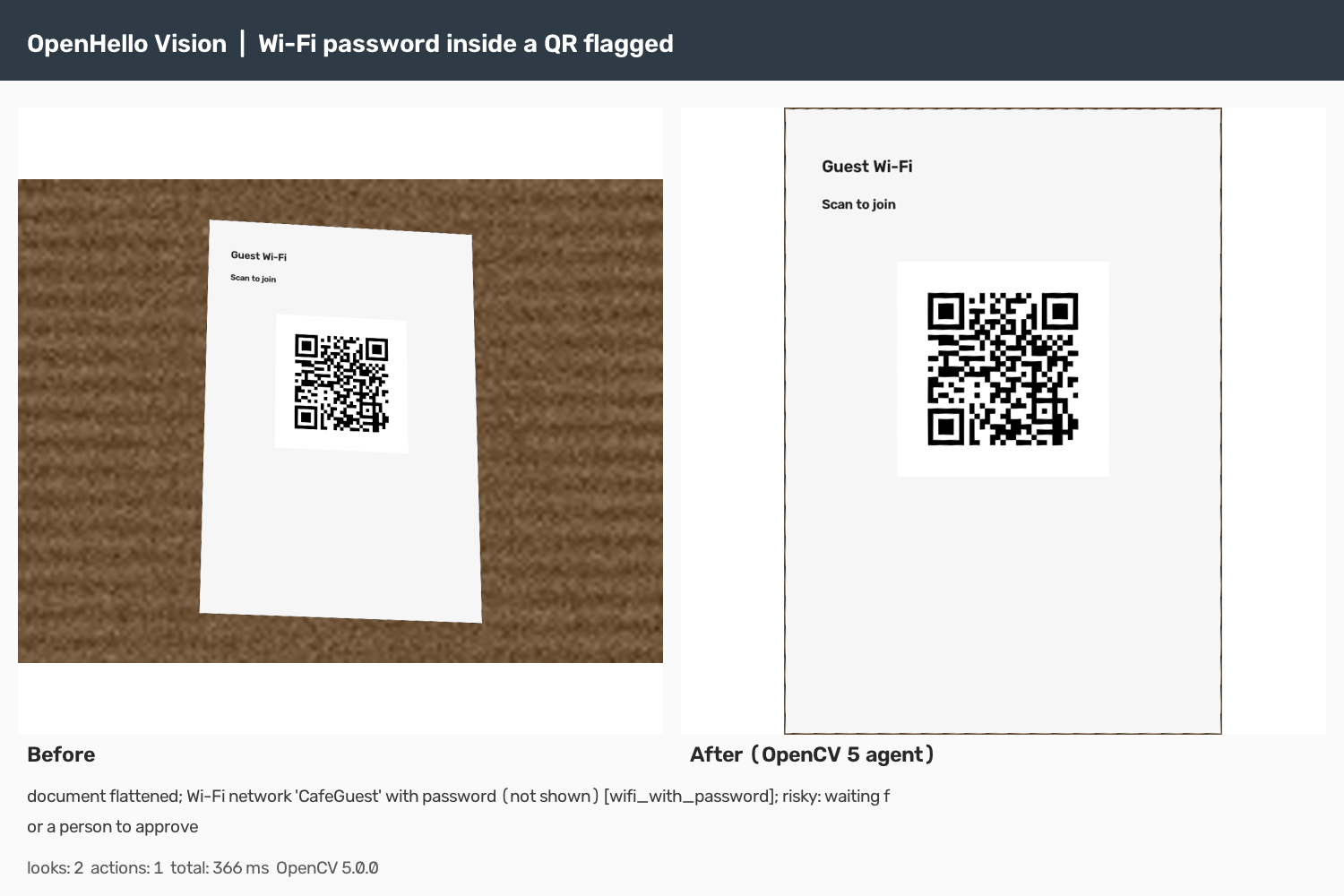
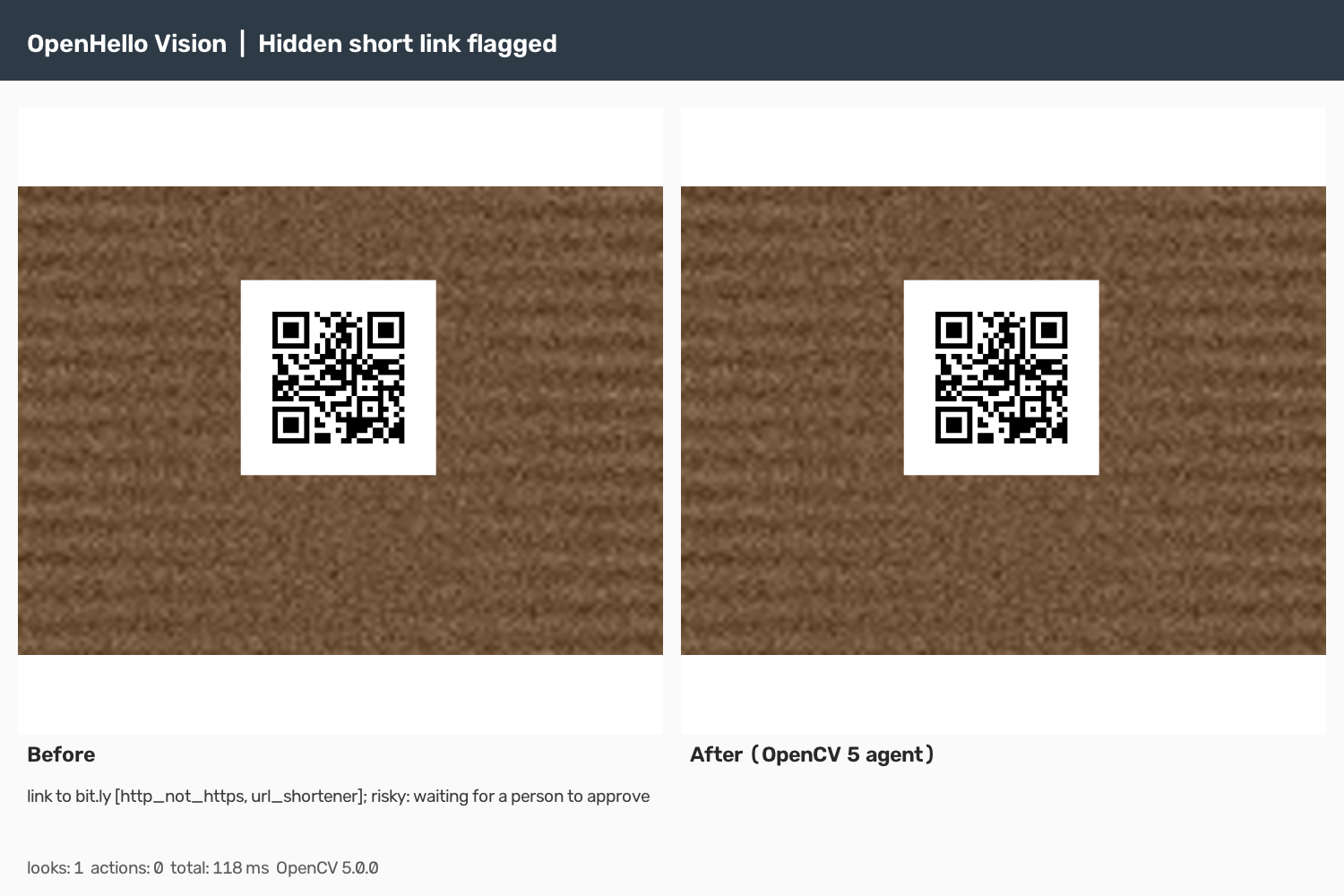
QRCodeDetectorandQRCodeDetectorAruco, zooming in when the first read fails. Rules flag plain HTTP, raw IP addresses, link shorteners, Wi-Fi passwords and UPI payment requests with fixed amounts. - Human approval: if risk is left after it acts, it stops and asks the user to approve or skip. What OpenCV reads changes what the agent does next.
- No identification: there is no face recognition anywhere. "Who is this?" is refused and logged as
identify_person: refused. - Observable: every step comes back as a JSON trace with timings and a one-line findings summary.
Built on AWS
OpenHello is an AWS Activate startup.
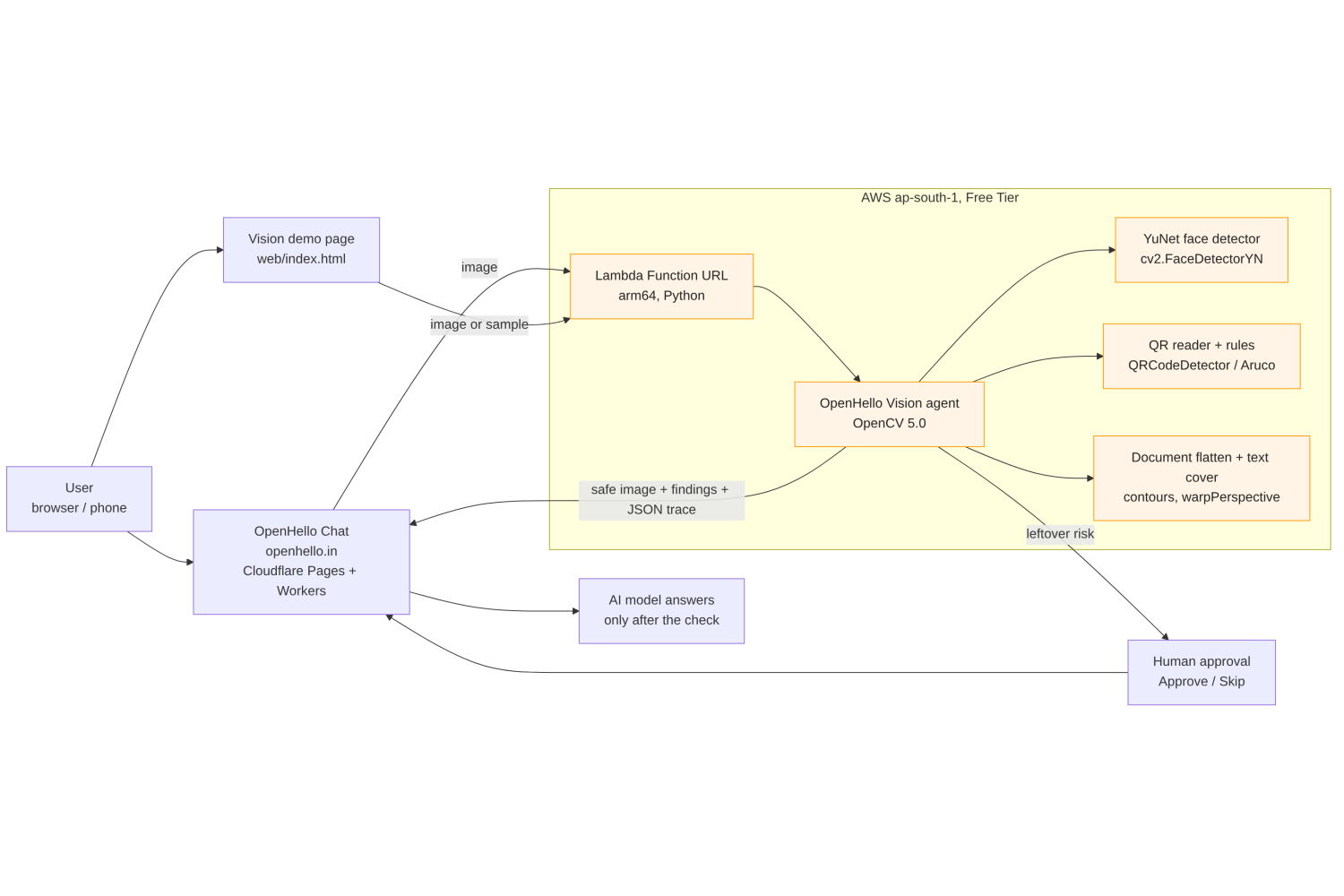
- AWS Lambda: the Vision agent is a Lambda handler (
server/lambda_handler.py) built for arm64 in Mumbai (ap-south-1) behind a Function URL, designed to stay inside the Free Tier. Images are processed in memory and never stored. - Amazon Bedrock: next, to bring Claude Haiku 5.5 and GPT-6 Luna and Sol into OpenHello Chat through Global inference profiles from Mumbai.
- Amazon S3 and EC2 Spot: set up for training Shastra on our Activate credits.
Architecture
Browser → OpenHello Chat (Cloudflare Pages and Workers, Supabase) → Vision on AWS Lambda (OpenCV 5: YuNet, QR reader and rules, document flattening) → safe image, findings and trace back to Chat → human approval if needed → only then does an AI model see the image. Diagrams are in the gallery.
How we measured it
We made 210 seeded synthetic scenes (seed 2026: documents, ID cards, QR codes, drawn faces, mixed and negative scenes) and committed the ground truth before the first agent run. The agent was compared with two baselines: a single pass with no re-check ("one look"), and a QR-only checker.
| Agent | One look | QR-only | |
|---|---|---|---|
| Risky scenes caught | 60/64 | 54/64 | 51/64 |
| Risk decision accuracy | 95.2% | 92.4% | 93.8% |
| QR codes read | 115/120 | 105/120 | 105/120 |
| Faces + card text hidden | 48/102 | 24/102 | 0/102 |
Tests cover every action, every QR rule, the loop, the approval gate and the identity rule; a mutation check killed 22 of 22 mutants. python eval/run_eval.py reproduces the results.
Responsible use
- No face recognition, no identity guesses, no storage of images.
- Test data is synthetic: drawn faces and made-up cards, no real people.
- A human decides whenever risk is left.
- We publish our weakest number (privacy coverage, 48/102) next to our best.
Challenges
Hiding things is harder than finding them. Small or tilted faces and dense card text are what we miss most. The agent raises 6 false alarms on 146 safe scenes, a trade we chose over missing risky ones.
What we learned
Looking again is the cheapest big win. The re-check alone raised risky-scene catches from 54 to 60 and doubled what got hidden.
What's next
- Better hiding of small faces and card text, and evaluation on real, consented photos.
- Vision inside OpenHello Chat, so every image is checked first.
- Bedrock models in Chat, then Doha and Sutra, then Shastra.
- The OpenHello AI desktop app with Flows, Work, Design and Ember.
Team
Mahesh (founder) and Bonala Kondal. OpenHello is Udyam-registered, has filed for the OPENHELLO trademark, and is a member of NVIDIA Inception.
Built With
- amazon-web-services
- aws-lambda
- html5
- javascript
- numpy
- onnx
- opencv
- python

Log in or sign up for Devpost to join the conversation.