Inspiration
What it does
How we built it
Challenges we ran into
Accomplishments that we're proud of
What we learned
What's next for OpenGrant Mesh
Inspiration
Cross-border builders, researchers, and indie teams spend hours parsing fragmented hackathon and grant rules: territory exclusions, tax/KYC gates, judging rubric weights, and payout rails. Making this hub a true Open Agentic Website (Worldwide Agentic Web MVP Profile 0.3) lets both human visitors and their personal browser agents audit grant eligibility and milestone budgets directly in the browser with zero server-side agent execution.
What it does
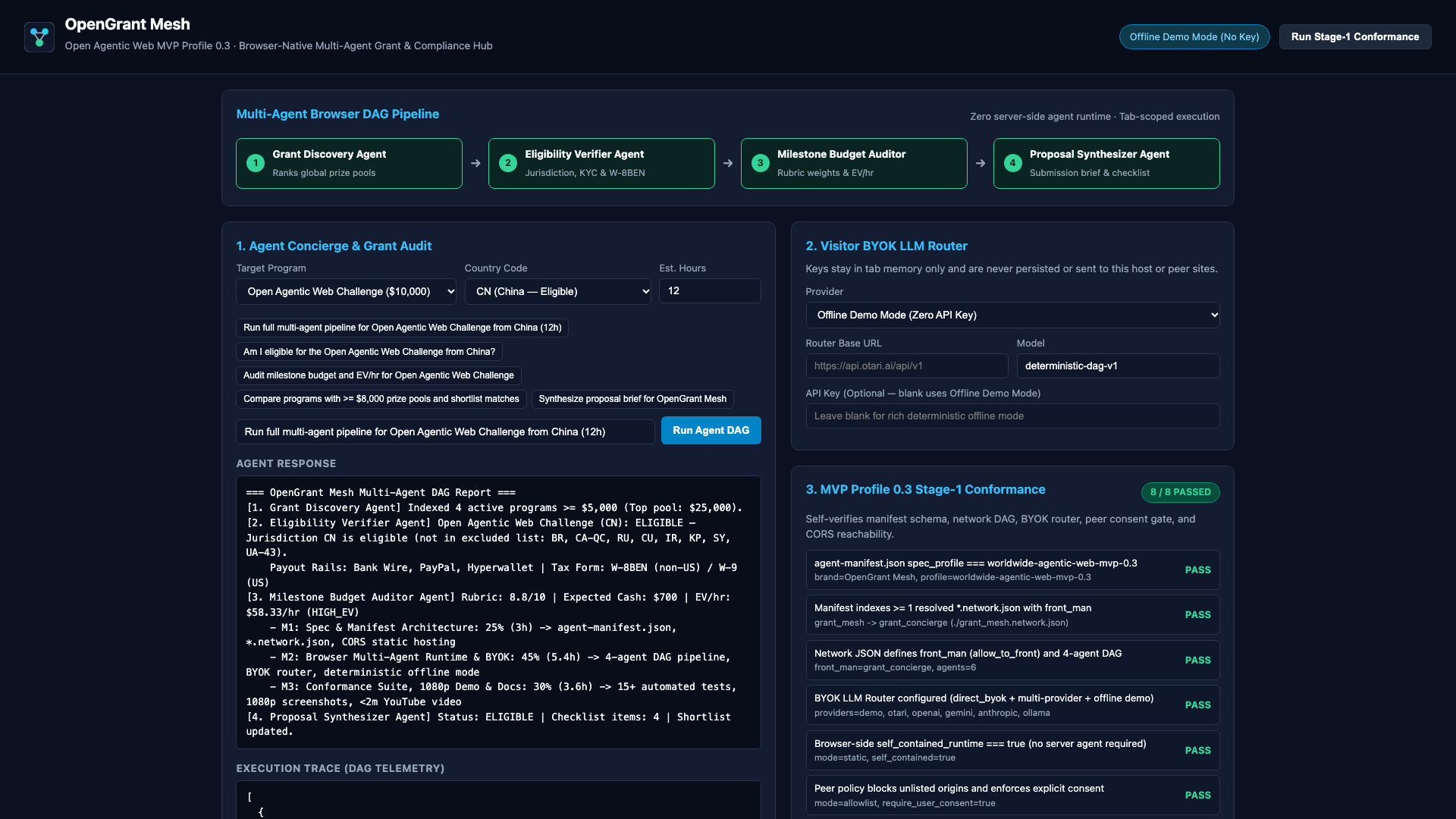
OpenGrant Mesh runs a 4-agent browser DAG (grant_concierge orchestrator) plus a strict Peer Federation Broker:
- Grant Discovery Agent (
grant_discovery_agent): Ranks global grant and hackathon programs by cash pool, credits, and domain fit. - Eligibility Verifier Agent (
eligibility_verifier_agent): Checks country/territory exclusions, legal age of majority, payout rails, and tax documentation requirements. - Milestone Budget Auditor Agent (
milestone_budget_auditor_agent): Computes rubric alignment scores, 3-phase milestone budget splits, and expected value per hour (EV/hr). - Proposal Synthesizer Agent (
proposal_synthesizer_agent): Produces a structured submission brief and updates the local shortlist. - Peer Federation Broker (
peer_federation_broker): Enforcesallowed_peersand explicit visitor consent before contacting external origins, never forwarding visitor API keys.
Live Links & Artifacts
- Live Open Agentic Website: https://alphonshhhomenicmtu.github.io/opengrant-mesh-agentic-web/
- Agent Manifest (CORS
*): https://alphonshhhomenicmtu.github.io/opengrant-mesh-agentic-web/agent-manifest.json - Network Definition: https://alphonshhhomenicmtu.github.io/opengrant-mesh-agentic-web/grant_mesh.network.json
- 6-Slide Architecture & Conformance Deck (PDF): https://alphonshhhomenicmtu.github.io/opengrant-mesh-agentic-web/opengrant-mesh-deck.pdf
- GitHub Repository (Apache-2.0): https://github.com/alphonshhhomenicmtu/opengrant-mesh-agentic-web
How we built it
We built the entire application in zero-build Vanilla ES Modules (HTML5, CSS3, JavaScript, JSON) with zero external CDN dependencies so it deploys cleanly on static GitHub Pages. It publishes agent-manifest.json, .well-known/agent-manifest.json, grant_mesh.network.json, and links.json, paired with a visitor-owned BYOK LLM router (Mozilla Otari, OpenAI, Gemini, Claude, Local Ollama, plus deterministic offline demo mode) and an interactive Stage-1 Conformance Self-Tester.
Challenges we ran into
Designing safe cross-origin peer delegation without leaking visitor credentials required separating prompt synthesis from external fetches and explicitly guarding against prompt-injection and grant-attenuation replay inputs. Our honest engineering trade-off is that GitHub Pages static hosting cannot execute server-side OAuth token exchange, so external LLM inference relies on visitor-supplied BYOK keys or the deterministic offline engine.
Accomplishments that we're proud of
- 36/36 Node.js automated tests passing covering MVP Profile 0.3 schema validation, DAG routing, BYOK fallback, and adversarial attenuation/replay/injection defenses.
- 11/11 Interactive Stage-1 Conformance Self-Tester checks passing live on GitHub Pages (10/10 offline + live HTTP/CORS verification).
- 0 console errors, 0 page errors, and 0 failed requests verified in headless Chrome at 1920x1080.
What we learned
Strict declarative manifests (agent-manifest.json + .network.json) turn static web pages into machine-verifiable agent endpoints without needing a centralized backend.
What's next
Add signed verifiable credentials for third-party grant sponsor manifests and expand live peer federation across additional public developer grant directories.
