-
-
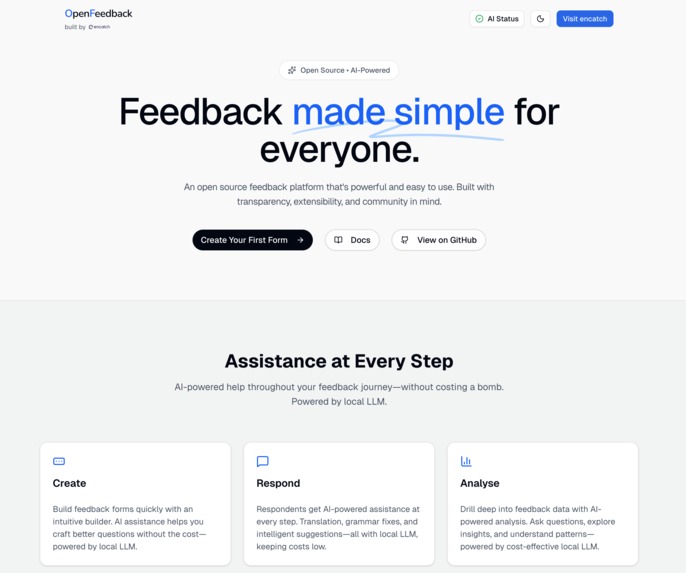
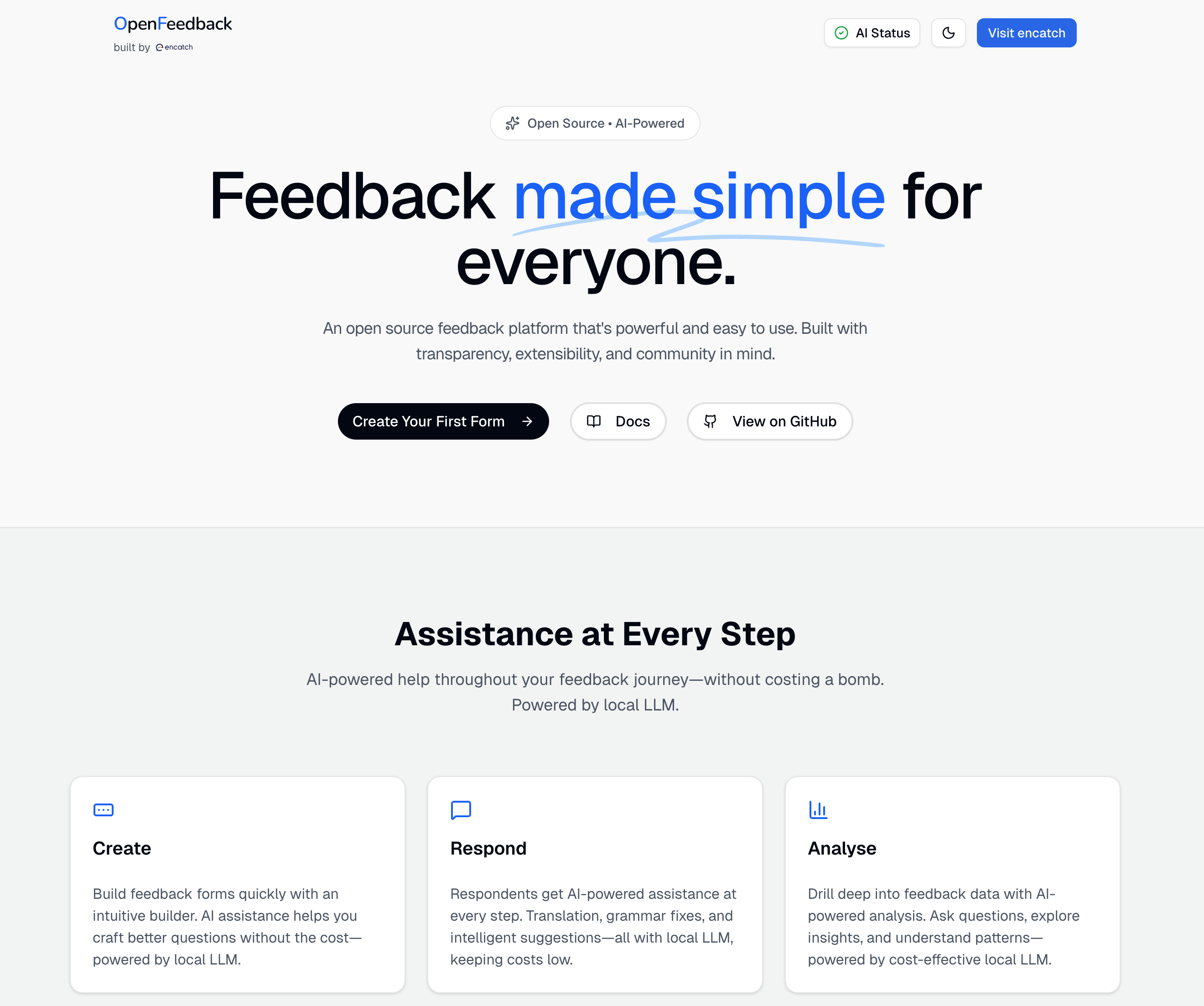
OpenFeedback website
-
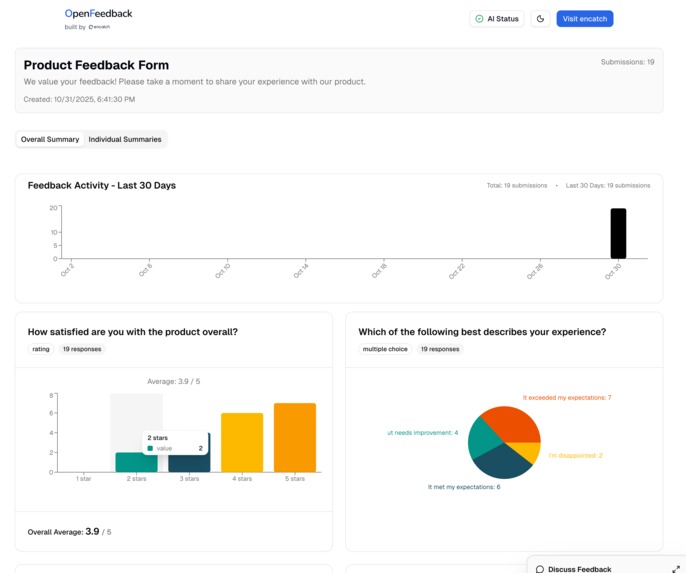
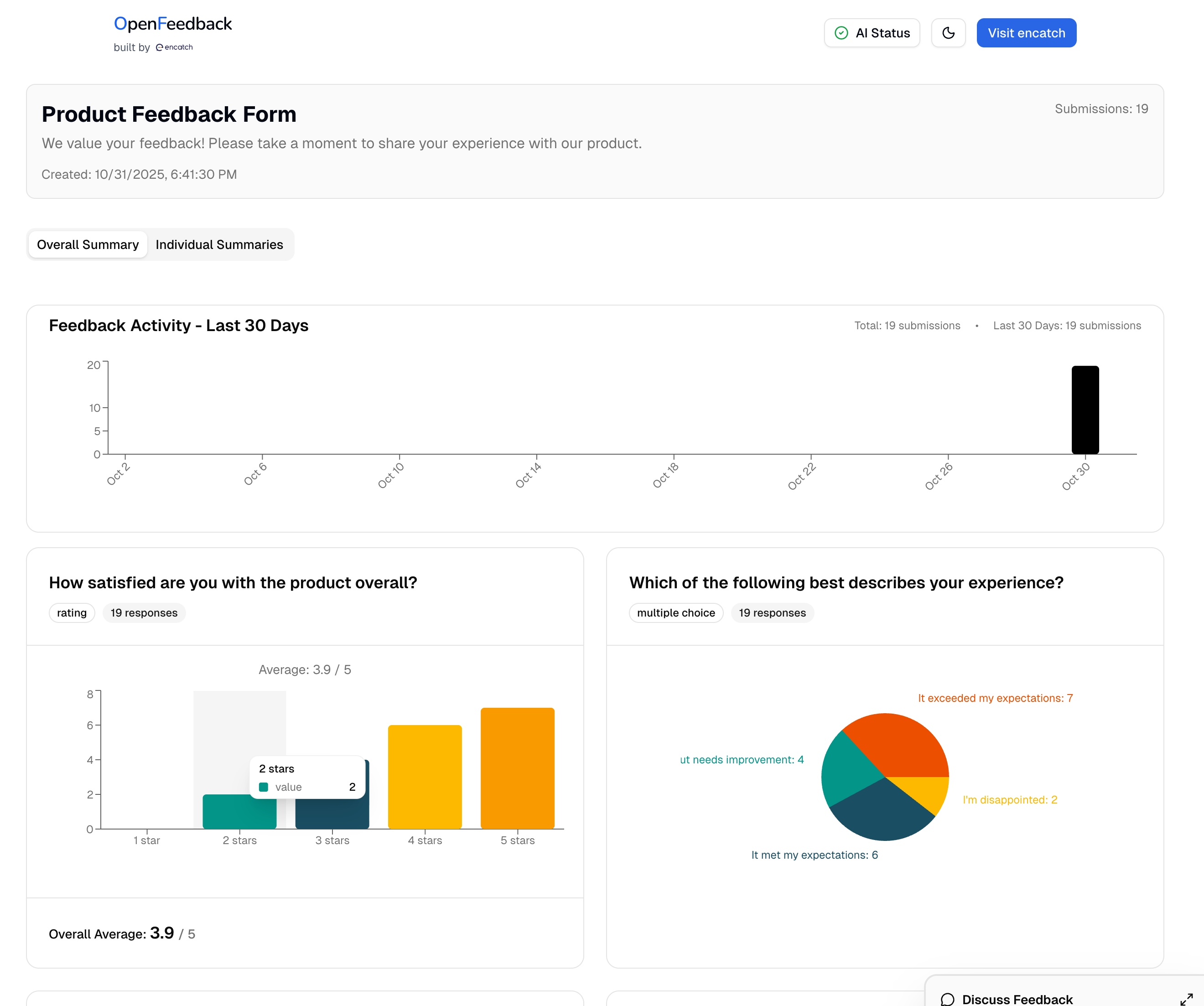
Reports analyse
-
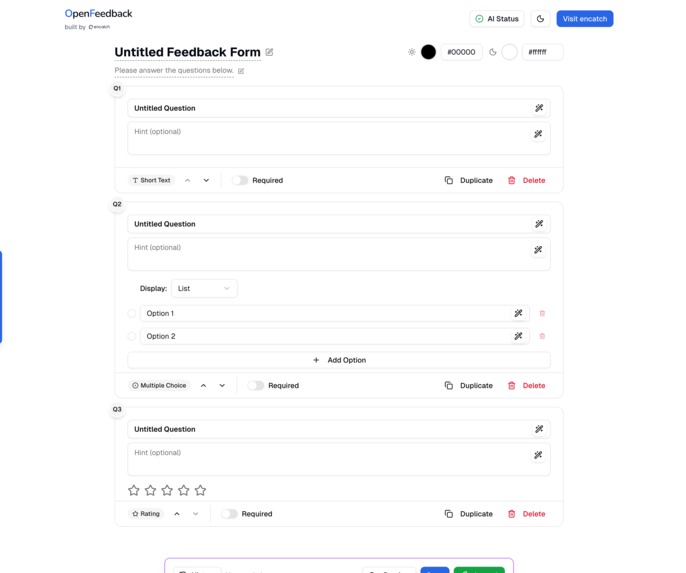
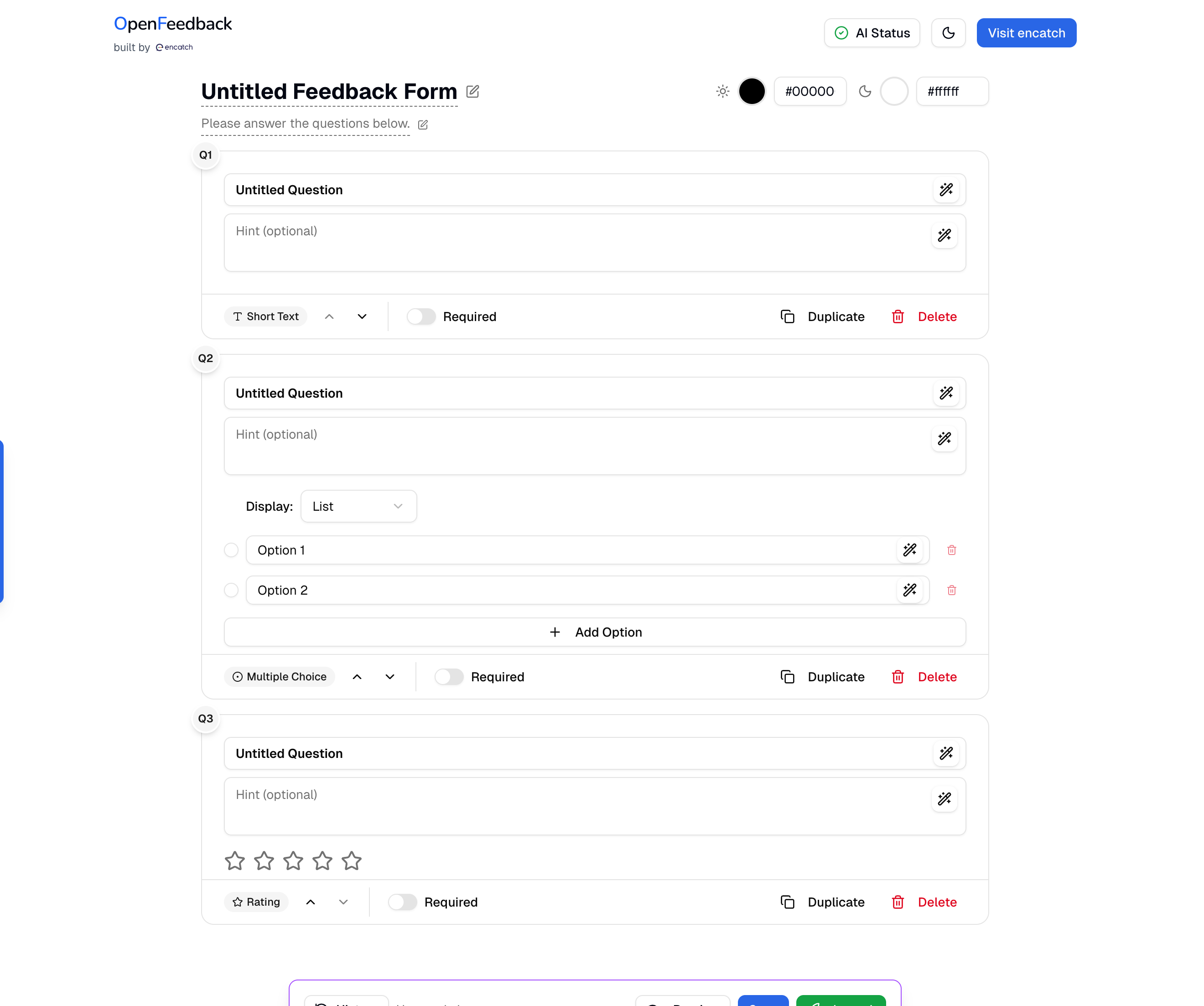
Create Forms
-
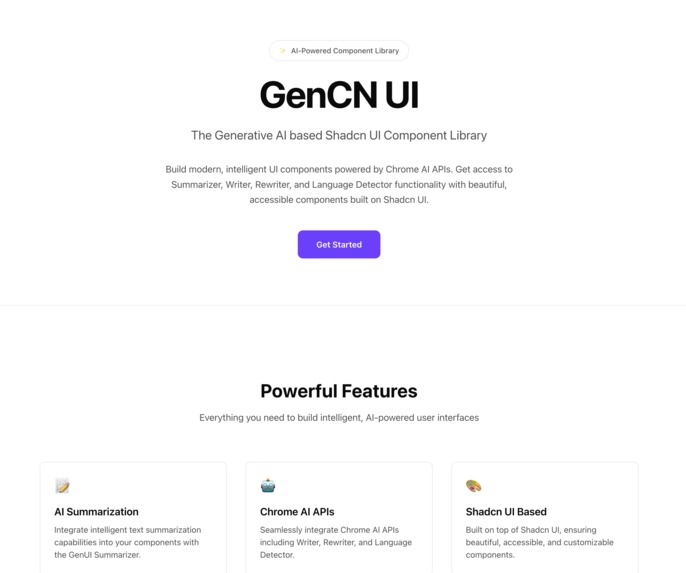
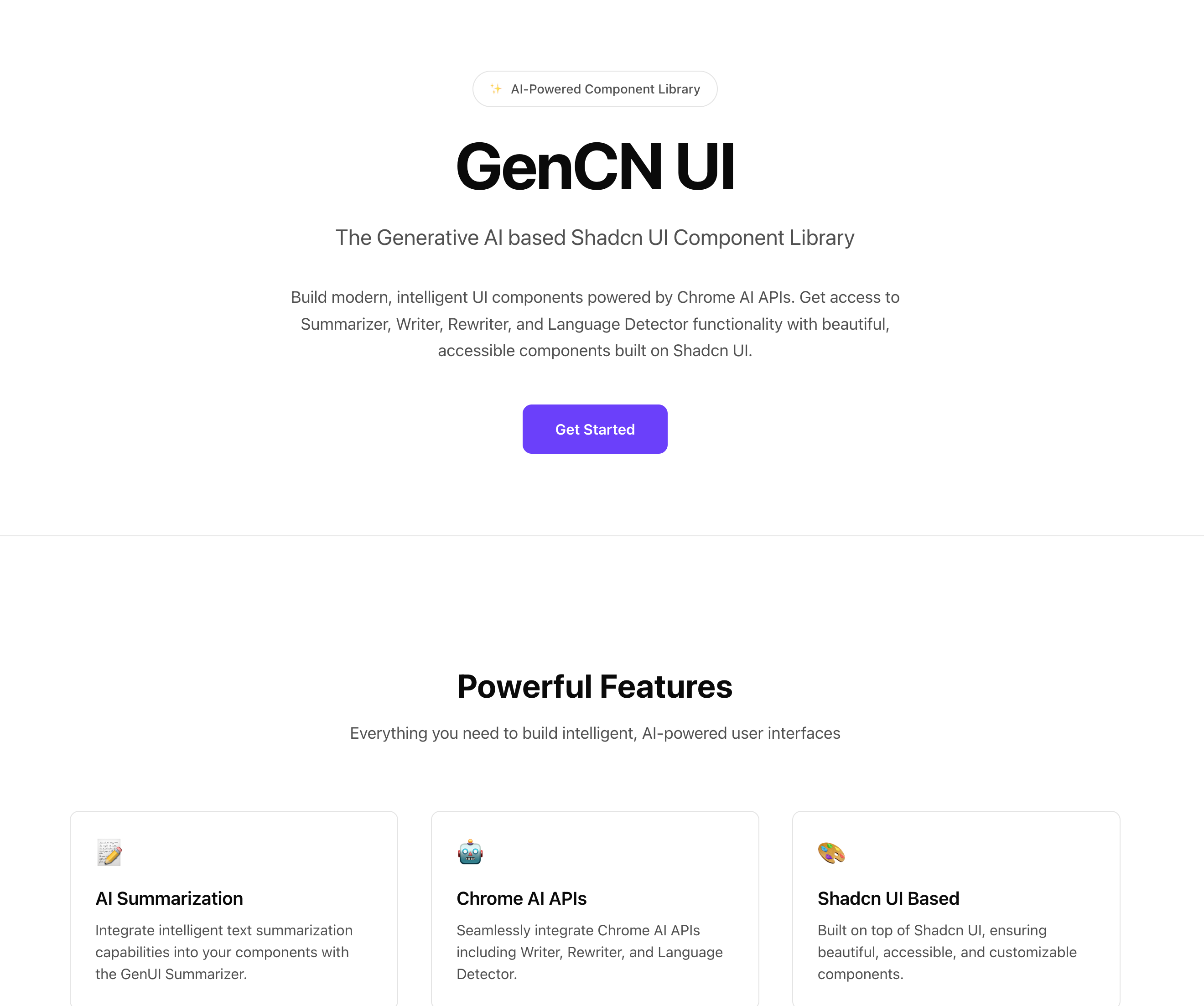
GenCN UI - The Chrome Built in and hybrid powered AI library
OpenFeedback — The Open Source Feedback Platform powered by GenCN-UI
Inspiration
We’ve all gone back and forth on creating a great feedback form with AI chat tools back and forth. We were curious other than questionnaire preparation and analysis what other places can AI have a role in the feedback journey and BE INLINE and not OUTSIDE (a new tab)? Here were our ideas
The creation stage
- Getting variants (improvement/shorten/ lengthen, etc) of question/hint text could be inline
- Ideating questions
- Translation
The response stage
- Lets assume feedback forms was designed by experts, but the audience may not be experts (knowledge / language gap), respondants end up writing what they keep
- Writing style can sometime reveal the respondants identity
- Respondants need way to make their responses look improves
The analysis stage
- language translation (since respondants has freedom of choice)
- reports may be limited by design, the analyst needs a new dimension
- Analyst need summaries
Other problem statement
- AI pricing can quickly grow, user should have control over what he wants to enable with AI.
- Can hosting a feedback tool powered with AI be near zero hosting?
That’s how OpenFeedback was born: an open-source, self-hostable feedback platform powered by GenCN-UI, a next-generation UI component library that blends shadcn, Chrome’s built-in AI APIs, and hybrid local/remote LLMs.
What it does
OpenFeedback makes it effortless to create, share, and analyze feedback powered with Chrome built-in AI.
From quick ratings to long answers, from multi-choice to open text — it’s all handled beautifully.
OpenFeedback aims to be the simplest, most intelligent feedback tool that anyone can run.
Our Journey
Day 1: Build AI powered feedback
Day 2: Move components out
Day 3: Make them library like Shadcn
Day 4: on-device llm can detect gestures. Hurray !!!
Day 5: Lets build human verification (my insurance guy asked to write on paper a text)
Day 6: llm chat sdks are pain.
Day 7: Wrap vercel ai-sdk
Day golive: we published OpenFeedback + GenCN-UI + useChat for hybrid llm
How we built it
We were looking to make a B2C feedback platform that meet most of the usecases for feedback while making life easier. The Chrome built-in AI hackathon wonder how we restrict the use of online LLM due to cost. The interesting fact was within the boundaries compared to online LLM, the gemini-nano is quite powerful for daily actions that user perform and all this with zero cost.
At the same time we saw how the world was adopting AI into feedback systems
- Either full manually form
- Bring to Form to AI chat interface
- Convert the form to conversational style
With all of the approached above it was either AI or manual because users did not have the flexibility to toggle. That said lets bring AI to form elements and in this process of OpenFeedback, we were like why not move the components to a library and thats how GenCN-UI was born.
Behind the scenes:
- GenCN-UI extends the beloved shadcn components with AI-first features — like rewriting, summarizing, and generating forms using the Chrome Prompt API.
- Feedback creation is on-device and private, with hybrid AI support for deeper insights.
- Respondents get clean, responsive UIs that feel light and fast.
- Creators can host it freely — no locked dashboards, no data leaving your control.
- Near Free Hosting This is powered by all opensource stack and serverless platform wherein many offer free credits and they are probably enough for achieving 50K feedbacks a month in that tier.
We built everything with Next.js, React, Shadcn, Vercel AI SDK, because of their community, ecosystem, serverless and the sheer joy of rapid iteration.
Our backend runs on PostgreSQL, keeping everything serverless and open-source so that anyone can deploy their own instance freely.
Our principle was simple:
“If feedback is yours, you control.”
Keeping the stack lightweight and serverless made hosting free and maintenance minimal — ideal for self-hosting.
How components did we release
- Hooks for Prompt API, rewriter, writer, proof reader, translator
- Hybrid LLM: the useChat extended hook for local llm on top of vercel ai sdk (You can see this in the chatbot where one can switch) with the possibility to change context between on-device and server llm
- Input & TextArea component that has a option button (with rewriter, writer, proof reader, translator)
- Toast message (Sonner): Making toast messages feels new everytime they appear (funny, sarcasm, etc. rewriter). They most of the times are funny (if you chose funny, atleast brought a smile on my face)
- I18n: enabling you to detect and translate in your given language
- Summarizer: enabling to summarize individual content and summarize group content like each review and overall review
- Human Verification: Prompt gestures (using hands ask user to make gesture), AI will randomly ask gestrues to be done in that (like raise right hand, show fist, etc). The AI then verifies if the gesture was performed
Challenges we ran into
AI inside the browser:
Extending shadcn to use Chrome’s new built-in AI APIs wasn’t straightforward.
Getting components to “think” locally required wrapping the Prompt API and re-engineering event flows.Vercel AI SDK extension:
The SDK was built for calling remote LLMs — we extended it to call local LLMs (on-device) via the Chrome APIs. That was a huge breakthrough.CAPTCHA re-imagined:
We experimented with making CAPTCHA smarter — instead of static text, we used the Prompt API to generate dynamic, expressive image checks, like “click on the image that shows gestures with hands.”
It made security both functional and human (with local LLM keeping it private).
Accomplishments that we’re proud of
- Created GenCN-UI, a first-of-its-kind AI-powered UI library that builds on shadcn having Chrome built-in AI and hybrid model with vercel ai-sdk as fallback with AI vendor agnostic.
- Released OpenFeedback — a full feedback tool, open source and free to self-host.
- Made AI local, privacy-first, and developer-friendly.
- Extended the Vercel AI SDK to support on-device LLMs seamlessly.
- Extended the popular @ai-sdk/react useChat hook to talk with on-device chrome built-in AI for text chat with flexibility to switch over to online LLM and on-device without loosing context.
What we learned
We learned that AI doesn’t have to mean cloud — local, browser-based intelligence can unlock creativity while keeping privacy intact.
We learned that simplicity and openness beat scale and secrecy.
And most of all, we learned that the developer community thrives when tools empower — not abstract — the creative process.
*Some decisions we took *
- serverless databases prefer their js libraries / db connection via shared pool. we choose the later, to be vendor agnostic
- usechat from vercel ai-sdk allows adoption of on-device ai by others more possible (hybrid ai)
- GenCN-UI based on shadcn components because llms and human both love them
What's next for OpenFeedback — the OSS tool powered by GenCN-UI
We’re building towards a future where every open-source project, indie app, or startup can plug in feedback effortlessly — powered by on-device AI / Hybrid and beautiful extended shadcn UI components.
Next steps:
- Additional components usecases.
- Captacha option with Audio.
- Performance with queuing requests and re-render situations.
- Make all apis wrapper hooks hybrid
Because great feedback should be open, fast, and intelligent — and now, it finally can be.
Now i wish this project also has the GenCN-UI box which will allow me local edit for grammar. :p
🔗 Live:


Log in or sign up for Devpost to join the conversation.