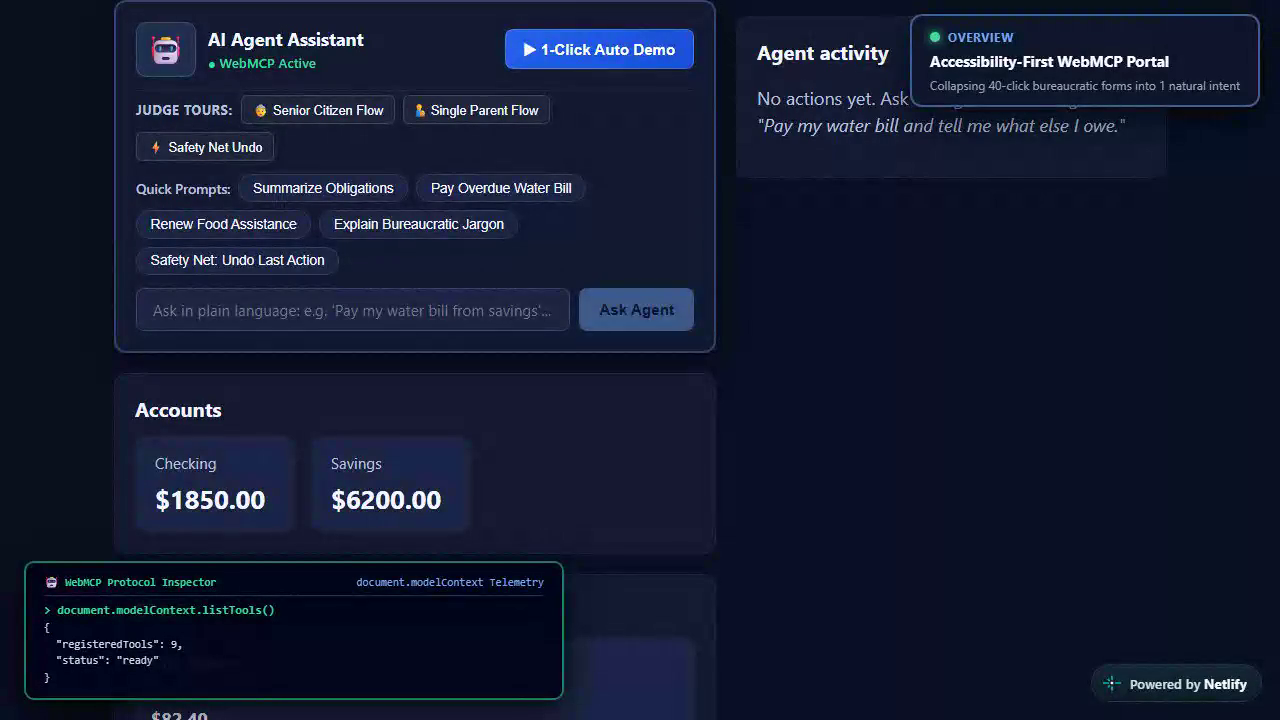
60-Second Judge Quickstart: OpenDoor Access features 1-Click Judge Persona Tours mounted directly at the top of the live portal (https://aesthetic-chebakia-a2278a.netlify.app):
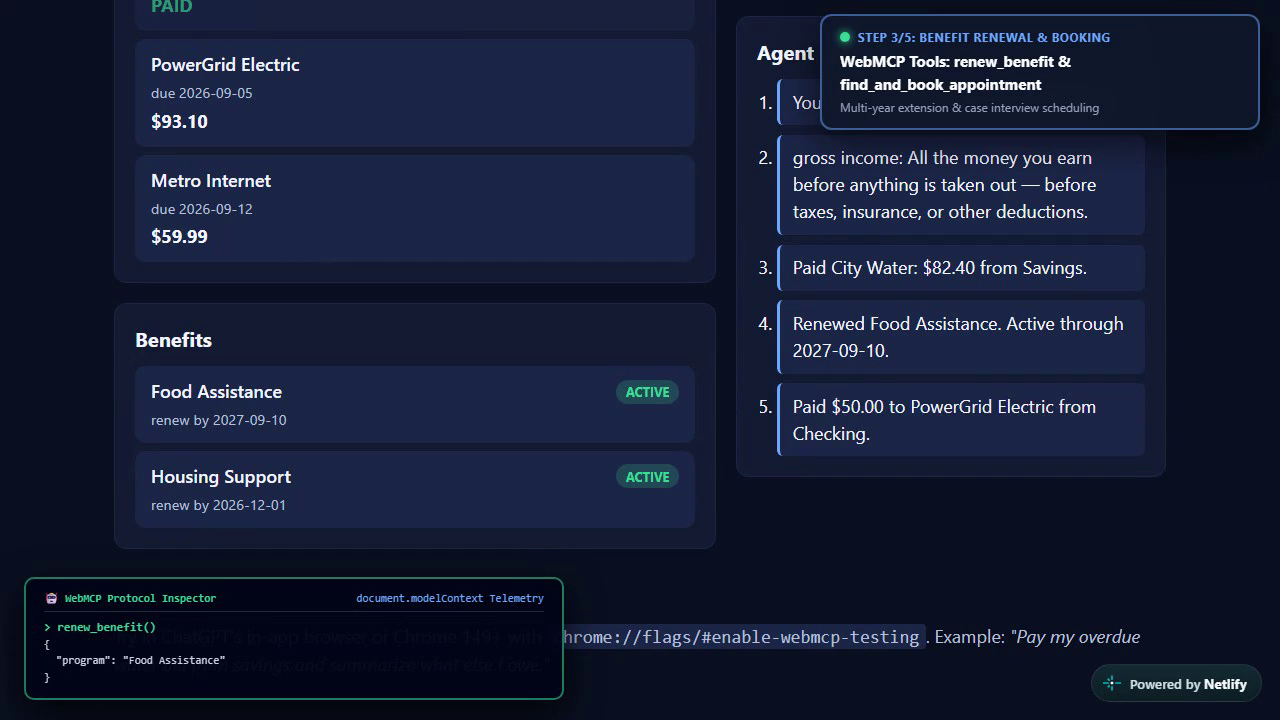
- Senior Citizen Flow: Checks obligations -> translates "gross income" into plain language -> prepares and confirms water bill payment.
- Single Parent Flow: Renews Food Assistance (SNAP) for 1 year -> splits payments -> schedules caseworker appointment.
- Safety Net Undo: Reverses accidental actions with instant undo rollback.
Or test via ChatGPT in-app browser or Chrome 149+ with #enable-webmcp-testing by asking: "Pay my overdue water bill from savings and summarize what else I owe."
==================================================
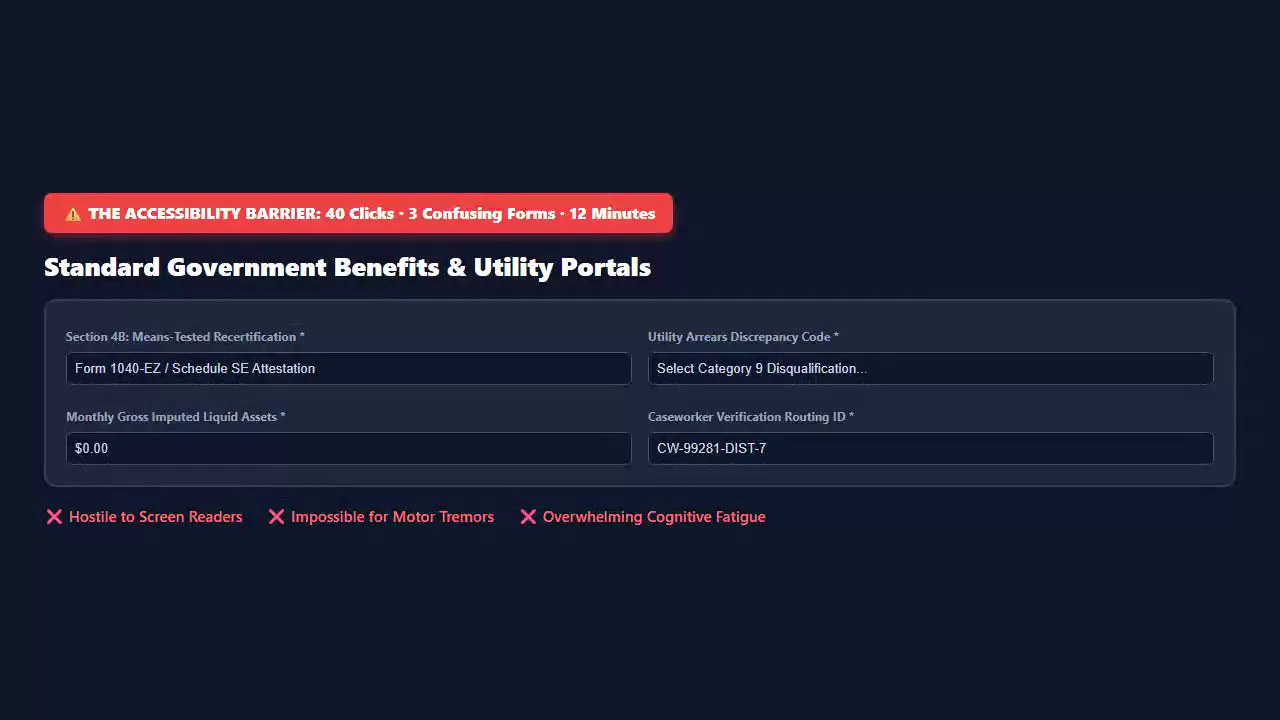
- Why this use case is a strong fit for WebMCP Standard public service portals (benefits renewals, utility bill-pay, appointments) are a difficult obstacle course of 40+ form fields, 3 confusing pages, and dense legal jargon.
For individuals with low vision, motor tremors (Parkinson's, ALS), or cognitive fatigue from a disability, navigating these portals independently is a major barrier. Screen readers narrate the page structure, but they cannot complete the multi-step task.
WebMCP enables an agent-native web: exposing structured, typed tools directly in the user's browser session. Instead of screen-scraping or guessing selectors, an AI agent coordinates user intent reliably and securely.
- What humans and agents can do together
- Single Spoken Sentence Task Completion: A person asks "Renew my food assistance and pay my overdue water bill from savings" and the agent coordinates tools across benefits, accounts, and billers seamlessly.
- Shared Surface Collaboration: Every agent tool invocation updates the live high-contrast UI, announces politely to assistive technology (ARIA live regions), and logs to a transparent on-screen transcript. A user, caregiver, and agent all perceive the exact same state in real time.
Bureaucratic Jargon Translation: The explain_this_form tool translates terms like "gross income", "attestation", and "recertification" into plain language before taking action.
Two-Phase Commit Security and Safety Net
Two-Phase Financial Safety: Money never moves on initial calls. pay_bill validates balances and returns a preview token. Only confirm_payment debits funds after explicit user approval.
Undo Stack: Every action registers a reversible closure, giving users complete confidence to explore without fear of accidental transactions.
Active Defense: The engine rejects overpayments, attempts to pay $0-balance bills, and overdrafts beyond available funds.
How WebMCP is Implemented
9 Intent-Level Tools: pay_bill, confirm_payment, renew_benefit, find_and_book_appointment, summarize_my_obligations, explain_this_form, download_payment_receipt, export_appointment_to_calendar, and undo_last_action.
Dual Integration: Uses imperative JavaScript registration via document.modelContext.registerTool() (with AbortController lifecycle cleanup) and declarative HTML attributes (data-webmcp-tool).
Triple-Channel Accessibility: Politeness-separated live regions (status vs alert), opt-in Web Speech API queue, and WCAG AA/AAA contrast.
Verification and Test Suite
61 Unit Tests (npm test): In-memory store logic, penny precision, ReDoS defense, 200-op fuzzing, and receipts/.ics exports.
41 Playwright E2E Tests (npm run test:e2e): Full WebMCP loop in real Chromium driving all 9 tools via navigator.modelContextTesting.
1 Production Smoke Test (npm run test:prod): Automated live verification against Netlify.
Open Source: MIT License with clean, documented TypeScript codebase.
Built With
- accessibility
- edge-tts
- netlify
- node.js
- playwright
- react
- typescript
- vite
- webmcp

Log in or sign up for Devpost to join the conversation.