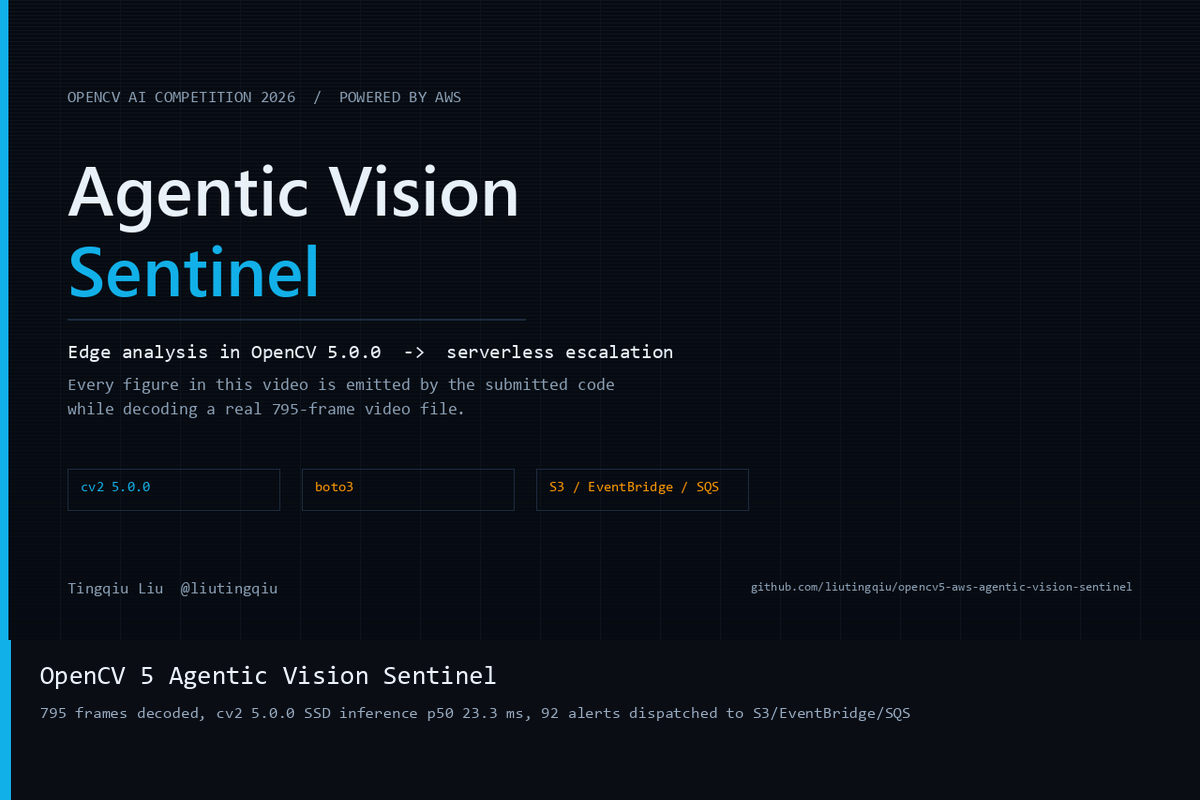
Inspiration
Fixed-camera sites already own the camera but not the attention. A human watching a dozen streams misses most events, and shipping every frame to a cloud inference service costs more than the guard it replaces while adding a round trip that makes any alert arrive too late to matter.
The constraint we designed around: decide at the edge, escalate to the cloud only when a decision was actually made.
What it does
The pipeline runs four stages on every decoded frame:
- OpenCV 5 detection — SSD-MobileNet-v1 (COCO) exported to ONNX and executed by the OpenCV 5 DNN engine, filtered to the person class with geometric sanity checks (minimum height, aspect ratio, area ratio).
- Classical motion channel — MOG2 background subtraction, morphological open/close, contour extraction and area filtering, kept independent of the learned detector so the two signals can be compared on the same frames.
- Spatial decision layer — a normalised polygon zone, a ground-contact point per detection, greedy frame-to-frame association, and dwell timing. This is where a detection becomes an event:
INTRUSION_DETECTED,DWELL_EXCEEDED, orTHERMAL_PROXY_HIGHfrom an HSV warm-hue mask inside the zone. - AWS escalation — on an event, the annotated frame is written to Amazon S3, a structured detail is published to Amazon EventBridge, and an alert message is queued in Amazon SQS.
How we built it
- Edge core:
sentinel/—detector.py(cv2.dnn + MOG2),zones.py(polygon containment, association, dwell state),thermal.py,pipeline.py(per-frame orchestration and artifact writing),config.py(every threshold in one auditable file). - Cloud boundary:
sentinel/aws_dispatch.py— one boto3 boundary fors3.put_object,events.put_eventsandsqs.send_message, identical in--mode awsand--mode local. - Artifacts per run:
annotated.mp4,evidence/*.jpg,events.jsonl,metrics.json,dispatches.json,aws_calls.jsonl. The project page, the report and the video all read from that one directory. - Tests: 9 pytest cases over real decoded frames, zone geometry, artifact writing, and the dispatch contract (asserting non-empty
MessageId/EventIdandFailedEntryCount == 0).
Challenges we ran into
OpenCV 5.0 rejects the float32 blob that OpenCV 4 accepted for this graph: ssd_mobilenet_v1_10.onnx declares a uint8 image_tensor:0, so cv2.dnn.blobFromImage fails with CV_32FC1 given, CV_8UC1 expected. Building the tensor as uint8 NHWC fixed it. The second trap was calling forward(name) once per output, which re-runs the graph — 92 ms per frame instead of 25 ms. A single net.forward(list_of_names) brought it back under budget.
cv2.HOGDescriptor is gone in 5.0, which removed the usual pedestrian baseline, so the second channel had to be classical motion analysis.
Accomplishments that we are proud of
On the bundled 795-frame, 768x576, 10 fps clip, on CPU with no GPU:
- inference p50 23.31 ms, p95 30.62 ms, max 34.89 ms; end-to-end frame budget 31.54 ms
- 4.48 detections per frame on average, peak 9, with a person present in all 795 frames
- 92 alerts raised and dispatched — each one a real S3 put, EventBridge put_events and SQS send_message
- 9/9 tests passing
What we learned
Percentiles, not means. A pipeline whose average is 31 ms still breaks a 10 fps budget on the tail, and only p95 and max make that visible. The other lesson is scope honesty: a narrower system whose every claim is traceable to a frame index and a request identifier is worth more than a broad one that sounds impressive and cannot be demonstrated.
What is next
Replace greedy nearest-point association with a real tracker (ByteTrack/OC-SORT) so crossing tracks stop splitting a dwell interval; add COOL on AWS Graviton with a measured throughput comparison; and run a precision/recall benchmark against a labelled set, which this entry does not have.
Stated plainly
The cloud boundary in the recorded run was exercised with moto, using the same boto3 calls and identifiers that --mode aws uses against a live account. COOL/Graviton execution and PPE detection are not implemented and are not claimed. No labelled accuracy benchmark was run; the report gives latency, event counts, and the known failure cases instead.
Built With
- amazon-web-services
- boto3
- computer-vision
- edge-computing
- eventbridge
- lambda
- opencv
- python
- s3
- sqs
