-
-
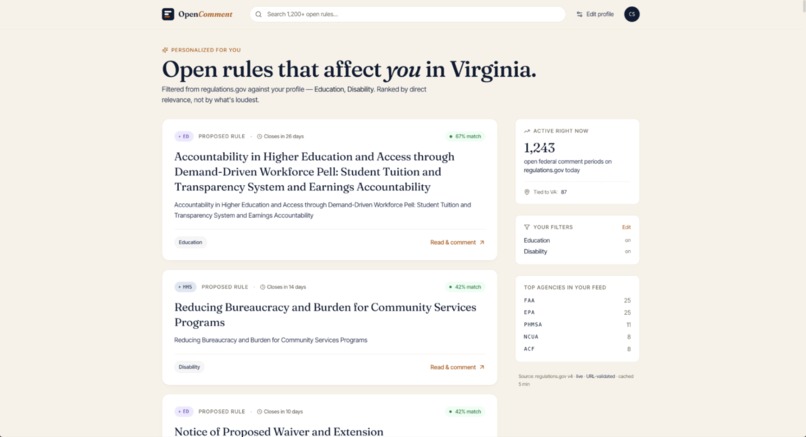
Browse Relevant Issues
-
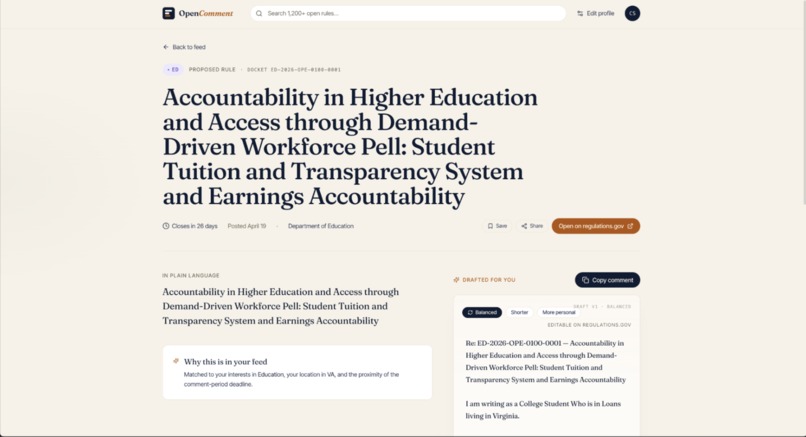
Issue Summary + Personalized Comment
Inspiration
Democracy is currently struggling with an access gap, not an apathy gap. Corporate lobbyists have entire legal teams tracking federal dockets and drafting 50-page comments to shape policy to their advantage. Meanwhile, the average citizen, whose daily life, healthcare, and income are directly impacted by these exact rules, is locked out by dense legalese and 200-page PDFs. We realized that public rulemaking is effectively paywalled by jargon. We wanted to build a tool that levels the playing field, giving everyday Americans the exact same localized, direct influence over federal policy that K Street insiders enjoy.
What it does
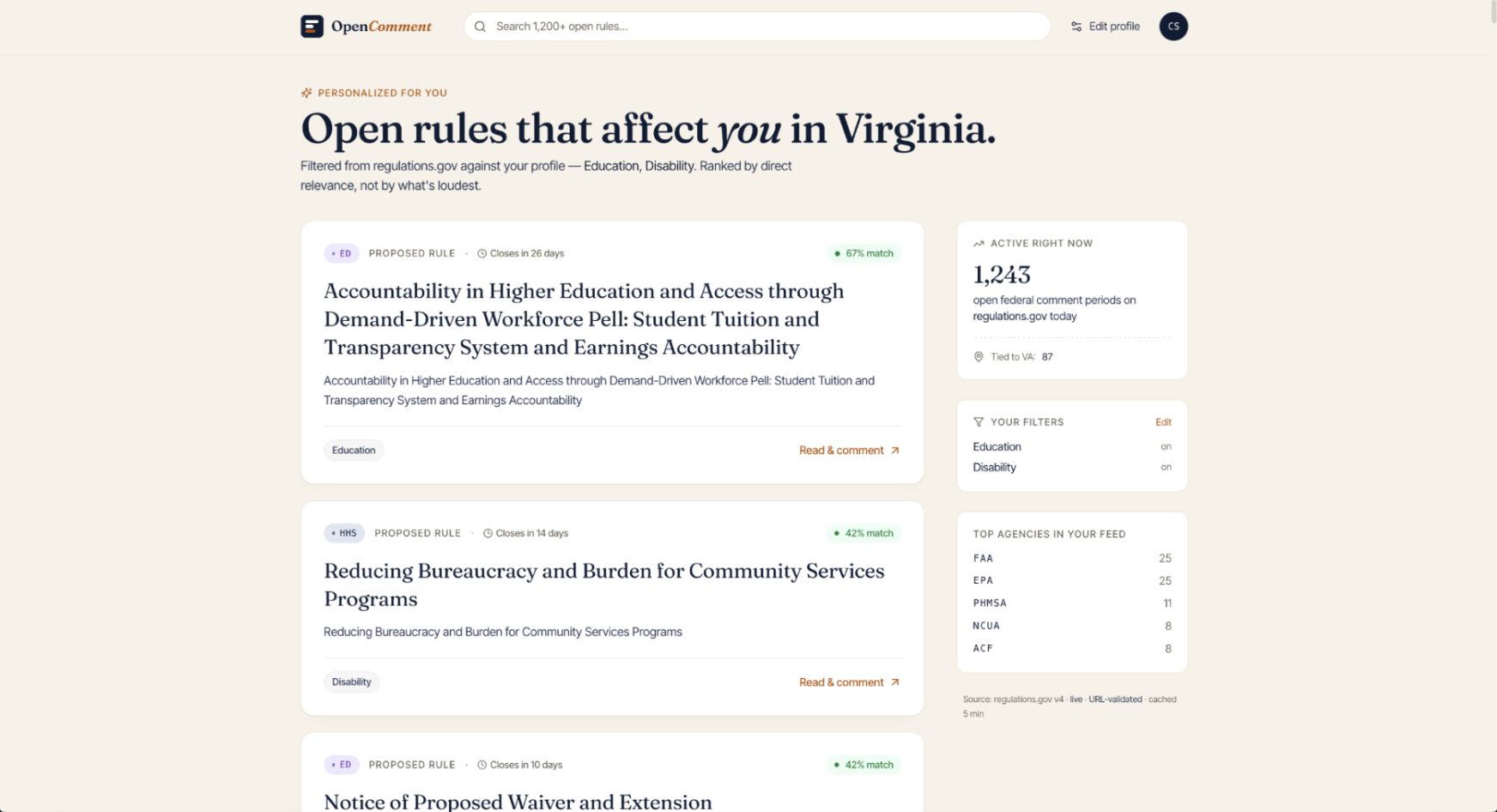
OpenComment is an AI-powered civic platform that transforms how citizens interact with federal policy. Users start by inputting basic demographics and their core topics of interest (like Healthcare, Labor, or Housing). The platform then queries the live federal docket through the regulations.gov API and curates a personalized feed of open, relevant regulations.
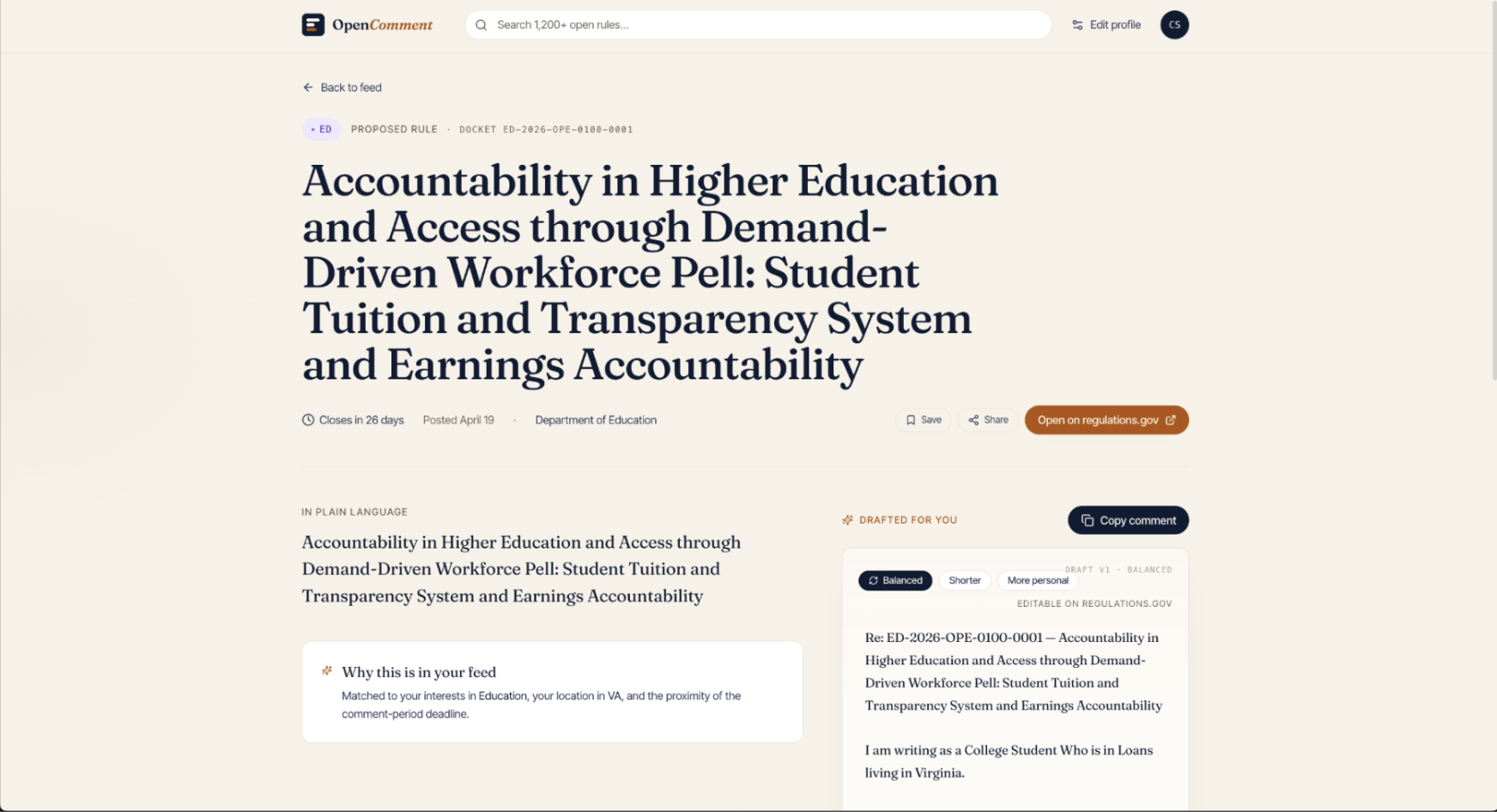
When a user clicks a regulation, OpenComment bypasses the dense legal text entirely. It provides a plain-English summary of how the proposed rule impacts them, and then uses AI to automatically draft a highly personalized, substantive public comment. This draft is anchored directly to the user's lived experience and geographic location, ready to be copied and submitted to the official regulations.gov portal.
How we built it
We designed OpenComment to feel like trusted, modern civic infrastructure, adopting a minimalist, document-driven aesthetic. The frontend is built entirely on Next.js 14 (App Router) using TypeScript for strict type safety. We styled the interface with Tailwind CSS and selectively integrated shadcn/ui primitives to ensure a fast, responsive user experience without sacrificing our custom design language.
On the backend, we built a custom Next.js Route Handler that acts as a secure proxy to query the live api.regulations.gov/v4/documents endpoint. We dynamically map the user's onboarding interests to API search parameters to surface the most relevant proposed rules. For the generation engine, we utilized an LLM to ingest the dense regulatory abstracts and output the clear, personalized comment templates displayed on the frontend.
Challenges we ran into
Federal APIs are incredibly powerful but can be notoriously slow and strictly rate-limited. We had to implement server-side caching and graceful fallbacks so the feed would load instantly during the demo without hitting the 1,000 requests/hour cap.
Additionally, federal data is messy. Some regulations lack clean abstracts or have highly irregular metadata, requiring us to build robust error-handling to prevent the UI from breaking. Finally, prompt-engineering the LLM was surprisingly difficult; we had to meticulously constrain the model so it generated comments that sounded like genuine, concerned citizens rather than robotic, generic AI boilerplate.
Accomplishments that we're proud of
We are incredibly proud of the end-to-end user narrative. Taking a user from a simple demographic onboarding screen to a fully drafted, context-aware 400-word federal public comment in a matter of seconds is a massive UX achievement.
We also managed to successfully nail our target aesthetic. By stepping away from the typical glossy "AI startup" look and utilizing serif fonts, clean layouts, and a restrained palette, we delivered an interface that feels authoritative, accessible, and ready for real-world public deployment.
What we learned
We learned just how vast and active the federal docket is on any given day, and how many critical rules fly completely under the public radar. More importantly, we discovered that the highest-value use case for LLMs right now isn't always generating novel ideas, but acting as a "translation layer" between complex bureaucratic systems and ordinary people.
Technically, we gained deep, practical experience in managing complex API request lifecycles within Next.js Server Components and handling asynchronous state in a high-speed sprint.
What's next for OpenComment
Currently, OpenComment generates the text and links users out to regulations.gov to paste their final draft. The immediate next step is integrating the official Federal Comment Submission API so users can post securely and directly from our platform without ever leaving the app.
Beyond that, we want to scale the architecture down to the local level. By scraping state legislative dockets and city council agendas, OpenComment can become the definitive tool for citizens to advocate for changes right in their own neighborhoods.
Built With
- nextjs
- tailwind
- typescript

Log in or sign up for Devpost to join the conversation.