Inspiration
Developer agents are becoming extraordinarily capable, but users are often forced to choose between privacy, provider freedom, extensibility, and a polished desktop experience.
I wanted a complete agent workspace that lives on the user's computer, works across local and cloud models, and can help build, test, research, organize, and operate the Mac. It should feel coherent and alive without locking the user into a single model provider.
What it does
OpenCode Superapp is a full native macOS agent application built on the OpenCode harness.
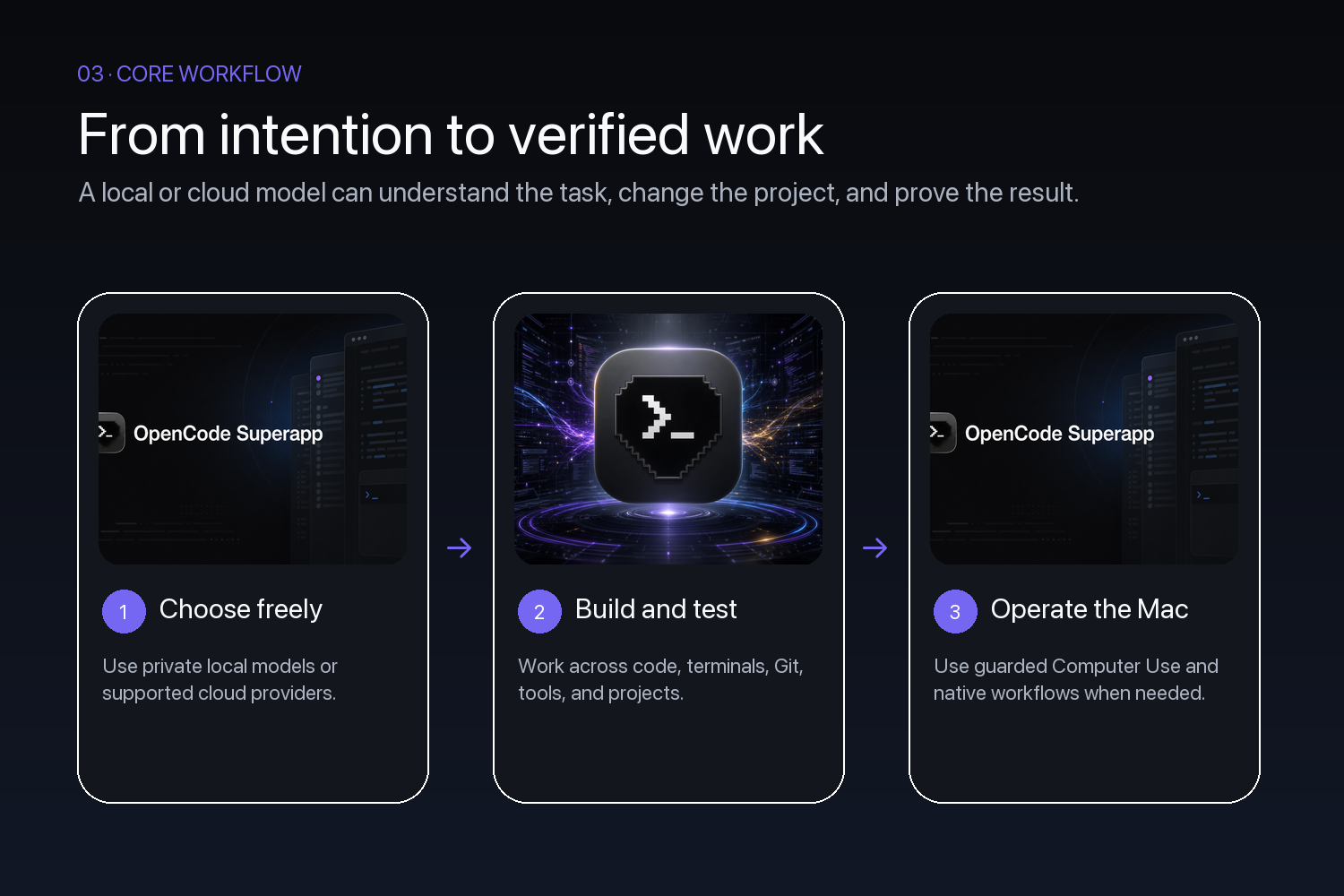
It combines projects, sessions, worktrees, terminals, Git, model and provider selection, permissions, skills, MCP servers, extensions, voice, whiteboards, remote access, and computer interaction in one workspace.
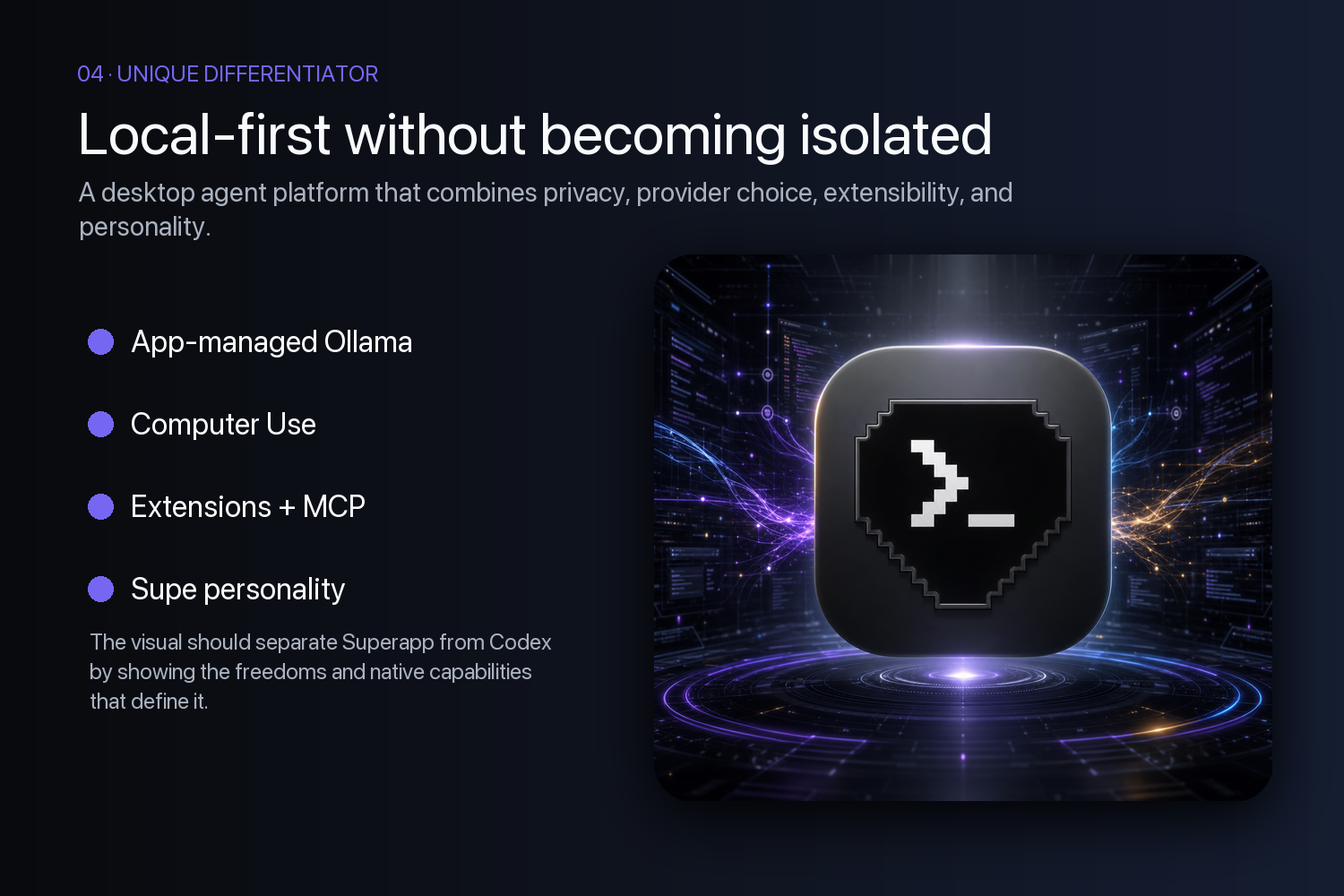
Users can run private models through an app-managed Ollama engine or choose supported cloud providers. Its Computer Use system can inspect and interact with desktop applications through explicit permissions and supervised control.
The extension platform lets developers and users add skills, MCP integrations, widgets, tools, and native capabilities. Supe gives the application its superhero identity, appearance, and personality while preserving model and provider choice.
This is not a thin model wrapper. It is a native, local-first, multi-provider platform for working with agents across the entire computer.
How it was built with GPT-5.6
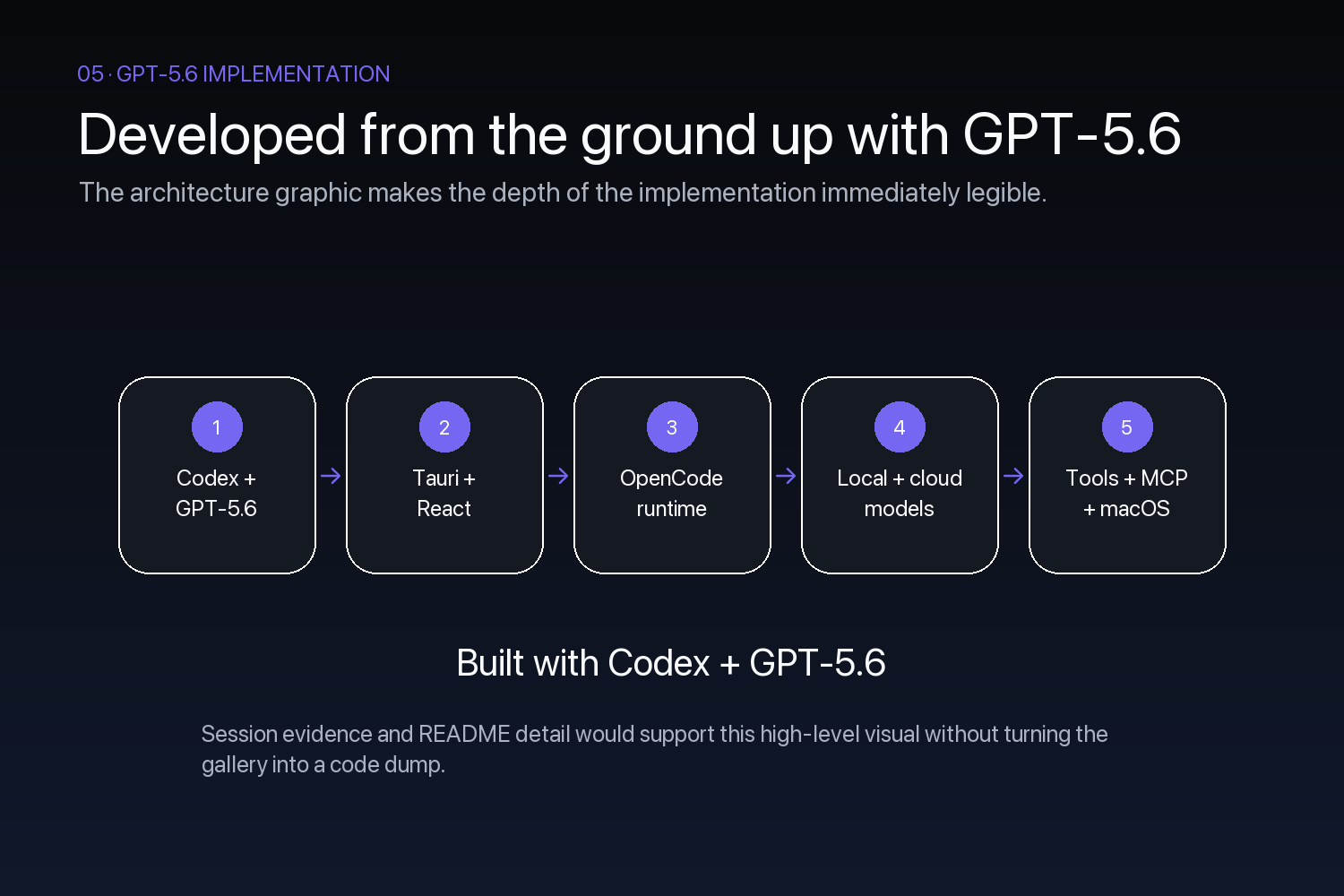
OpenCode Superapp was developed from the ground up with GPT-5.6 through Codex.
GPT-5.6 participated across the whole product: architecture, native Rust and Tauri systems, React and TypeScript interface work, OpenCode integration, local AI, extensions, Computer Use, Supe, debugging, testing, documentation, security boundaries, and release workflows.
The submission documentation will include the primary and supporting Codex session IDs so the development process can be inspected directly.
Architecture
The desktop application uses Tauri and Rust for lifecycle, permissions, sidecars, security boundaries, and operating-system integrations. The interface is built with React and TypeScript.
A bundled, authenticated OpenCode server owns agent sessions, messages, tools, providers, and execution. Local AI uses an application-managed Ollama server on a private loopback endpoint. Extensions execute through a dedicated host and integrate with OpenCode through defined Skill and MCP contracts.
Challenges and lessons
The hardest problem was not connecting an agent to more tools. It was establishing understandable boundaries between the native application, OpenCode, local models, extensions, remote services, and privileged computer actions.
Local-first also does not mean isolated. Users should be able to keep work private while retaining the freedom to use other providers when they deliberately choose them.
What's next
Next steps include expanding the extension ecosystem, broadening platform support, and continuing to make advanced desktop agents accessible without requiring users to assemble their own collection of terminals, model servers, and automation tools.
Built With
- codex
- gpt-5.6
- macos
- mcp
- ollama
- openai-api
- opencode
- react
- rust
- tauri
- typescript

Log in or sign up for Devpost to join the conversation.