-
-
canva
-
Dashboard
-
Landing Page
-
Landing Page
Inspiration
Artificial intelligence has advanced at an incredible pace, but building AI applications still feels fragmented.
Today, developers jump between countless tools just to create a single AI product. One platform hosts the model, another manages workflows, another stores vectors, another handles memory, another runs fine-tuning, while deployment, plugins, APIs, and monitoring all live somewhere else. Instead of focusing on solving problems, developers spend their time stitching together infrastructure.
I wanted to build something different.
I started asking myself a simple question:
What if building AI applications was as simple as drawing a flowchart?
And what if you didn't even have to draw it yourself?
What if you could simply describe your idea in natural language, and an AI system could design the entire application for you?
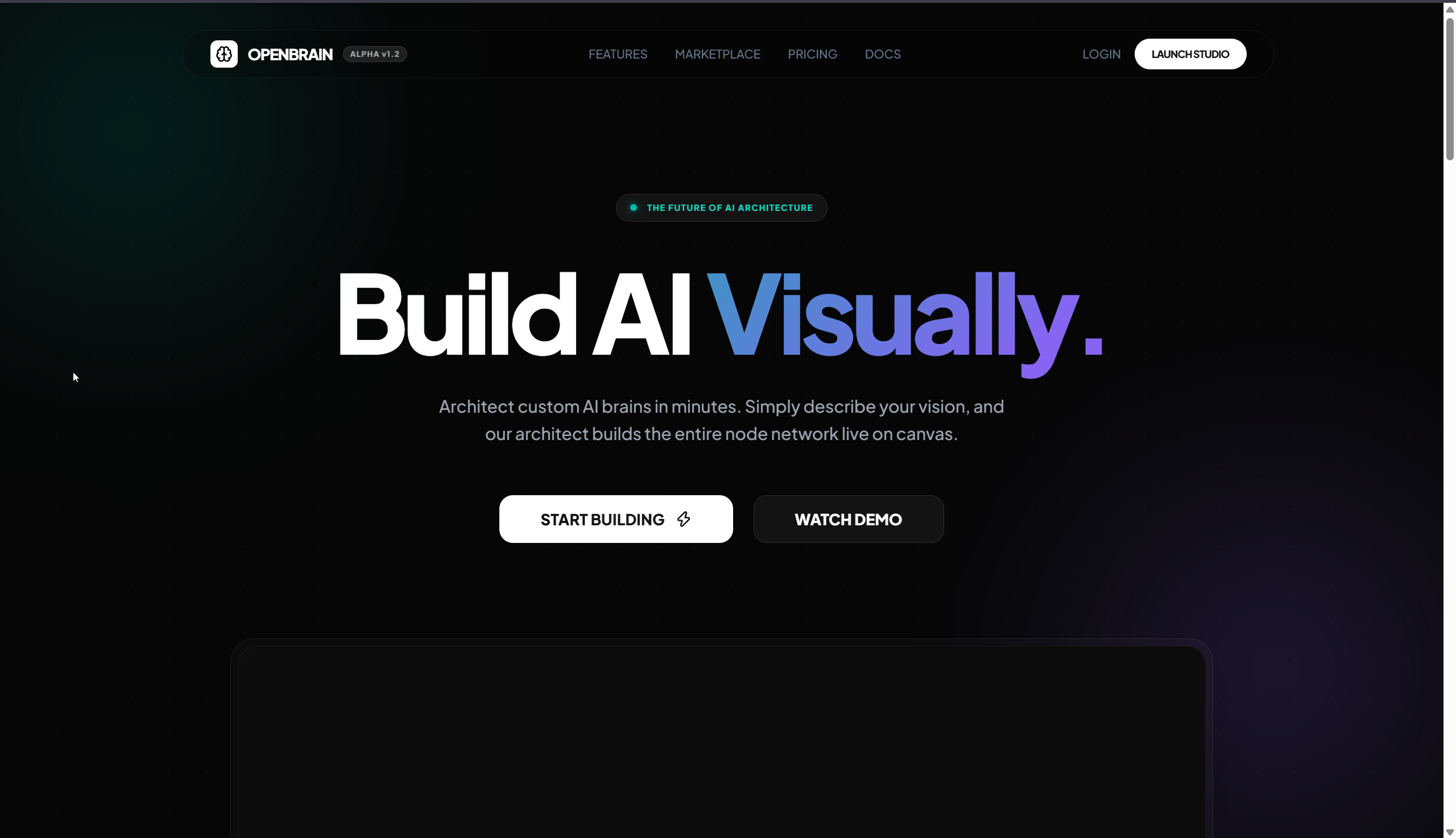
That vision became OpenBrain.
My goal wasn't to build another workflow builder. I wanted to explore what programming AI-native software could look like if visual graphs became the language itself.
What it does
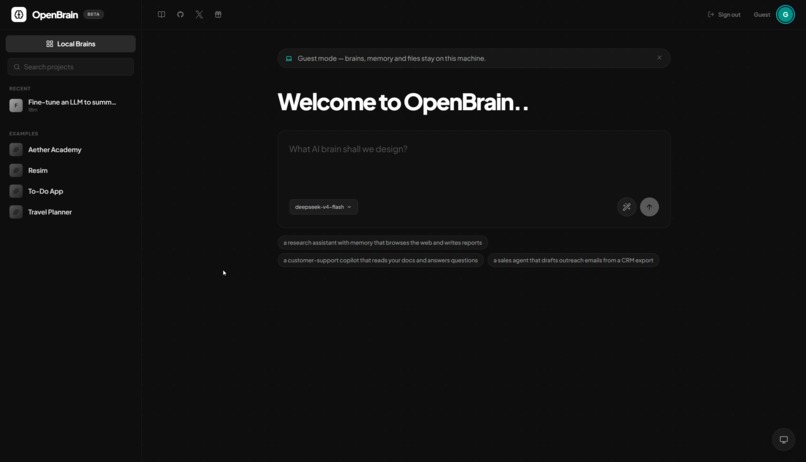
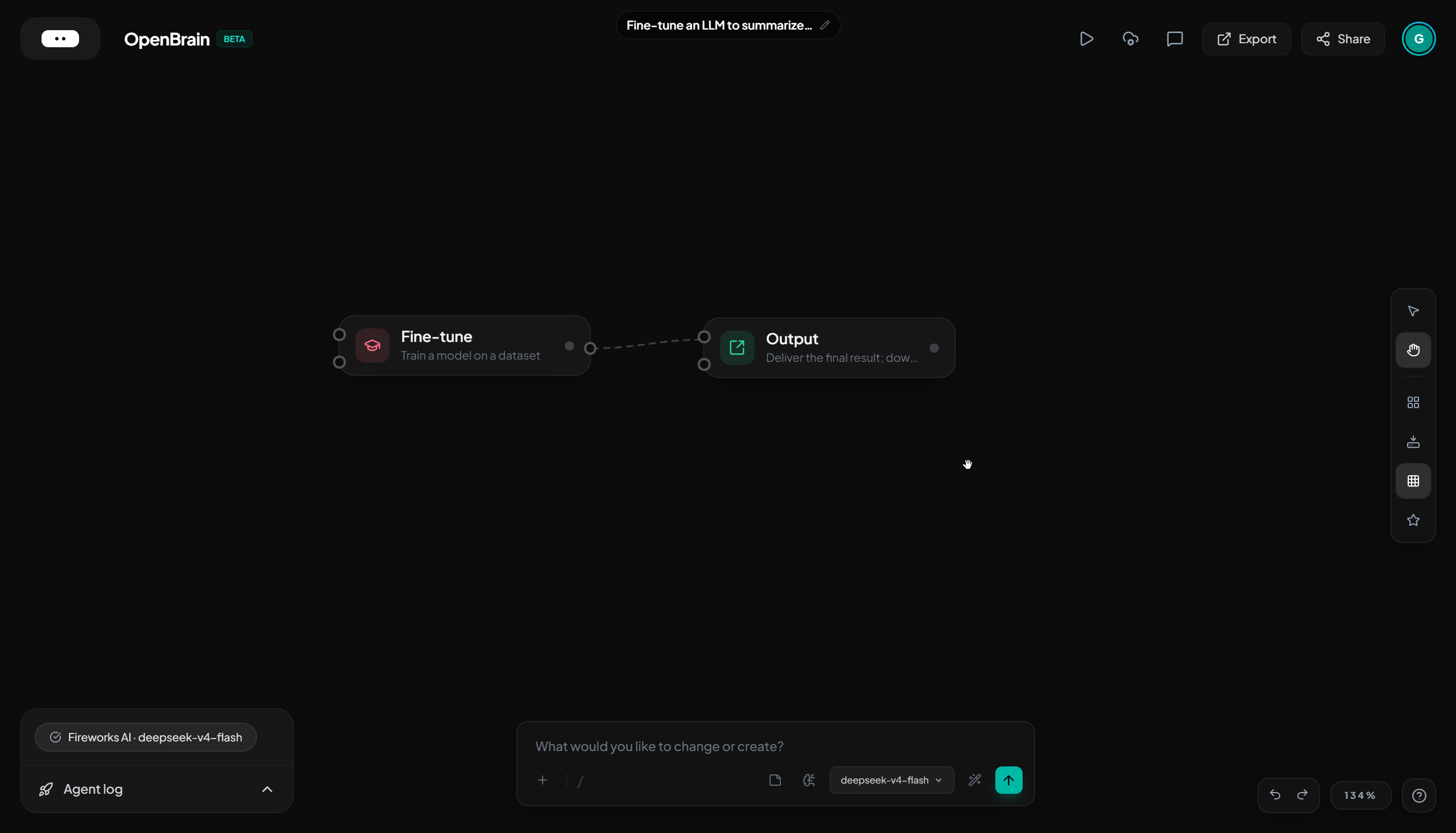
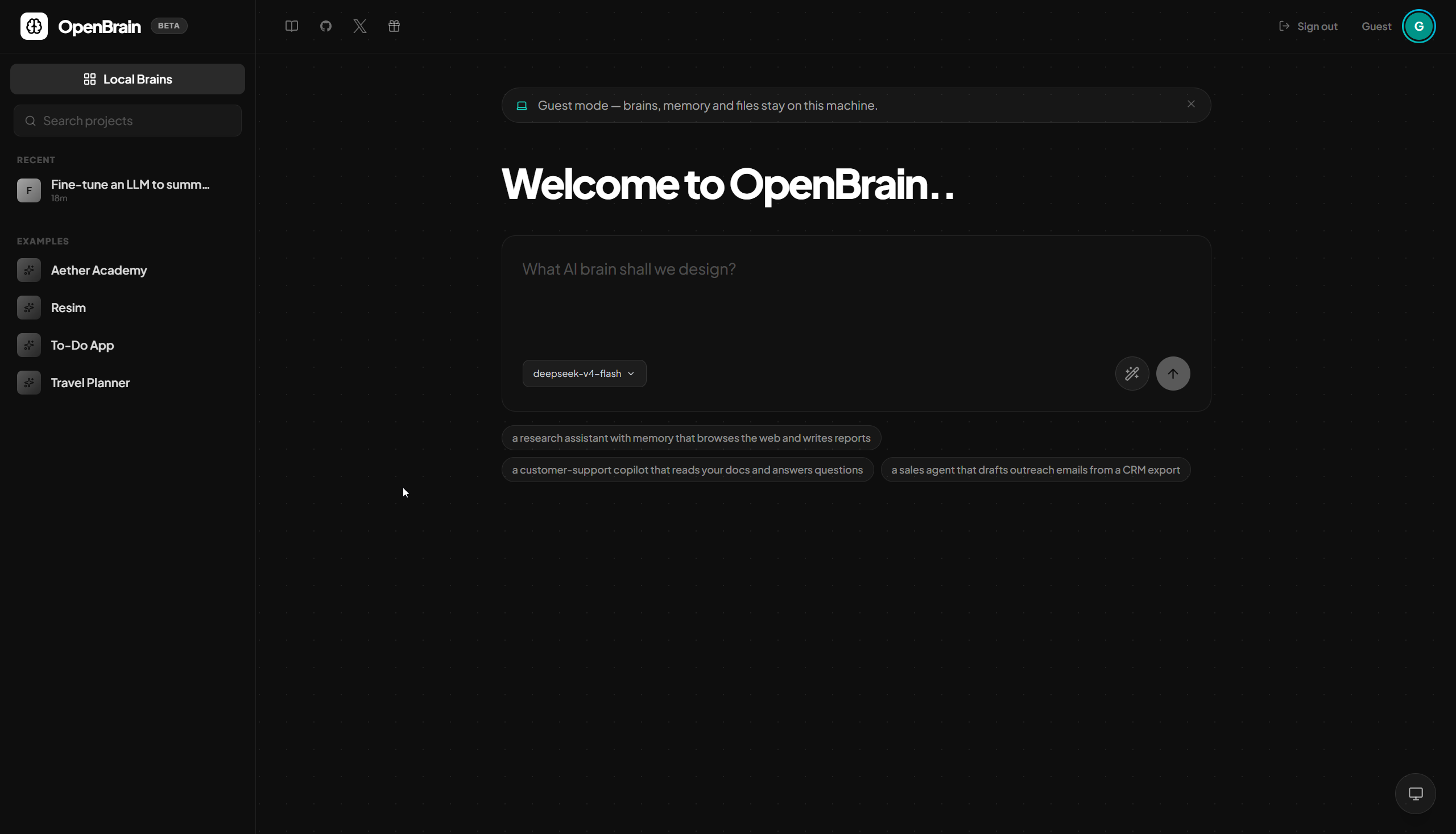
OpenBrain is a local-first AI development platform where every AI application is called a Brain.
A Brain is more than a workflow. It represents an entire AI application, containing its reasoning, memory, knowledge, execution graph, provider configuration, lifecycle, and runtime.
Instead of manually wiring together APIs and writing orchestration code, developers simply describe what they want to build.
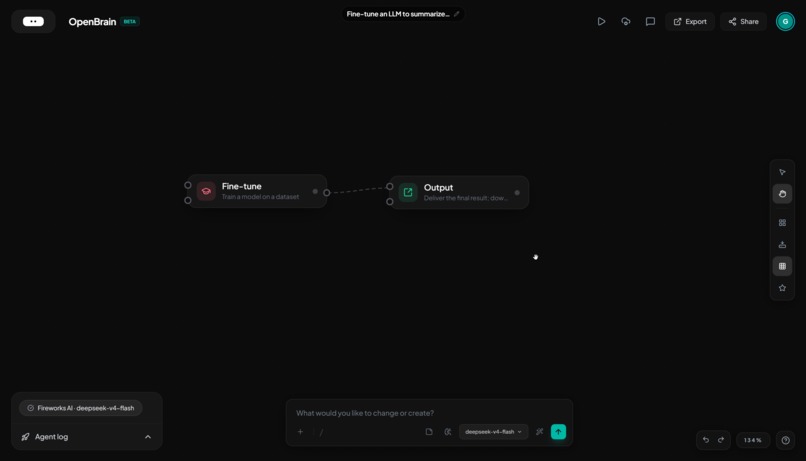
OpenBrain's AI Architect analyzes the request and automatically generates a complete executable Brain, including its nodes, connections, configurations, and execution flow.
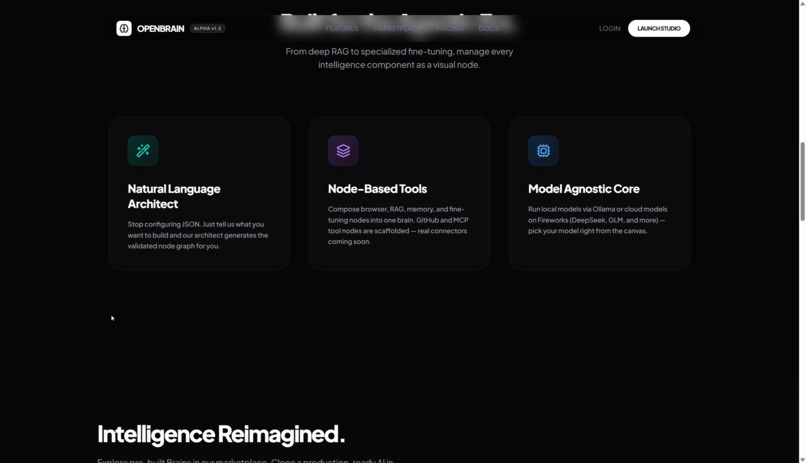
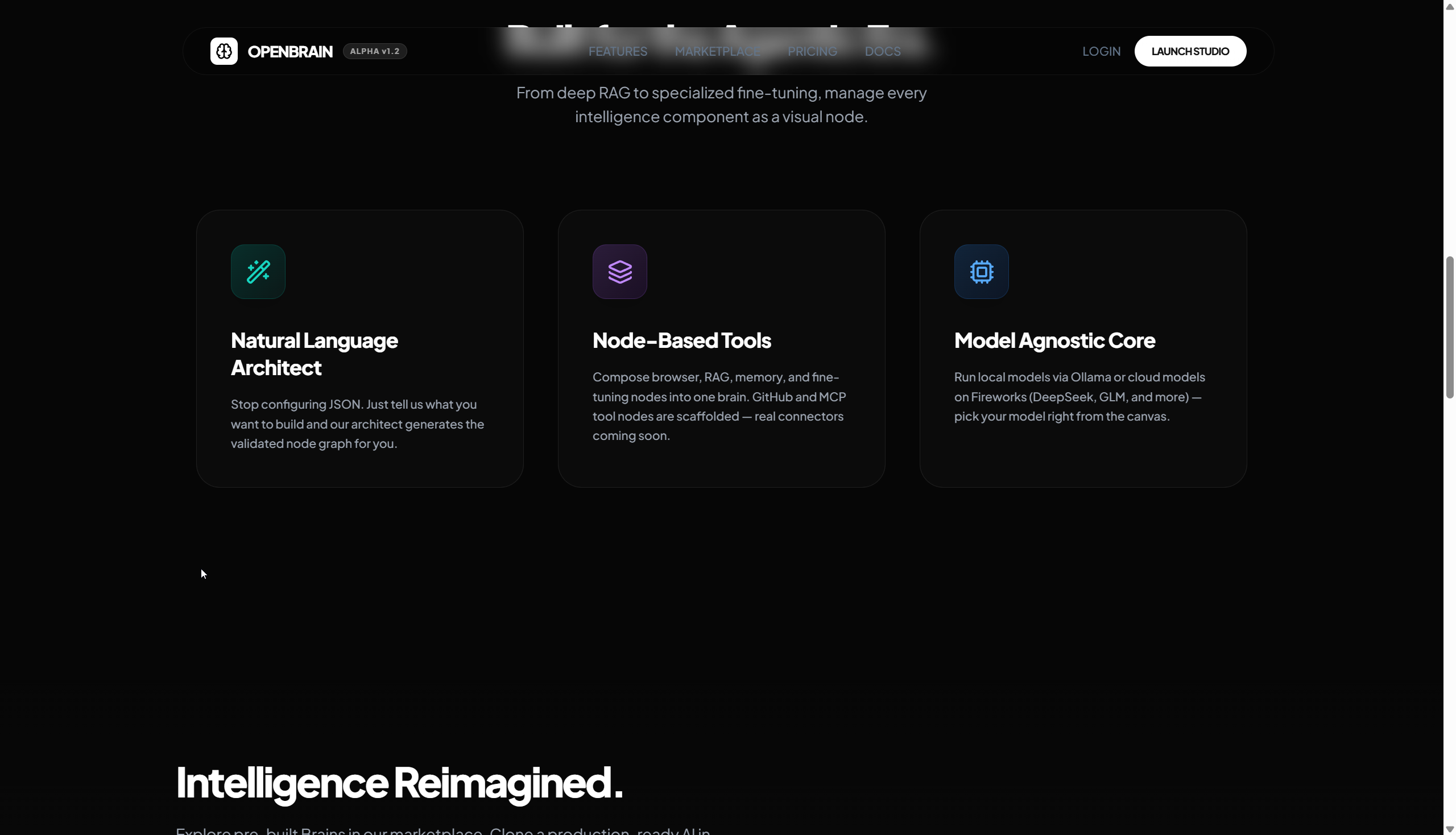
Each node represents a real capability. Brains can combine cloud language models through Fireworks AI, local models through Ollama and Transformers.js, persistent memory, retrieval-augmented generation (RAG), GitHub integration, browser automation, Model Context Protocol (MCP) tools, Python execution, image generation, reusable sub-brains, plugins, and much more.
Every Brain can be edited visually, executed locally, exported as a portable .brain file, shared with others, versioned, executed through the built-in runtime, or controlled from the command line.
One feature I'm especially proud of is the built-in fine-tuning workflow. OpenBrain understands the task you're trying to solve, recommends an appropriate base model and Hugging Face dataset, estimates the training cost, and allows you to choose between launching a cloud training job or fine-tuning locally on your own hardware using LoRA or QLoRA.
Rather than becoming another isolated AI tool, OpenBrain aims to become the environment where intelligent applications are designed, executed, and shared.
How I built it
I built OpenBrain entirely as a solo developer, handling every part of the project—from product design and software architecture to frontend development, backend systems, AI integrations, runtime design, and developer tooling.
The visual editor was built using React, TypeScript, Tailwind CSS, and React Flow, creating an interactive canvas where developers can inspect and edit AI applications visually.
Behind the interface, I designed an entirely new architecture centered around the concept of a Brain.
Every Brain contains its own nodes, edges, execution state, memory, knowledge, provider configuration, lifecycle, metadata, and logs. Around this domain model, I built a dedicated Brain Runtime, execution engine, plugin architecture, serializer, SDK, command-line interface, Docker deployment, and a portable .brain project format.
For AI capabilities, OpenBrain supports Fireworks AI for cloud inference alongside Ollama and Transformers.js for local execution, allowing developers to switch seamlessly between cloud and offline workflows.
From the beginning, my focus wasn't simply building features—it was building a scalable architecture that could continue evolving long after the hackathon.
Challenges I ran into
The biggest challenge wasn't creating the interface—it was designing an architecture capable of supporting the long-term vision.
OpenBrain combines visual programming, AI generation, execution graphs, cloud and local providers, plugins, runtime management, serialization, memory systems, and developer tooling into a single platform.
Designing those systems so they remained modular, extensible, and easy to maintain required redesigning major parts of the project multiple times throughout development.
Another challenge was balancing simplicity with flexibility. I wanted someone new to AI development to generate a working application in seconds using natural language, while still giving experienced developers complete control over every node, connection, and execution path.
Like every hackathon project, time was limited. There are still bugs, unfinished integrations, and features that I plan to continue building after the event. Rather than trying to polish everything, I chose to focus on building a solid foundation that can grow into a real product.
Accomplishments that I'm proud of
I'm incredibly proud that I built OpenBrain entirely as a solo developer.
During the hackathon I created:
- A visual AI Brain editor
- The AI Architect capable of generating complete execution graphs from natural language
- A modular Brain Runtime
- Cloud and local AI support
- A plugin architecture
- A portable
.brainproject format - A command-line interface and SDK
- Docker deployment
- Fine-tuning planning
- A scalable Brain domain architecture designed for future expansion
Most importantly, I built the foundation for a platform that I genuinely plan to continue developing beyond this hackathon.
What I learned
Building OpenBrain reinforced something I've believed for a long time.
The future of AI isn't only about better language models.
It's about building better developer tools.
Today, creating intelligent software still requires too much infrastructure and too many disconnected platforms. I believe AI development should become more visual, more intuitive, and more collaborative.
This project also taught me the importance of investing in architecture early. Separating the editor, runtime, providers, execution engine, plugins, and Brain domain made it possible to continuously expand the project without constantly rewriting it.
What's next for OpenBrain
The hackathon version is only the beginning.
I plan to continue expanding OpenBrain into a complete platform for building AI-native software.
Future work includes a Brain Marketplace, collaborative editing, additional AI providers, native fine-tuning, advanced debugging tools, deployment targets, richer plugins, improved MCP integration, and version control for Brains.
My long-term vision is much bigger than a visual workflow editor.
Just as Unreal Engine introduced Blueprints as a new way of building games, I believe node graphs can become a new way of programming intelligent software.
OpenBrain is my exploration of that future.
Built With
- cli
- composio
- docker
- express.js
- fireworks-ai
- hugging-face
- llm
- mcp
- node.js
- ollama
- plugin-system
- postgresql
- python
- qdrant
- rag
- react
- react-flow
- redis
- sdk
- supabase
- tailwindcss
- transformers.js
- typescript
- vector-search


Log in or sign up for Devpost to join the conversation.