-
-

Thumbnail
-
-
-

Inspiration
While many nonprofits achieve remarkable impact, some organizational models can lead to confusion and unintended challenges, undermining groups. For instance, OpenAI’s structure—a nonprofit overseeing a for-profit entity—illustrates how blurred boundaries can complicate accountability and trust between entrepreneurs and donors. Motivated by a desire for tangible, positive change, we developed ClearBank to empower ethical organizations. Our platform is designed to help small businesses build transparent relationships with donors, ensuring that trust and accountability remain at the forefront of their operations.
What it does
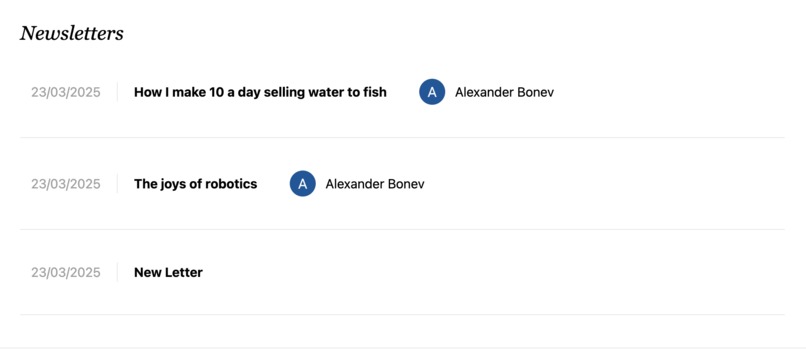
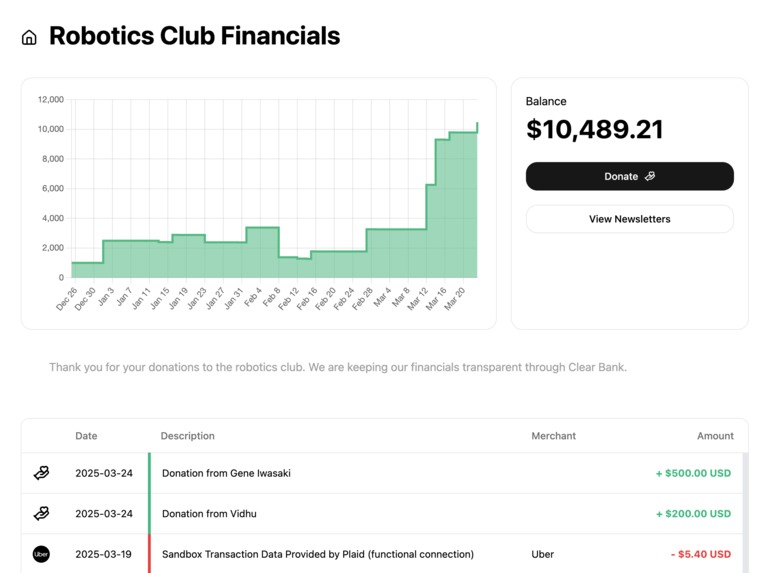
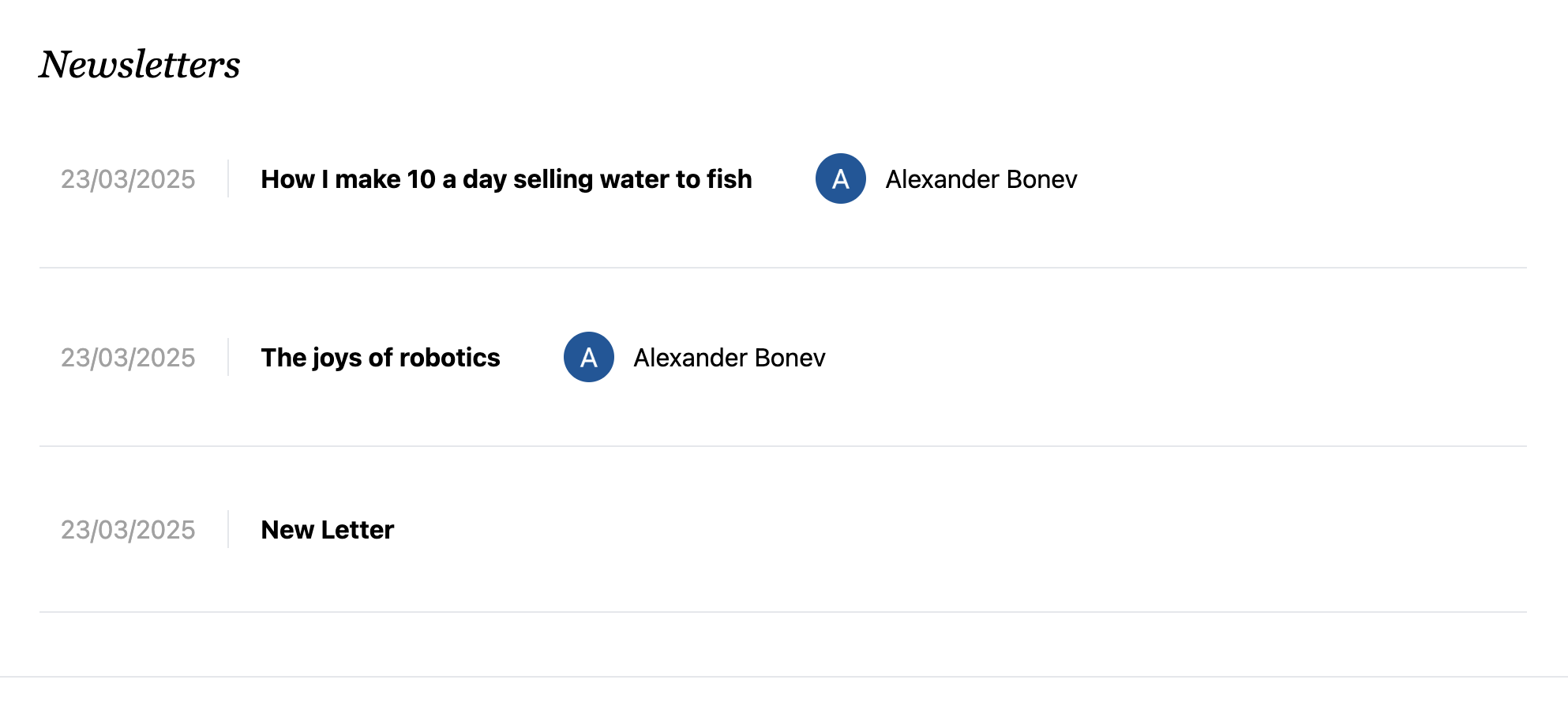
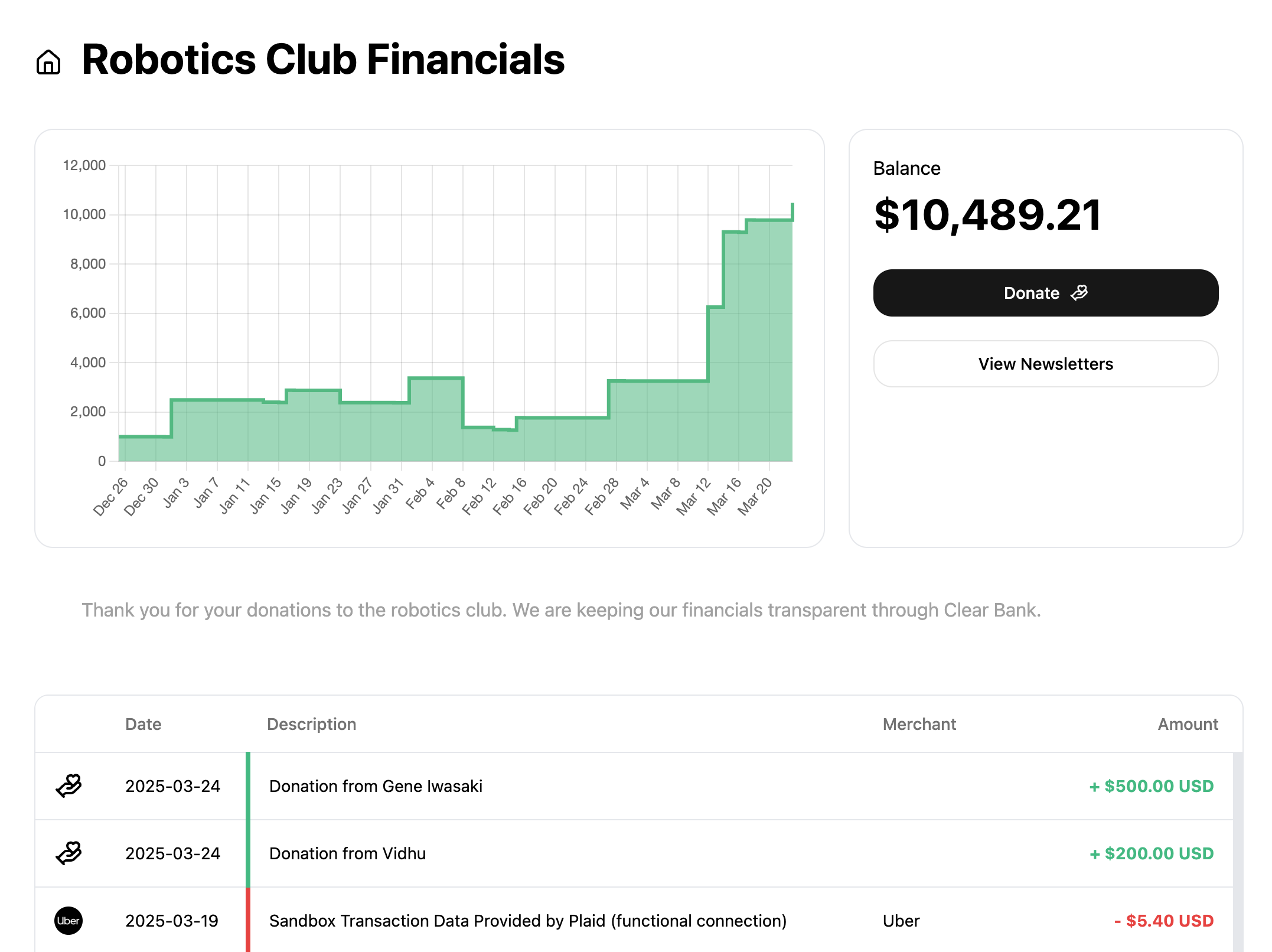
It allows non-profits and other entities to publicize their funds and donations/expenses for full transparency, as well as having a list of all donations and expenses for different prospective donors to check the validity of the nonprofit. If someone sees that money is spent well and for a good cause, they are far more inclined to donate. It also allows non-profits to create newsletters and update their donors and prospective donors on the progress of their cause.
How we built it
We used Plaid which is the industry standard for securely connecting your bank to the apps and is used by apps like Venmo. For the frontend development, we used Svelte 5 and SvelteKit to create the web application, with tailwindcss being used for styling. We integrated these frontend features with the Pocketbase real-time database and used end-to-end type safety to ensure all unexpected errors are caught before they have any impact. To create the graphing system, we used the ChartsJS, and NumberFlow for the numerical values. We integrated Markdown into the newsletter to be expressive while both robust and simple.
Challenges we ran into
The first challenge that we ran into when creating the application was working with the Plaid API for the first time. Due to the tight security that Plaid uses to validate its banking system, we needed to integrate the sandbox environment with our more robust and expansive use case with the nonprofit system. The second challenge that we ran into was the integration of the data that we get from the Plaid API and translating that data into a ledger that updates in real-time and can be seen by both the donors of the nonprofit and any prospective donors looking to check the validity of the nonprofit's expenses.
Accomplishments that we're proud of
The Plaid API was a new and difficult piece of technology that none of us had any prior experience in, so integrating it into our app in a seamless way was truly an accomplishment that we were proud of. Also, when creating the graphing system for tracking the nonprofit's balance over time, the way that we made it updated in real-time and available to interactively see the nonprofit's balance over time was another thing that we were really proud of. We also believe that the overuse of AI in hackathon projects leads to a lower level of creativity, so we completed this whole hackathon without integrating any form of AI into our project.
What we learned
The theme idea was really difficult for us to come up with a suitable concept for, and we learned that if we want to make a project that is up to our standards, the first thing that we need to do is come up with an idea that allows for a lot of freedom, but still leads us in a direction so we don't get overwhelmed. We also learned that delegating responsibilities was a great way of always having someone do something useful, and not wasting any precious time.
What's next for ClearBank
At Continuity Labs, we really like to take the projects that we build in a hackathon, and flesh them out to a more polished state after the hackathon is over. We believe that this idea has a lot of potential to become a fully fledged product, so we will most likely look into expanding the non-profit system, and integrating with the Stripe API to fully finish the already-complex banking system.
Built With
- chartsjs
- markdown
- plaid
- pocketbase
- svelte
- sveltekit
- tailwindcss
- typescript


Log in or sign up for Devpost to join the conversation.