-
-

OpenDissertation logo
-
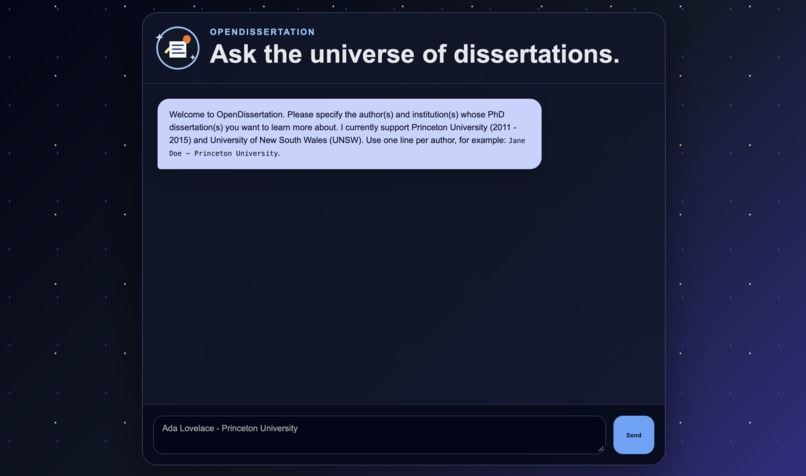
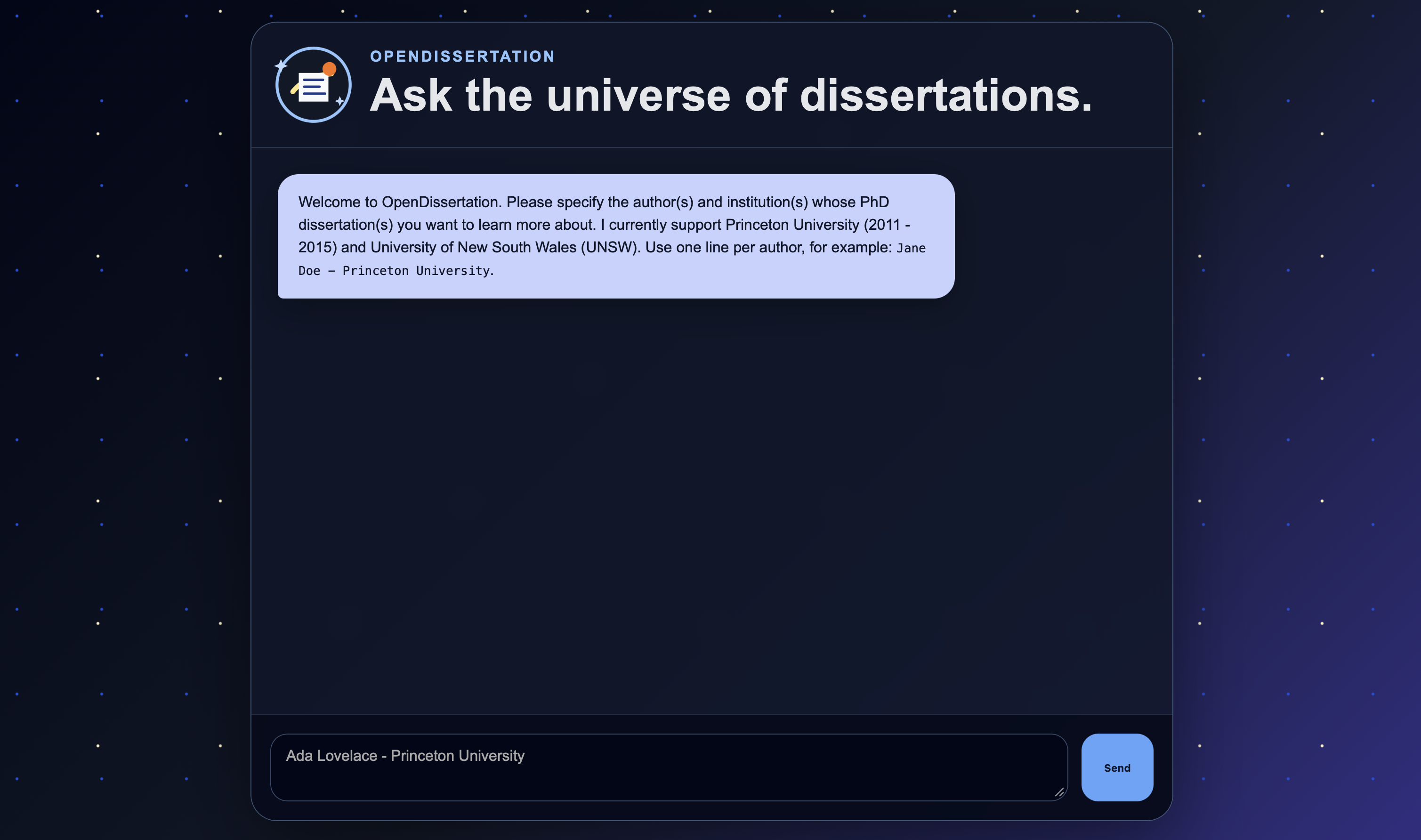
Initial state of OpenDissertation site
-
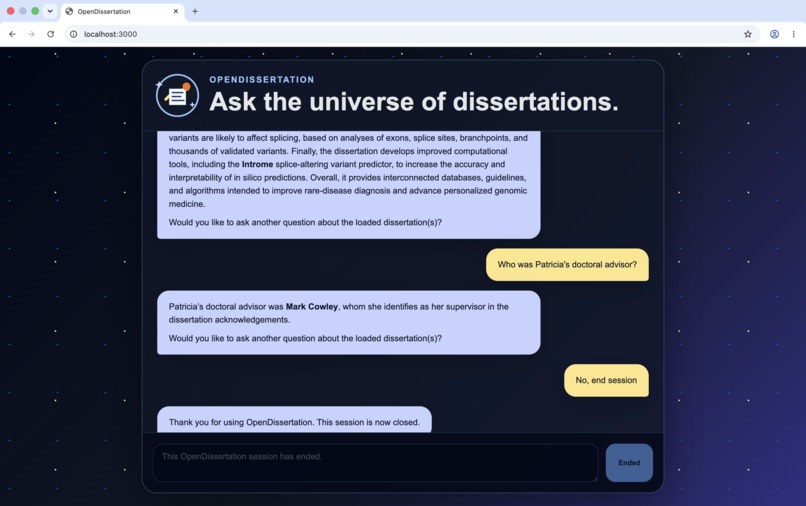
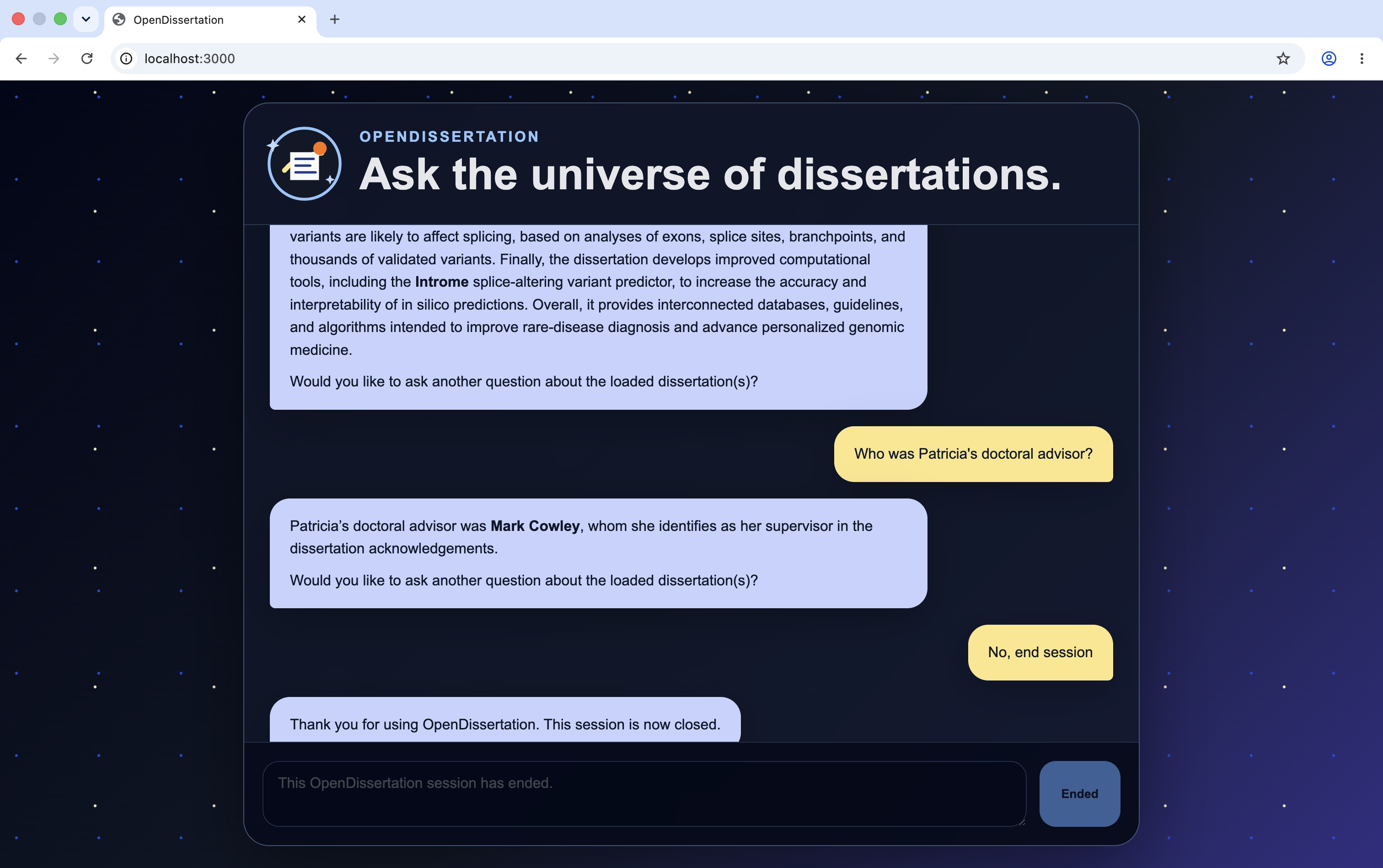
OpenDissertation after answering the user's questions

Inspiration
Seong was tired of having to find, download, and read doctoral dissertations from different authors. Most PhD dissertations are the culmination of at least five years of very in-depth research and are often one hundred pages or more. He wanted an AI model that could easily answer his questions about the selected works with the click of a button.
What it does
OpenDissertation is a space-inspired, multi-turn chat format website between Chat-GPT 5.6 and the user. When prompted, the user specifies one or more author-institution pairings. Currently, only dissertations from Princeton University (between 2011 - 2015) and the University of New South Wales are supported.
OpenDissertation will find the dissertations, upload them to Chat-GPT's file store, create a vector store for Retrieval-Augmented Generation, and answer the user's questions about the works. When the conversation is finished, OpenDissertation cleans up the vector store and deletes the uploaded files from Chat-GPT.
How we built it
The OpenDissertation website consists of a NextJS front-end paired with a FastAPI back-end that incorporates the asynchronous Chat-GPT 5.6 Luna Python client. Docker containers for both are deployed on Google Cloud Run.
Jeffry and Seong knew that programming in JavaScript or TypeScript would be their weakness so they relied on Codex to rapidly build the entire front-end. For the back-end, Seong used Chat-GPT, Codex, and Claude to determine how to download publicly available doctoral dissertations from institution websites.
Jeffry referred to a previous hackathon submission to set up FastAPI endpoints that handled file processing and also incorporated the OpenAI client. Jeffry relied on Codex to integrate Seong's download scripts as a FastAPI endpoint and he also took care of bug fixes through Codex's code review comments on pull requests. He set up the CI/CD pipeline in the back-end repository to not only improve the robustness of his programming but also enable Codex to automatically detect and fix lint issues.
Challenges we ran into
Well, we started writing code two days ago on Sunday, July 19, 2026 so it was a challenge to get everything finished by the deadline on Tuesday, July 21, 2026. Seong initially tried to retrieve dissertations from ProQuest.com but realized that access to their API required permission and vetting. Princeton University uses DataSpace to store their dissertations and Seong ran into a bot-protection verification page that initially prevented the works from being downloaded.
The integration of Seong's download scripts as a FastAPI was non-trivial and Jeffry decided to let Codex handle it after thinking about solutions for several hours. It performed incredibly well and accomplished the task in a few minutes. Jeffry also ran into challenges due to differences between local deployment via docker compose and production deployment on Google Cloud Run from GitHub. He managed to figure out issues related to DOCKER_BUILTKIT and Cloud Logging.
Accomplishments that we're proud of
Completing our original idea, narrowed in scope, within three days.
What we learned
Chat-GPT 5.6 and Codex are remarkable tools. Three days ago we only had an idea. Now we have a publicly available service on the internet that can help you understand doctoral dissertations faster.
What's next for OpenDissertation
- Support dissertations from other institutions
- Add other research formats like publications and conference presentations
- Given an advisor and department, enable querying of all dissertations from their students
- Integrate Redis for persistent storage (we are currently using in-memory storage)
- Add unit tests
Built With
- chat-gpt
- docker
- fastapi
- google-cloud
- javascript
- nextjs
- python

Log in or sign up for Devpost to join the conversation.