-
-
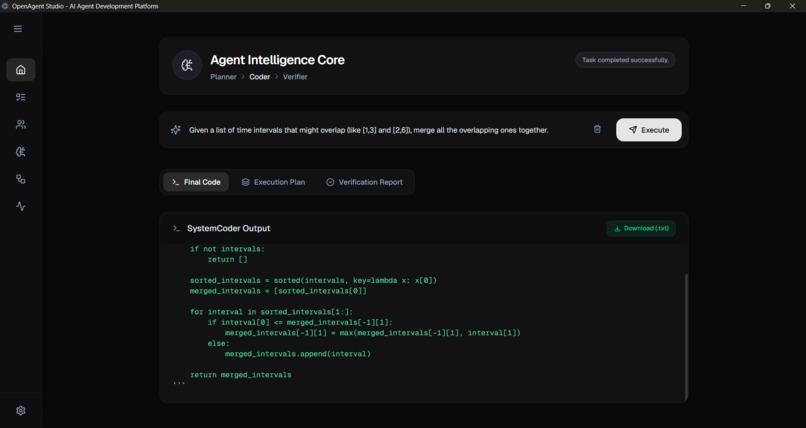
Native Desktop Application of OpenAgent Studio
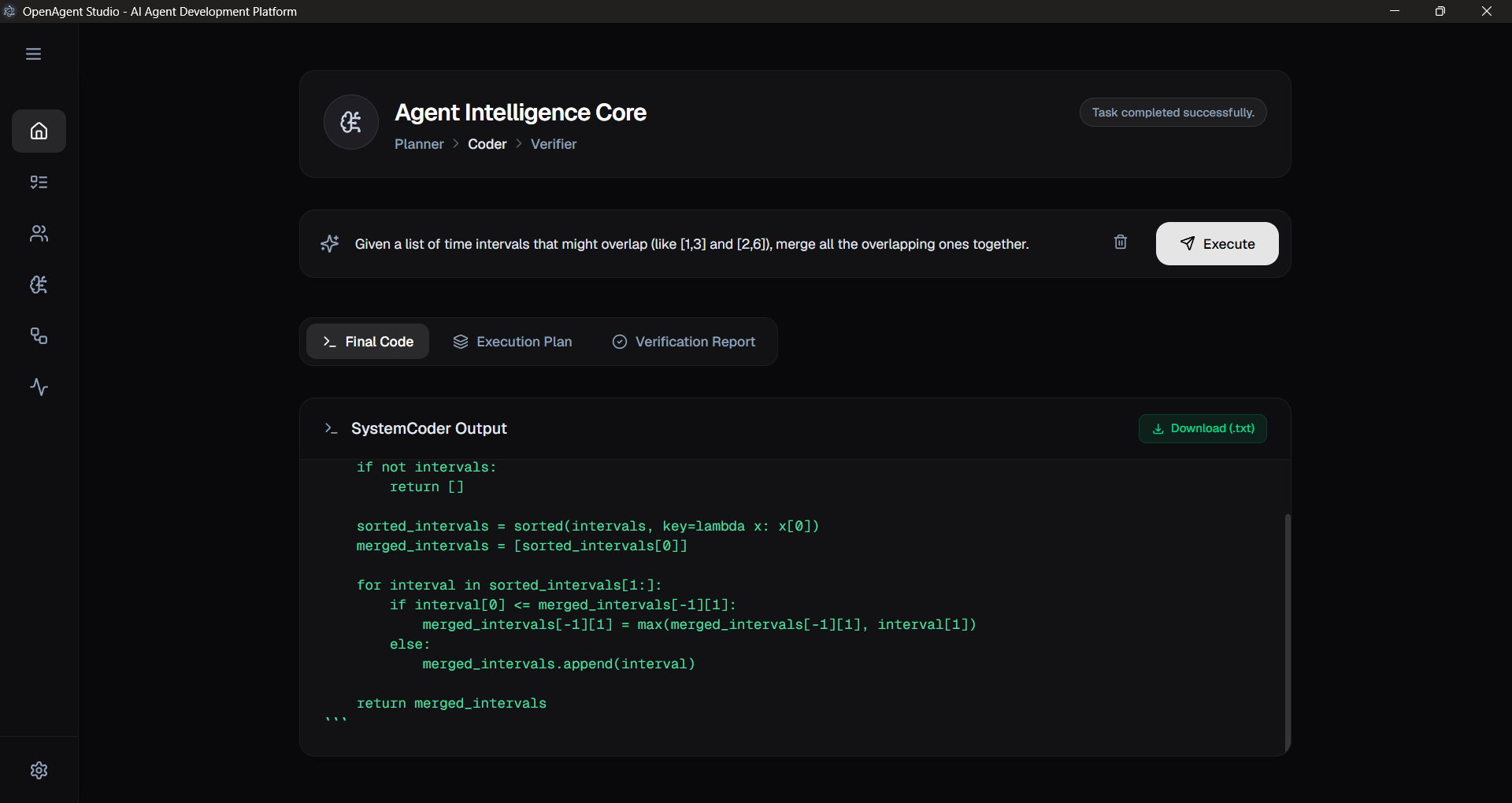
Inspiration
Modern AI coding tools heavily rely on paid cloud APIs, introducing data privacy risks, subscription costs, and external network latency. We set out to build OpenAgent Studio—a sovereign, offline-first AI Operating System that puts an entire engineering department directly on local hardware. Our goal was to prove that local, open-weights models can deliver production-grade software engineering without a single byte of user data or intellectual property ever leaving the machine.
What it does
OpenAgent Studio is an autonomous multi-agent code writer built around a strict zero-hallucination pipeline:
- SystemPlanner: Decomposes complex coding instructions into discrete, verifiable sub-tasks.
- SystemReasoner & Coder: Drafts architectural logic designs and writes clean, idiomatic Python code with live token streaming.
- SystemVerifier: Audits generated code for safety, correctness, and adherence to clean architecture principles before delivery.
- Memory System: Retains cross-session code history and structured context locally using SQLite and local vector embeddings.
- Real-Time Diagnostics: Monitors local Ollama, FastAPI, and Next.js service health to guarantee system stability.
How we built it
- Frontend & Desktop App: Built with Next.js, React, Tailwind CSS, and shadcn/ui; packaged into a native Windows desktop experience using an Electron wrapper.
- Backend Architecture: Python FastAPI handling Server-Sent Events (SSE), agent state orchestration, and structured task dispatching.
- Local AI Core: Powered by Meta's Llama 3.1 (8B) model running locally via Ollama, paired with PyTorch and
nomic-embed-textembeddings. - Deployment & Tooling: Fully containerized with Docker Compose for web deployment, supported by automated process cleanup scripts (
Start-CodeWriter.bat). - Autonomous Engineering: Collaboratively architected, debugged, and refined using Google Antigravity and Gemini.
Challenges we ran into
- Container-to-Host Networking: Configuring seamless communication between containerized FastAPI services and the host-bound Ollama instance across Docker networking boundaries.
- Sub-repository Build Clashes: Resolving nested Git repository boundaries and managing port conflicts (8000 & 3221) between standalone Next.js builds and background processes.
- Guardrailing Local LLMs: Designing the verification agent to catch edge-case hallucinations and eliminate code bloat while maintaining fast local inference speeds.
Accomplishments that we're proud of
- Achieving 100% data sovereignty with zero external API dependencies or subscription costs.
- Engineering a multi-agent UI that visualizes the Planner, Coder, and Verifier outputs in real time.
- Open-sourcing a complete, production-ready developer platform under the Apache 2.0 License.
What we learned
- Compact 8B parameter models, when guided by structured multi-agent verification gates (Chain-of-Verification), can produce code quality comparable to massive cloud models.
- Modular agent separation (separating reasoning from coding and verification) drastically reduces logic errors.
What's next for OpenAgent Studio`
- Multi-File Workspace Editing: Enabling full codebase indexing and AST-aware cross-file refactoring.
- Sandboxed Execution: Running automated unit tests inside isolated micro-containers before delivering final code.
- Custom Agent Workflows: Allowing users to define and plug in specialized domain agents.


Log in or sign up for Devpost to join the conversation.