-
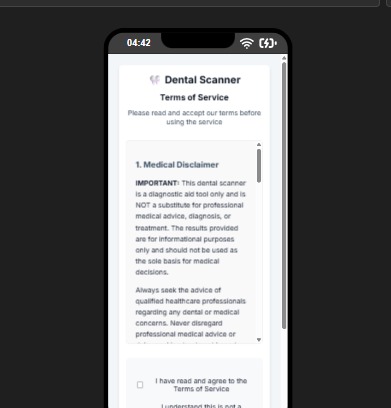
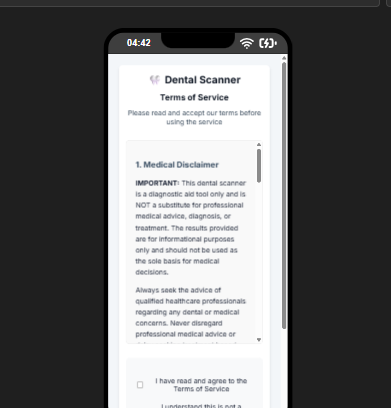
Mobile app display (showing terms and conditions)
-
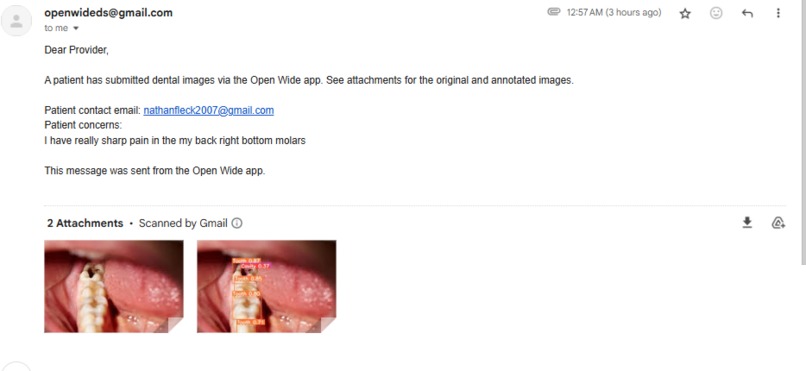
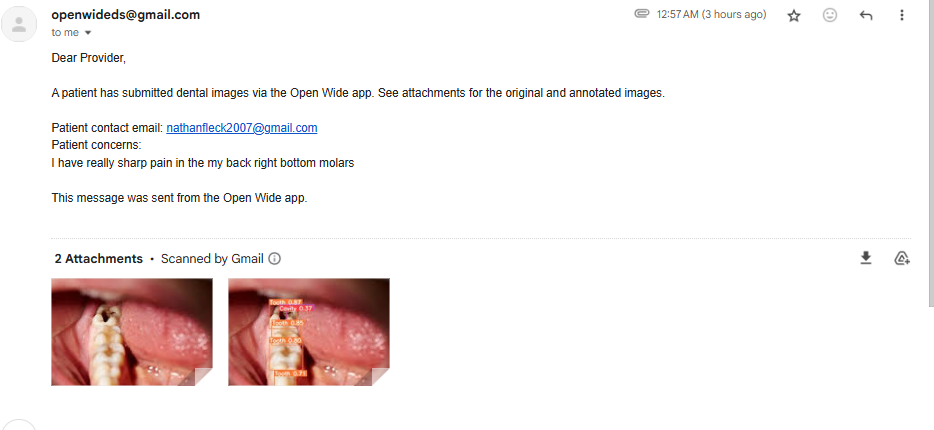
Sends an email to the patient's healthcare provider with any concerns the patient may have along with the images of the patient's teeth.
-
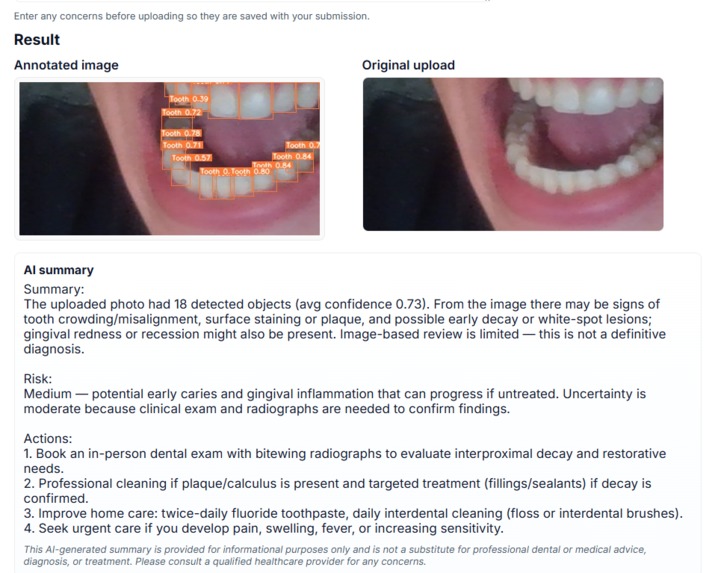
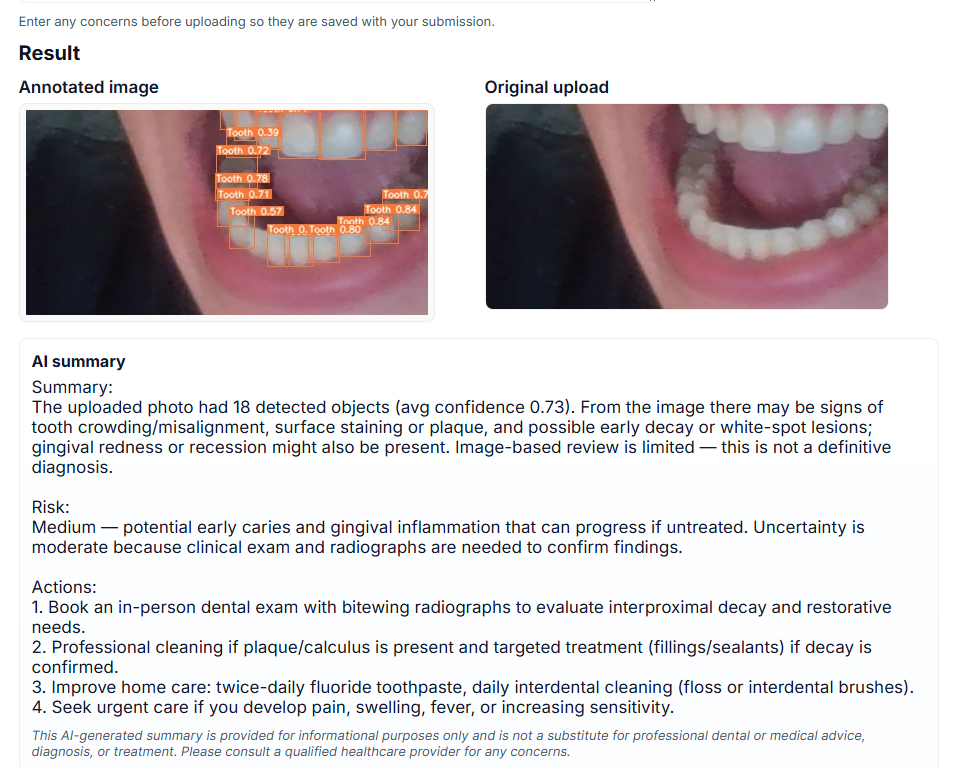
Allows the user to upload an image of their teeth, which is then annotated followed by an ai summary and plan for further action.
Inspiration
Open Wide was inspired by the vision of bringing high-quality dental care beyond the clinic empowering people to access reliable oral health screening from home, while giving professionals the tools to extend their reach and improve outcomes at scale.
What it does:
Open Wide allows users to either upload an image of their teeth or capture one in real time using their device’s camera. Once submitted, the image is processed through our clinically trained AI object classifier, which has been trained through annotated dental datasets. The system automatically identifies key dental structures, highlights potential pathologies such as cavities, and assigns statistical confidence scores to each finding.
How we built it
To built Open Wide, we first had to find a dataset which we used Kaggle. Then, in order to train and annotate the dataset, we used RoboFlow. After our model was trained, we had to make a back and front end, so the backend uses Flask (Python) with SQLite for managing user data and sessions, while AI model inference runs via subprocess calls. In the frontend, Vanilla JavaScript with AJAX helps create an interaction, paired with HTML/CSS for a responsive, mobile-first design. Also we used the OpenAI API for generating patient-friendly health summaries
Challenges we ran into
We ran into many challenges, the biggest challenge being training our own dataset. In this short period of time, for the model to be accurate enough, it was a big challenge to train a model with over 3000 pictures.
Accomplishments that we're proud of
Accomplishments we are proud of is our model having an accuracy rate of 63.4%. In this short period of time, we are proud of having this accomplishment and having our model working at a decent accuracy rate.
What we learned
We learned many things throughout these couple days. We learned how to integrate object detection models into a web-based platform, optimize image capture for diagnostic accuracy, and manage data securely in an environment. On the development side, we deepened our skills in bridging backend inference pipelines with responsive frontend design, ensuring seamless user interaction. Most importantly, we learned the importance of balancing technical innovation with clinical usability, designing not just a working product, but one that healthcare professionals can trust and patients can easily engage with.
What's next for Open Wide Dental Scanner
Next for Open Wide Dental Scanner is to deploy to the app store to make it available for public use. Along with that improve the accuracy of our model. This will help users receive more reliable at-home dental screenings, empower healthcare professionals with stronger diagnostic support, and ultimately expand access to preventative oral care on a larger scale.


Log in or sign up for Devpost to join the conversation.