-
-

Presentation slide with older prototype and features
-
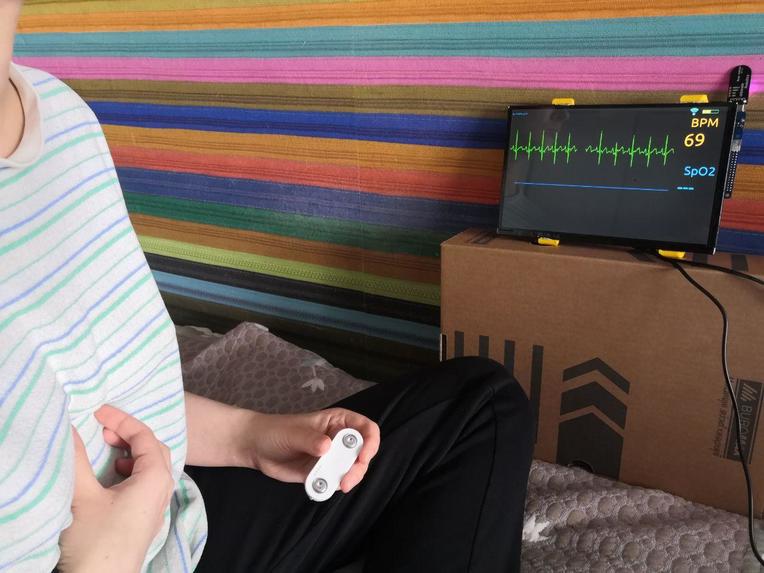
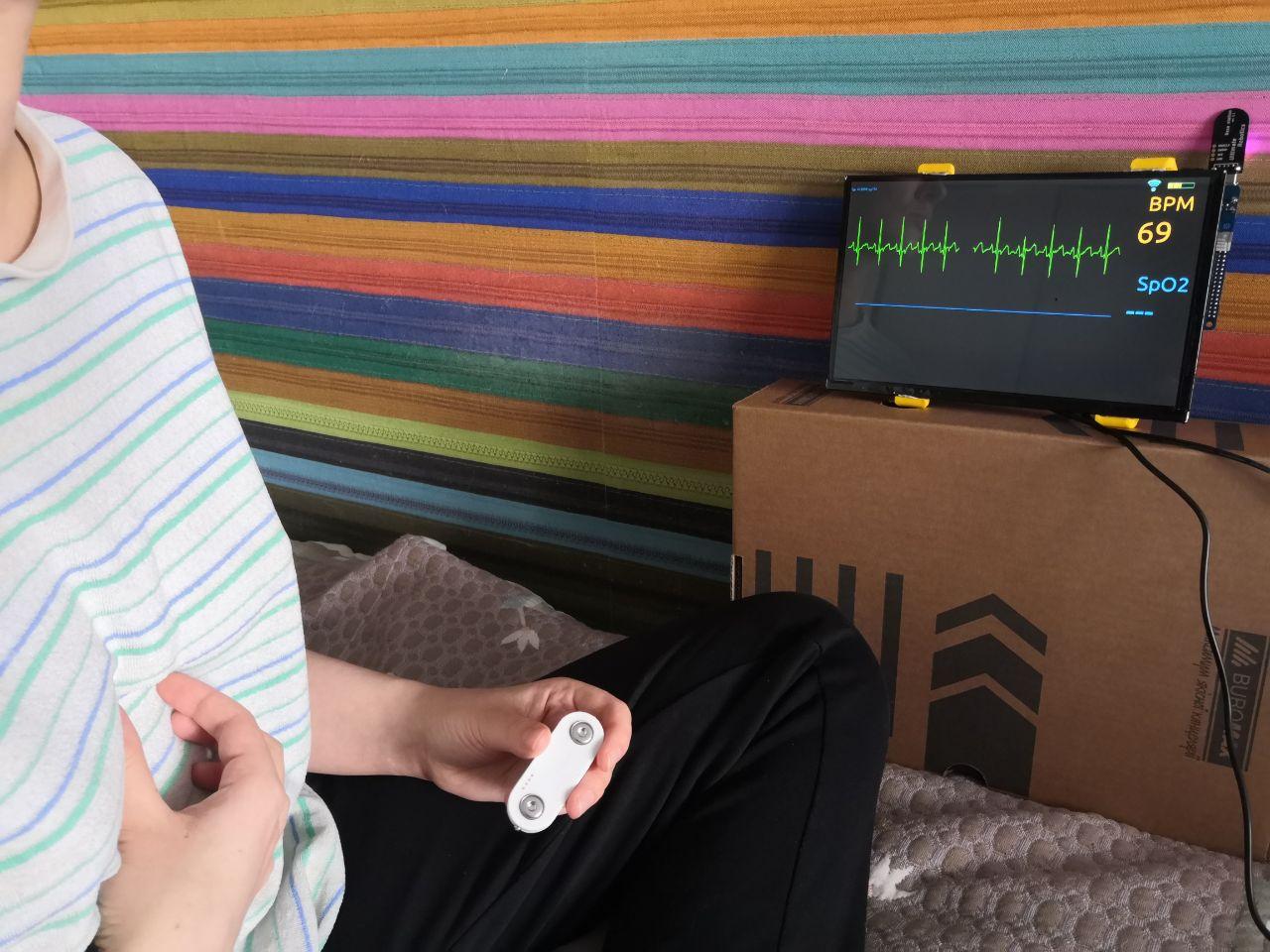
Our new prototype during testing! (Kseniia is wearing and holding our uECG device)
-
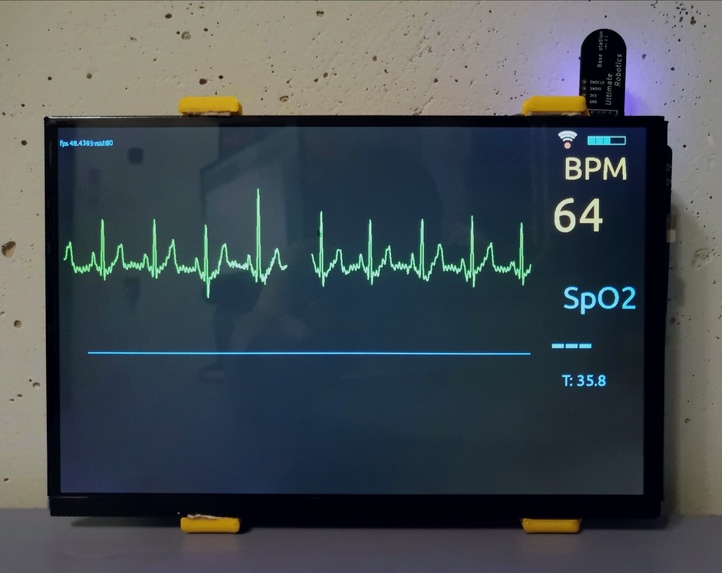
Added temperature!


Inspiration
Patient monitoring is critically important when a lung ventilator is applied, but it is also important to monitor state before that in order to track patient state and react in time if things go worse. In 2nd and 3rd world countries, monitors aren’t available in required quantities even for ICU beds (in Ukraine only about 60% of ICU beds have monitors, and virtually none of non-ICU beds). But even in developed countries there will be a shortage in monitors during the peak of pandemics.
Yet we want to go even further and make such a simple and cheap solution that can be used by patients at home, monitoring their state and allowing doctors to make better decisions whether a patient requires additional care.
It is equally important for us to provide this solution to as many people as possible in the short time, so it is a modular and completely open source / open hardware system, which can be produced locally in different regions.
What it does
It monitors ECG, SpO2, arterial pressure, temperature, and we also want to add acoustic monitoring to record coughing/wheezing sound (possibly analyse them using ML algorithms at a later stage), and provides remote access to realtime and stored data for a remote doctor (requires server side, not implemented yet)
Sensors and their state
- ECG - 2-lead wearable. Fully operational, based on our previous project uECG
- SpO2 - designed in late March, now in assembly. Expecting to get it working next week
- Arterial pressure - will be calculated from the delay in peaks between ECG and PPG (used for SpO2). Algorithm is described in several papers, expecting to get it working in mid-May
- Temperature - precise module in development. Rough value (~1 C error vs body core) is obtained via uECG device
- Acoustic module - in development, prototype should be operational by mid-May, after that we’ll optimize it, and fully usable version can be ready in early June
How we built it
The project is based on uECG device (small open source / open hardware ECG wearable) which we developed during 2019. When the pandemic began, we designed and started production of a PPG module (now it’s almost completed). Arterial pressure will be calculated from the delay between peaks in ECG and PPG (precisely timed peak detection on ECG works well, we hope to use the same approach for PPG peaks). Also we want to adapt a sound processing project we developed for acousting sensing. All data is sent via wireless link to a single-board PC (we use Odroid, it can be adapted for Raspberry as well), and shown as real time charts, and we want to add a server connectivity so the data can be analysed by a doctor remotely.
Challenges we ran into
We still aren’t sure which position for uECG device gives the most information about patient condition. Our guess is that it should be placed differently, depending on the particular case, but we lack knowledge. It is also possible to use 2 devices simultaneously, thus receiving more information, but we don’t know if it really makes sense.
Accomplishments that we're proud of
The best thing we see in this system is its price: the whole setup takes less than 350 euros (and possibly even less if produced in high quantity), and is fully open source / open hardware, so it can be produced locally in different countries. Also, while production itself requires some expertise, getting it work from assembled modules is really simple and virtually anyone can make it, so it could become really accessible even in the remote parts of 3rd world countries.
What we learned
What's next for Open source patient monitor
Built With
- ble
- nrf52
- odroid
- raspberry-pi
- uecg
- uoxy





Log in or sign up for Devpost to join the conversation.