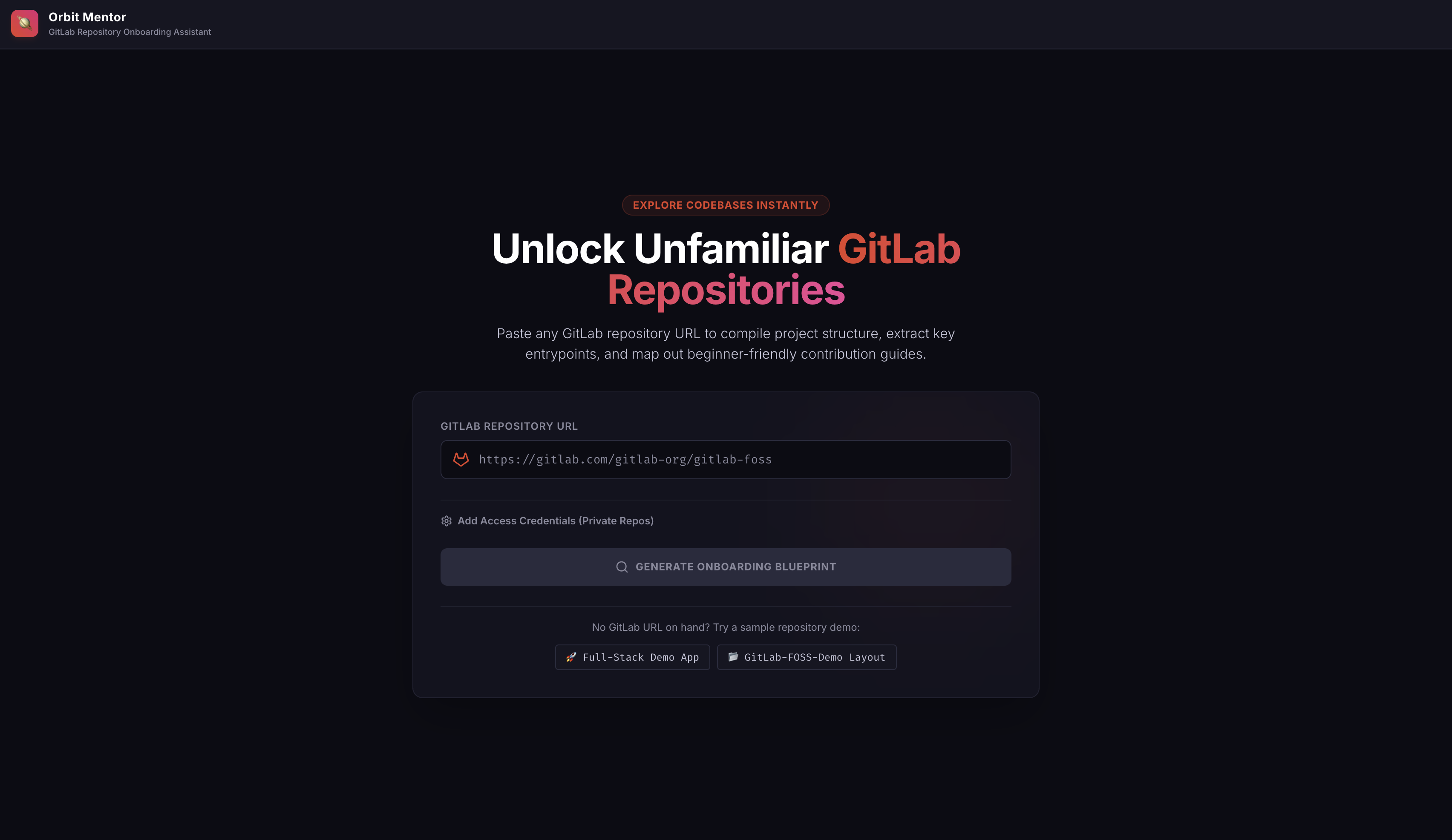
Orbit Mentor: AI-Powered GitLab Repository Onboarding
Inspiration
Joining a new project is often overwhelming. Developers frequently spend hours exploring unfamiliar repositories, searching through deeply nested directories, outdated documentation, and unclear entry points before they can make meaningful contributions.
We wanted to solve this problem by creating Orbit Mentor, an intelligent onboarding assistant that analyzes a GitLab repository and generates a structured learning path for contributors. Our goal was to reduce onboarding friction and help developers understand complex codebases faster.
What It Does
Orbit Mentor automatically analyzes a repository and provides:
- A high-level architecture overview
- Repository health and complexity scores
- File importance rankings
- Dependency and service relationship visualizations
- Beginner-friendly contribution opportunities
- Personalized onboarding recommendations
Instead of manually exploring hundreds of files, developers receive a guided roadmap that helps them understand where to start and what matters most.
How We Built It
Orbit Mentor was built as a full-stack application consisting of three primary layers:
Frontend
The frontend was developed using:
- React
- Vite
- TypeScript
- Tailwind CSS
We designed a modern dashboard focused on clarity and developer productivity. Interactive visualizations help users understand repository structure and service relationships at a glance.
Backend
The backend was built using:
- Node.js
- Express
- TypeScript
It handles repository analysis, metadata extraction, dependency inspection, and score generation.
AI Analysis Engine
Our analysis engine follows a dual-path architecture:
- AI Mode
- Uses OpenAI or Gemini models when API keys are available.
- Generates architecture summaries, onboarding plans, and repository insights.
- Offline Mode
- Uses local parsing and heuristic analysis.
- Performs dependency audits, file scoring, and structural analysis without requiring external AI services.
This approach ensures Orbit Mentor remains functional even when AI APIs are unavailable.
Mathematical Models
To make repository evaluation more objective, we designed custom scoring systems.
Repository Health Score
The overall repository health score is calculated as:
$$ H = \frac{D + S + C + T + K + M}{6} $$
Where:
- (D) = Documentation quality
- (S) = Project structure quality
- (C) = CI/CD configuration quality
- (T) = Testing coverage
- (K) = Configuration management quality
- (M) = Maintainability score
The final score ranges from 0 to 100.
File Importance Ranking
To determine which files developers should study first, we calculate:
$$ R(f) = w_e E(f) + w_c C(f) + w_b B(f) - \lambda d(f) $$
Where:
- (E(f)) indicates whether the file is an entry point
- (C(f)) indicates whether it is a critical configuration file
- (B(f)) represents business logic density
- (d(f)) represents directory depth
This ranking system helps new contributors focus on the most impactful files first.
Challenges We Faced
Serverless Deployment Compatibility
Traditional Express applications rely on explicit port binding using:
app.listen(port)
However, serverless platforms manage routing differently. We adapted the application to export the Express instance while only starting a listener during local development.
Dynamic Architecture Visualization
Generating architecture diagrams from repository metadata required building a lightweight graph rendering system. We developed custom coordinate calculations to render nodes and connections efficiently without relying on large graph libraries.
Reliable Structured AI Responses
AI-generated outputs needed to conform to strict TypeScript interfaces. We implemented structured JSON generation and validation pipelines to ensure consistency and reliability across different models.
What We Learned
Building Orbit Mentor taught us valuable lessons in:
- Repository analysis and static code inspection
- AST-based parsing techniques
- AI-assisted software engineering workflows
- Serverless deployment architectures
- Data visualization and graph rendering
- Type-safe API design
- Structured AI output validation
Most importantly, we learned how to combine traditional software engineering techniques with AI capabilities to solve a real developer productivity problem.
Future Improvements
We plan to extend Orbit Mentor with:
- Multi-repository dependency mapping
- Pull request onboarding suggestions
- Contributor skill-based learning paths
- Automated documentation generation
- Repository evolution tracking over time
Our vision is to make onboarding into any software project as simple as opening a map before beginning a journey.
Built With
- express.js
- javascript
- node.js
- tailwindcss
- typescript

Log in or sign up for Devpost to join the conversation.