-
-
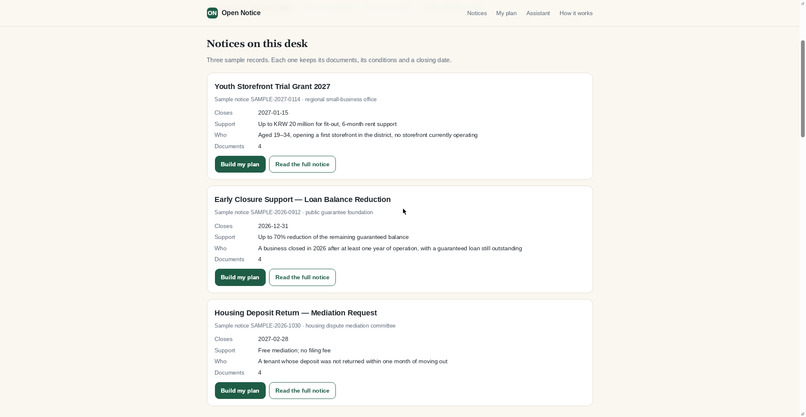
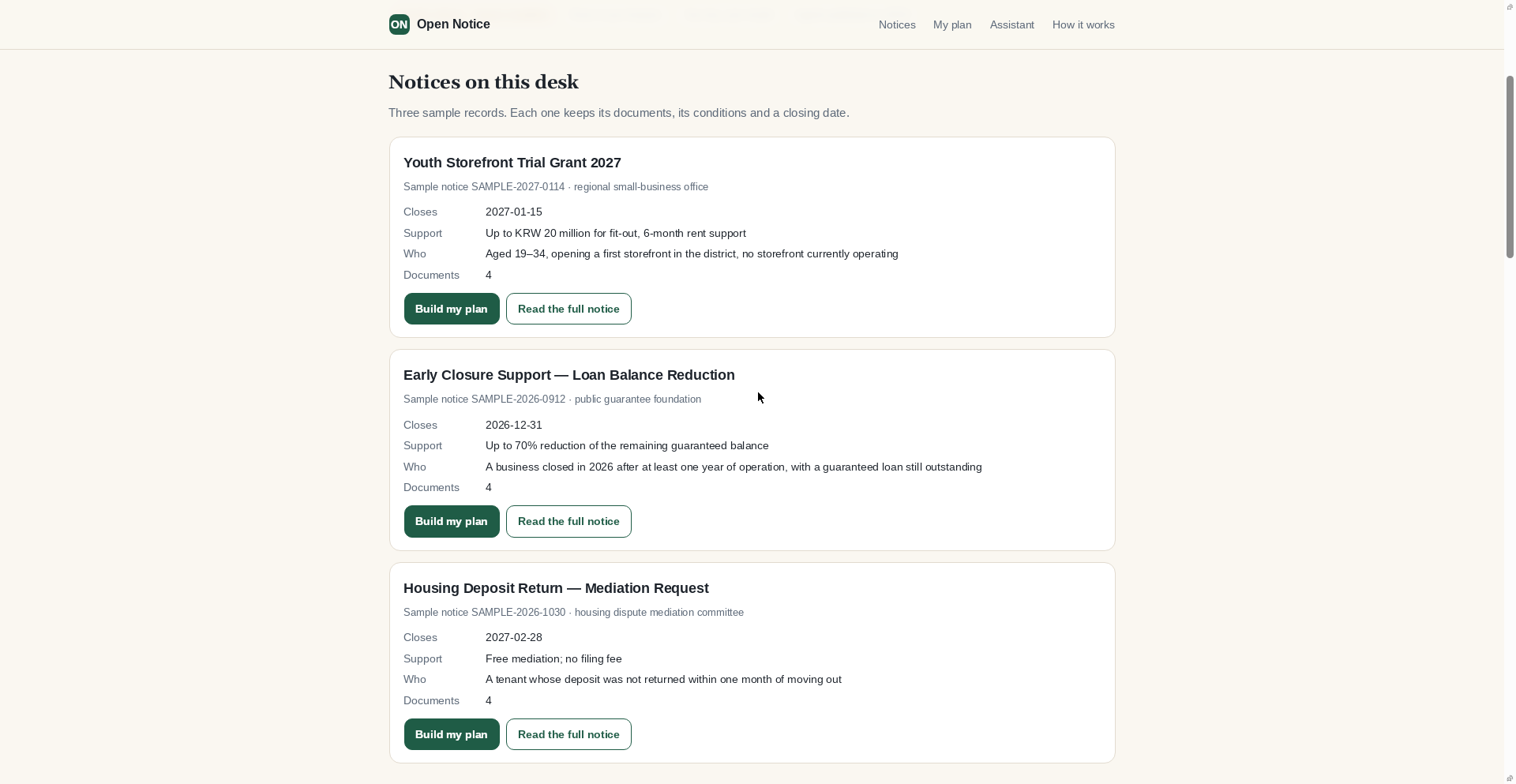
Notices as dated records: who each one is for, what it gives, and what it asks you to bring.
-
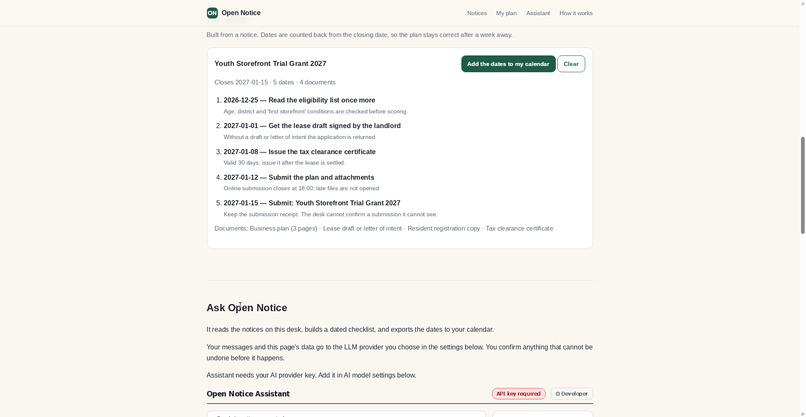
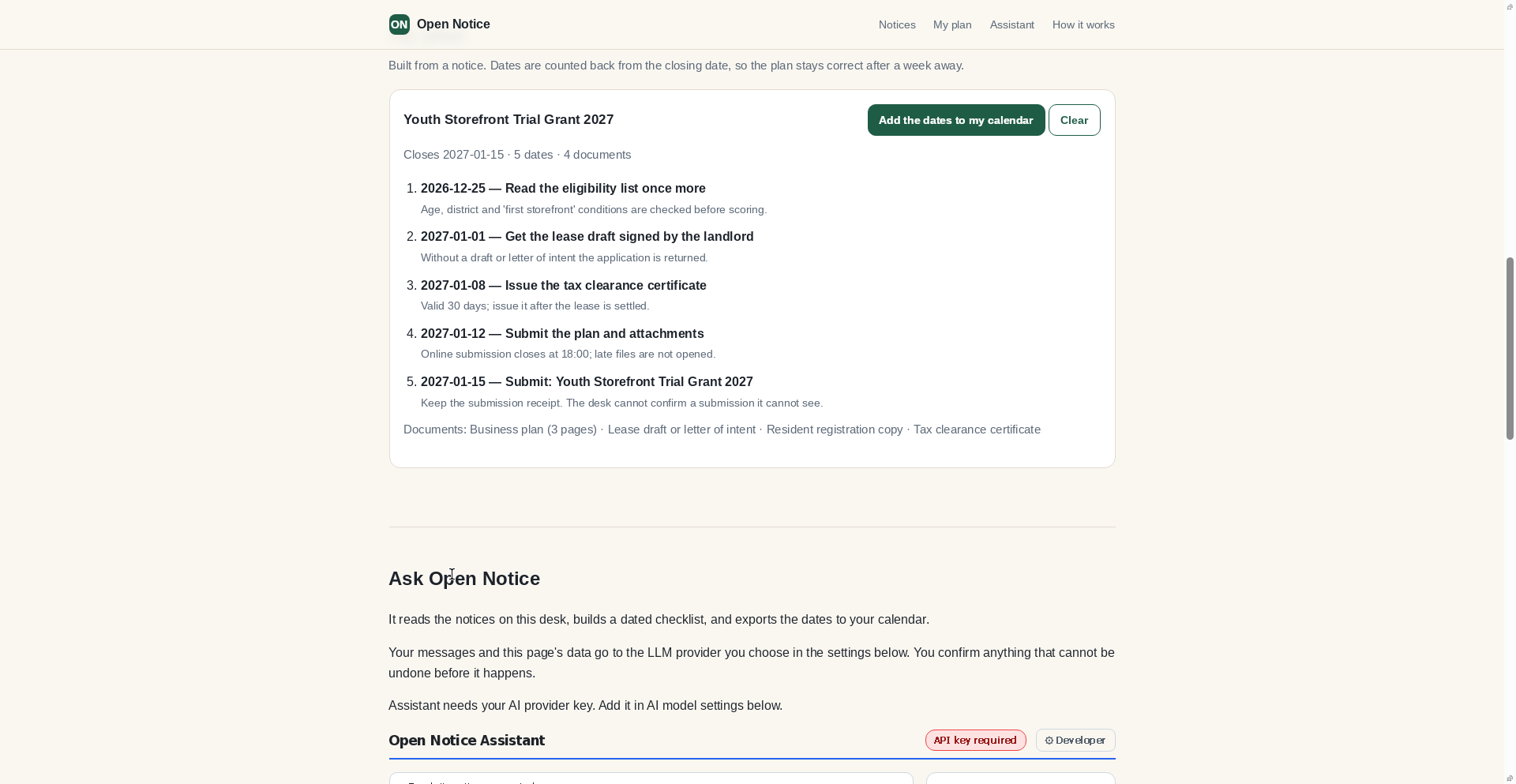
One press: the closing date becomes dated steps, and the dates leave the page as an .ics file.
-
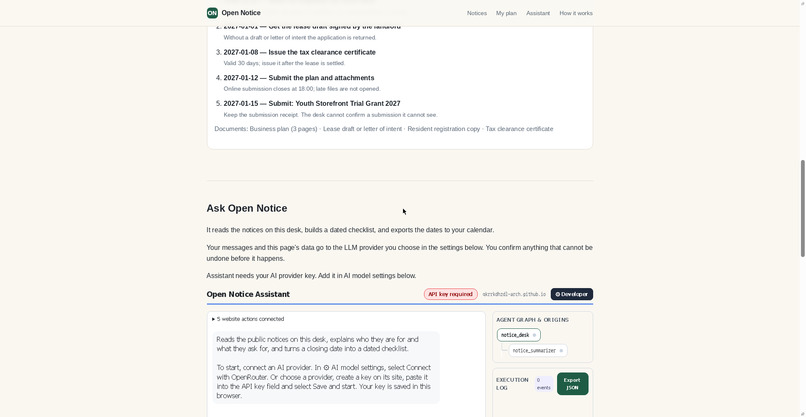
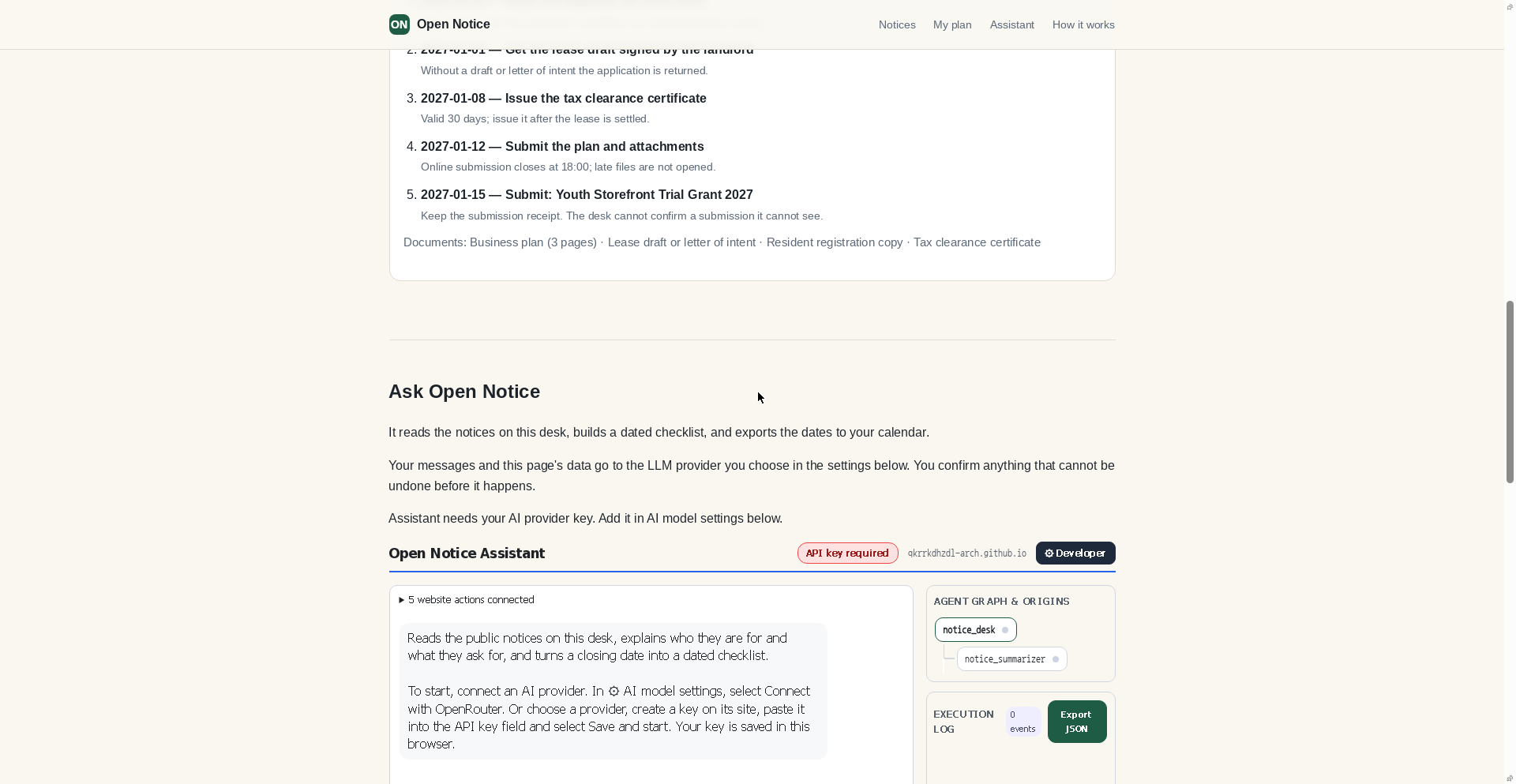
Two published agents and five page actions, running in the visitor's browser on the visitor's own key.
Inspiration
Every public notice is written for the office that publishes it: a closing date, a list of documents, conditions in the passive voice. The person reading it still has to do the translation — into dates, errands and a folder of paper — usually at the last minute. I ran a small shop and closed it, and I have watched people miss a deadline that was printed in front of them. The missing piece is not information; it is the step between reading and doing.
What it does
Open Notice is a small public desk that reads one notice with you. It holds notices as dated records — who each one is for, what it gives, what it asks you to bring — and turns the closing date into a dated checklist: every step is counted back from the day the door closes. The document list travels with the plan, and the dates leave the page as an .ics file. The assistant is a published agent network, not a chat box bolted onto a page: a front desk agent and a summariser, declared in JSON, with five page actions (read the state, read one notice, build the plan, export the calendar, clear the plan). It runs in the visitor's browser on the visitor's own model key, so the site never pays for the conversation and never sees it. Because the network is a public data file, another agentic site can fetch the manifest, resolve notice_desk, and run the same two agents for its own visitors — and with the action bridge the build writes, those visitors get the reads this site shares.
How we built it
- The page's own functions keep the rules (
script.js);site-actions.jsonly wraps them, so the buttons and the agents share one implementation. - The network is authored in HOCON and built to
notice_desk.network.jsonwith the reference build script, which validates it against the Worldwide Agentic Web MVP 0.3 profile. agent-manifest.jsonpublishes the network, the router and the page actions;links.jsonand the discovery files are written by the same build.- The runtime is the reference nsdeploy static runtime, unmodified, in
runtime/. - Tests:
node --testcovers the date arithmetic, the refusals, storage and the .ics export (7/7).
Challenges we ran into
- Conformance is mostly about what the site refuses: a malformed network, an action module without
registerActions, a stale version, a plan that does not exist. The build script and the runtime's validator caught each of these before a model ever ran. - Dates have to survive being read a week later, so every step is counted back from the closing date when the plan is built instead of being frozen into the file.
- Bringing your own key means the first visitor sees an empty chat, so the page does everything it can without a model: read, plan, export.
Accomplishments that we're proud of
- A site that conforms to the MVP profile and still works as a page: the plan, the document list and the calendar file are usable with no key at all.
- One implementation of the rules, shared by the buttons and the agents, so the assistant cannot drift from the page.
- The whole thing is a static folder on GitHub Pages: no server, no key, no database.
That is the whole of it.
What we learned
Publishing an agent network is a different discipline from shipping a chatbot: the graph is data, the visitor holds the credential, and the interesting design work sits in the refusals and the limits rather than in the prompt.
What's next
Publish the same shape for real issuers, so an office writes its notice once and any community site can carry the desk. The next pieces are a scored timeline across several notices and a call to a planner network that another site publishes.
How it follows the specification (MVP 0.3)
- Portable network:
notice_desk.network.jsonis the resolved, data-only JSON serialisation of the Neuro SAN HOCON model — two agents with their instructions, invocation schemas and tools, with no includes or environment substitutions. - Browser execution: parsing, validation, agent-to-agent delegation, tool calls and bounded history all happen in plain ES modules on the page.
- Pluggable inference: the manifest names a default router; the page takes the visitor's own OpenAI-compatible base URL, key and model (BYOK), and the network carries only a model hint.
- Publication:
agent-manifest.json(name, front_man, hocon),links.jsonand the discovery files are public GET, CORS-enabled, so a caller resolves a peer from the URL alone, with no registry. - Trust boundary: no private context is passed between agents or to peers; the bridge shares only the reads, and every write stays on this page. Every claim above can be checked by hand: the site publishes a conformance page at qkrrkdhzdl-arch.github.io/open-notice/conformance.html that links every published file, maps each MVP 0.3 requirement to where it is satisfied, and states what the project does not claim — no live model run in the demo, no partner call, and three sample notices rather than real ones.
