-
-
Logo of OECO.
-
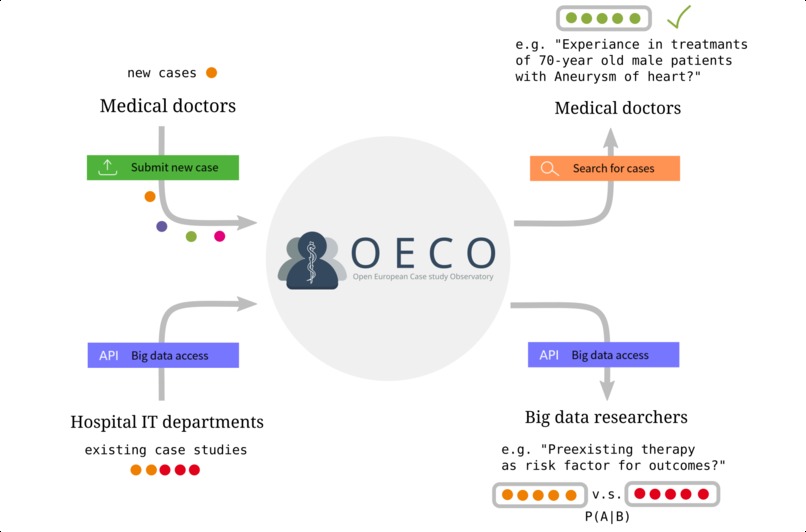
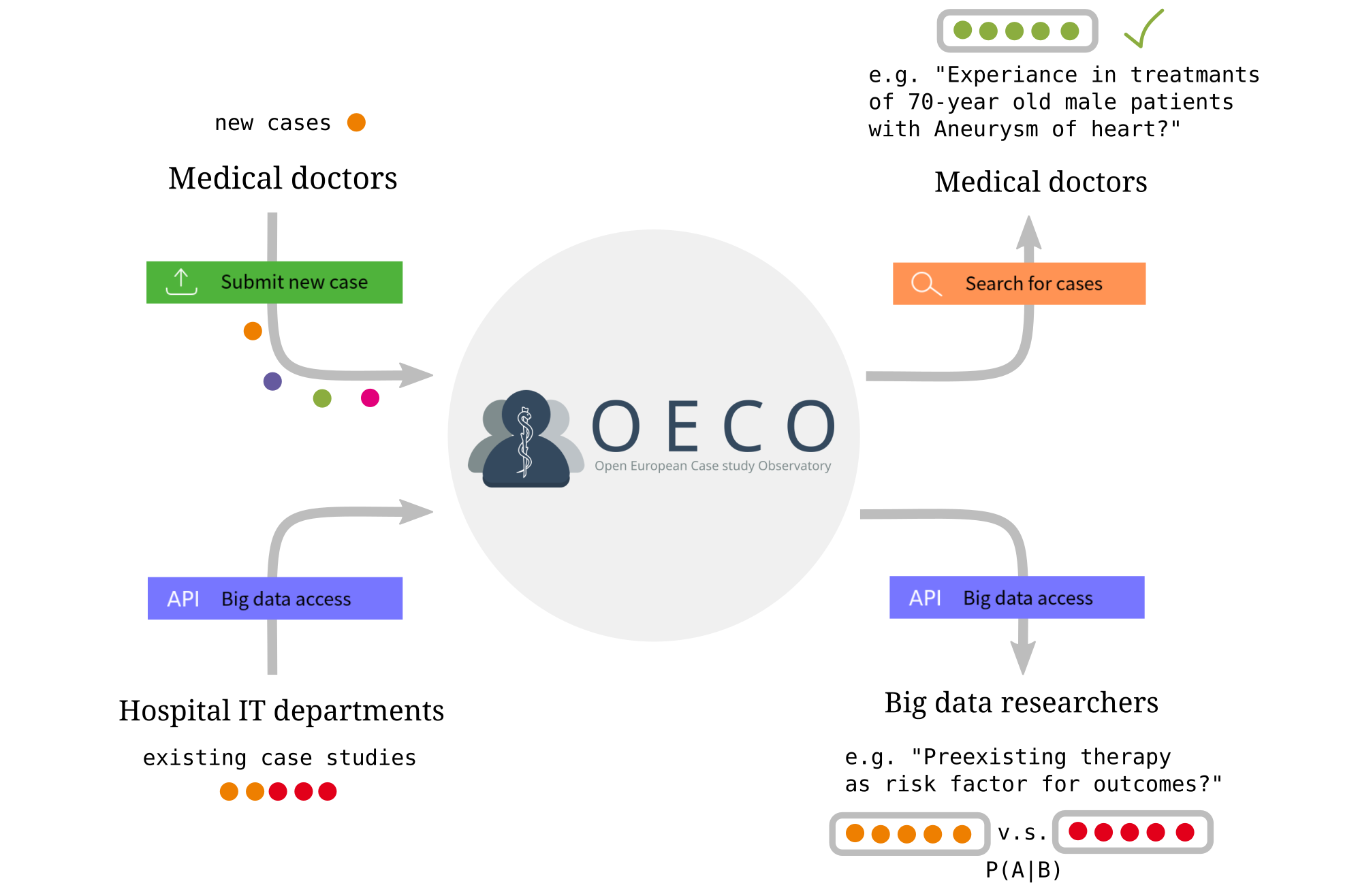
Diagram of OECO case flow.
Inspiration
There is a need for a tool that allows easy sharing of de-personalized case studies. It solves a small, but clear problem that has big impact. It has to be owned by community and open-source.
Currently the commonly shared data sets consist from case numbers and outcomes which are not useful for improving patient treatments. Exchange of information between doctors on front-line is still often over social media, and locally accumulated data is too small to make more than a guess. With additional information about age, therapies, existing conditions, accumulated across the continent, we can improve speed of development of therapy protocols.
What it does
OECO - Open European Case study Observatory
Web platform for creation of structured data lake of case reports across Europe, with data open and accessible in real time. Simple queries can be run by medical doctors to extract case studies for specific patient categories and see statistics. Associated with web platform will be index of data dashboards created by the community showing real time data analysis.
Who are users?
- doctors documenting cases (source of data to be shared)
- doctors interested in case studies and treatments tried for specific patient groups (via simple dashboard on line)
- researchers trying to understand treatment strategies and form hypothesis (community that would use data and could contribute data dashboards)
What's the impact?
We want to allow:
- doctors to tip into existing knowledge of their colleagues on front-lines, by sharing knowledge about treatments and experiences with patients with different existing conditions
- clinical researchers and big data researchers to form best possible quantifiable insights and hypothesis, spotting trends.
What is project structure?
What is technical structure? (i) Front end (ii) Database (iii) Simple site and presentation
Front end? Minimalist interface: uses international classification of diseases and databases of drugs; allows time segments for case progression; allows numeric inputs for quantitative diagnostic findings; allows discrete input for qualitative diagnostic findings (e.g. CT scan). Does not allow input of personally identifying information by design.
Database? Automatically updated in real time. Accessible via API and data dumps. Hosted in AWS (has all security clearances).
Simple site and presentation? Simple interface for intuitive queries by medical doctors. Index of dashboards using data
Interdisciplinary team behind
We have medical doctor, full stack developer, medical economist, legal expert and physicists. We are also receiving input by: data analysis people on national health databases, biomedical researcher in neuroimmunology and epidemiology, business expert, people with expertise in care pathway designs, and people with experience cross-national health systems within WHO and EU.
EUvsVirus project Challenge: Health > Real time communication & prevention > real transfer knowledge, insights and experiences among hospitals





Log in or sign up for Devpost to join the conversation.