-
-
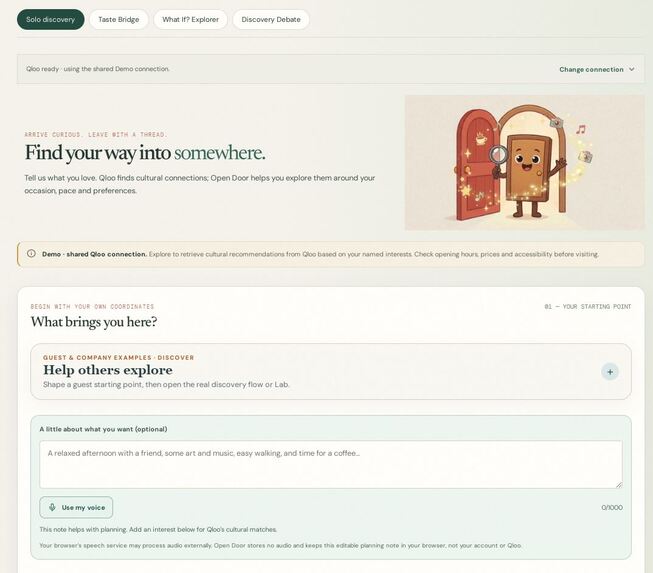
Explore for Yourself - Solo Discovery
-
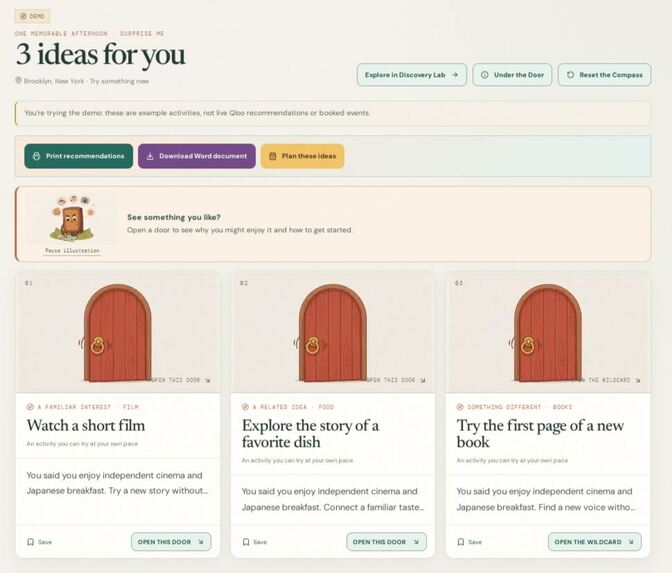
Choose your door
-
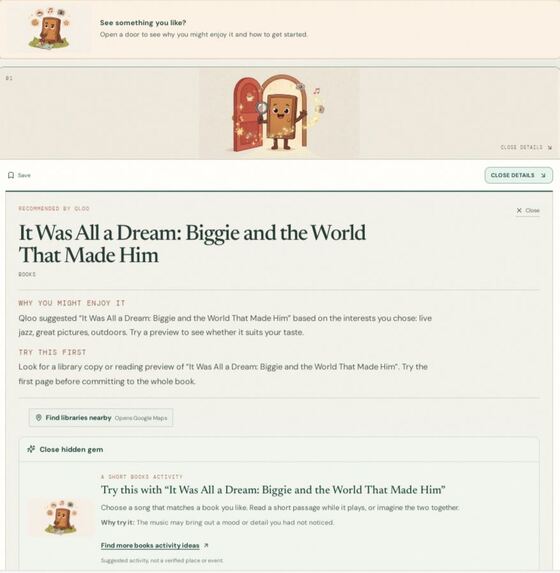
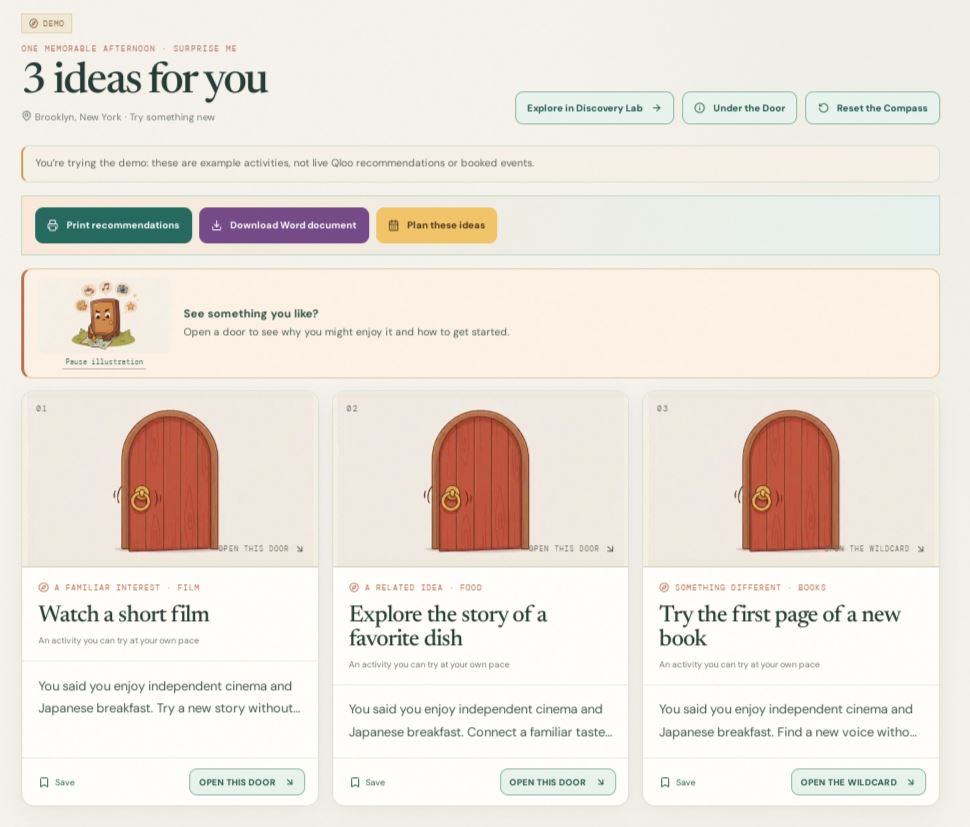
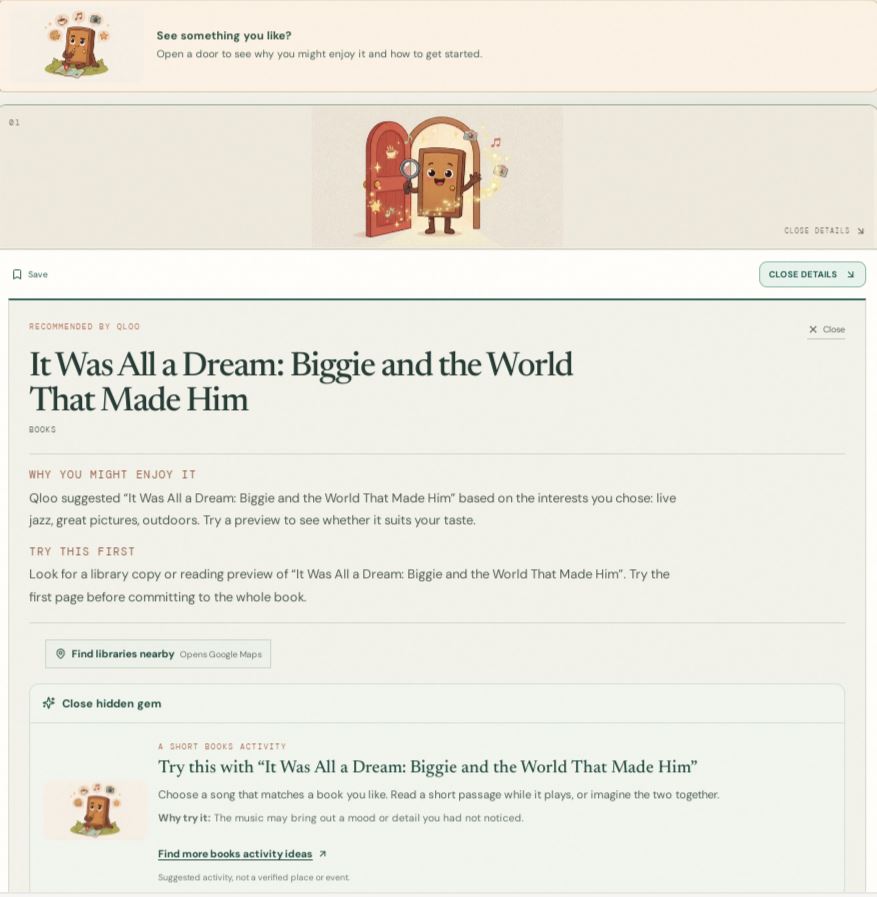
View a recommendation
-
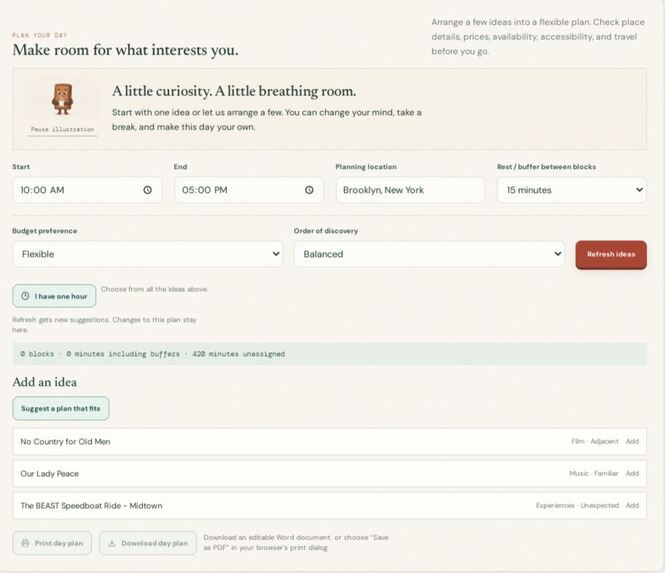
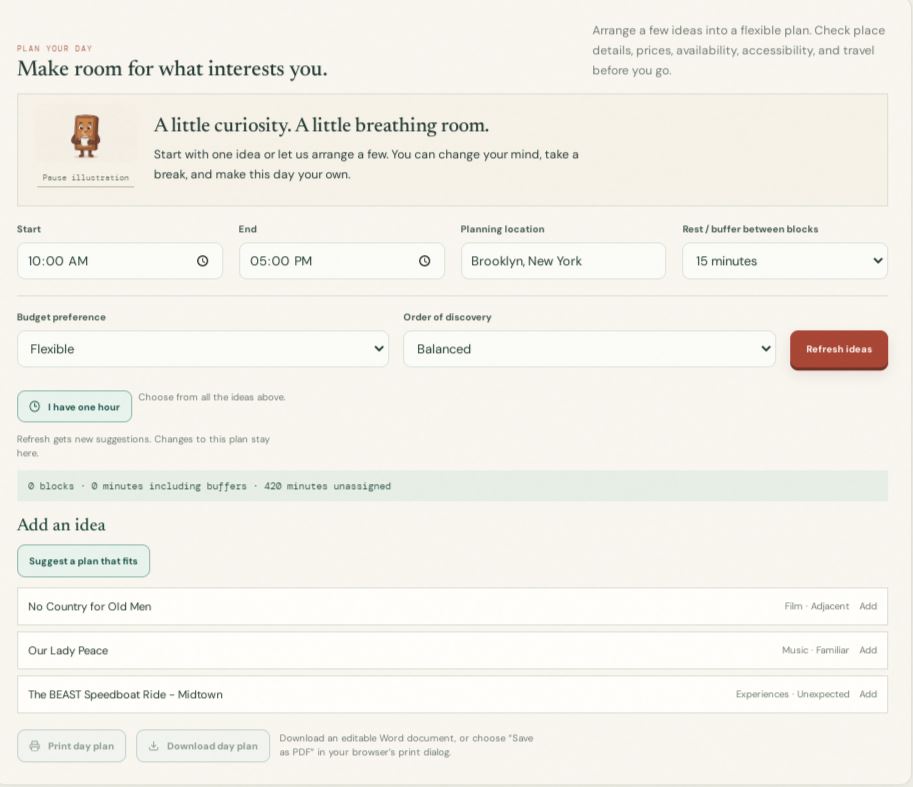
Plan your day
-
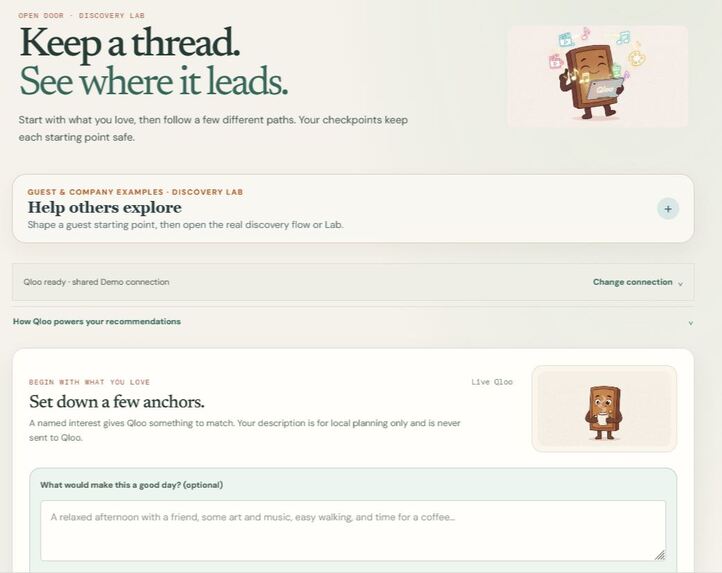
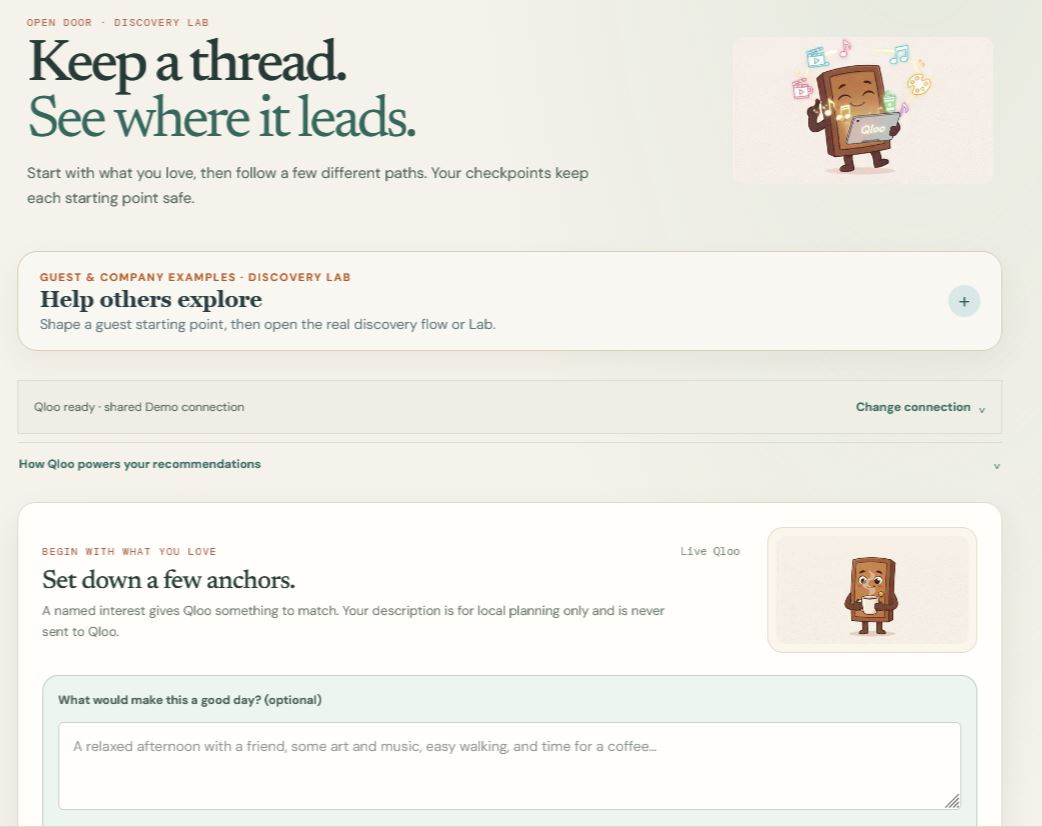
Discover Labs, explore alternative ideas
-
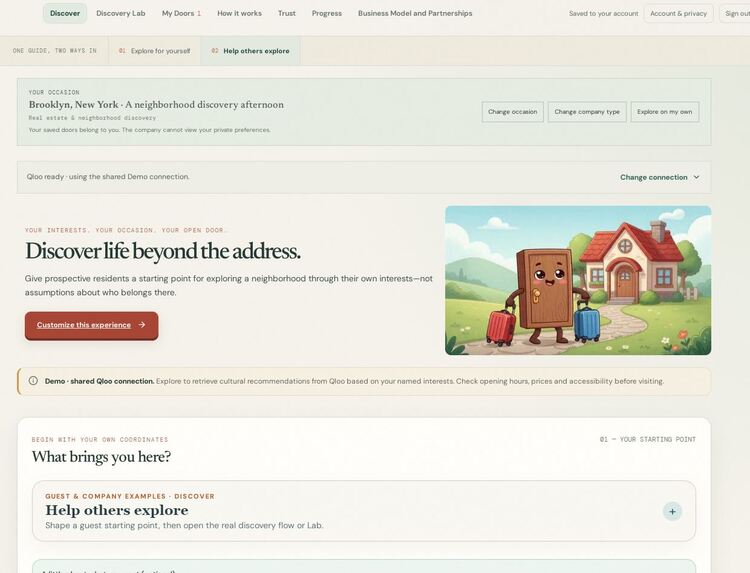
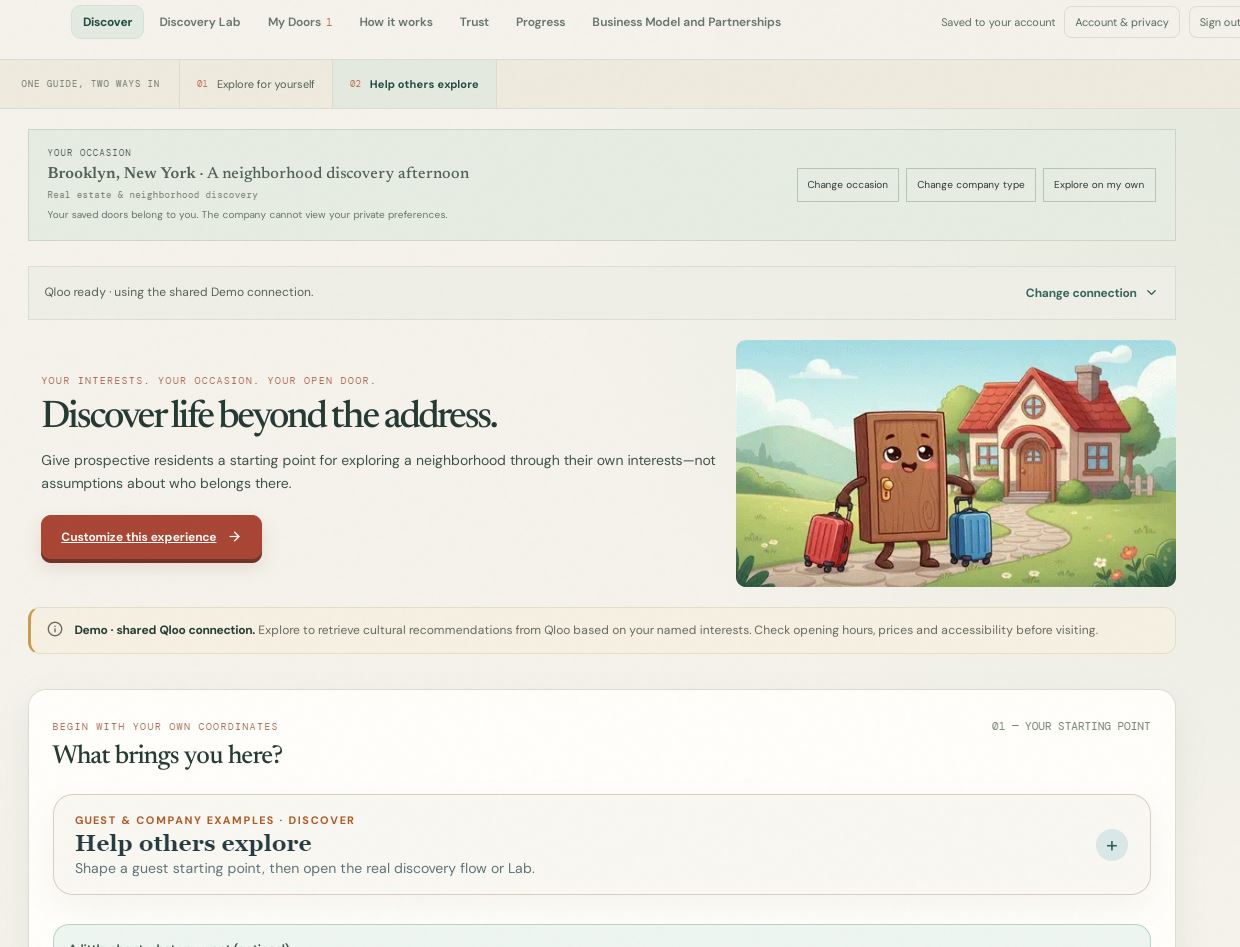
Explore a new neighborhood - Sample
-
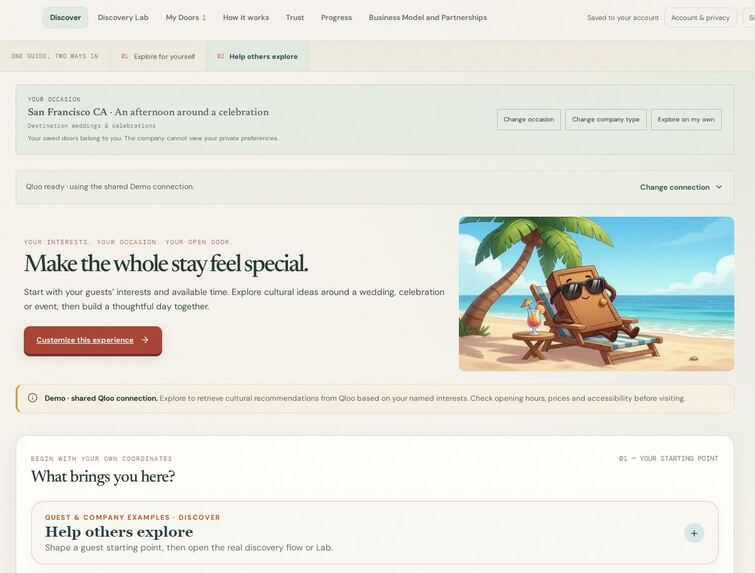
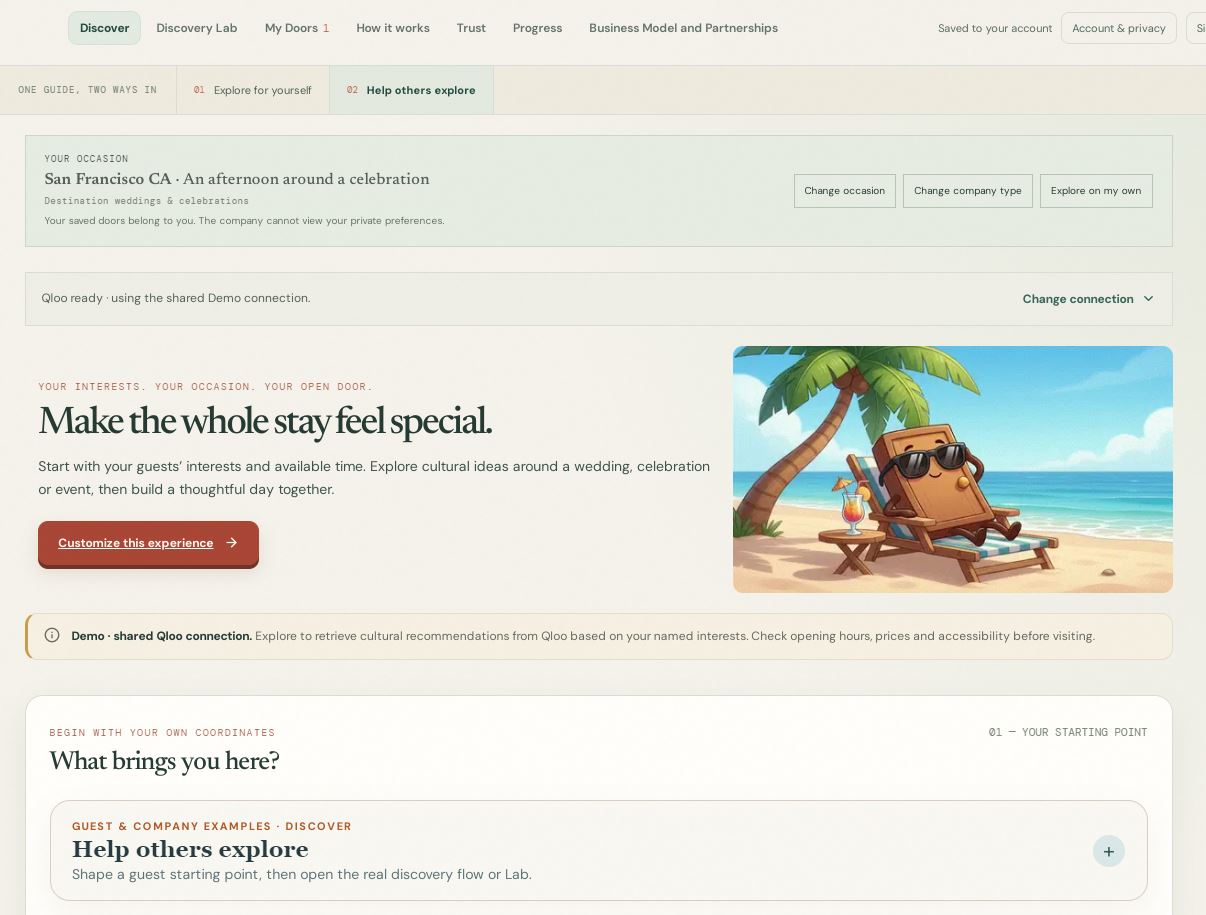
Explore a destination wedding location - Sample
-
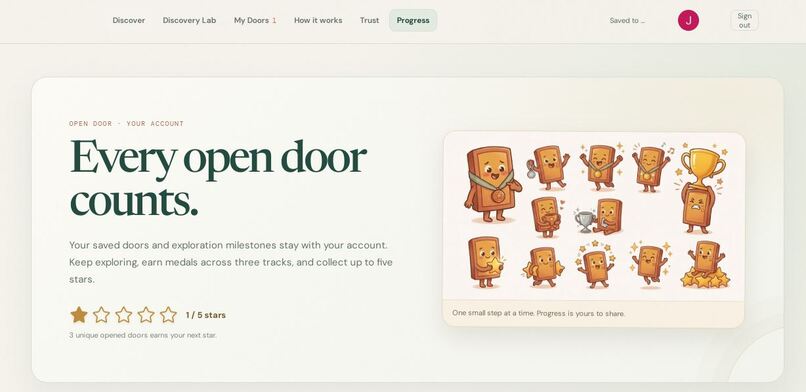
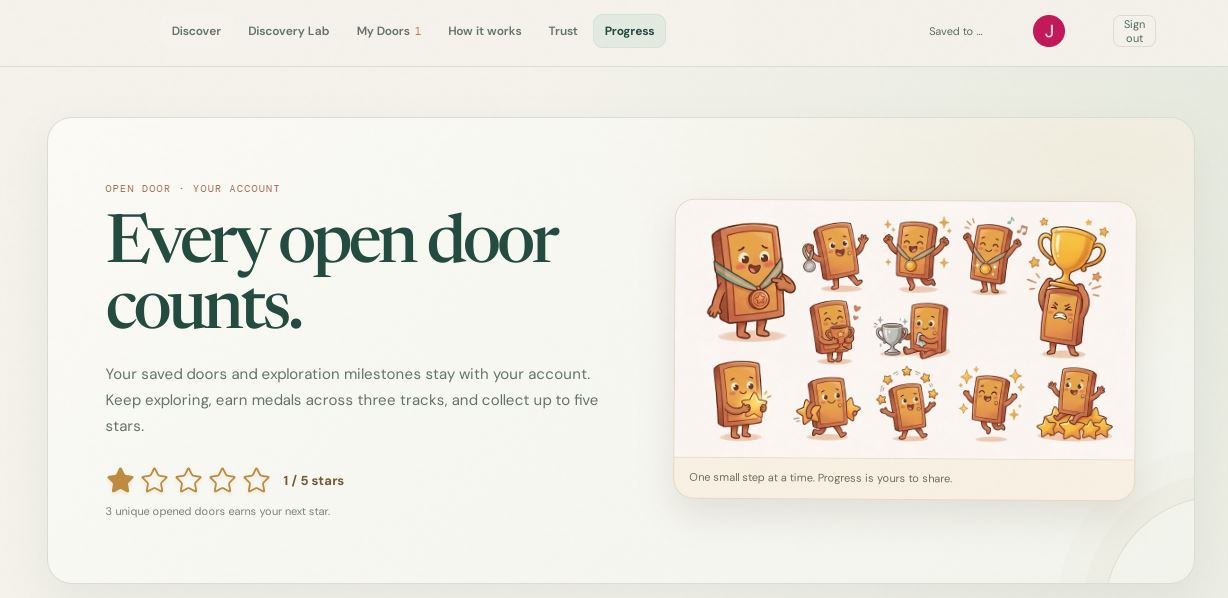
Rewards
-
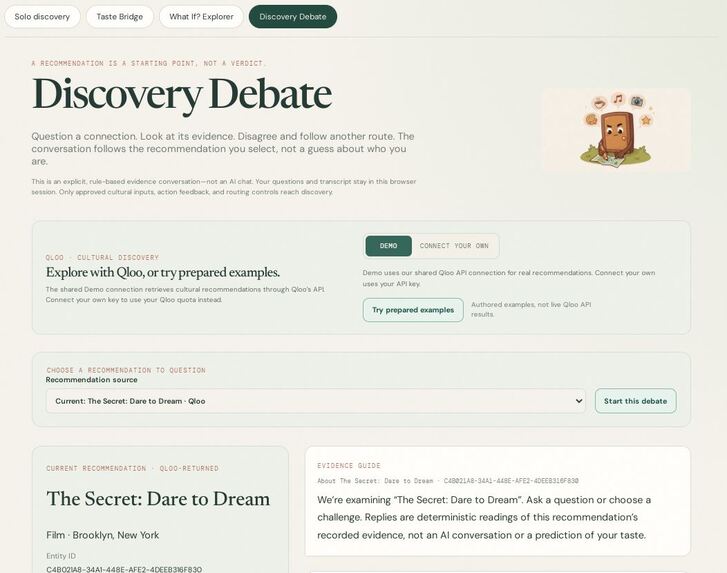
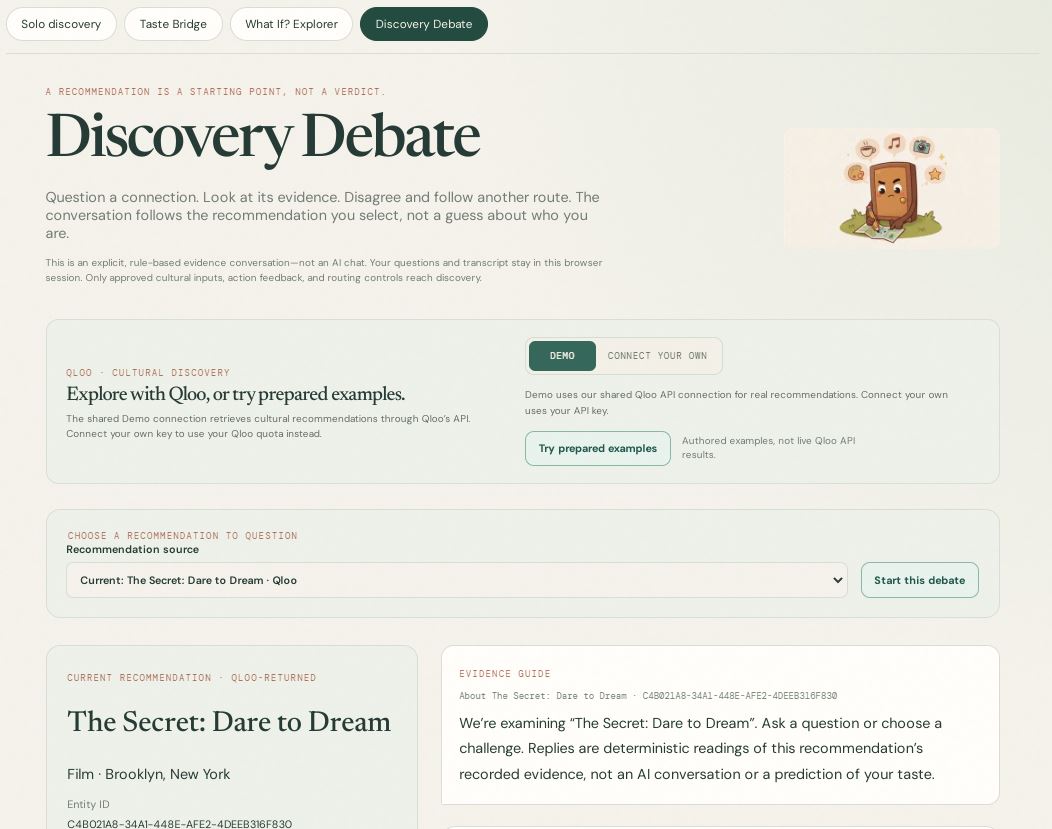
Discovery Debate
-
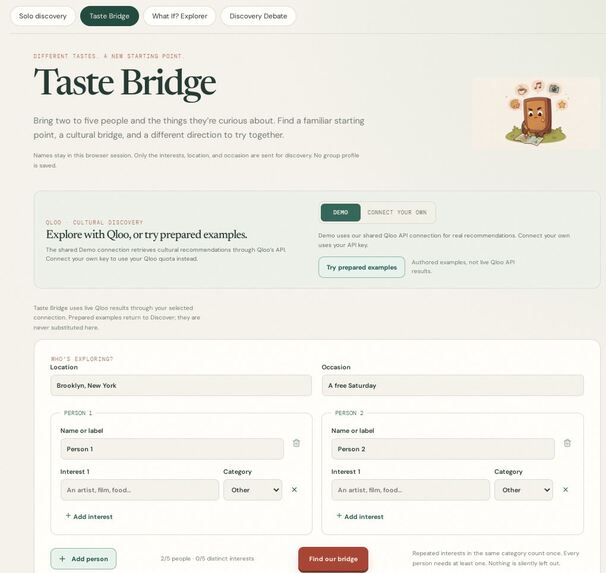
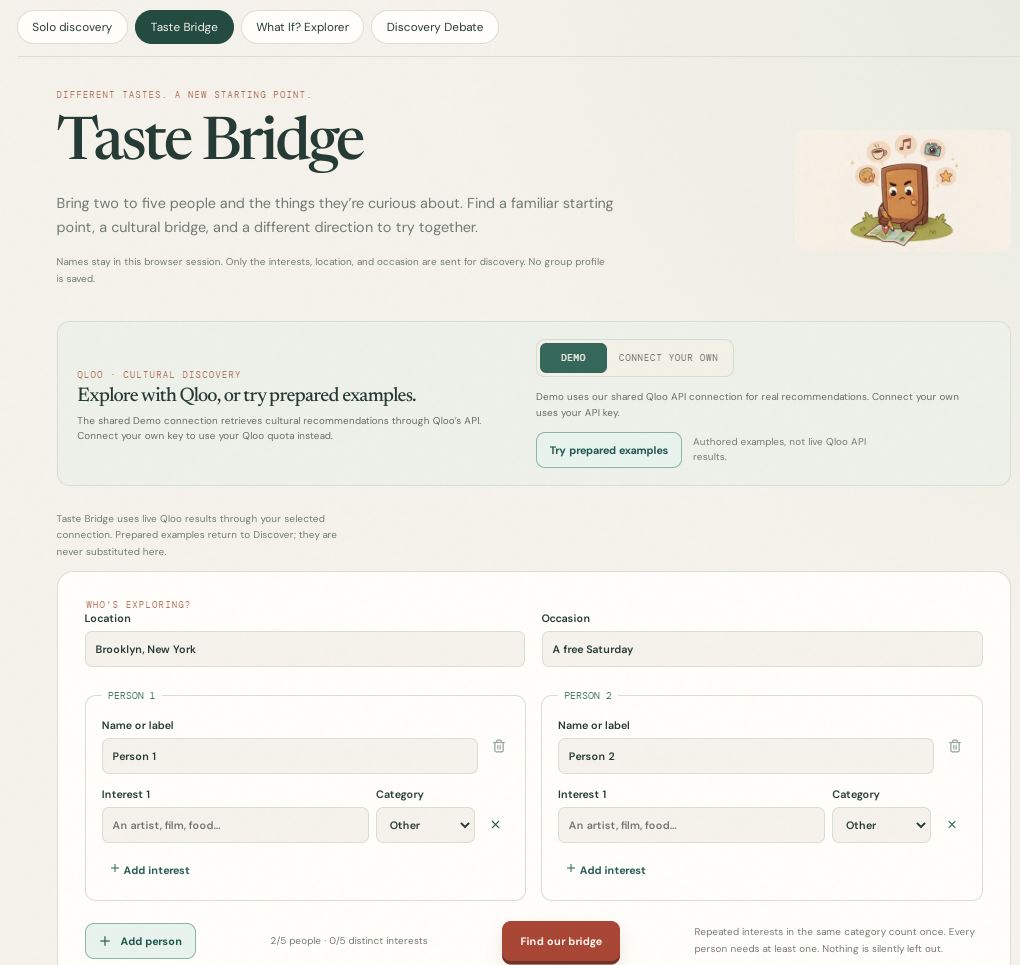
Taste Bridge
-
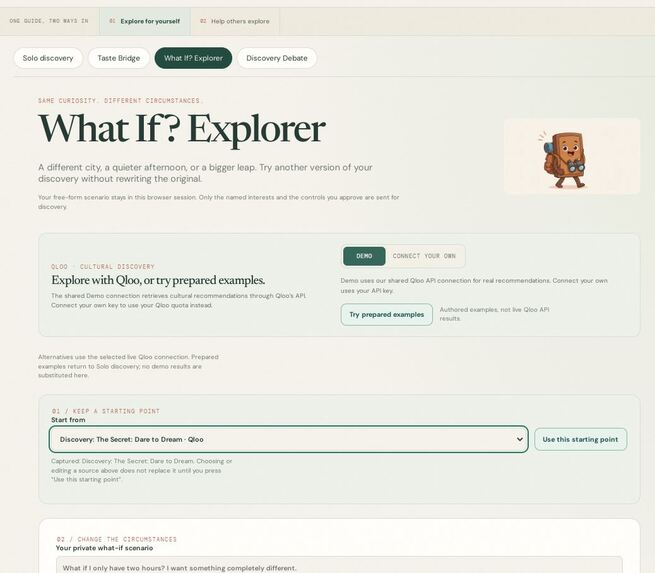
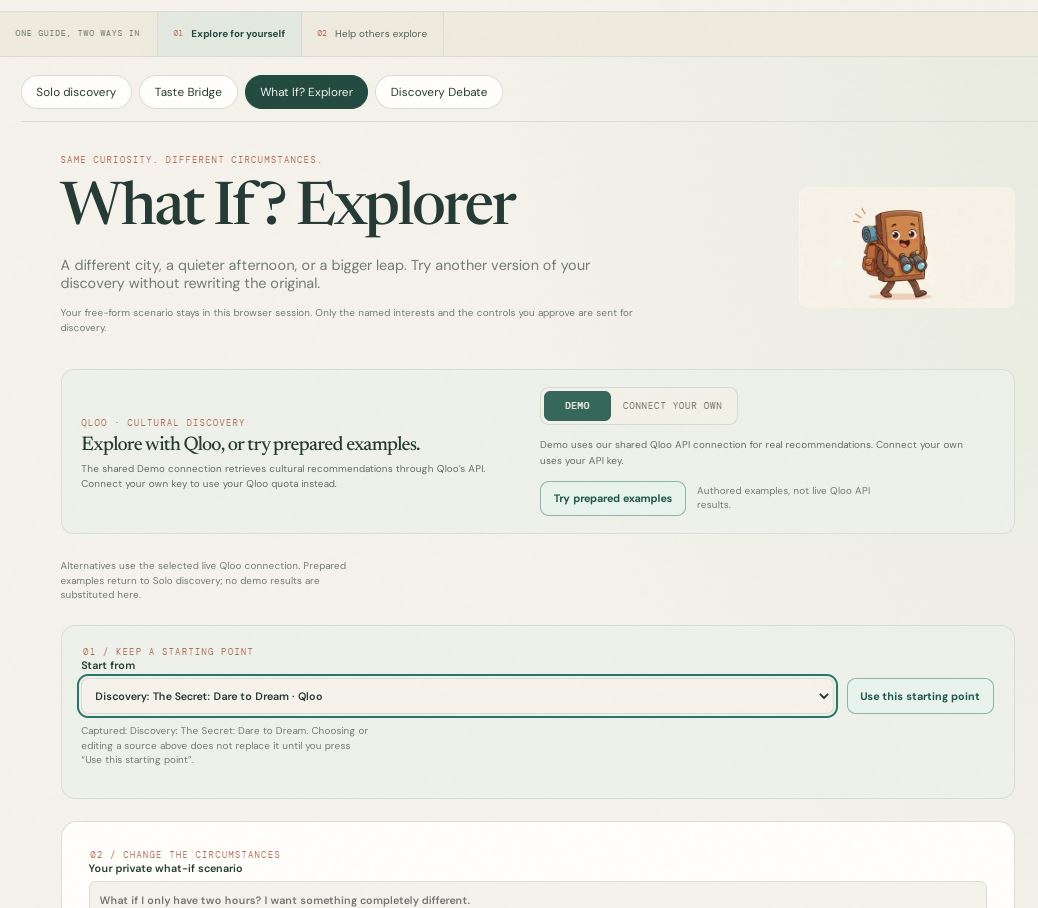
What if Explorer
-
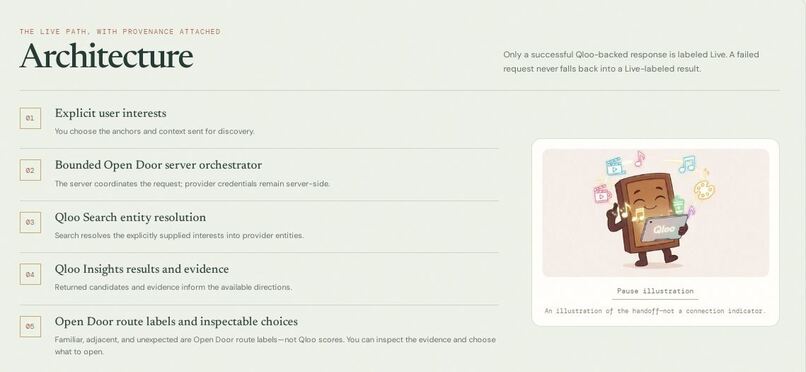
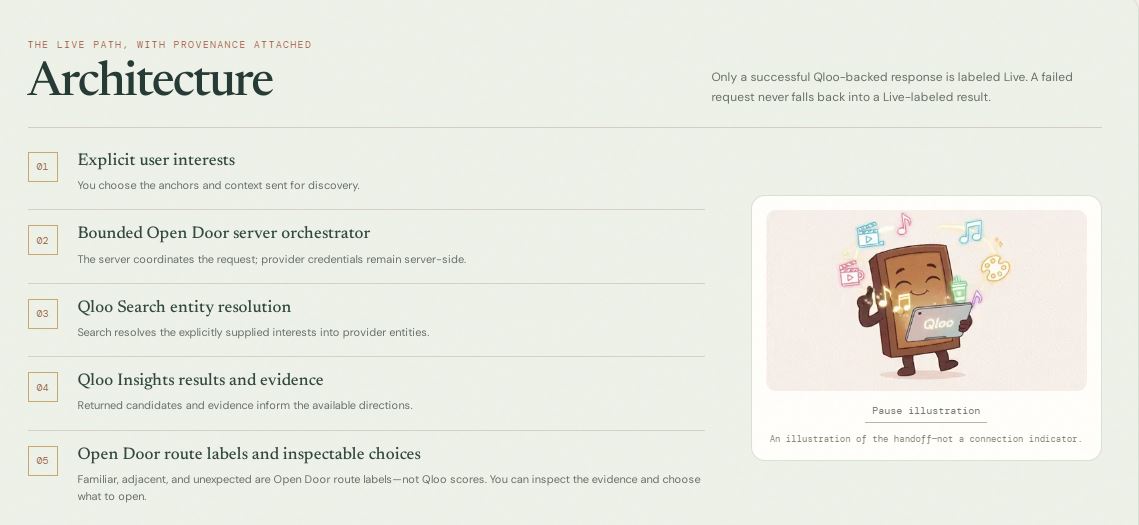
Archecture
-
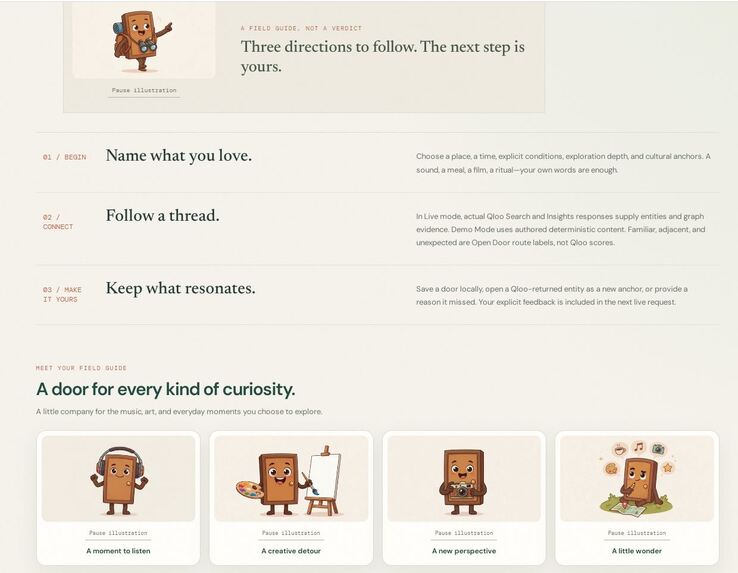
How it works
-
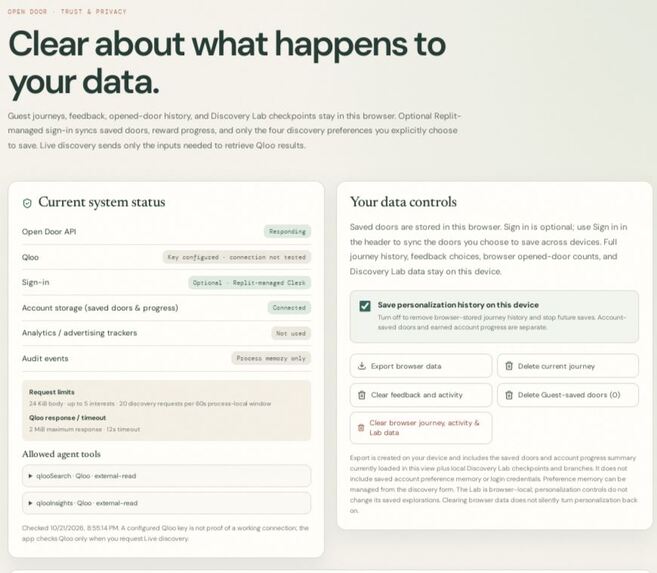
Trust and privacy
-
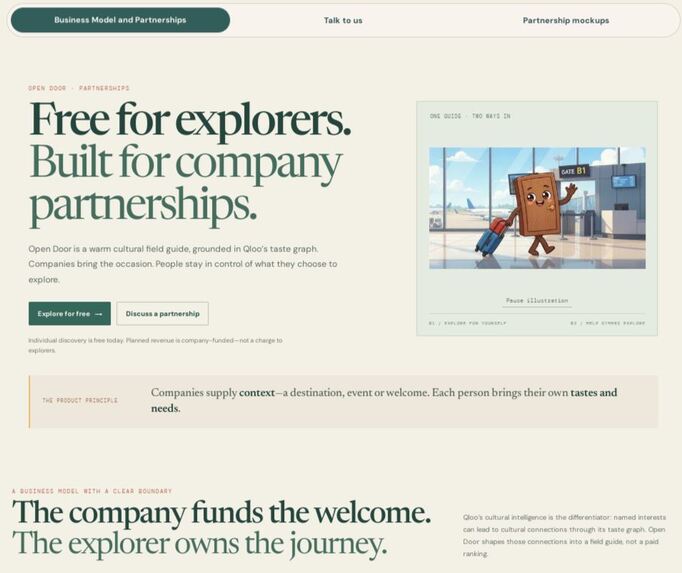
Partnership Business Model
Inspiration
Every great discovery starts with something you already love. What if it could lead you somewhere you never expected?
You have a free Saturday. You want art, music, a good coffee, and an afternoon that fits your mood. You know what you enjoy but you don't necessarily know what to search for next.
Traditional recommendations tend to give us more of what we already know. Search engines need us to know what we're looking for. And planning an outing involves more than finding popular places: it means considering the occasion, your interests, your energy, your budget, and the kind of experience you want.
I wanted to build something different.
Open Door uses Qloo's cultural intelligence to turn the things people love into starting points for discovery.
Culture is a starting point for discovery, connection, and possibility.
It connects familiar cultural interests with new possibilities across categories, giving people a way to explore beyond their usual searches.
The door is the central idea: every interest can open another door, and every door can lead somewhere unexpected.
But discovery should feel personal. A relaxed afternoon with a friend should not look like an adventurous solo outing. Planning for a wedding guest or hotel visitor should not mean assuming everyone has the same tastes. What someone wants today matters just as much as what they already enjoy.
I built Open Door to bring those ideas together: real Qloo-powered cultural connections, an inviting experience, personal choices, and practical ways to turn curiosity into something you can do.
And discovery shouldn't stop with the first recommendation. What if two people with completely different tastes could find something meaningful together? What if changing the circumstances opened up a completely different set of possibilities? And what if users could challenge a recommendation instead of simply accepting it?
Those questions inspired three additional ways to explore: Taste Bridge, What If? Explorer, and Discovery Debate.
Your interests. Your circumstances. Your kind of discovery.
What it does
Open Door is a Qloo-powered cultural discovery experience that helps people move from what they already love to what they might love next.
Start with what you love
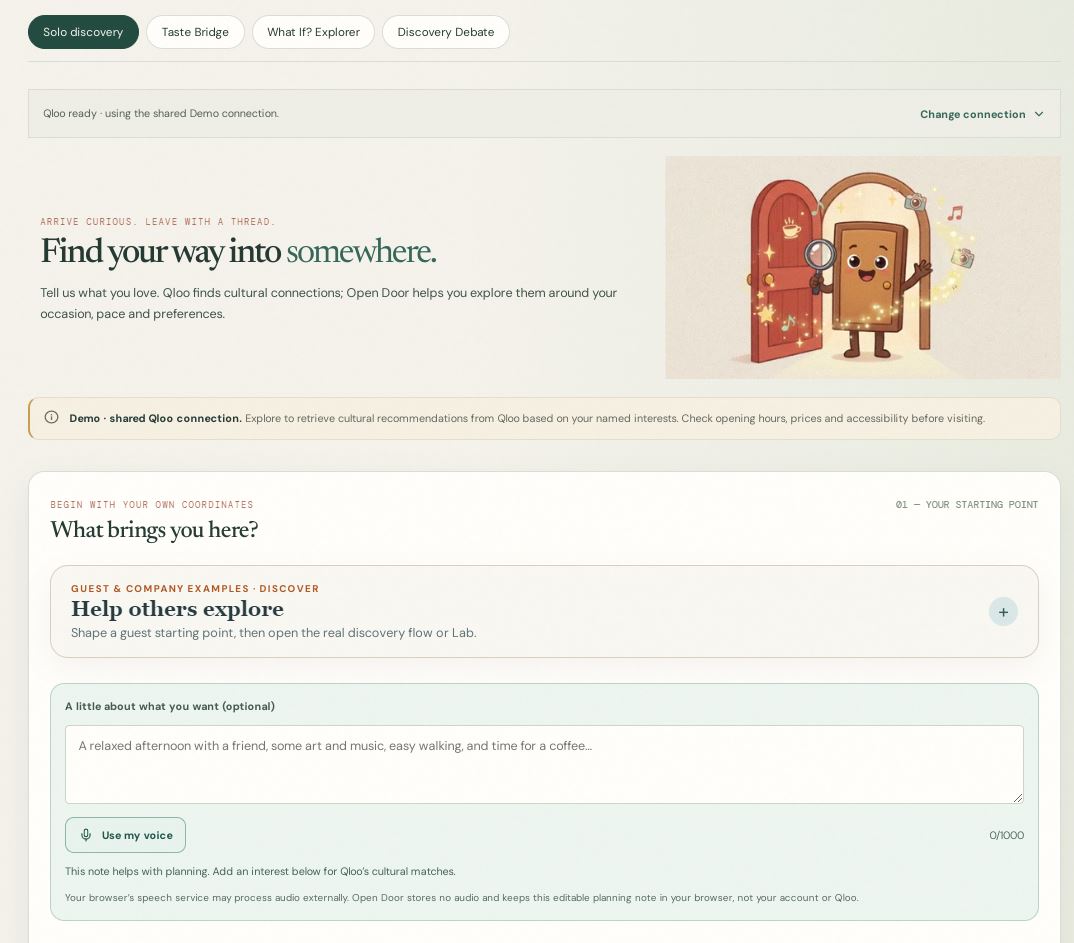
The experience begins with a simple question: What brings you here?
Users choose a place, describe what they want from the experience, and add named cultural interests—a sound, meal, film, ritual, artist, or place. They can start from their own interests or explore example starting points.
Users can also describe their plans in their own words or use voice input in supported browsers. That personal note helps shape planning, while named cultural interests provide the anchors for Qloo matching.
This distinction is intentional: the user's personal description is not automatically sent to Qloo as a cultural query.
Let Qloo open the door to something new
Qloo is the foundation of Open Door, not a decorative API integration.
- Qloo Search resolves the named cultural interests users provide.
- Qloo Insights retrieves cultural connections across relevant domains.
- Open Door organizes the returned candidates into three discovery paths: Familiar, Adjacent, and Unexpected.
These paths give users different ways to approach discovery: stay close to what they know, explore something related, or venture further from their usual interests.
Users can also choose among four discovery directions: Close to home, A little further, Surprise me, and Take me somewhere unexpected. These choices shape the Qloo result types Open Door requests; they are not Qloo-generated scores or claims about a person's identity.
The result is a guided way to explore cultural connections, with room for both recognition and surprise.
Follow the connection
Discovery doesn't stop at the first result.
Users can open a door in place, explore a cultural connection further, see why a possibility may be interesting, review available evidence, and discover practical next steps. They can continue from the actual returned Qloo entity rather than starting over with a generic keyword search.
An unexpected result becomes a new starting point. One connection can lead to another, allowing users to follow their curiosity instead of being handed a static list and left to figure out what comes next.
Open Door also offers a hidden-gem activity or idea, giving users another way to turn a discovery into an experience.
Make it personal, not generic
People don't all want the same kind of day. Open Door lets them tell the experience what matters to them instead of relying on assumptions.
Users can shape an outing with:
- Time and occasion: such as a free Saturday or a particular event.
- Intent: find my people, go deeper, or try something new.
- Discovery direction: stay familiar or explore somewhere unexpected.
- Practical context: budget, movement preference, conditions and energy, and whether the journey is solo.
- Personal considerations: optional age-related needs, personal style, health and wellbeing, or custom preferences.
These choices help users adapt the experience to their actual circumstances. They can select an example and make it their own, or describe a different situation.
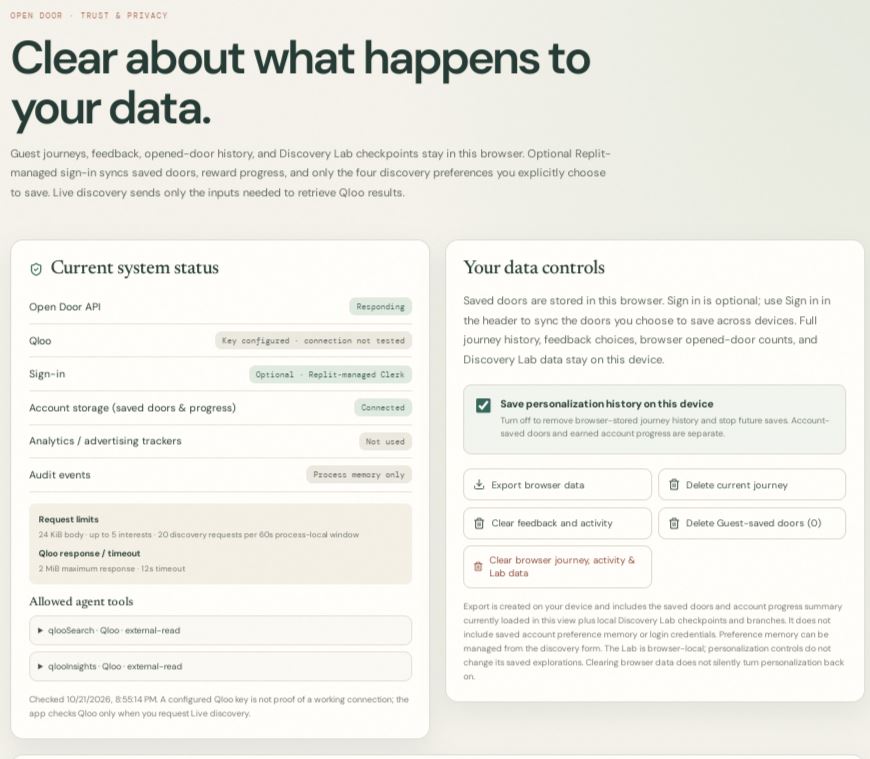
Open Door uses explicit preferences rather than assuming someone's needs based on age, health, identity, or other characteristics. Personal planning notes and custom considerations remain in the browser and local journey data; they are not sent to Qloo or stored as account preference memory. Suggestions are not medical advice and do not verify venue suitability.
Explore on your own or help someone else discover
Open Door is designed for individual curiosity and experiences shared with others.
Someone planning an afternoon can explore for themselves. An organizer can create a starting point for a guest, visitor, friend, or group without deciding what everyone must enjoy.
The Help Others Explore experience lets organizers choose guest or company examples, supply a public place and occasion, and open the real discovery flow or Discovery Lab. Shareable starting links make it easier to invite someone into an exploration.
The organizer supplies the context; the individual still gets room to discover their own preferences.
This creates possibilities beyond individual trip planning, including hotel stays, neighborhood exploration, destination weddings, and other occasions where someone wants to help guests find experiences that suit them.
Explore for Others: Example Celebrations in Charleston
What if you could help someone discover a place or experience for a special occasion? Open Door lets organizers create a starting point for guests to explore, while leaving room for each person's own interests and discoveries.
Try the Charleston celebration example →
Try a new neighborhood example →
Taste Bridge: Connect people through what they love
People don't always share the same interests. Taste Bridge takes discovery beyond the individual and explores the cultural connections between different people's tastes.
Users can bring together the interests of multiple participants and discover three kinds of connections:
- Shared Ground: Find interests and experiences participants have in common.
- The Bridge: Discover cultural connections that link people with different tastes.
- The Wild Card: Explore a surprising possibility that participants might never have searched for themselves.
The goal isn't simply to find the safest compromise. It's to uncover something meaningful that can bring people together, even when they start from very different interests.
What If? Explorer: Change the circumstances, change the discovery
What if you had less time? A different budget? Different people joining you? What if you wanted something more adventurous, or something completely different from your usual preferences?
What If? Explorer lets users take an existing discovery or set of interests and change the scenario to explore new possibilities.
Users can ask their own questions or change conditions such as time, budget, location, interests, companions, and the type of experience they want.
Rather than losing the original discovery, users can compare the new possibilities with where they started, understand what changed, and continue exploring alternative journeys.
Discovery Debate: Challenge the recommendation
Why was something recommended? Does the connection really make sense? Could there be something better?
Discovery Debate lets users challenge recommendations and have an interactive conversation about the cultural connections behind them.
Users can ask for explanations, question the relationship to their interests, request stronger alternatives, or ask for something more unexpected.
The experience is designed to explain its reasoning using available cultural evidence, acknowledge when a connection is weak, and explore alternatives when a user disagrees.
Discovery becomes a conversation rather than a one-way recommendation.
Turn discoveries into real plans
Open Door connects cultural exploration with practical next steps.
Users can organize discoveries into a flexible day plan, use Google Maps category searches to continue exploring places, and take their plans with them through editable Word exports, printing, or saving as a PDF through the browser.
These tools help bridge the gap between an interesting cultural connection and an outing someone can actually plan. Maps searches are starting points, not guarantees of venue availability, opening hours, bookings, or accessibility.
Keep discoveries and celebrate curiosity
Users can begin as guests without creating an account. Those who sign in can sync saved doors across devices and explicitly opt in to supported preference memory.
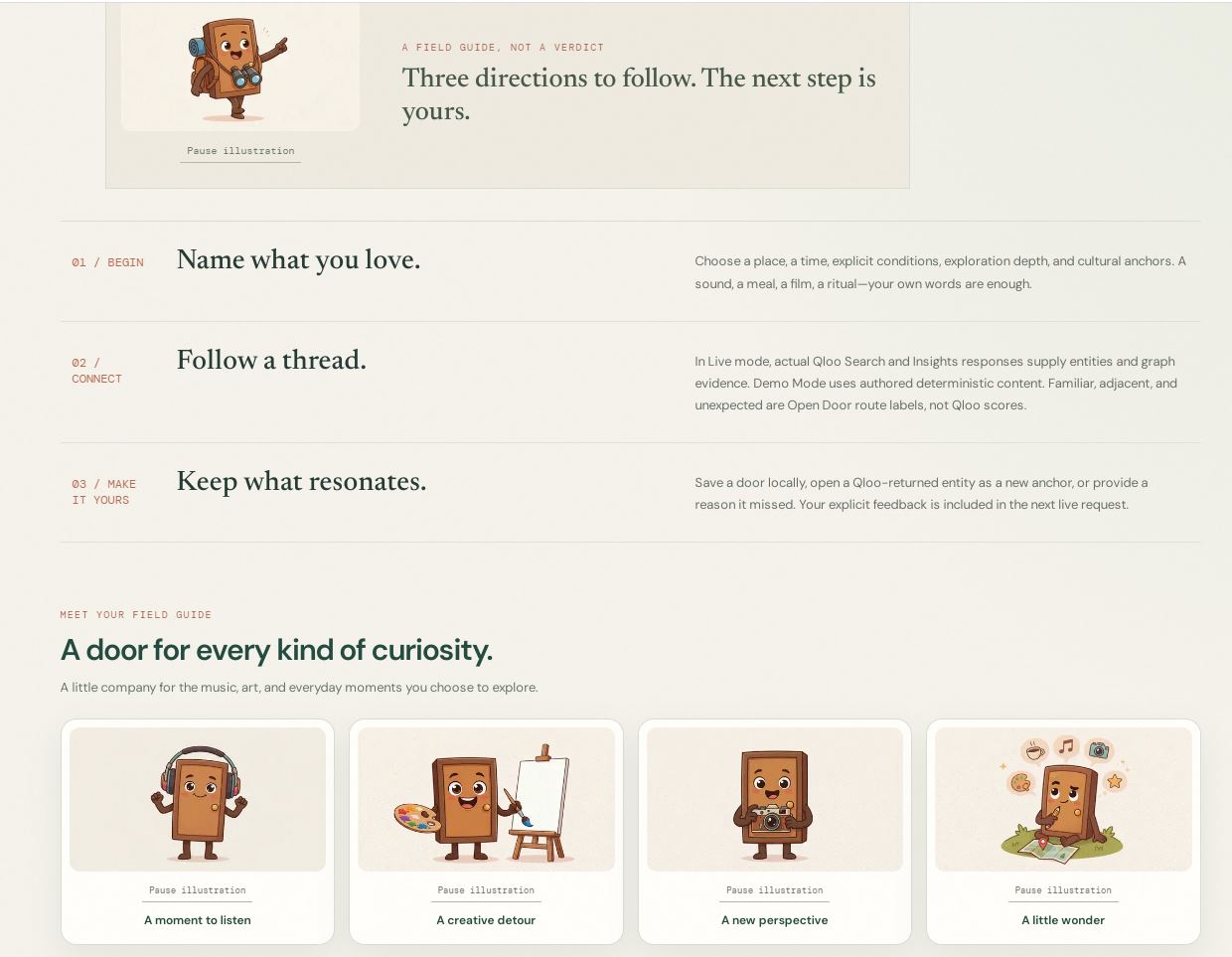
Open Door also has its own personality: a wooden door mascot, opening animations, optional sound, and progression tracks including Brave, Explorer, and Door Collector. Medals, trophies, stars, and shareable achievements celebrate the user's exploration.
The goal is to make cultural discovery feel welcoming, playful, and worth returning to—not like filling out another search form.
Explore alternative journeys
Discovery Lab lets users preserve a starting checkpoint, branch into different planning approaches, and compare alternative journeys while keeping their individual histories separate.
It gives people a way to experiment with different possibilities without losing their original exploration. It extends Open Door's central idea: discovery is a journey with multiple possible directions, not one answer that everyone should accept.
Explore the possibilities for partnerships
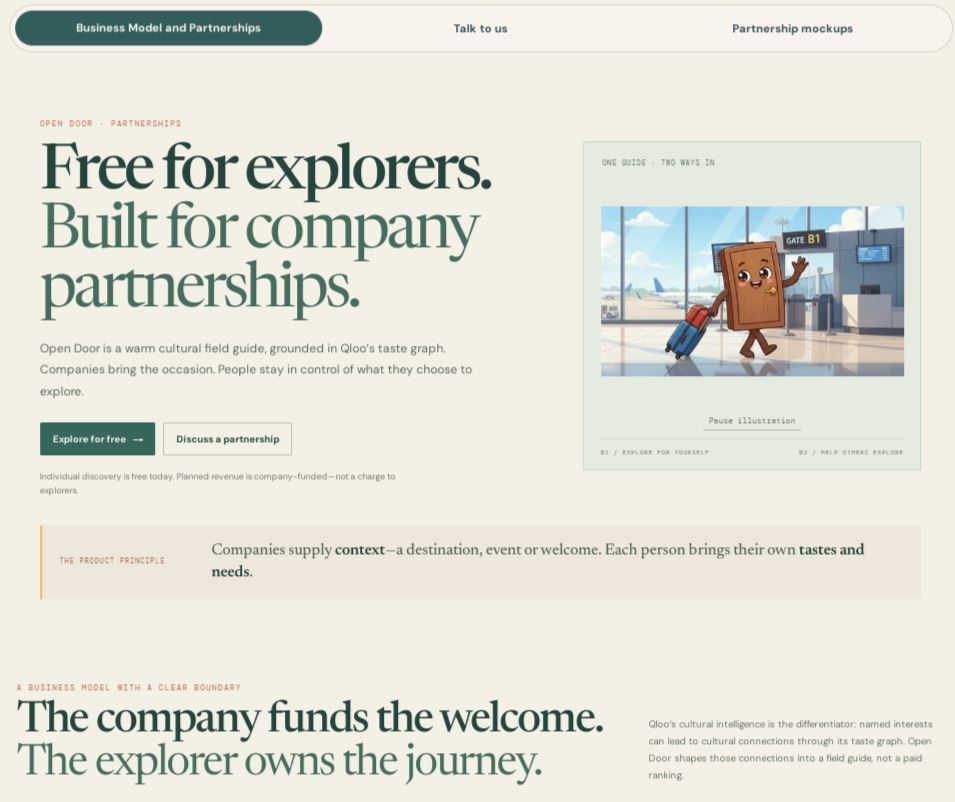
Open Door includes dedicated Business Model and Partnerships, Talk to Us, and partnership-preview pages that demonstrate how the experience could be adapted for hotels, destination weddings, and neighborhood discovery.
Interactive previews include fictional businesses and photo-backed placement concepts, clearly labeled as mockups rather than existing partners, live advertisements, or Qloo endorsements. A working inquiry form collects collaboration requests for administrator review.
The proposed model explores how organizations might fund branded guest experiences, clearly disclosed placements, or partnership services while allowing people to retain control over their own cultural discovery.
Users can choose the shared live Qloo Demo connection or provide their own Qloo API credentials. Prepared sample journeys are distinguished from live Qloo-backed results.
How we built it
Qloo supplies the cultural intelligence. Open Door turns it into an interactive discovery experience.
The application combines a modern web interface, server-side orchestration, persistent account-backed data, and browser-local exploration state.
Our stack includes React, TypeScript, and Vite on the frontend; Node.js and Express on the backend; PostgreSQL; and Clerk for optional authentication.
The most important technical work was integrating Qloo into the actual discovery journey.
- Cultural retrieval: Open Door uses Qloo Search to resolve named interests and Qloo Insights to retrieve cultural connections across relevant domains.
- Entity-aware continuation: When users choose a returned connection, Open Door can carry its exact Qloo entity ID into the next exploration. This preserves the cultural thread across steps.
- Structured discovery paths: Open Door organizes retrieved candidates into Familiar, Adjacent, and Unexpected directions and requests documented result types based on the user's explicit discovery choices.
- Evidence and transparency: Returned entity IDs, metadata, and available explainability support provenance views and expandable request traces, making the underlying cultural retrieval more inspectable.
- Stateful exploration: The application supports expanding doors in place, preserving checkpoints, maintaining independent Discovery Lab branches, and comparing alternative journeys.
- Flexible persistence: Account-backed saved doors and opt-in preference memory are separated from browser-local guest experiences and Lab data.
- Privacy-conscious sharing: Guest links carry the relevant use case, public place, and occasion rather than a person's private preferences or planning scenario.
The additional discovery experiences extend this same foundation:
- Taste Bridge uses multiple participants' cultural interests as starting points for identifying shared interests and connections between different tastes.
- What If? Explorer builds on existing discovery context and user preferences to explore alternative scenarios without overwriting the original journey.
- Discovery Debate uses the original recommendation, the user's interests, and available Qloo evidence as context for an interactive challenge-and-response experience.
These features are designed to reuse the existing Qloo integration and discovery infrastructure rather than introduce duplicate recommendation systems.
We made a deliberate architectural choice: the current agentic workflow uses structured tool orchestration rather than an external LLM inventing cultural relationships. Qloo provides the retrieved cultural grounding, while Open Door coordinates the next steps and presents the results in a usable experience.
We also worked to make connection failures understandable. Live requests can show visible errors or partial results rather than silently substituting prepared examples.
Development included 104 passing unit and server tests, along with targeted automated browser checks covering interactions, privacy boundaries, voice-input fallback behavior, guest sharing, and partnership previews.
Challenges we ran into
The biggest challenge was making a complex discovery experience feel simple.
A user should be able to start with an interest and reach a meaningful discovery without navigating a maze of settings. We refined the flow so interests could be entered naturally, results could expand in place, and advanced options and technical details could remain available without overwhelming the initial experience.
The Qloo integration also required a clear distinction between a named cultural interest, a personal planning note, and the preferences used to shape the outing. We wanted people to describe what they needed without accidentally turning every personal detail into a cultural query.
Continuing a discovery introduced another challenge. The next step needs to retain the actual cultural connection that led there, not just repeat a broad search. Entity-aware continuation helps preserve that thread.
Personalization and privacy needed equal attention. We wanted people to adapt discovery to their circumstances—or help someone else explore—without making assumptions about who they are. That meant separating explicit preferences from inferred identities and keeping personal planning notes outside Qloo requests and account preference memory.
The new experiences introduce additional discovery challenges. Taste Bridge needs to find meaningful connections without reducing different people's interests to the lowest common denominator. What If? Explorer needs to change the scenario while preserving the original discovery. Discovery Debate needs to respond to disagreement with actual reasoning and available evidence, rather than simply defending every recommendation.
Finally, we had to distinguish cultural relevance from practical certainty. A Qloo connection does not prove that a venue is open, accessible, available, or suitable for a particular health need. We made room for evidence, planning notes, and Maps searches while being clear about their limitations.
Accomplishments that we're proud of
We built a complete experience around cultural discovery—not just an API call and a list of recommendations.
We're proud that Qloo sits at the heart of a product people can actually use. Someone can start with a cultural interest, discover cross-domain connections, choose a direction, open a door, follow a returned entity, and continue exploring without losing the thread.
We're proud of the concept itself. The door is more than a visual motif: it represents the way one interest can open onto another possibility. Familiar, Adjacent, and Unexpected give that idea a clear structure, while the in-place exploration experience makes it tangible.
We're proud of the breadth of the experience we built around that foundation:
- A guided starting experience for interests, places, occasions, and personal context.
- Four discovery directions that let users choose how far they want to venture.
- Voice input and natural-language planning notes, with explicit privacy boundaries.
- Personal style, age-aware, wellbeing, and custom considerations that users control.
- A way to explore for yourself or create a starting point for someone else.
- Follow-on cultural exploration using returned Qloo entity IDs.
- Hidden-gem activities and practical day planning.
- Saved discoveries, guest access, optional sign-in, and shareable starting links.
- Discovery Lab branching and comparison.
- A distinctive mascot, animations, optional sound, and curiosity-based rewards.
- Interactive hospitality and destination-event partnership previews, plus an inquiry form.
We're also expanding what discovery can mean:
- Taste Bridge explores connections between people with different interests, creating opportunities for shared experiences and unexpected discoveries.
- What If? Explorer makes discovery more flexible by allowing users to change their circumstances and explore alternative possibilities.
- Discovery Debate gives users a voice in the recommendation process, letting them question, challenge, and refine what Open Door suggests.
These are not separate ideas assembled into a portfolio page. They work together around one purpose: helping people discover possibilities they might not have found on their own and giving them a way to do something with those discoveries.
We're also proud of the care taken with evidence, privacy, state management, and the distinction between live Qloo results and prepared examples. We wanted the experience to be inviting without hiding how it works or overstating what it can verify.
What we learned
Cultural intelligence becomes more valuable when people can understand it, explore it, and act on it.
A connection returned by an API is only the beginning. The product experience determines whether that connection feels meaningful: how it is presented, what the user can learn from it, where it leads next, and whether it fits the day they actually want.
We learned that discovery needs both structure and freedom. Familiar, Adjacent, and Unexpected provide useful directions, but users still need control over their own choices. A single recommendation cannot anticipate every mood, circumstance, or occasion.
We also learned that personalization should come from explicit preferences rather than assumptions. People should be able to tell Open Door what matters to them, change their minds, and explore for someone else without pretending that everyone shares the same tastes.
The new experiences take that idea further. Discovery can be social, because different people can find unexpected connections between their interests. It can be flexible, because changing circumstances can open new possibilities. And it can be conversational, because users should be able to challenge a recommendation and understand why it was made.
On the technical side, entity-aware continuation and independent exploration state matter when a product is meant to support a journey rather than a one-time answer. Transparency matters, too: cultural connections, authored activities, practical searches, and commercial mockups should not be presented as though they have the same evidentiary status.
Finally, we learned that a commercial opportunity and user trust have to grow together. Organizations may have reasons to fund discovery experiences, but paid placement should never be confused with proof that a recommendation reflects someone's cultural interests.
What's next for Open Door
The next step is to test Open Door in the real world.
We would like to work with a hotel or destination-wedding organizer on a focused pilot. The goal would be to learn whether guests find useful and surprising experiences, whether they use the planning and saving features, whether they return, and whether organizations see enough value to fund the experience.
Our proposed business model keeps individual discovery free while exploring company-funded guest experiences, clearly labeled placements, and partnership services. The current previews demonstrate what these experiences could look like; a real pilot would help validate the model.
Future development could include partner attribution and reporting, continued accessibility and usability improvements, and API or MCP integrations that bring cultural discovery into other workflows.
The larger vision is to make the world feel more discoverable: to start with what someone loves, use Qloo's cultural intelligence to reveal connections they might not have considered, and help them turn curiosity into an experience that fits their life.
Your interests. Your circumstances. Your next discovery.
Open Door opens up what's possible.
Built With
- clerk
- css3
- express.js
- html5
- javascript
- node.js
- playwright
- postgresql
- qloo-api
- react
- replit
- typescript
- vite
- web-audio-api

