-
-

Our Project Logo
-
Our Gallery Banner

Inspiration
In almost every community, the help already exists. Food banks have food. Rent-relief funds have money. Clinics have open chairs. The cruel part is that the people who need them most can't find them in time, because the help is scattered across dozens of agencies, websites, and forms, each with its own rules and language.
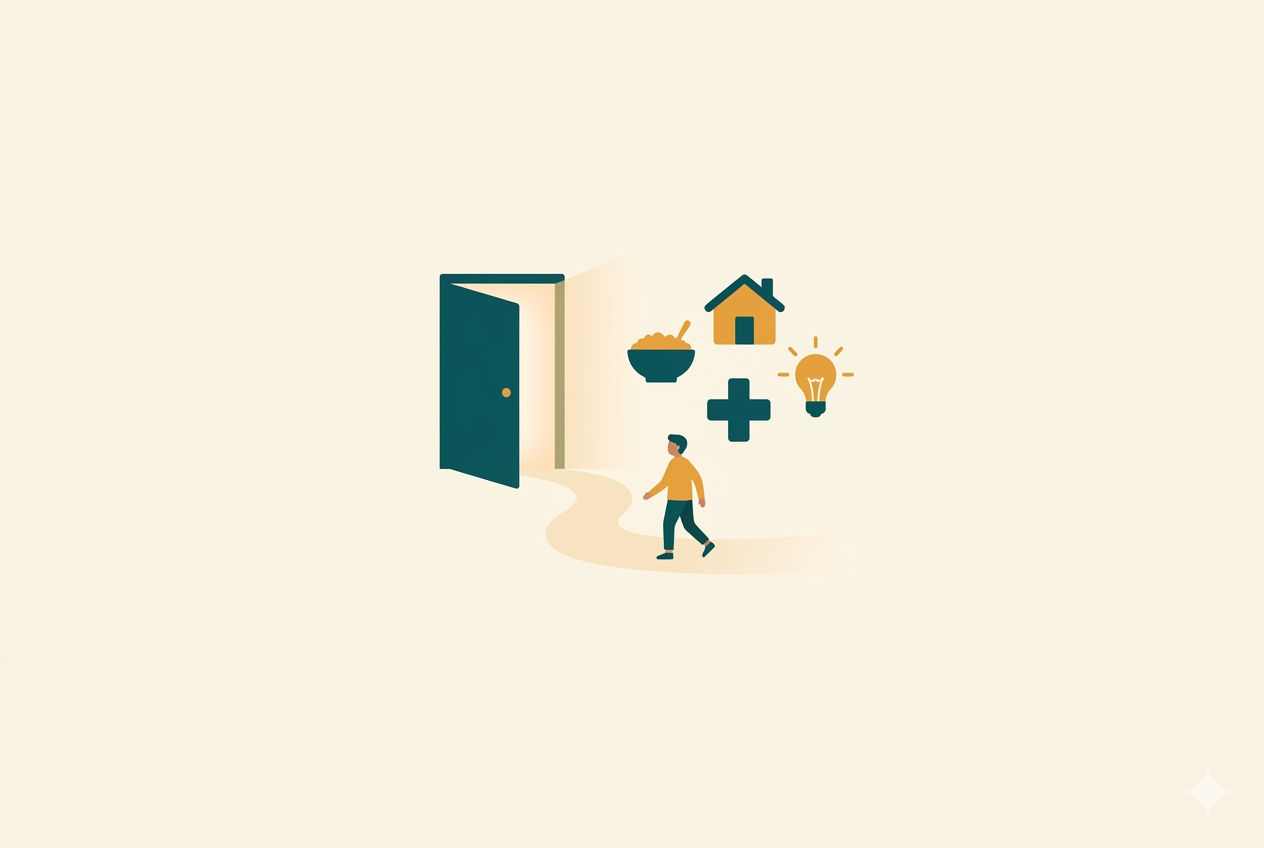
We kept returning to one person we named Mohsin: 41, a single father, laid off last week, rent due Friday, an empty fridge, and two kids who don't know any of that yet. Mohsin doesn't need forty browser tabs and a stack of eligibility PDFs. He has the least time, money, and energy of anyone, exactly when the system asks the most of him. We built Open Door so that the moment he can describe his situation in one sentence, he understands what he may qualify for and what to do next.
What it does
Open Door is a Benefits Navigator. You describe what's going on in plain language. It asks a couple of guided questions (household size, income range, what's happening), then for each support program it gives you a clear verdict, you may qualify, possibly, or unlikely, with three things a search engine never gives you: the plain-language reason, the actual eligibility rule behind it, and a prepared next step. It never says "you qualify," only "you may qualify," because the program makes the final call. A second view turns anonymized checks into a live map of where need is concentrated, for the providers trying to help.
How we built it
The interface is a lightweight web app that runs anywhere, even on a basic phone. When someone describes their situation, natural-language processing reads it and turns it into a structured profile. A transparent rule engine then interprets each program's eligibility criteria against that profile and produces a reasoned verdict, with the rule and source shown. A final step generates the next action: what to bring and a ready-to-send message. Anonymized checks feed the provider view. The directory is a structured dataset we built, modeled on public sources and designed to plug into real ones.
The difference it makes
Before Open Door, someone like Mohsin reads dense eligibility rules under stress, guesses, and often applies to the wrong program or gives up, losing days he can't spare. After, in about two minutes he sees which programs he may qualify for and why, each with the rule behind it and a prepared next step, moving from confusion to one clear action he can take today.
Challenges we ran into
The hardest problem wasn't the AI, it was trust. A tool that confidently tells someone they qualify, when they don't, is worse than no answer, because it burns the little time and hope they have left. So we designed against over-reliance: never guarantee, always show the rule and source, always offer a human. Designing for stress, low bandwidth, and privacy shaped the build as much as the model did.
Accomplishments that we're proud of
We turned one stressed sentence into an interpreted, explainable answer in plain language, not a list of links. We're proudest of two choices: making it two-sided, so the same tool that helps one person reveals community-wide gaps, and treating responsible AI as how the system behaves, not a disclaimer at the bottom.
What we learned
The real failure point in public systems isn't discovery, it's understanding and action, the gap between seeing a program and knowing whether it's for you. Once we saw that, the whole design pointed at interpreting rules and preparing the next step.
What's next for Open Door
Integrate live eligibility data from public sources. Add SMS and voice so it works on any phone. Support more languages. And pilot with a local nonprofit, measuring one number: how many people don't just find help, but get it.
Built With
- anthropic-claude-api
- css
- figma
- github
- html
- javascript
- rule-based-eligibility-engine


Log in or sign up for Devpost to join the conversation.