Inspiration
In a classroom, a student can be lost without wanting to raise a hand or explain personal details in public. A teacher may see only the students who speak up, while quieter access barriers remain invisible. Open Door Classroom turns one small lesson signal into a privacy-filtered classroom adjustment.
What it does
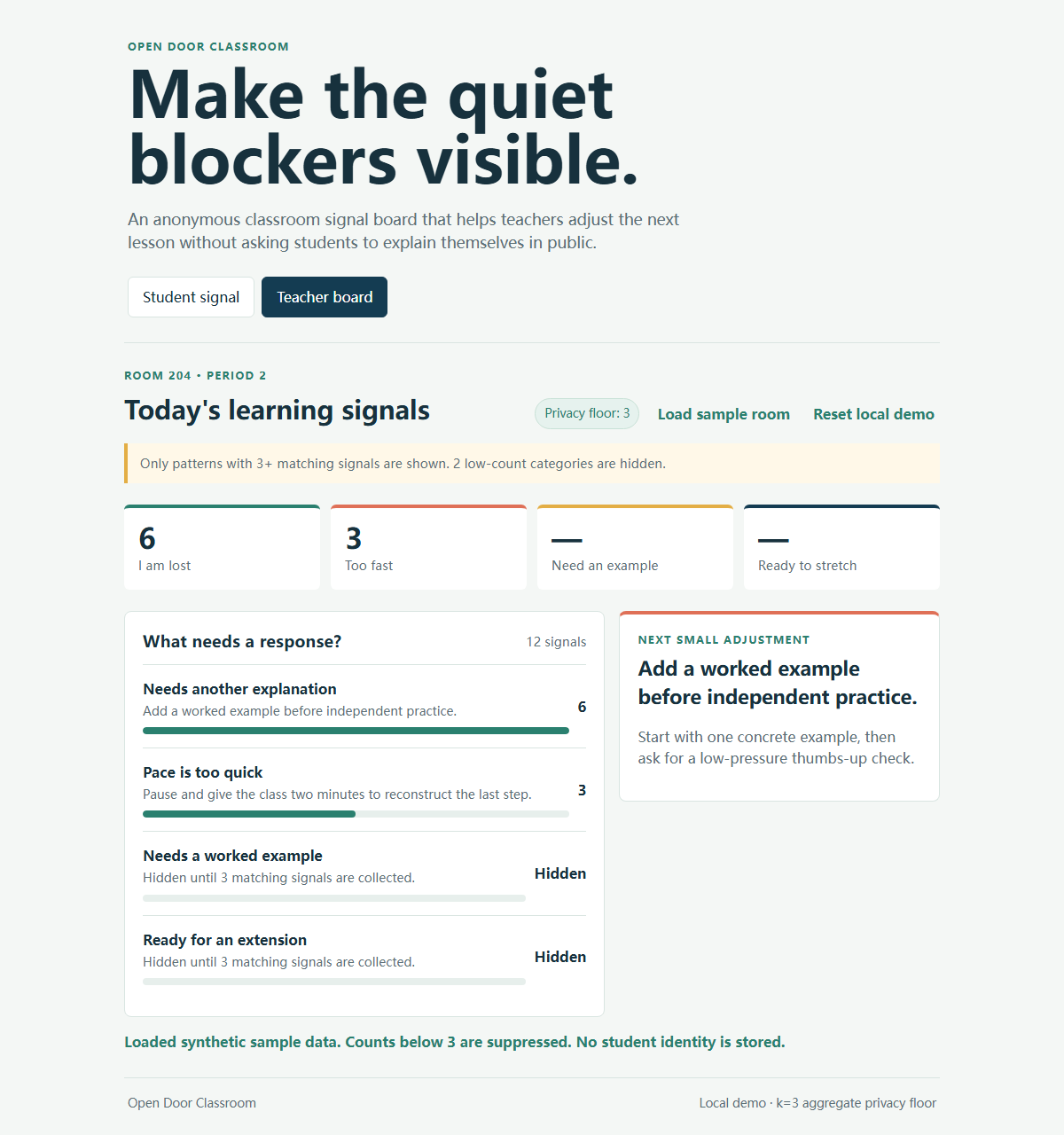
Students choose one low-pressure signal: lost, too fast, need an example, or ready to stretch. The teacher board aggregates synthetic signals and applies a k=3 privacy floor before showing a category. When a pattern is visible, the board gives one concrete next classroom move. Low-count patterns stay hidden instead of becoming a label about one student.
How we built it
The prototype is a browser-only HTML, CSS, and vanilla JavaScript app. Signals are stored in localStorage on the device. The board counts categories, suppresses every category below the privacy floor, and maps the visible pattern to a bounded classroom action. The visible Reset local demo action clears stored signals, so the retention boundary can be demonstrated rather than merely claimed. The demo uses synthetic data and has no account, network request, identity field, or diagnostic model.
Challenges we ran into
The hard part was making privacy protection visible without making the board useless. A raw count can reveal a small group, but hiding everything makes the teacher unable to act. The k=3 floor creates an explicit boundary: the system can show a shared classroom pattern, but it refuses to turn one person's signal into a public label.
Accomplishments that we're proud of
Open Door Classroom connects a low-pressure student interaction to a teacher action while keeping the privacy rule inspectable. The interface shows both the visible aggregate and the reason a low-count category is withheld.
What we learned
Privacy is not only a policy paragraph. It can be part of the product's visible behavior and its decision boundary. We also learned to keep the recommended action concrete and reversible instead of pretending that an aggregate signal explains why a student struggled.
What's next
The next step is a consent-based classroom pilot with educators, accessibility review, and a broader set of non-identifying signals. The prototype should remain local-first until a real school governance process exists.

Log in or sign up for Devpost to join the conversation.