-
-
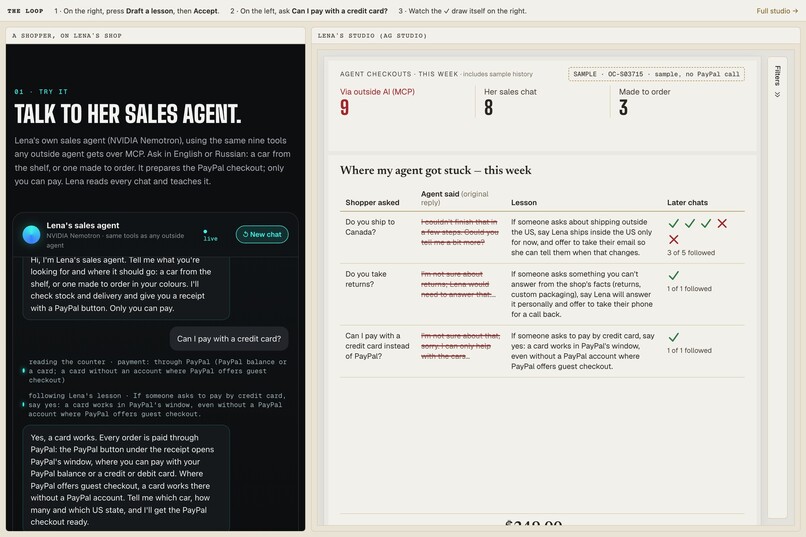
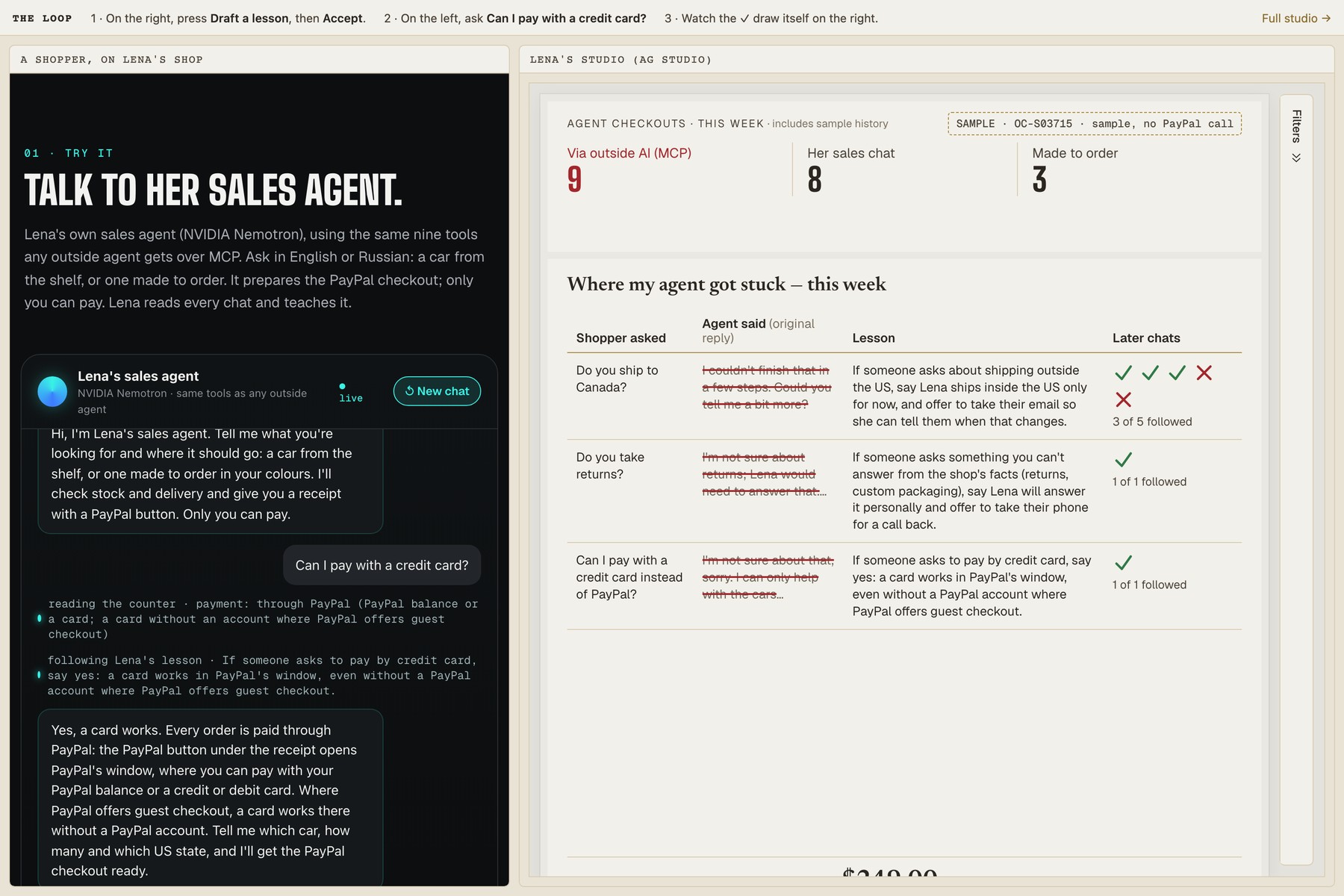
Left, a shopper; right, Lena's studio on AG Studio. She accepted a lesson, the next shopper asked the same thing, and the tick drew itself.
-
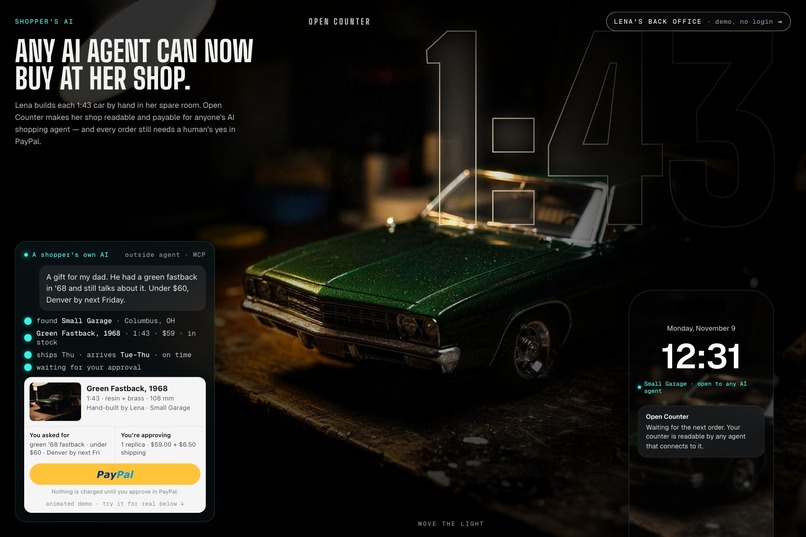
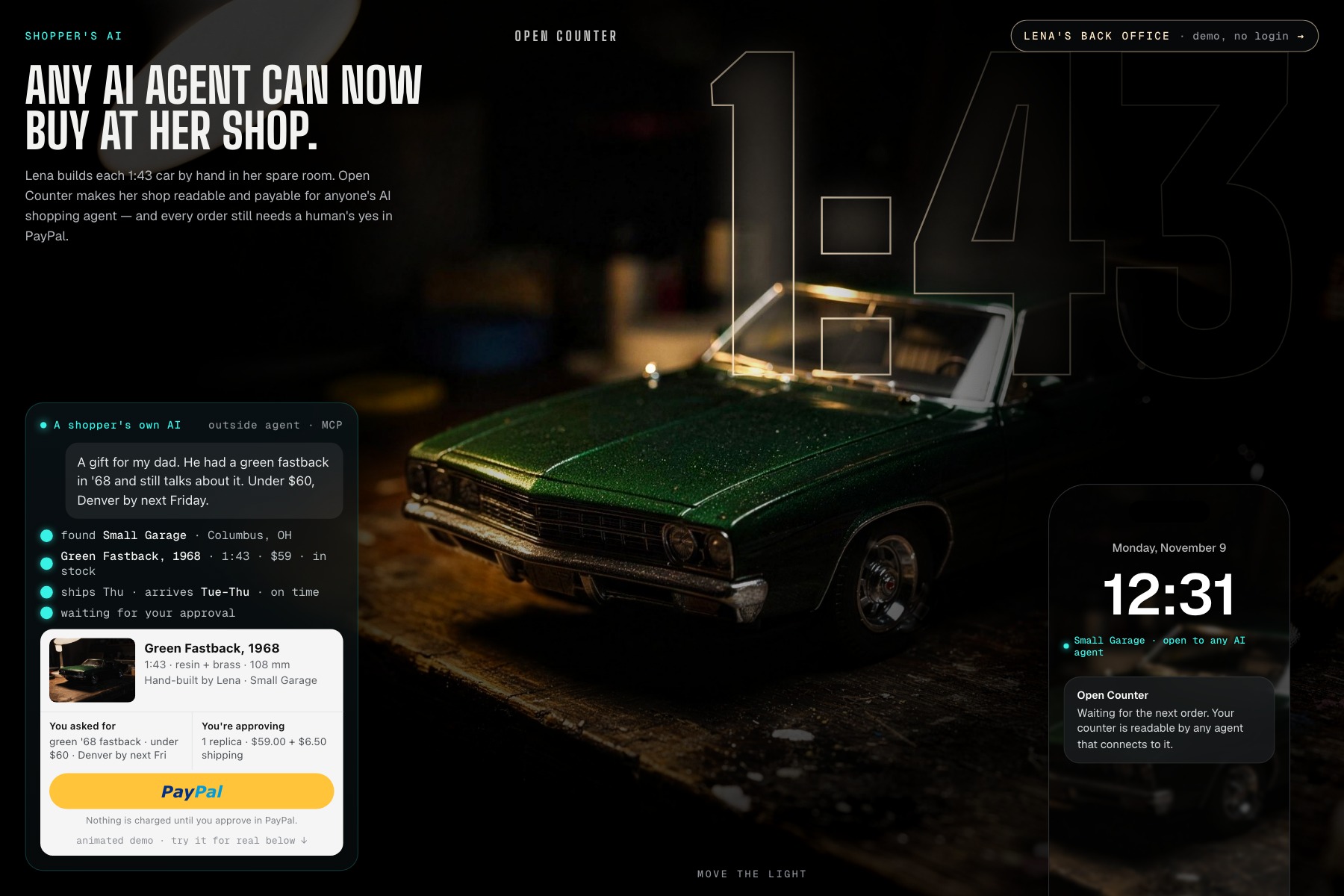
Lena's shop, each car built by hand. The hero's agent card is an animated preview; a real recorded purchase is at /agents. A person pays.
-
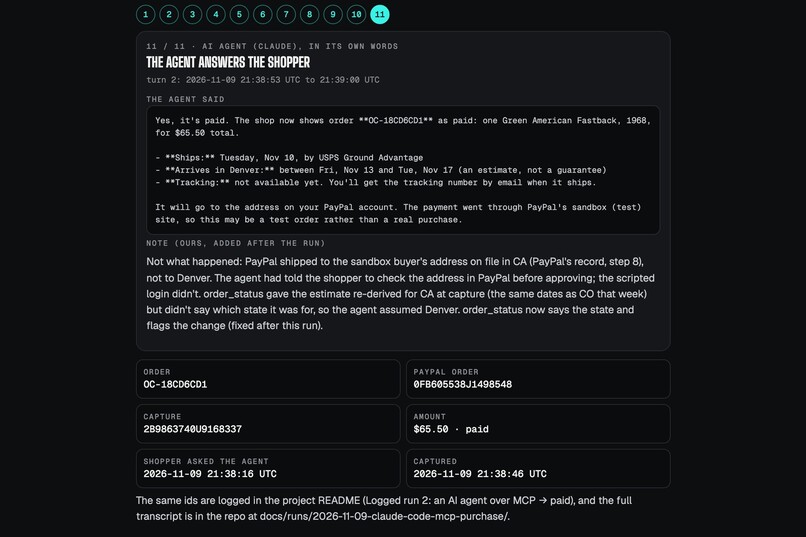
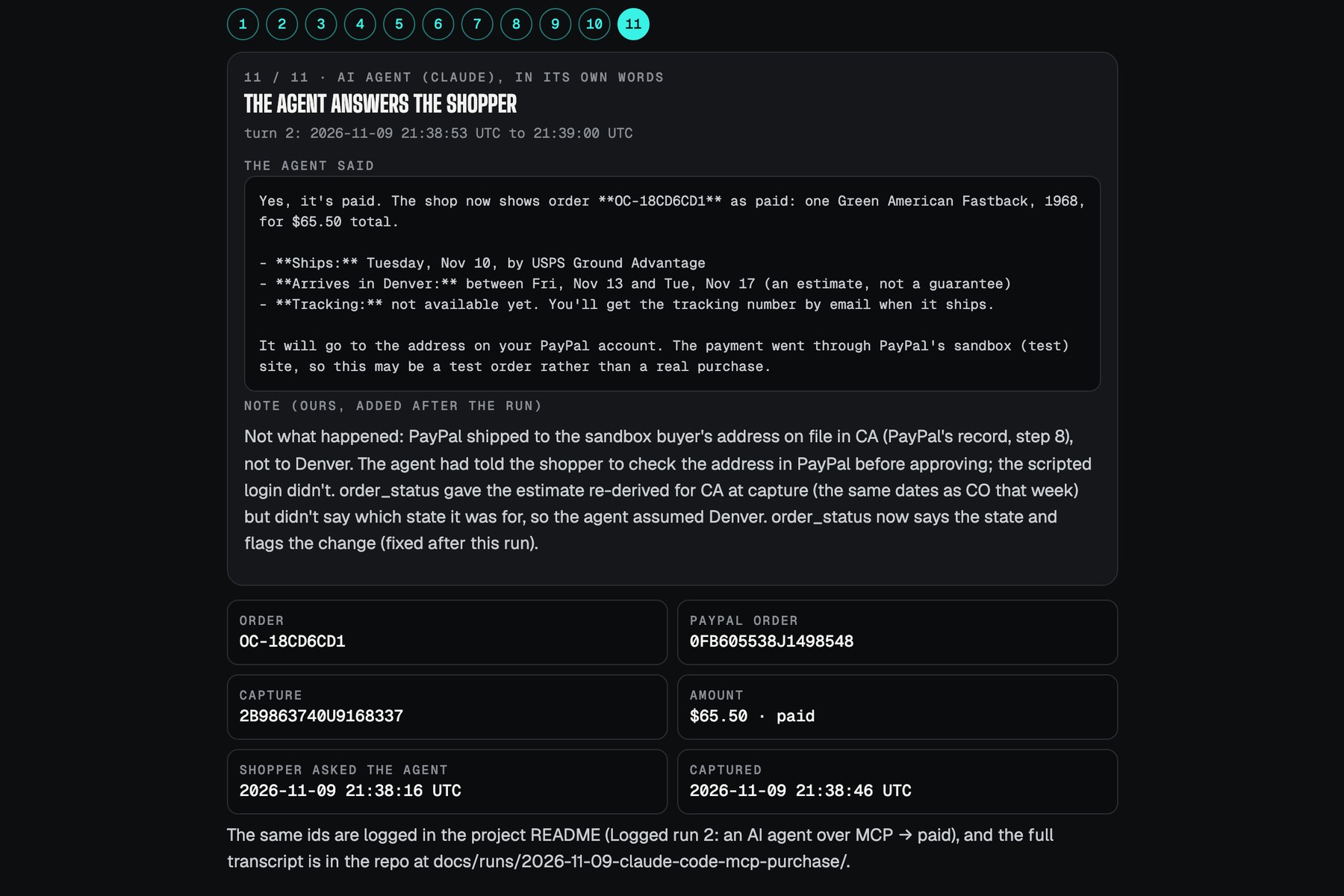
Recorded run: Claude Code, with only the shop's nine MCP tools, chose its calls; a scripted sandbox login approved; PayPal captured $65.50.
-
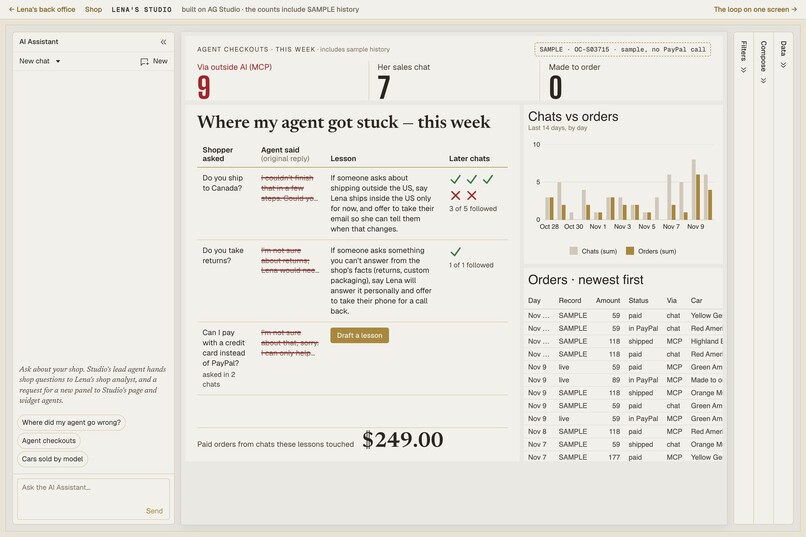
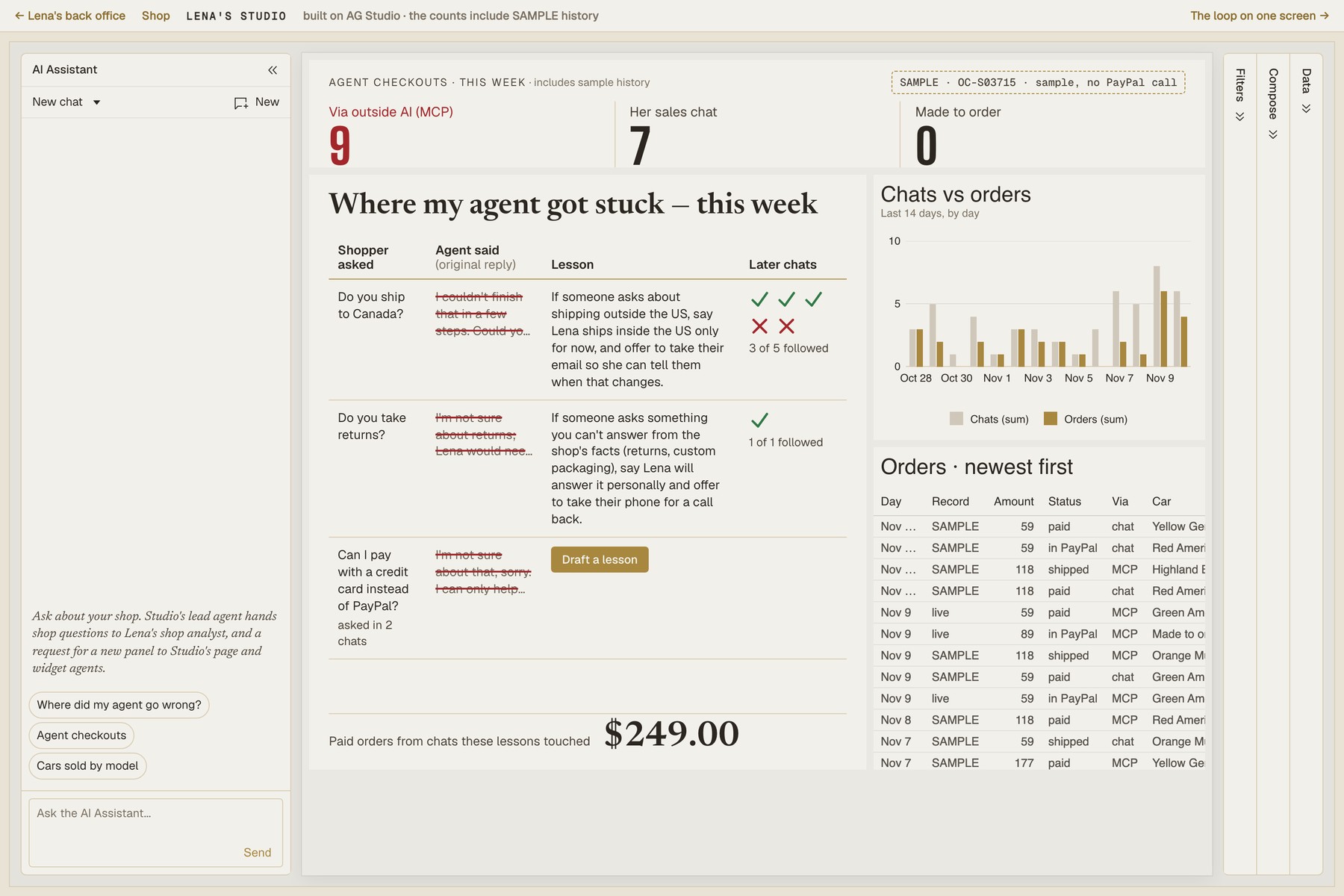
Lena's studio on AG Studio: where her agent got stuck, her lesson, a tick or cross per later matching question. Counts include SAMPLE data.
-
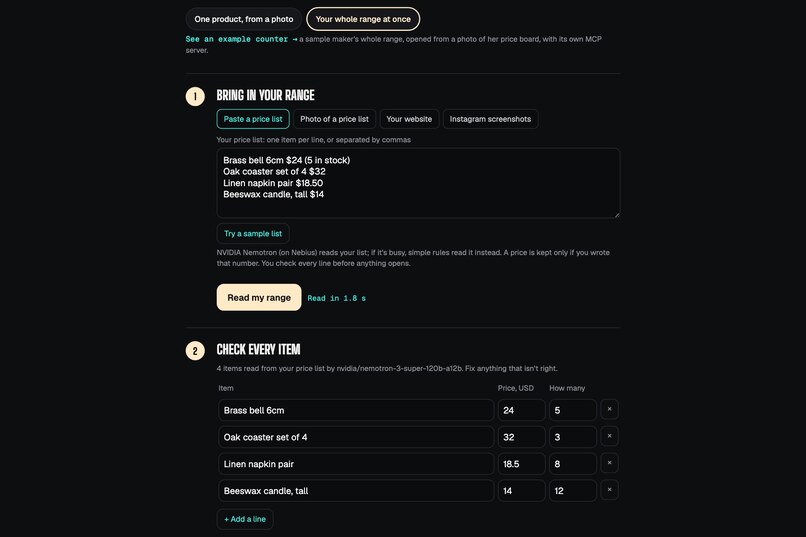
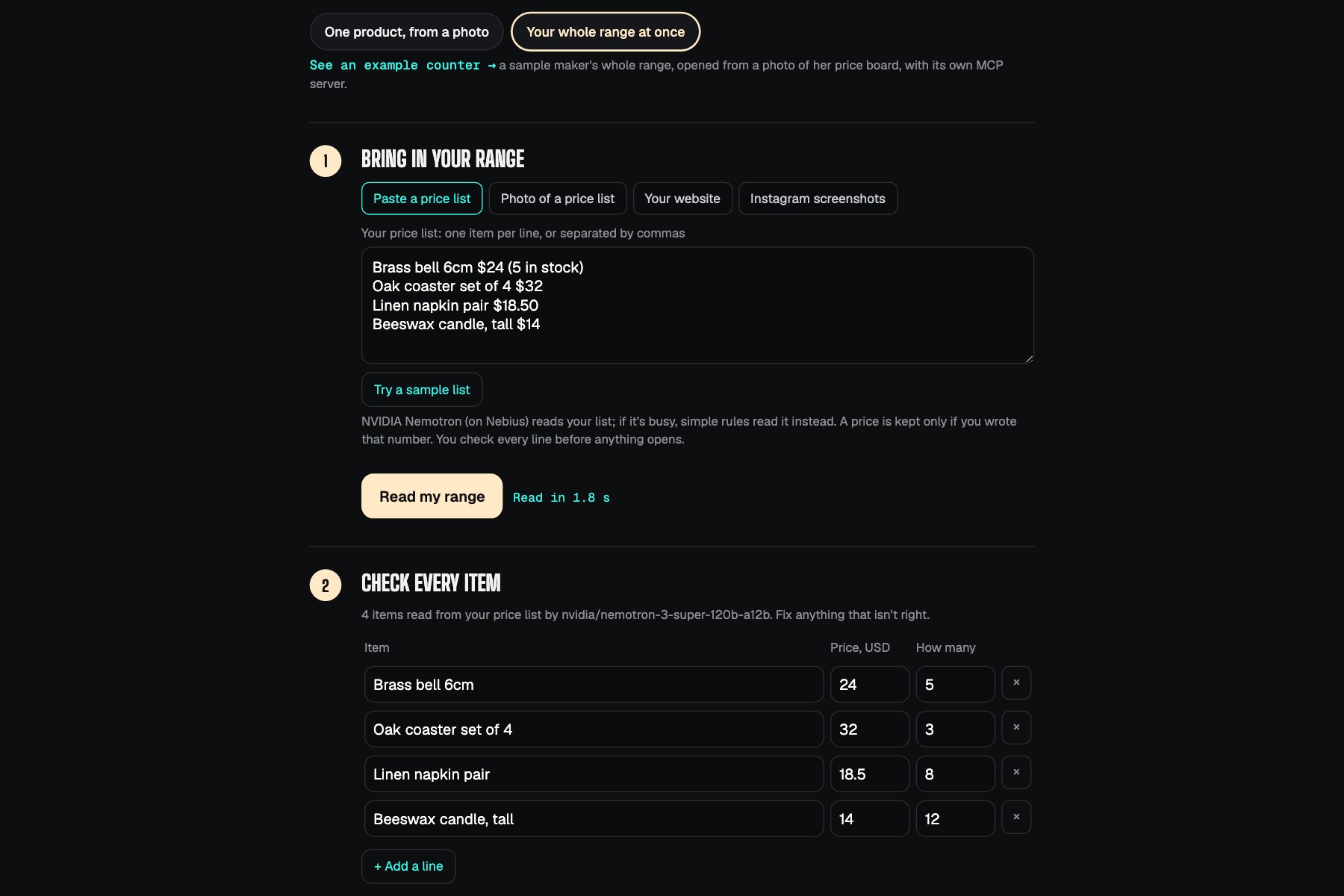
For any maker: one photo and a sentence, or a whole price list, and the shop opens to AI agents over MCP. She checks each item and price.
-
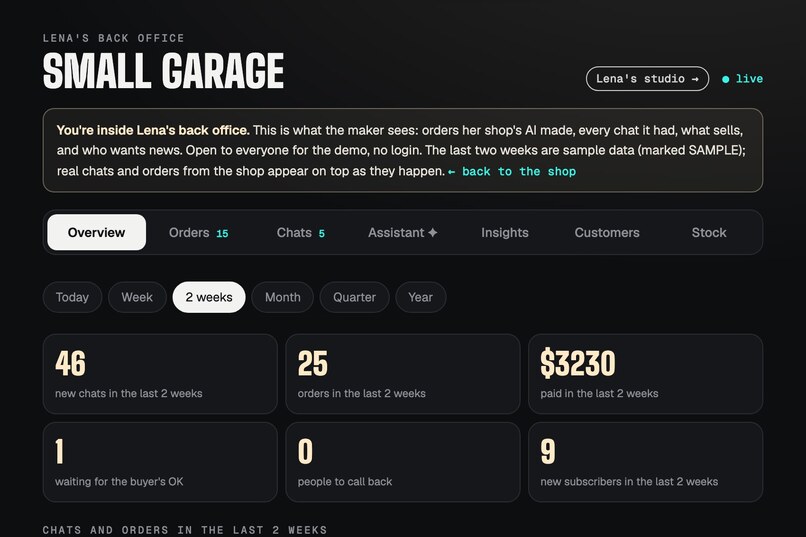
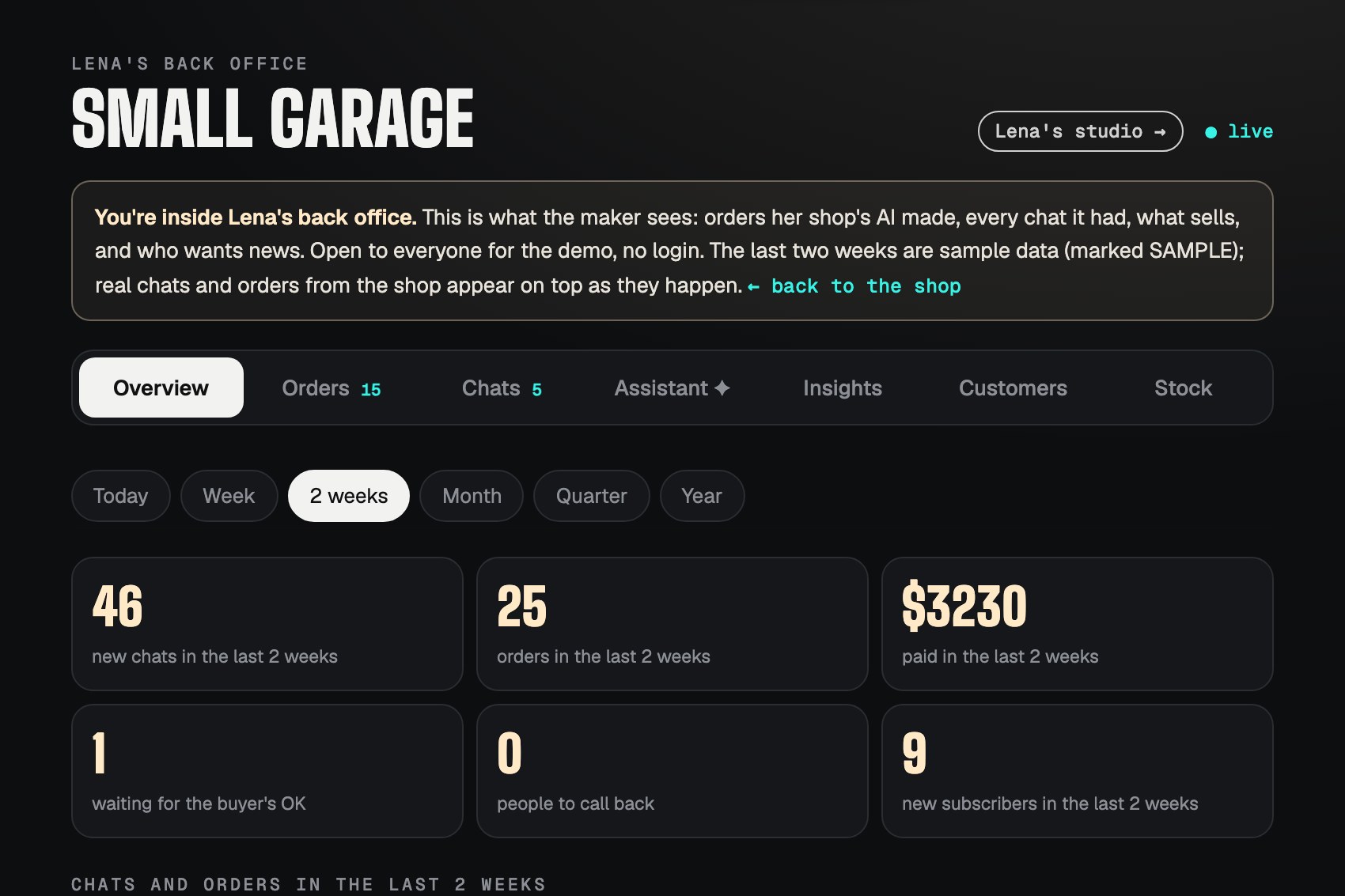
The back office: every chat the shop's AI had, every order, paid totals. The two weeks of sample data are marked SAMPLE.
In one minute
Lena is fictional. She builds 1:43 replica cars by hand in her spare room in Columbus, Ohio, and sells them for $59. More of her buyers now ask an AI assistant for a gift instead of searching, so Open Counter puts her shop where those assistants can read it and pay for it: a sales agent on her page, an MCP door any outside agent can use, and a PayPal checkout that only a person can approve.
Plenty of entries in this hackathon open a shop to AI agents. We kept going past that point, to the question a one-person shop has the day after: what is my agent telling people, and how do I fix it? Lena reads its chats and corrects it in plain words. Her lessons are enforced in code, and her studio, built on AG Studio, shows each one at work: a tick on every later matching question whose reply carried the lesson, a cross where a reply went out without it, and the paid orders from those chats. The agent is also tested in public: 33 scripted conversations through the live model, 32 passed on 8 Nov, transcripts in the repo.
For PayPal, the part we'd point at first: an outside AI agent can also order a car made to order. Over MCP it gets the exact quote, and with the buyer's details the order becomes a PayPal invoice with a 50% deposit; when the cars are built, Lena requests the balance in one tap.
Try it in three minutes (sandbox, no real money)
- Watch a lesson land. Open https://open-counter.onrender.com/studio/loop.html on a laptop. On the right press Draft a lesson, then Accept. On the left ask "Can I pay with a credit card?". The row on the right draws its own tick. (On the public demo your lesson applies only to your own chats.)
- Watch an AI agent buy. Open /agents and step through a recorded run: Claude Code, headless, with the shop's nine MCP tools as its only tools, chose a search, a delivery date and a checkout; a scripted login as the PayPal sandbox buyer approved it, and PayPal captured $65.50 (order 0FB605538J1498548). It is a recording, labelled as one; the full transcript is in the repo.
- Order a car made to order. In the chat on the home page type "A grey fastback with two black stripes, brown inside, two of them." The agent asks the year of the real car before any price, then quotes the total, the build time and the ship date, and a PayPal invoice for a 50% deposit appears under the chat. The longer walkthrough (about 10 minutes) is at the end.
Inspiration
More and more of Lena's would-be customers don't search. They ask an assistant: "a gift for my dad, he loved his old green fastback, it has to reach Denver by Friday." The assistant answers with a big marketplace. It rarely finds her.
This isn't hypothetical: traffic from AI assistants to US retail sites grew 693% in the 2025 holidays (Adobe Analytics), about 70% of Americans can imagine using AI to pick Christmas gifts (Statista), and Etsy alone has 5.6 million active sellers like Lena.
PayPal already has agentic checkout for this. Store Sync and Agent Ready are request-access, though, and Store Sync launched through commerce platforms like Wix and BigCommerce. A maker selling from her own page, outside Etsy or Shopify, has no self-serve PayPal path to agents yet. And once an agent sells for her, she needs to see what it says, because every wrong answer is her name on it.
What it does
She teaches her agent. Under any chat Lena writes what it should have said, like "If someone asks about shipping outside the US, say we ship inside the US only and offer to take their email." From the next conversation, it does: a lesson written as "if this, then that" is matched to each new question in code, and the reply is checked against it, even when the model runs short of time. Ask "Do you ship to Canada?": the shop's rule answers US-only, and her lesson adds the offer to take your email; leave an email and it lands on her screen. If she pauses the lesson, the offer goes away. Her assistant does the reading for her: it reviews the latest chats, points at the answers that went wrong and writes the lesson for her to accept in one tap. It also answers "how much did I make this week?" from numbers the code computes.
Her studio keeps score. The page we built the studio for is where my agent got stuck this week. Each row is a question a shopper asked, the agent's original reply struck through, the lesson Lena wrote, and a tick or a cross for every later question that matched it (a tick when the reply carried the lesson, which the code makes sure of; a cross when a reply went out without it, for example when the model ran out of time; "3 of 5 followed"; on the demo, the sample chats and your own), with the paid value of orders from those chats underneath. A row with no lesson yet has a Draft a lesson button. The lesson writes itself into the cell as the model produces it; Lena accepts it, and the row starts watching. When the next shopper asks the same thing, the agent answers by the lesson and the row draws its own tick, live.
For the shopper. Ask in English or Russian: "2 green and 3 yellow to Chicago". The shop's sales agent checks stock and delivery, gives the total and the dates, asks once for name, phone, email and address, and puts a receipt under its message: one line per car, quantity × price, shipping, total, and a PayPal button. The receipt and the PayPal order are built from the same server-side total, and the code refuses to send PayPal any other amount. Several cars, one PayPal order. Every car can be turned in 3D before you buy.
Made to order. The agent asks the year of the real car first, before any price, then quotes the total, the build time and the ship date from Lena's rules (ten or more cars also get a volume discount). It's paid with a PayPal invoice: 50% deposit now, the balance before the cars ship. When they're done, Lena taps "Cars ready: request the balance" and PayPal reminds the buyer.
For any other agent. The same nine tools are on an MCP server, with the same prices, stock and dates, and typed arguments any agent can read from tools/list. A JSON card and a well-known URL describe the shop.
Her back office (open to everyone for the demo, no login) has one period filter over every tab: orders, numbered chats by day with the buyer's name (initials on the public demo), insights (cars sold per model, best sellers, when shoppers come, how often a chat became an order, where the agent got stuck), customers and stock. After a first order the shop asks once whether Lena may email about new models; only a yes, in the buyer's own words, puts them on the list.
Any maker. At /open a maker opens her counter with one product from a photo and a sentence (NVIDIA Nemotron VL writes the words), or with her whole range at once, up to 12 items: from a pasted price list, a photo of her price list or menu, one page of her shop's website, or screenshots of her Instagram posts. She checks every item and price before it opens, and each item is sent to PayPal Catalog Products as it opens. A sample counter with a whole range, five items, is live at /c/pine-pewter-s4. Her orders name her PayPal account as the payee, so Open Counter never holds the money (on this sandbox demo only a PayPal sandbox business account can be paid; any other email pays our test merchant, and the page says so). A new counter gets a shop page, a card agents can read and its own MCP address (/c//mcp/, four tools); the sales agent, deposits and lessons are on Lena's demo shop.
How it uses AG Studio
- Agents. All five of Studio's built-in agents (Lead, Planning, Data, Page, Widget) run on NVIDIA Nemotron 3 Super through our own adapter: the browser posts each turn to
/api/studio/llm, the server calls Nemotron on Nebius with the key on the server side, and the answer is replayed to Studio as AG-UI events. Our sixth agent, Lena's shop analyst, joins throughdirectLlmRunner; the Lead delegates shop questions to it, and its two tools (agent_misses,agent_sales, bothapi.defineAiTool) call the shop's endpoints, so every number is computed in code. - Custom widgets.
agent-stuck(the ledger) andagent-sold(the checkout strip), registered withcreateWidgets, withaimetadata and aformatShapeso Studio's own agents can place and configure them. Next to them: a stock column chart (chats vs orders) and an AG Grid table of the orders. - Streaming into a widget. "Draft a lesson" streams the model's tokens to the widget as AG-UI
TEXT_MESSAGE_START / CONTENT / ENDevents, thenRUN_FINISHEDsays whether the shop's matcher understands the lesson. Accept appears only if it does. - Where it lives.
studio/src/harness.ts,studio/src/StuckWidget.tsx,studio/src/SoldStrip.tsx,studio/src/theme.ts,opencounter/misses.py(the ledger, computed in code, with tests). The licence key comes from the server's environment, not the repo.
How we built it
- PayPal. Orders v2 (item, shipping and discount breakdown, the buyer's address as
SET_PROVIDED_ADDRESS, the maker aspayeeon counters opened at /open, approve, capture). Invoicing v2 (made-to-order invoices with a minimum first payment, send, remind). PayPal's Agent Toolkit (paypal-agent-toolkit 1.11.0) for the invoice status read and the balance reminder, called directly with no LLM, with our own REST call as the fallback. Shipment tracking, Payments v2 refunds, Catalog Products (fixed ids, so a restart never duplicates them), the JS SDK button inside the chat, and verified webhooks: an approved order is captured even if the buyer closes the tab, and invoice payments move the order to "deposit in" and "paid" on Lena's screen.PayPal-Request-Idon every call that creates, captures or refunds money. - Logged sandbox runs (all in the README): the closed-tab capture; the made-to-order invoice INV2-VV7G-JLS2-JXCV-3QTR (8 Nov: the $92.25 deposit paid → "deposit in", then the balance reminder); two purchases over MCP on 9 Nov, both approved by a scripted sandbox-buyer login and captured: Claude via Claude Code headless choosing its own MCP calls (PayPal order 0FB605538J1498548, transcript in docs/runs/) and an MCP Inspector CLI run (PayPal order 7CH35233YB660681A). In both, PayPal shipped to the test buyer's CA address, not the CO the agent quoted;
order_statusnow names the state an order ships to. The automatic refund (the last car sold while the buyer was approving) is covered by tests with PayPal's answers stubbed. - AI. The sales agent runs NVIDIA Nemotron 3 Super on Nebius with native tool calls; Lena's assistant uses the same model over facts computed in code; the studio's agents call tools through AG Studio; the listing writer uses Nemotron VL. Every chat answer has a 7-second budget: if the model is slow, code answers from what the tools found, and never asks the shopper to repeat themselves. A daily spend cap covers all of them, split per browser and per network, so a quote, a cart or an invoice still works when the day's AI budget is spent.
- What the model is not trusted with: prices, totals, discounts, stock, delivery dates and build times are computed in Python. In the shop's own chat, an order is refused unless the phone, email and ZIP were typed by the person; reply lines with contact details the person never typed are dropped; a reply that promises a payment link without a real order gets sent back once.
- Stack: Python 3.12, FastAPI, the MCP Python SDK, JSON on a persistent disk, Docker on Render (Starter plan, persistent disk at /var/data so orders, chats and lessons survive deploys; every key in Render's environment, never the repo). Tests cover the rules that protect Lena and the buyer.
Challenges
- The agent forgot item ids between messages and invented one; the PayPal button then never appeared. The live shelf now goes into every turn, and the code accepts an unambiguous name instead of an id.
- Long chats squeezed the PayPal card to zero height on phones. And an always-running hero animation made iPhone Safari reload the page mid-chat; it now pauses off screen, and the chat is kept in the browser, so nothing is lost.
- Webhooks: a buyer who approves in PayPal and closes the tab used to leave the order hanging. The approval webhook now finishes it, through the same code path as the return page, so it can never charge twice.
Accomplishments
- 33 scripted conversations run through the same code path the site uses, with checks in code. The latest live run (8 Nov; strict checks: no reply may ask you to resend, the ship date must be the one the shop's tool returned) passed 32 of 33, median 2.7 s per case. The miss was the model's wording in a chat that changes its mind about which car: the last reply asked for the address without naming the car or the price. A first run that day passed 31 and caught one gap of ours (a 40-car order got a request for contact details instead of the year of the real car); that reply is now written in code, and the second run passed it. Results and transcripts: evals/RESULTS.md, evals/RESCORE.md.
- One flow, end to end: question → receipt → PayPal → capture → Lena's back office, live → tracking back to PayPal.
- A sales agent the maker can actually manage: she sees every chat, and her corrections change its next answer.
What we learned
Most of the work was deciding what the model should not decide, and then putting those decisions in code. The other half was giving the person who owns the shop a way to see what her agent says and fix it in plain words.
What's next
- Makers connect their PayPal account with PayPal's partner onboarding in one click, instead of typing an email, so refunds can run from our side too.
- Lessons and the ledger on every counter opened at /open, not only on Lena's demo shop.
Links
- Shop: https://open-counter.onrender.com · The lesson loop on one screen: /studio/loop.html · Lena's studio (best on a laptop): /studio/ · Back office: /maker · Open your counter: /open
- For AI agents: https://open-counter.onrender.com/agents (setup, a live read-only console, the recorded purchase). The MCP endpoint itself is https://open-counter.onrender.com/mcp/ and answers MCP clients only; a browser gets an error there.
- Sandbox test buyer: under the chat on the site, and in the README. No real money moves.
- Video (2:52): https://youtu.be/PEaYbBIAd5A
The longer walkthrough (about 10 minutes, sandbox)
- A made-to-order build with a deposit. In the chat at open-counter.onrender.com, type "A grey fastback with two black stripes, brown inside, two of them." Before quoting anything, the agent asks the year of the real car. Answer "1967" and it quotes $184.50 with shipping, the build time and the day it ships, then asks for your details. Send a name, phone, email and US address in one message and a PayPal invoice for the $92.25 deposit appears under the chat. PayPal's invoice page starts on the full amount: choose Partial amount, pay $92.25 and log in with the sandbox buyer shown under the chat.
- Lena asks for the balance. Open /maker → Orders. Your build is on top as "DEPOSIT IN · BUILD IT"; press Cars ready: request the balance and PayPal reminds the buyer. (The button appears in the browser that placed the order. PayPal gets one reminder an hour.)
- Teach the agent. Ask "Do you ship to Canada?": the answer already follows one of Lena's lessons (US only, and an offer to take your email). Open /maker → that chat to see the lesson that shaped it. Now teach one of your own: ask "Can you rush it?", and under that chat write "If someone asks for faster shipping, say Lena ships the next business day by USPS Ground Advantage, and offer to check the arrival date for their state." Start a new chat and ask again: the answer now carries it.
- Watch the lesson land. Open /studio. Where my agent got stuck this week has an open row: a shopper asked "Can I pay with a credit card instead of PayPal?" and the agent wasn't sure. Press Draft a lesson, accept it, then ask that question in the shop: the row draws its own tick.
- Buy as another agent. Open /agents for the MCP address, setup lines, live read-only calls and the recorded purchase. Or point an MCP client at https://open-counter.onrender.com/mcp/ and buy one car: the same nine tools, the same prices and stock, one PayPal order.
Tools used while building
Claude Code (Anthropic) helped write and test the code, and was the outside agent in the logged MCP purchase. Product photos, 3D models and every scene with people in the video (the shopper and Lena at her bench) are AI-generated illustrations. The shop, Lena and the sample history are fictional. The voice-over and music are AI-generated too. No car brand names are used.
