Inspiration
Alexa+ is making voice-based AI more capable, but we noticed a major gap: large brands can afford engineering teams to integrate with AI assistants, while small local businesses often cannot. A neighborhood bakery, salon, clinic, or repair shop may have great products and services but still remain invisible to voice agents.
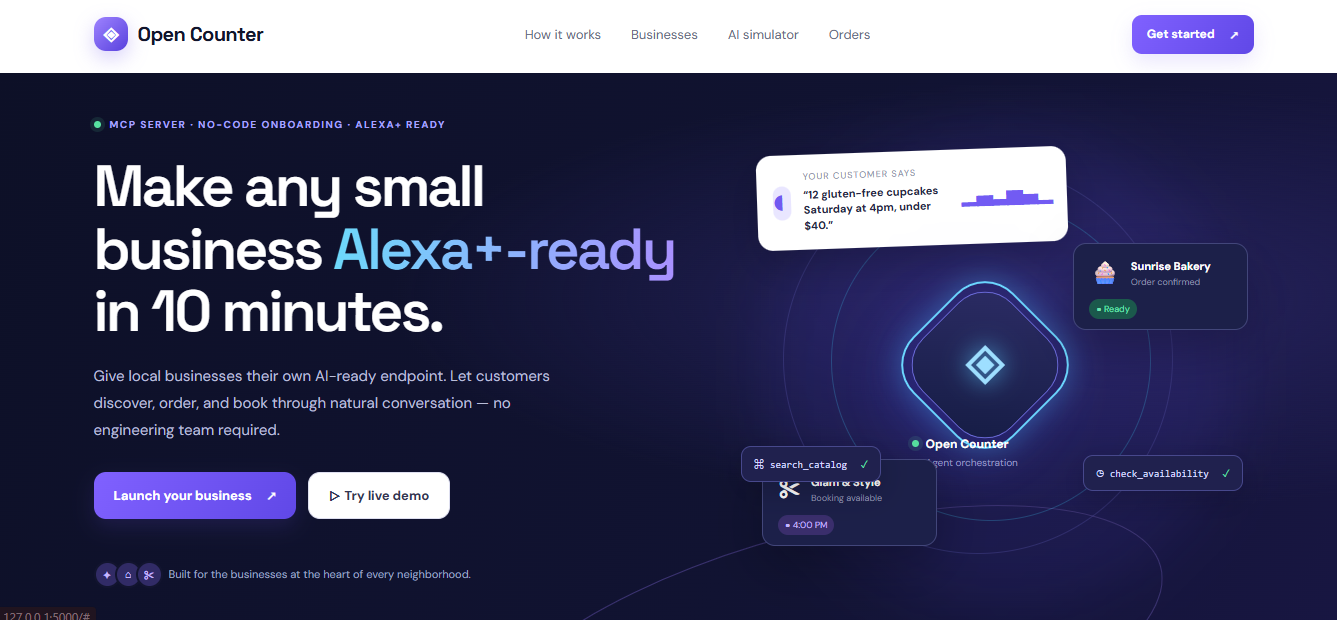
We built "Open Counter" to close that gap. Our goal is simple: make any small business Alexa+-ready in 10 minutes, without requiring the owner to write code
What it does
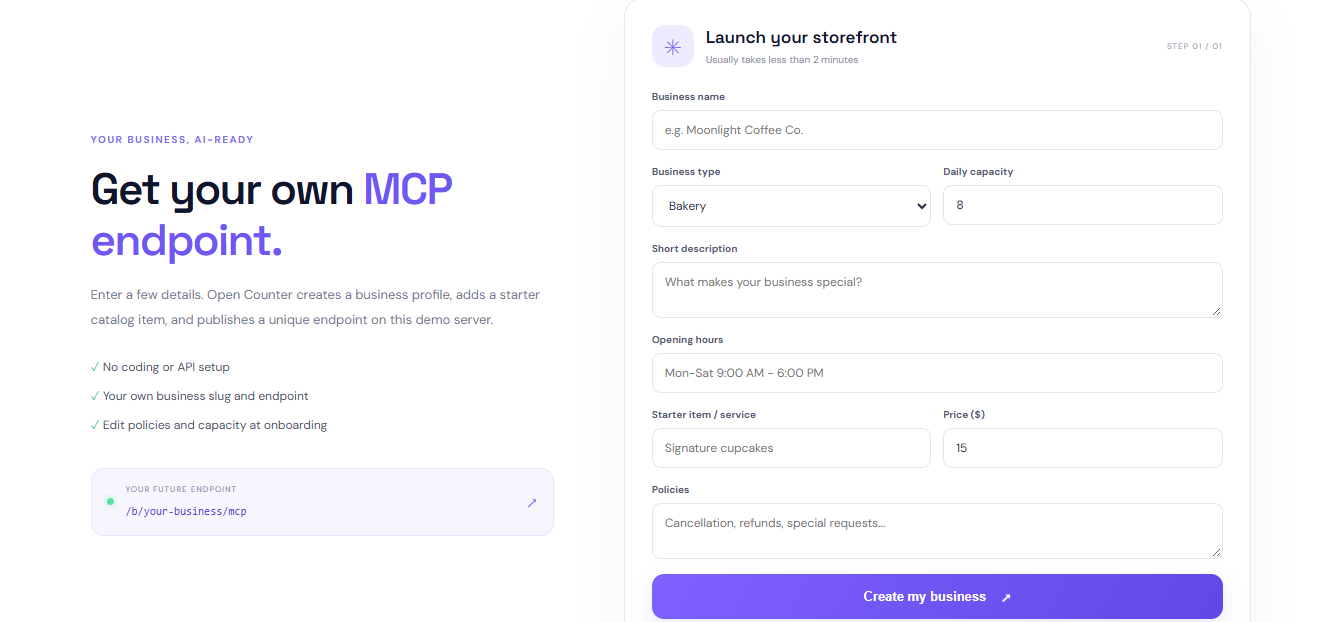
Open Counter is a multi-tenant MCP server with a no-code onboarding experience for small businesses.
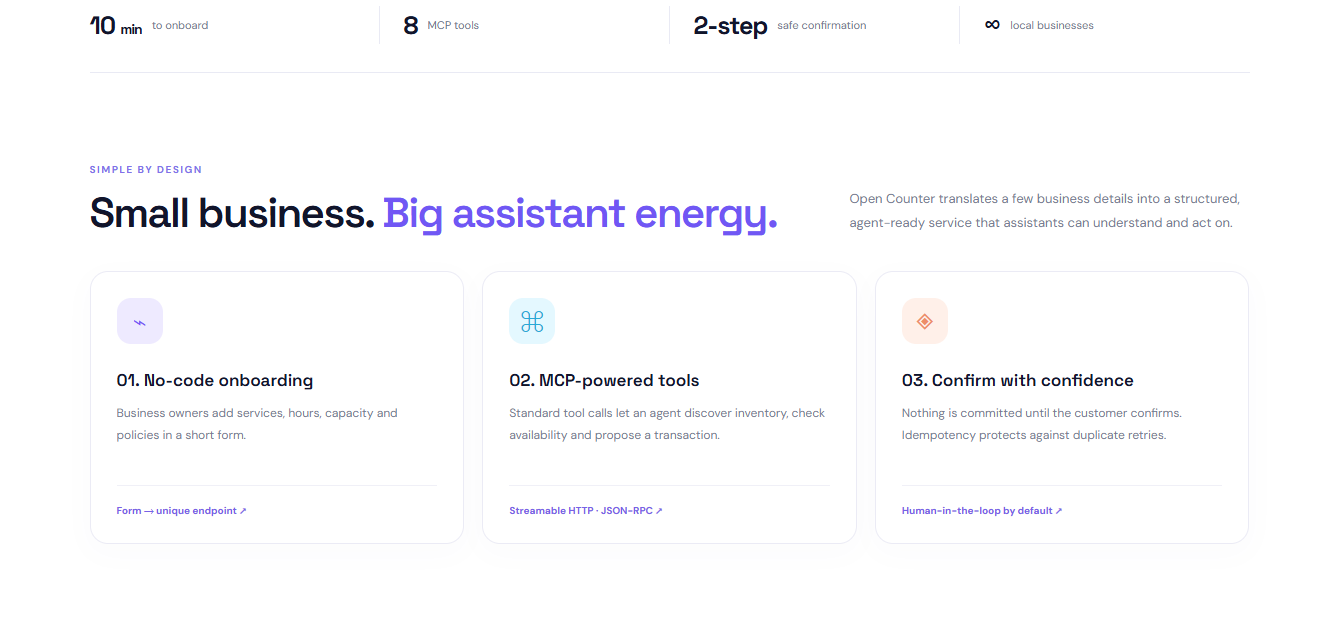
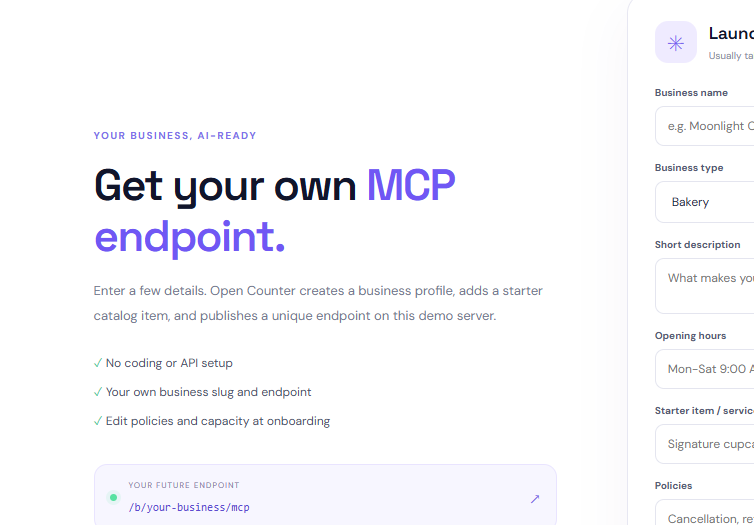
A business owner enters their menu or services, operating hours, capacity, and policies through a simple form. Open Counter then provides the business with its own MCP endpoint.
Customers can make natural voice requests such as:
“I need 12 gluten-free cupcakes Saturday at 4 PM, under $40.”
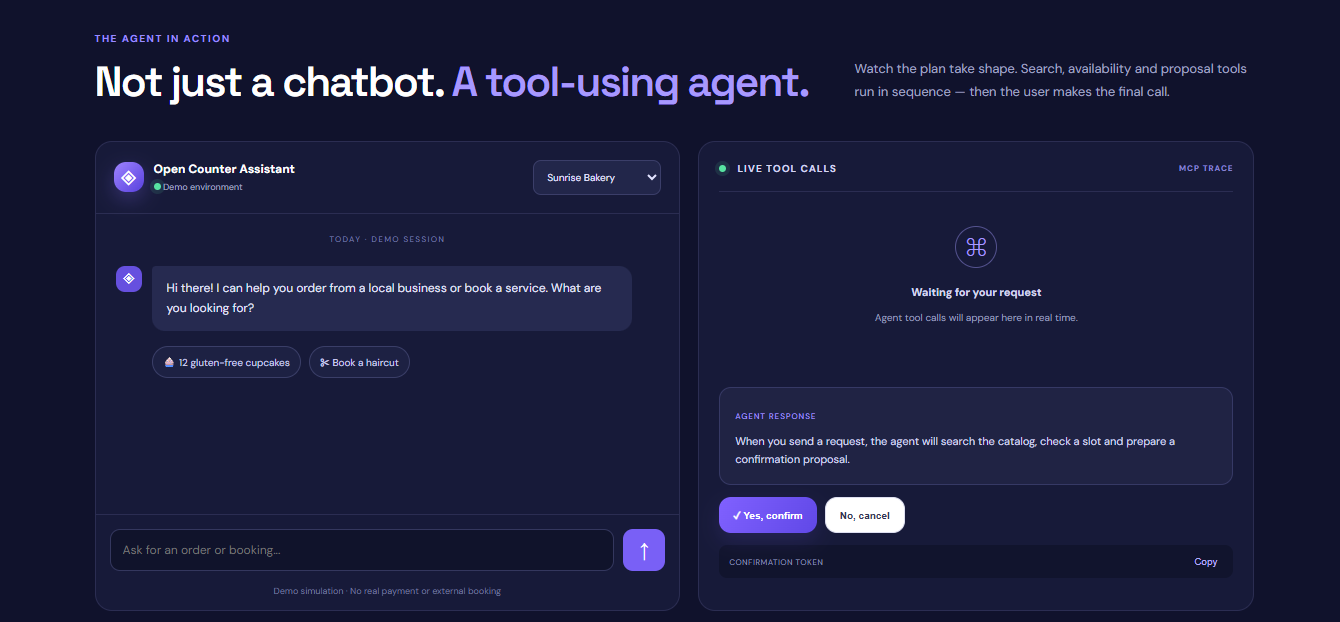
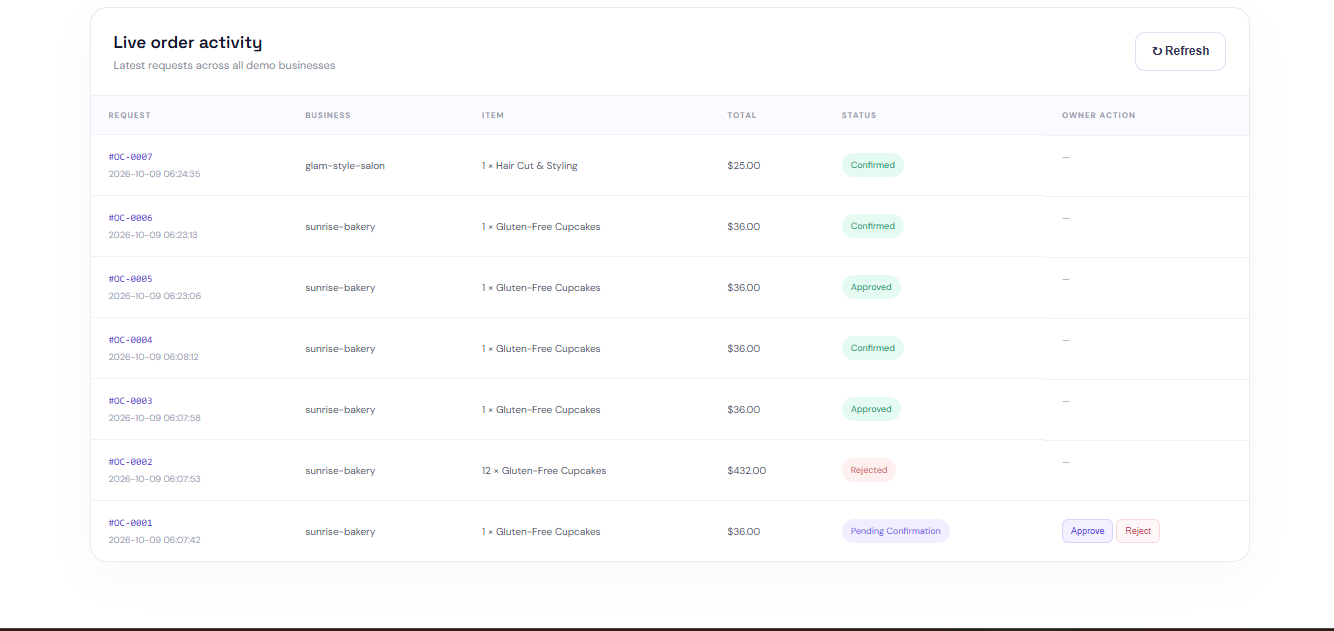
The agent can search the catalog, check availability, propose an order, and ask for explicit confirmation before committing it. The owner can then see the request through a live dashboard and approve or reject it.
This creates a complete flow from "business onboarding → AI discovery → availability checking → customer confirmation → business approval"
How we built it
We designed Open Counter around an "MCP-based architecture", allowing the same underlying system to support different businesses without creating custom integrations for each one.
The core workflow uses tools such as search_catalog, check_availability, propose_order, and confirm. We also designed a two-step confirmation process so that an order is not committed simply because an AI agent misunderstood a request.
For the customer experience, we created a web-based Alexa+ simulation with voice interaction and visible tool execution. On the business side, a dashboard provides visibility into incoming requests and approval actions.
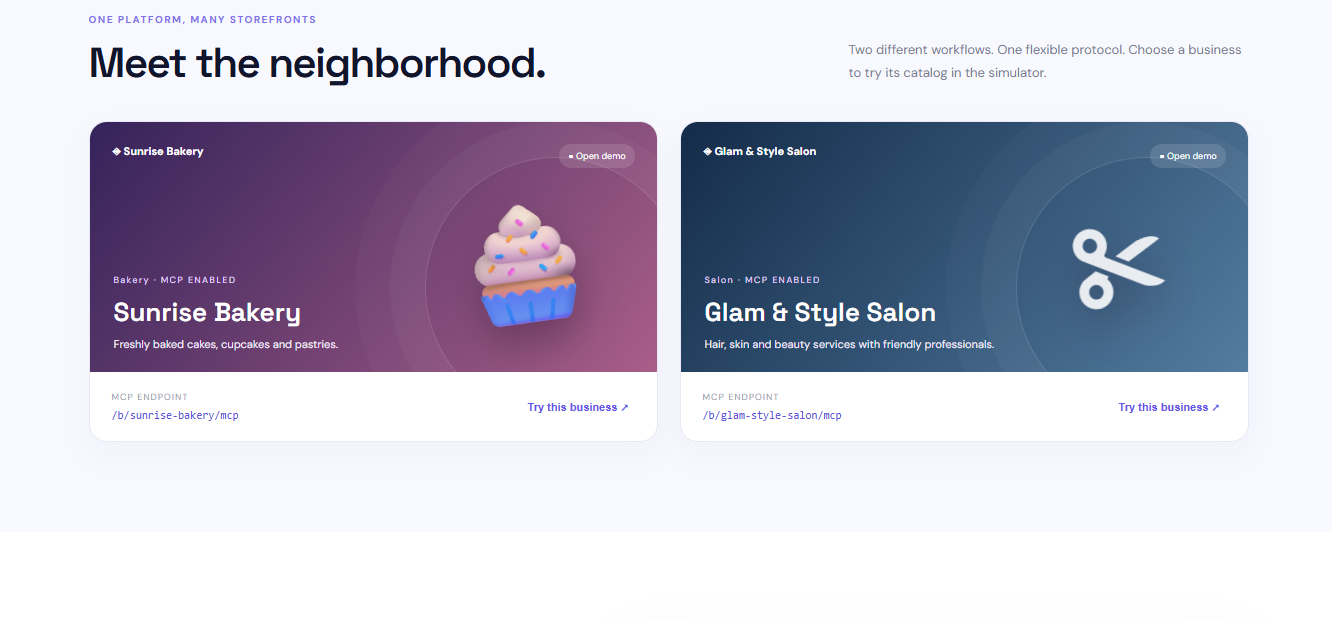
The architecture is designed to be reusable: a "bakery and a salon can run on the same engine", using their own business data rather than requiring separate custom implementations.
Challenges we ran into
The biggest challenge was making an AI-driven transaction "safe and predictable".
An agent may retry a request, misunderstand an instruction, or encounter an unavailable time slot. We therefore focused on transaction safety rather than simply making the demo work.
We addressed this through:
Propose-then-confirm tokens before committing transactions Explicit customer confirmation before an order is finalized Idempotency keys to prevent duplicate orders during retries Owner approval for larger or sensitive orders Clear separation between searching, proposing, and confirming
This helped us think beyond a chatbot and design Open Counter as an actual agentic workflow
Accomplishments that we're proud of
We are especially proud that two very different business types—a bakery and a salon—can use the same Open Counter engine without custom code.
That demonstrates the core idea behind the project: small businesses should not need their own engineering team to participate in the emerging AI-agent ecosystem.
We also built the project around a realistic multi-step interaction instead of a simple question-and-answer chatbot. The agent can reason across multiple MCP tools, check constraints, propose an action, and wait for confirmation before completing it.
What we learned
Building Open Counter taught us that agentic AI is not only about giving an AI more tools; it is about designing reliable workflows around those tools.
We learned how MCP can provide a standardized interface between AI agents and business capabilities, and how important confirmation, state management, retries, and transaction safety become when an AI agent is allowed to take real actions.
We also learned that a strong AI product needs to solve a practical adoption problem. For small businesses, reducing technical complexity is just as important as the AI itself.
What's next for Open Counter
Our next step is to make Open Counter a broader voice-commerce platform for local businesses.
Future improvements include:
- 💳 Secure payment integration
- 🌍 Multi-language voice support for local customers
- 📦 Inventory synchronization with existing POS systems
- 📍 A directory for discovering nearby Open Counter businesses
- 🔄 More business types and service workflows
- 📊 Better analytics for business owners
Built With
- api
- web

Log in or sign up for Devpost to join the conversation.