Inspiration
Portable Bluetooth printers are inexpensive, useful, and widely available, but most depend on closed-source mobile apps. These apps often request unnecessary permissions, connect to remote servers, and give users little visibility into how their data is handled.
Until recently, understanding each printer’s undocumented protocol required substantial manual reverse engineering. Codex changes that. It can help analyze authorized app behavior, Bluetooth captures, and existing code, making it practical for individual users to understand the hardware they own and create open alternatives.
Open Bluetooth Printer began with a simple idea: every decoded printer protocol should make the next one easier to decode.
What it does
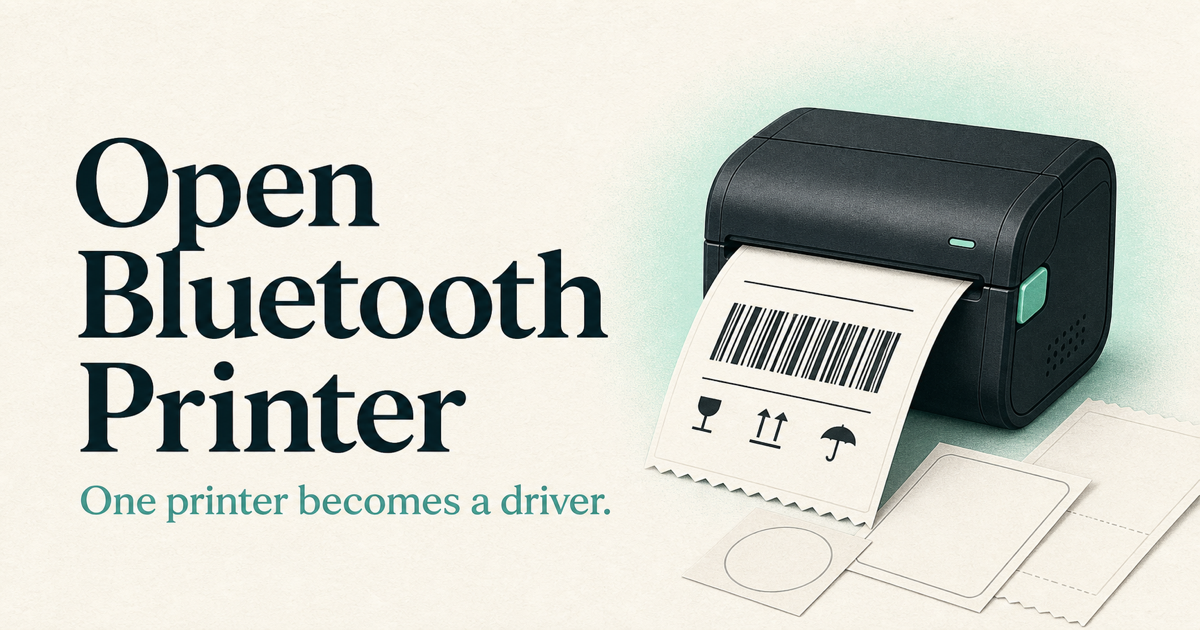
Open Bluetooth Printer is an open-source app and extensible framework for communicating directly with portable Bluetooth printers—without depending on their proprietary apps or cloud services.
It provides a common interface for discovering printers, connecting over Bluetooth, preparing printable content, and sending device-specific commands. Printer protocols can be added as modular drivers, allowing the community to support new hardware without rewriting the entire application.
The longer-term vision includes reusable Codex skills and guided workflows that help contributors analyze Bluetooth traffic, document unknown protocols, implement drivers, and test their work.
How we built it
We started with a working printer integration and separated the reusable printing workflow from device-specific protocol details. This created a foundation where each printer can have its own driver while sharing the same connection, image-processing, and user-interface components.
Codex helped us inspect the existing project, reason about undocumented byte sequences, organize protocol knowledge, and accelerate implementation. We designed the project so discoveries are captured as code, documentation, test data, and eventually reusable skills—not left inside a one-off reverse-engineering session.
Challenges we ran into
The biggest challenge is that Bluetooth printer protocols vary widely and are rarely documented. Even visually similar printers may use different commands, packet formats, compression methods, or initialization sequences.
Bluetooth captures can also be noisy. It is necessary to distinguish protocol data from connection setup, retries, status messages, and unrelated application behavior. A successful print does not automatically explain which bytes control alignment, image dimensions, feed distance, density, or device status.
We also had to think beyond supporting one printer. A useful open-source project needs clear driver boundaries, reproducible test cases, contributor documentation, and a workflow that people can follow without already being reverse-engineering experts.
Accomplishments that we're proud of
We transformed a single-device experiment into the beginning of a reusable platform.
The project demonstrates that owners can communicate with portable printers directly, without relying on opaque vendor software. More importantly, it establishes a path for turning each protocol discovery into a reusable driver that benefits everyone.
We are especially proud of the project’s compounding model: one contributor investigates one printer, but the resulting code, documentation, and Codex-assisted workflow reduce the effort required for every future contributor.
What we learned
We learned that AI changes the economics of working with undocumented consumer hardware. Tasks that were previously too time-consuming for a small open-source community can now be broken into manageable steps: collect evidence, compare messages, form hypotheses, implement a driver, and validate it against real hardware.
We also learned that protocol knowledge needs structure. Raw Bluetooth captures are useful, but documented commands, annotated examples, test vectors, and shared abstractions are what turn an isolated discovery into a maintainable open-source contribution.
Finally, we learned that privacy can be a practical product feature. Users should be able to print a note, label, image, or receipt without sending their content through an unknown server.
What's next for Open Bluetooth Printer
Next, we plan to expand the driver interface, support more printer families, improve image and text rendering, and add tools for recording and comparing Bluetooth sessions.
We also want to create Codex skills that guide contributors through the full process: safely analyzing an app and their own device, identifying protocol commands, generating a driver, running tests, and preparing a contribution.
Our goal is a community-maintained library of open printer protocols and drivers. Eventually, someone should be able to bring an unknown Bluetooth printer, follow a repeatable Codex-assisted workflow, and add support for it in hours rather than weeks.
Bring your printer. Discover its protocol. Contribute a driver. Keep printing open.
Built With
- codex
- gpt
- gpt-5.6
- typescript

Log in or sign up for Devpost to join the conversation.