OpEd
oped is an offline, voice-first AI on the teacher's own phone that listens to a child read for two minutes, finds their exact reading level, checks they actually understood, and tells the teacher what to teach tomorrow.
Inspiration
In India, children attend school and get promoted, but nobody checks whether they learned. ASER 2024 found that about 7 in 10 Grade 3 children cannot read a Grade 2-level text. A teacher with 30 to 50 children, often across several grades, has no practical way to see each child's real level, because assessing one class one-to-one takes 3+ hours. Lessons start at the wrong level and the gaps compound silently. We were especially bothered by the "silent child", often a girl or a first-generation learner, who never reads aloud and so is never measured or helped. We wanted every child to be heard once, patiently and without judgment.
What it does
oped is a voice-first AI companion that runs on the teacher's own smartphone, with no new hardware and no internet needed. In about two minutes per child, it:
- Listens to the child read aloud in Hindi or English.
- Locates their level on the ASER ladder (letter, word, paragraph or story).
- Scores fluency using EGRA-style words correct per minute.
- Verifies understanding with 2 to 3 comprehension questions, so a child who reads fluently but understands nothing is flagged, not passed.
- Names the precise gap, such as matra recognition, blending, vocabulary or inference.
- Guides the teacher with grouped action cards for tomorrow and a living class level-map that updates weekly.
The teacher confirms or overrides every AI-assigned level. The AI proposes and the teacher decides.
How we built it
Everything up to the dashboard runs on the phone. The pipeline is:
- On-device speech: fine-tuned models for Hindi and English child speech, including Indic-model families.
- AI layer: an ASER level classifier, an EGRA-style scorer, and a comprehension and diagnosis layer.
- Local database: results stay on the phone.
- Dashboard: action cards and the class level-map.
Anonymized results sync to the cloud only when connectivity returns. Voice never leaves the device by default, and content filters check every AI-generated question and card. We designed the assessment on established science: the ASER framework and EGRA subtask methodology, plus retrieval practice, formative assessment with rapid feedback, and mastery progression.
Challenges we ran into
- Child-speech accuracy: generic speech models struggle with children's speech, and accuracy varies across dialects, noise and low-end phones.
- Noisy classrooms: a room of 40 children is loud, and far-field audio degrades recognition.
- Fluency is not understanding: counting words correct per minute isn't enough, so we had to build comprehension checking into the core flow.
- Privacy: children's voice data needs the strictest handling, which shaped our on-device-first design.
- Teacher time: teachers have minutes, not hours, so the product has to work in 2 minutes per child with 10 minutes of onboarding.
Accomplishments that we're proud of
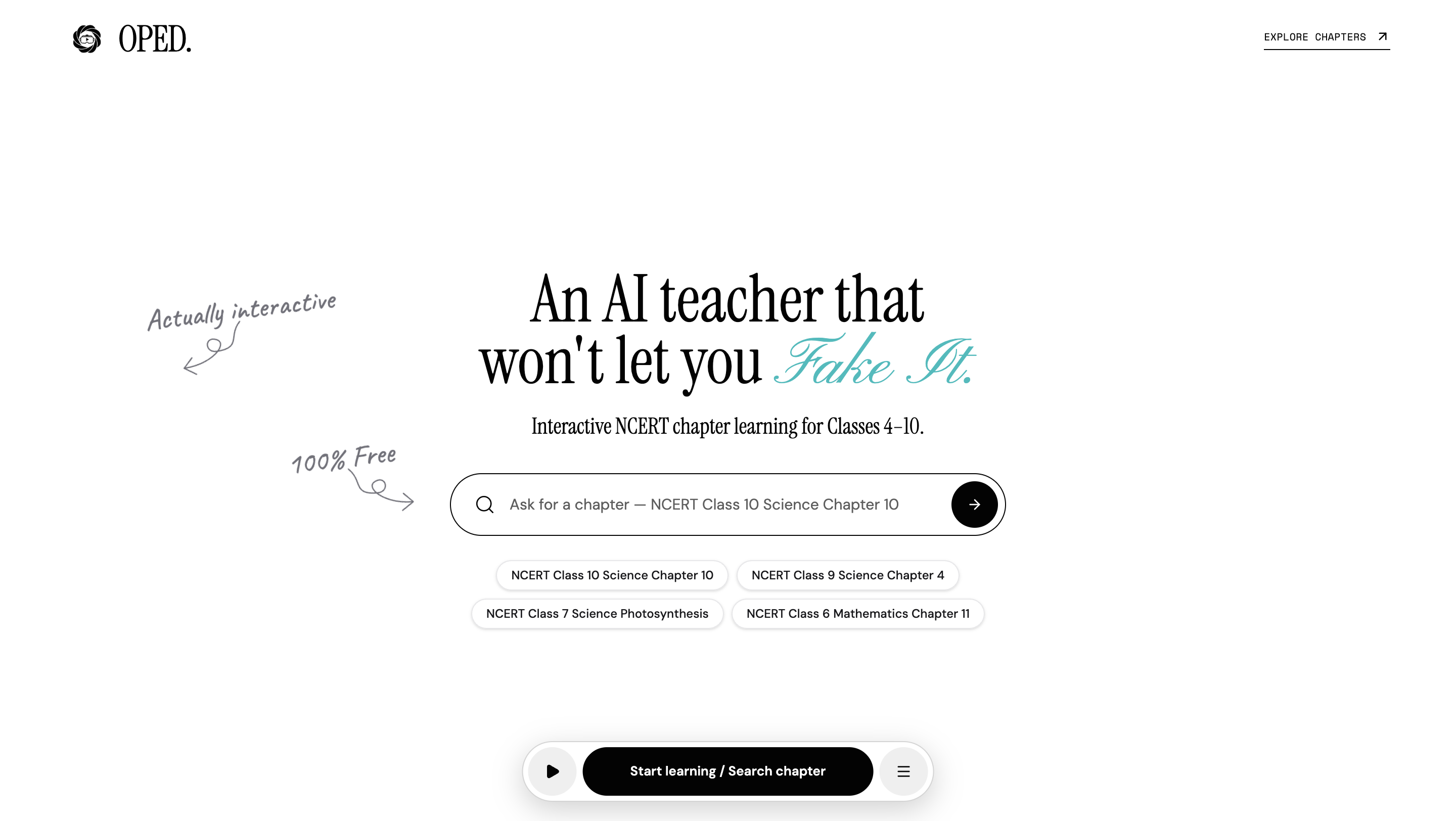
- We have a complete product concept, assessment design and technical architecture, and a public concept site is live.
- We built the product on ASER, the scale India already trusts, so teachers, principals and policymakers can read the output on day one.
- Our design flags "fluent but doesn't understand" children and turns measurement into a concrete next-lesson plan, not just a dashboard.
- It is human-in-the-loop, offline-first and privacy-first from the start.
- We have a costed 18-month plan (Rs. 2 crore) with every rupee tied to a de-risking milestone.
What we learned
- Measurement only matters if it turns into action. The unit of value is a Tuesday morning plan, not a chart.
- The constraints of the real classroom (patchy connectivity, basic phones, no spare time) should drive the design from day one.
- Trust comes from keeping the teacher in control and routing low-confidence cases to them.
- Child-speech accuracy is the biggest remaining risk, so it needs validation against ASER stimulus sets and independent audits before scale.
What's next for OpEd
- Months 1 to 6: build the working prototype (on-device speech pipeline, ASER/EGRA scoring engine, teacher app) and validate it against ASER stimulus sets before any classroom sees it.
- Months 7 to 12: run controlled pilots in 50 to 100 classrooms across 2 to 3 states, measuring level-gains against control cohorts and hardening for dialect, noise and low-end devices.
- Months 13 to 18: run state-partnership pilots through Samagra Shiksha channels, with teacher training embedded in existing in-service programs and DIKSHA alignment.
- Beyond that: start in the Hindi-belt states, extend to affordable private schools, move up the grades, and grow toward 100,000 classrooms.
Built With
- amazon-web-services
- elevenlabs
- gemini
- mediapipe
- opencv
- python


Log in or sign up for Devpost to join the conversation.