Inspiration
I sometimes help my 8-year-old neighbor with her studies. While tutoring her, I realized that when we teach children how to solve a problem, we don't always know whether they understand the logic or are simply following the steps we've shown them.
I wondered what if we let children become the teachers instead? I researched how children learn and found evidence supporting this approach. A 2022 meta-analysis covering 23 studies found a small but statistically significant learning benefit when students created teaching materials for others. Research also supports active recall as a way to improve learning and retention in primary-school children.
This inspired me to build Oopsy, starting with one child in mind but with the potential to help many more.
What it does
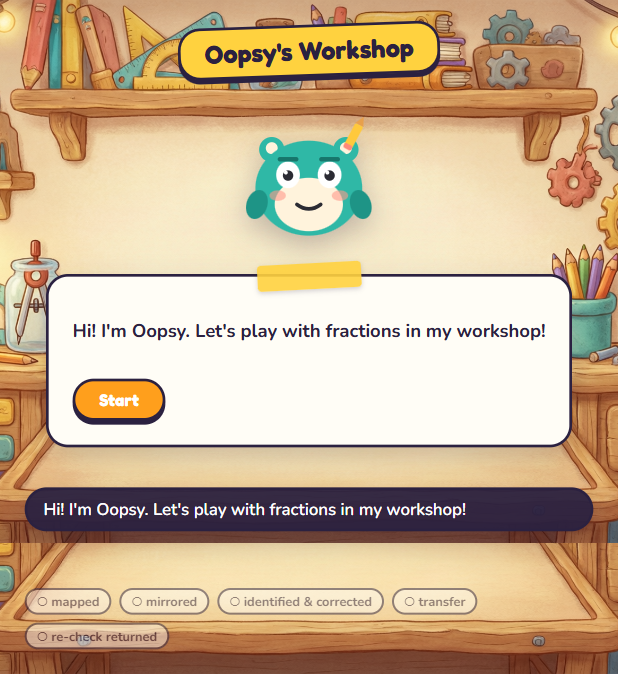
Oopsy is a learning experience where children become the teacher and help a character learn from its mistakes.
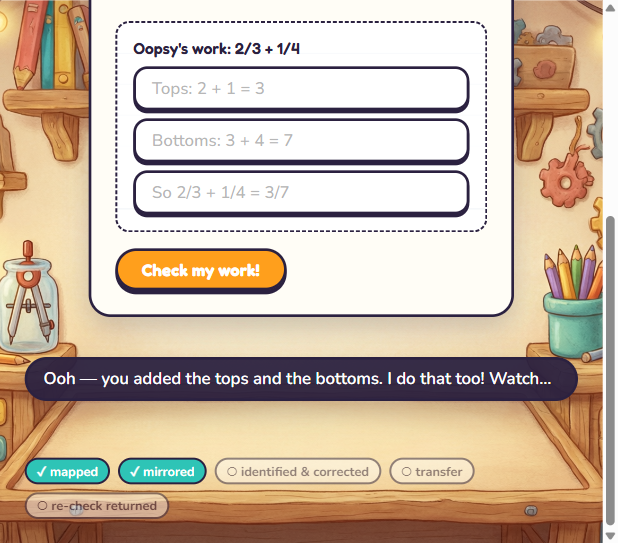
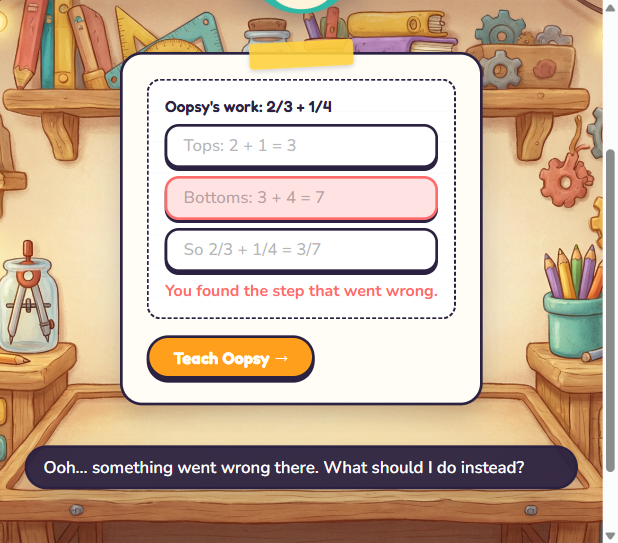
The first version focuses on fractions. The child solves a problem, then Oopsy makes a common mistake, such as adding the numerators and denominators directly. The child identifies what went wrong, chooses the correct principle, and teaches Oopsy how to rebuild the solution step by step.
Oopsy then gives the child a new problem and revisits the concept in a different context. The goal is to help children understand the reasoning, not just memorize the steps.
How we built it
I used the Devpost Learn Skill Pack to guide the project from idea to implementation. I worked through the planning process, created the scope, PRD, and technical specification, and broke the build into small, testable steps.
I used these documents to give AI clear context about the problem, the intended solution, and the requirements. I guided the product decisions, learning flow, and interaction design, using AI as a building partner rather than leaving it to decide what the product should be.
I kept the scope focused on one complete learning experience instead of trying to build an entire education platform.
Challenges we ran into
One challenge was making sure Oopsy's mistakes represented a recognizable misconception. A wrong answer does not always mean a child has the same misunderstanding, so the first version focuses on a specific fraction mistake rather than treating every incorrect answer alike.
Another challenge was turning the idea into more than a quiz. The child needs to identify the mistake, understand the correct principle, rebuild the solution, and apply the concept again.
I also had to balance the larger vision with what was realistic to build for the first version.
Accomplishments that we're proud of
I'm most proud that the child who inspired Oopsy was able to use it herself. Seeing her navigate the experience made the idea feel real and gave me an opportunity to see how the interaction worked with an actual child.
I'm also proud that I built a complete learning flow, from the initial problem to correcting Oopsy and testing the concept again, rather than stopping at a visual prototype.
What we learned
I learned that giving AI better context leads to better results. Instead of researching, planning, and coding as separate activities, I brought the research, scope, PRD, and technical specifications into the coding agent's workflow. This helped me communicate what I wanted to build more clearly and guide AI toward the intended product.
I also learned that getting a problem right is different from understanding why the answer is right. That insight shaped Oopsy's learning flow, where children identify mistakes, explain the correct principle, and apply it again.
What's next for Oopsy
Oopsy is currently a proof of concept focused on fractions. Next, I want to expand into other topics, including visual concepts such as geometry, where children can identify and correct mistakes in shapes and diagrams.
The goal is to help more children move beyond memorizing steps and develop a deeper understanding of the reasoning behind their answers.
Try: Link

Log in or sign up for Devpost to join the conversation.