Inspiration
Online fashion is a guessing game — will it fit, will it look right, is it
worth the return shipping — and the bill for that guessing is paid in returns:
roughly one in four garments bought online comes back. We were already
building OnPoint, an agent-commerce rail where AI agents shop real merchant
inventory with stablecoin micropayments, when the YouCam hackathon brief
landed, and it described our exact problem: replace the guess with something
closer to certainty. An agent that can see the garment on the shopper before
it spends money is the difference between a recommendation engine and a buyer.
So we wired YouCam's Apparel VTO into the one place it changes behavior:
directly in front of a payable offer.
What it does
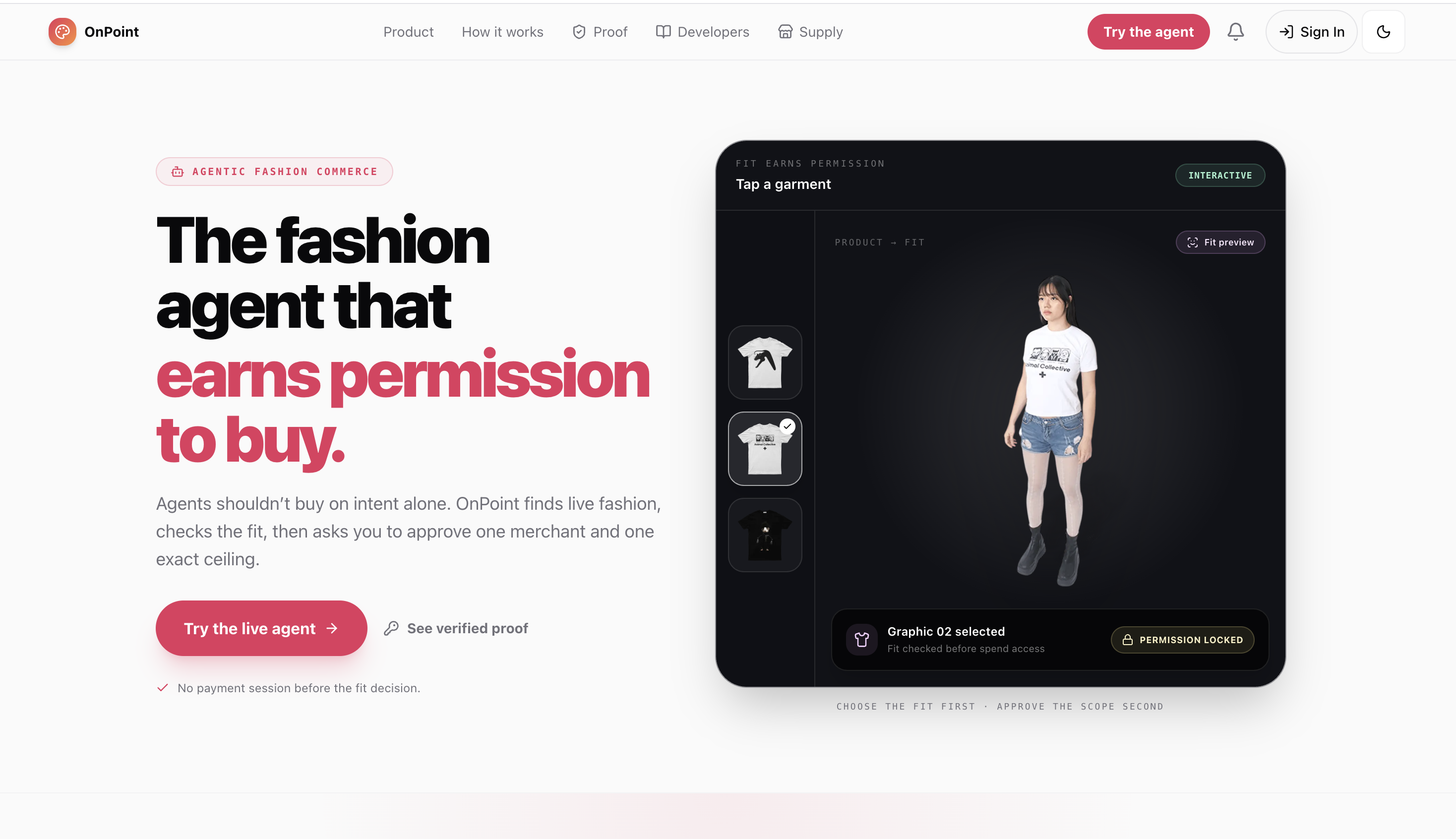
OnPoint is a live platform where humans and AI agents shop the same real
inventory. Curators publish storefronts with machine-readable offers (size,
stock, cUSD price). An agent browses a storefront, then requests a paid try-on
over HTTP x402: it pays 3 cents in cUSD on Celo, and in return gets a YouCam
cloth-v4 render of the actual listing photo on the actual shopper photo, plus
a structured fit signal and a shareable polaroid card. The agent reads the fit
verdict and either checks out on-chain or walks away — no human, no cart, no
returns guess. Every render fee and every purchase lands in a public
reconciled ledger with attribution, so the value of each try-on is measurable,
not claimed. The demo video shows a real end-to-end run: real API call, real
render, real cUSD payment, real ledger entry.
How we built it
The integration is a self-contained YouCam client (apps/api/lib/youcam-vto.js)
implementing the full server-to-server flow: data-URI inputs are pushed
through the File API (presigned PUT → file_id), public URLs pass through
as-is; a cloth-v4 task is created with garment_category: "auto", polled every
1.5 s, and resolved to a render URL. The client is plugged into OnPoint's
existing try-on engine as the first-choice provider of the paid tier, with a
graceful fallback chain (YouCam → Replicate IDM-VTON → Venice SD35) so the
commerce rail keeps working even when a provider is down or unconfigured.
Around it sit the existing OnPoint systems: x402 payment challenges on Celo,
curator payout wallets, cost accounting per provider in the funnel analytics,
and a suite of 160 unit tests including new coverage for the YouCam success
path and the auth-failure fallback path.
Challenges we ran into
The biggest mismatch was shape: YouCam cloth-v4 is asynchronous (create task,
poll for result) while an x402 paid request is a single synchronous HTTP
exchange — the agent pays once and expects an answer, not a job handle. We hid
the polling inside the paid request with bounded retries and typed errors so a
slow or failed task degrades cleanly instead of hanging the payment. Second,
shopper photos arrive as base64 data URIs from agents, but cloth-v4 wants file
IDs or URLs; the File API's two-step presigned upload had to be wired
transparently into the try-on path. Third, we had to make the integration
strictly additive: with no API key set, every pre-existing code path must
behave exactly as before, which drove the fallback-reason plumbing and the
401-failure test.
Accomplishments that we're proud of
This is not a mock-up: the submission includes a live smoke test against the
real YouCam API (task completed in ~11 s, render returned and displayed), and
a full agent purchase loop where the try-on that gates the sale is a YouCam
render paid for in cUSD on Celo mainnet. We are proud that perception sits at
the actual decision point of a real transaction — the render feeds a fit
signal an agent uses to buy or skip — and that every step (offer, payment,
render, payout) is machine-readable and publicly reconciled. The provider
chain degrades gracefully, the test suite is green, and the whole thing runs
on inventory a human shopper can browse at the same URL.
What we learned
We learned that generative try-on is most valuable as infrastructure, not as a
widget: bolted onto a checkout page it's a novelty, but placed in front of an
executable offer it becomes the agent's eyes, and the quality of the render
directly translates into purchase confidence. Technically we learned the
async-task + micropayment integration pattern (hide the job lifecycle inside
the paid request, type every failure mode, always keep a degraded path), and
we learned how much trust a public ledger adds: being able to show the exact
try-on fee, payout split, and attribution for the render in the demo made the
economics concrete in a way screenshots never could.
What's next for onpoint
Next we extend the fit loop: use YouCam renders across multiple sizes of the
same listing so the agent (or shopper) gets a size recommendation, not just a
fit/no-fit verdict; bring the same garment-conditioned try-on to the free web
tier so human shoppers get the upgrade path from "similar look" preview to
exact-garment render; and grow the curator base so the ledger reflects real
volume. Longer term, the try-on → conversion data becomes the onboarding
scorecard for new merchants, and the same perception-at-the-decision-point
pattern generalizes beyond fashion to any fit-sensitive physical goods.
Built With
- celo
- prava
- react
- typescipt
- x402

Log in or sign up for Devpost to join the conversation.