-
-
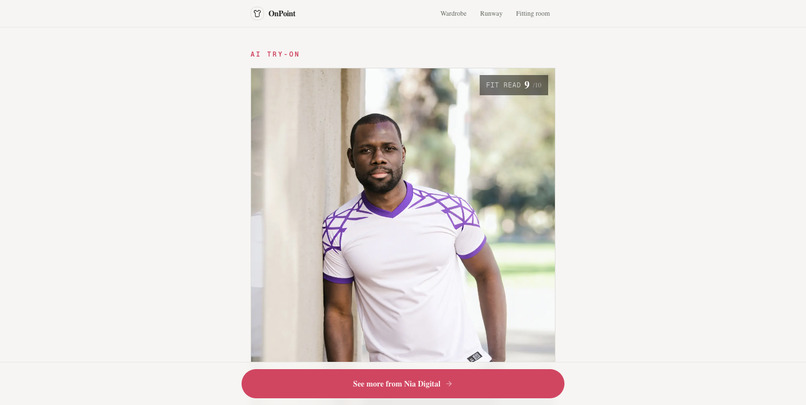
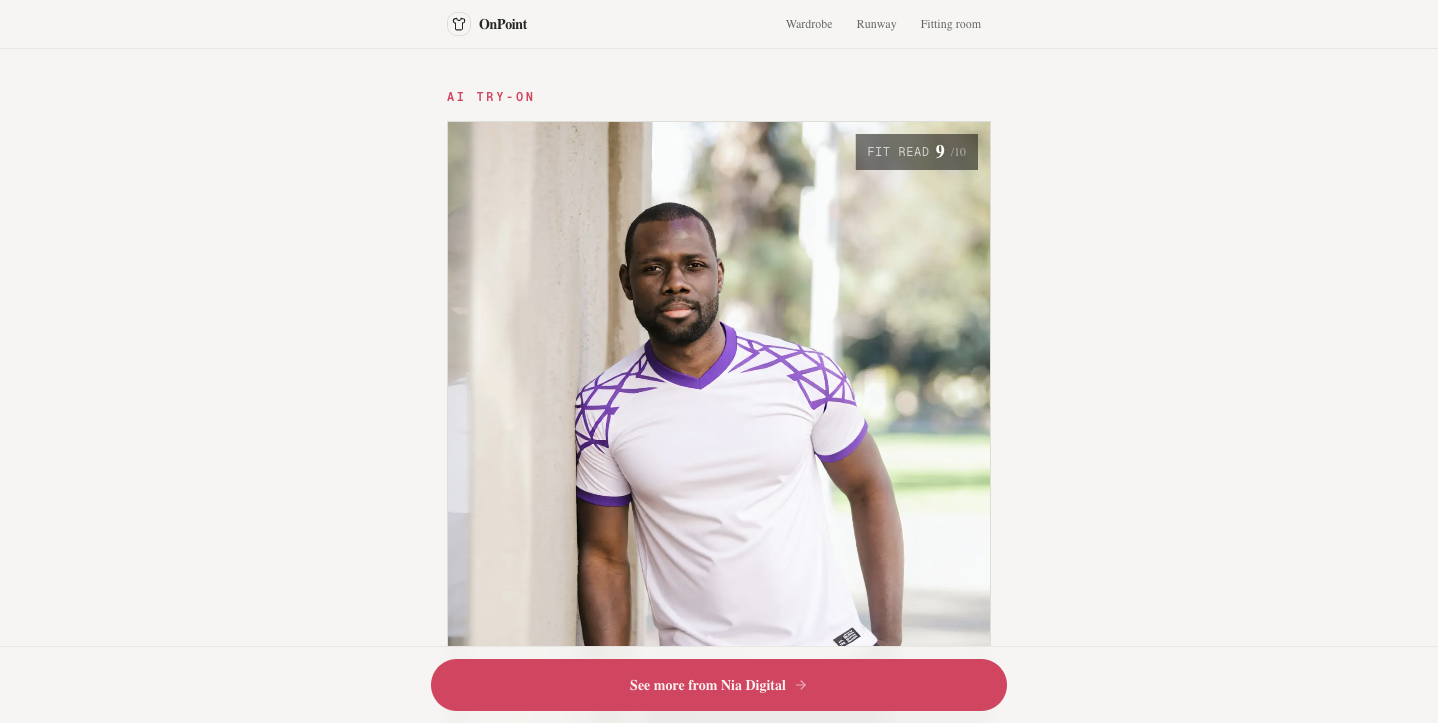
AI try-on render, paid via PayPal
-
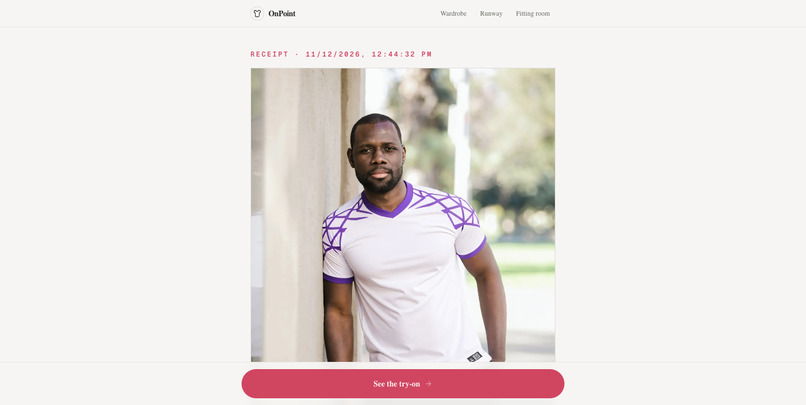
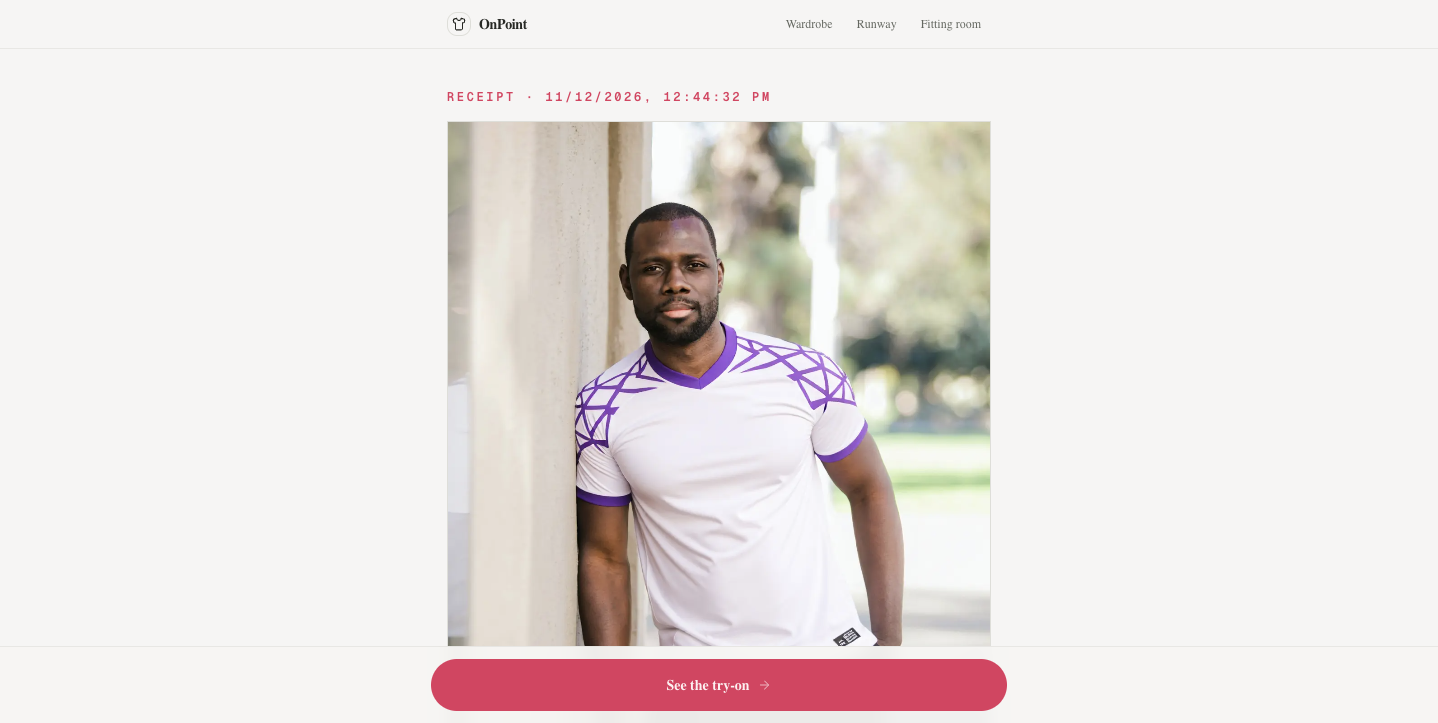
Public receipt with PayPal capture id
-
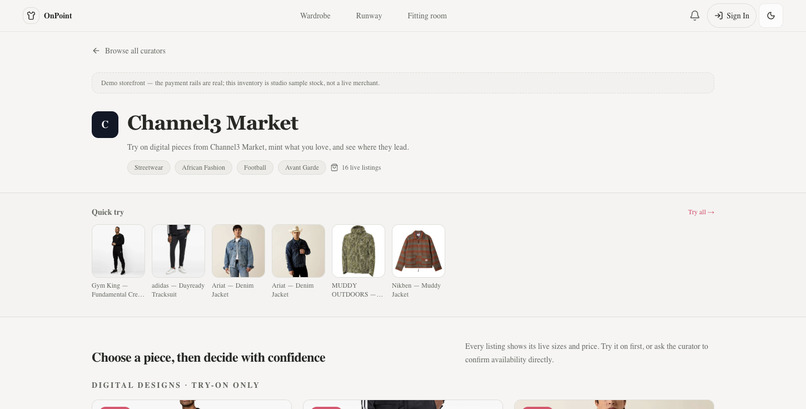
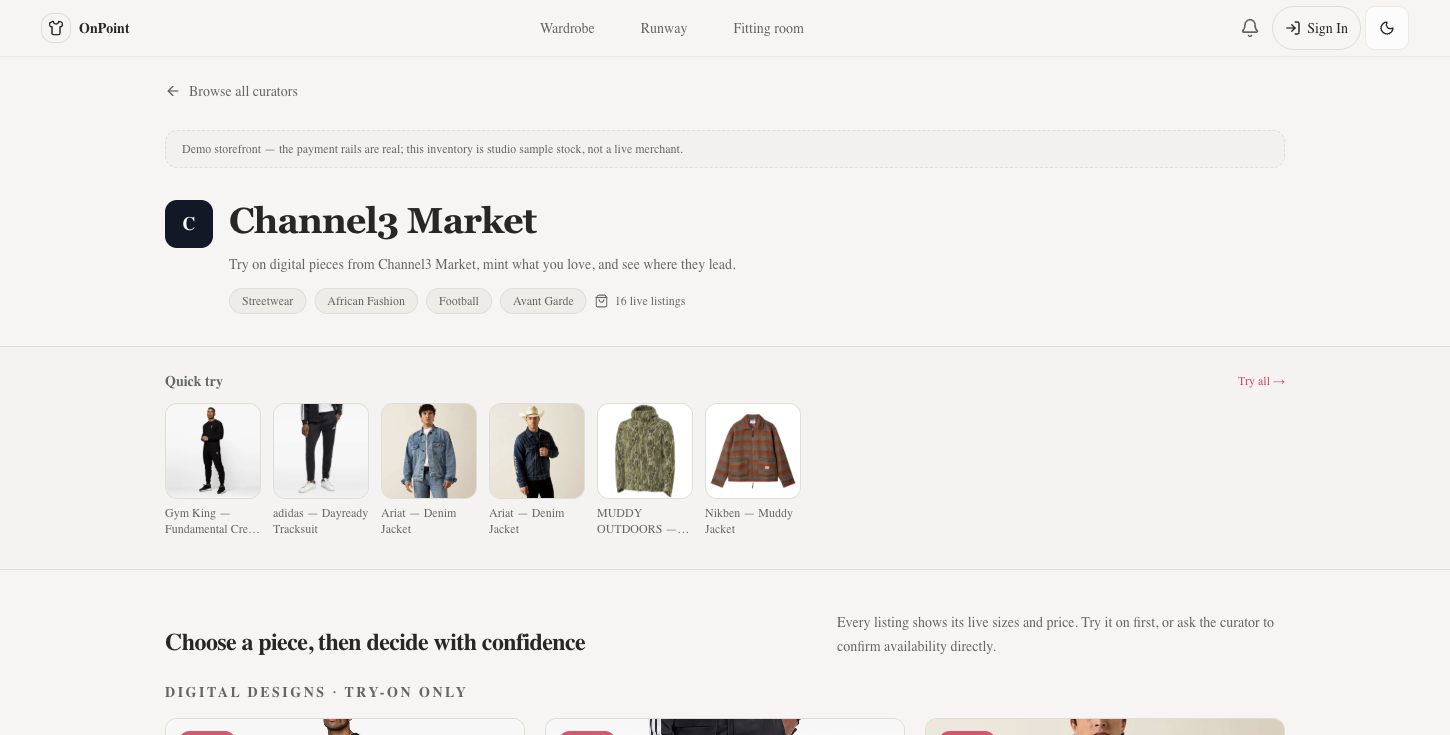
Channel3 Market storefront — 16 real products via /v1/search, each payable through the PayPal try-on rail
-
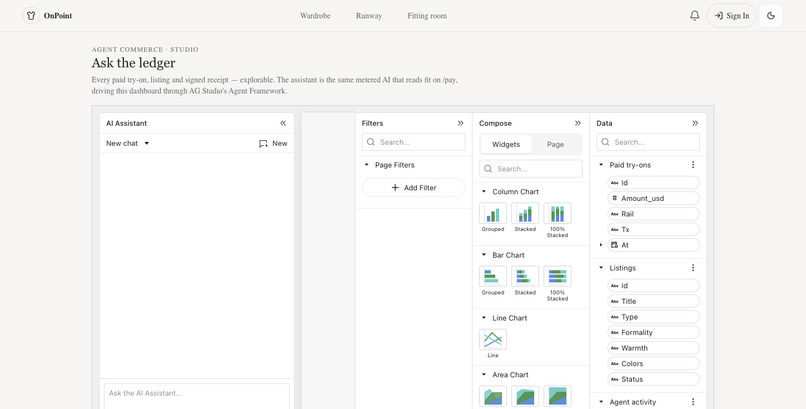
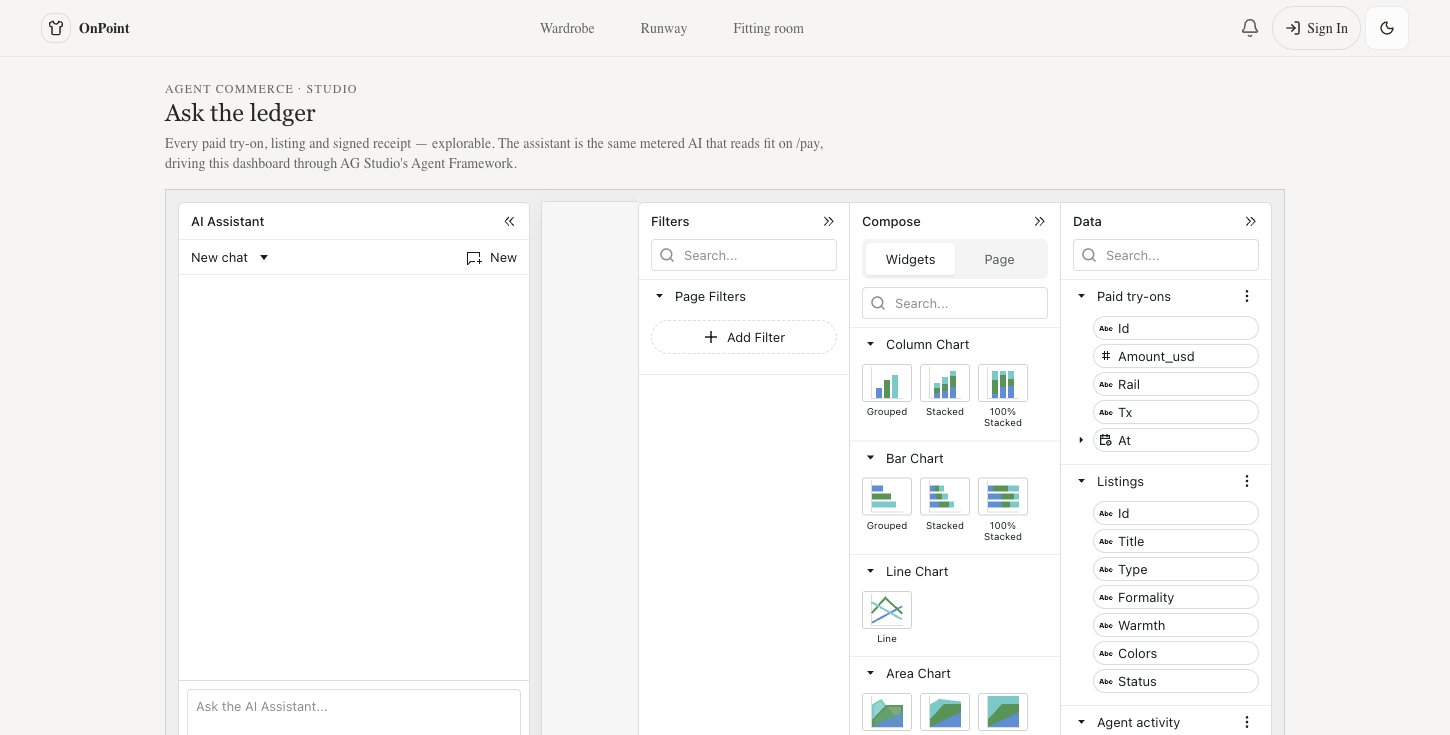
AG Studio commerce ledger — Studio Agent Framework over the live receipts + earnings data
The problem
AI agents can already tell you what to buy. What they can't do is spend your money — there is no consent path between an agent's recommendation and your wallet. OnPoint is that path.
Agents propose. Humans approve. PayPal is the consent surface.
What it does
OnPoint is agent-native fashion commerce. An agent (or a person on the storefront) picks a real garment from live merchant inventory and requests an AI try-on. The API answers HTTP 402 Payment Required with a quote that advertises payment rails — including PayPal. The agent relays quote.paypal.approveUrl to its human; the human approves at paypal.com; the server verifies and captures the order; the agent receives the AI try-on render, a fit read, and a public receipt carrying the PayPal capture id as the proof.
The same flow exists for a human without any agent: onpoint.trustfall.xyz/pay — add your photo, choose PayPal, approve in a new tab, and the render develops on the page like a polaroid, with its capture id and public receipt.
How we built it
PayPal (Orders REST v2). Server creates the order server-side (intent: CAPTURE, custom_id binding the order to exactly one quoted resource). On the agent's return call we verify the order's status is APPROVED, check currency and amount against the price, capture idempotently via PayPal-Request-Id, and require COMPLETED. The capture id is the replay-guarded proof of payment — stored in the same column as on-chain transaction hashes. The identical rail also covers physical goods checkout (POST /api/curator/{slug}/order).
AI. A metered inference pipeline: a vision model (served through an OpenAI-compatible gateway) produces the fit read, styling notes and garment attributes; an image-conditioned try-on model produces the render (YouCam cloth-v4, with Replicate / Gemini / Venice fallbacks). Every paid response reports aiCost — the per-call inference cost — so the service's unit economics are inspectable per receipt.
Why PayPal among several rails. The same executable offer can also settle in crypto (cUSD on Celo, NEAR) where the agent pays autonomously. The PayPal rail is the one that keeps a human in the loop by design — and that's the property real users actually want before money moves.
Inspiration
"What happens when you put AI behind the wheel?" needs a real answer for the brake pedal. Agentic commerce demos usually end at the recommendation or at autonomous crypto spend. Neither works for the 400M+ accounts whose money already lives at PayPal: the agent can't get in, and the user wouldn't want it to anyway without a say. The missing primitive isn't payment — it's consent.
Challenges we ran into
- PayPal checkout can't be fully automated — that's the point. Classic checkout requires a human to approve at paypal.com. Instead of fighting it, we made the constraint the product: the approval-relay pattern, where the agent orchestrates everything and the human provides the single authorizing click.
- Binding an approved order to one resource. A generic "send money" wouldn't be safe;
custom_idties the approved PayPal order to the exact try-on/order quote it paid for, and the capture id is replay-guarded so one approval can't mint two paid actions. - Receipt durability, found the hard way. During the hackathon we discovered receipts were living in the API process's memory and evaporated on restart; we moved agent state to Redis so a receipt a judge opens today still opens tomorrow.
- Rate limiting a fitting room. The paid try-on endpoint needed its own tier (30/min, 300/day) — five tries a day is a boutique with the lights off.
What we learned
The consent surface is the product. Agents don't need the keys to your wallet; they need a clean way to ask. PayPal's approval redirect turned out to be exactly that primitive, and capture-id-as-receipt makes the whole thing auditable by anyone, no login required.
Live evidence (no credentials needed)
- Try it yourself: onpoint.trustfall.xyz/pay (PayPal requires a sandbox buyer account; the receipt path below needs nothing)
- Public receipt of a real sandbox PayPal try-on: receipt_mwdjib6r_ba423717 — raw JSON also at
GET https://api.onpoint.famile.xyz/api/receipts/receipt_mwdjib6r_ba423717(paymentMethod: "paypal", capture id13K55568GE972304A,$0.03, modelyoucam-cloth-v4) - The try-on result page that receipt paid for: /p/a2c86aef-0deb-47f3-8ca2-91412c853bea
- Channel3-powered storefront: onpoint.trustfall.xyz/s/channel3 — 16 real retail products, each payable through the same PayPal try-on rail (verify
attributes.source: "channel3"viaGET https://api.onpoint.famile.xyz/api/curator/channel3/storefront) - Runnable agent demo in the repo:
RAIL=paypal node scripts/near-spike/agent-demo.mjs(needs sandbox creds)
Real supply via Channel3
OnPoint's own catalogue is intentionally thin — real curators activate after the hackathon. So supply comes from the Channel3 product API instead: Channel3 Market is a live storefront of 16 real garments pulled from /v1/search across retailers like Farfetch, Dick's Sporting Goods and Boden — imported with Channel3's background-removed product images, brand, live price and buy link (stored per-listing in attributes.offerUrl / offerDomain; provenance attributes.source: "channel3").
They are try-on-only listings by design: the same 402 → PayPal approval → AI render → public receipt loop runs on any of them. A judge can take a real retail product, pay $0.03 for the render and leave a public receipt. Channel3 is the supply layer; PayPal monetizes the AI service; the garment purchase completes at the retailer via the Channel3 offer link. Their /checkout endpoint (programmatic buy) is the documented next step.
Live proof: receipt_mwdthx2x_7ee83234 — a real sandbox PayPal try-on on "Picture — Everywhere Football Jersey" from Channel3 Market (capture 34P1908960914442P, $0.03, seller payout sent via PayPal Payouts batch PCWJ9N9XJMSZJ). Try-on page: /p/e6c6dbc1-c594-4ca0-9410-73c63e7cb471.
Ask the ledger — AG Studio + Studio Agent Framework
/agent/studio is a self-serve analytics surface built on AG Studio 3 (ag-studio-react) over OnPoint's live public ledger — three Studio data sources: paid try-ons (the curator earnings endpoint), storefront listings, and signed agent receipts. The chat panel runs the Studio Agent Framework wired to a custom AgLlmAdapter that proxies the same metered Otari AI gateway that prices fit reads — ask "paid try-ons by curator" and the built-in agents plan and build the widgets. Agents and users get equal power over the dashboard, which is the whole point of this project: every PayPal payment above lands in this ledger as a verifiable row.
What's next
- PayPal Payouts to close the merchant side (curator payout is currently recorded
pending_reconciliation) - PayPal Agent Toolkit so the agent side can speak PayPal-native agentic checkout
Built With
- artificial-intelligence
- channel3
- next.js
- node.js
- paypal
- postgresql
- redis
- typescript
